NEW MINISTER FOR WELFARE MINISTER OF MALAYSIA

NEW MINISTER FOR WELFARE MINISTER OF MALAYSIA
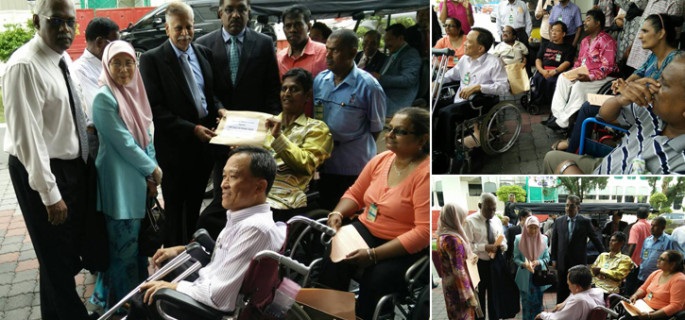
Badan Latihan dan Hidup Berdikari Malaysia (ILTC) pada 23hb Mac 2016 menyerahkan memorandum kepada ahli-ahli parlimen mendesak supaya golongan orang kurang upaya (OKU) dikecualikan daripada cukai barangan dan perkhidmatan (GST).

Disabled Members Protest

Disabled Members Protest
Disabled Members Protest at JPJ Wangsa Maju

ILTC Malaysia members staged a protest outside JPJ Wangsamaju KL.

ILTC Malaysia members staged a protest outside JPJ Wangsamaju KL.
Disabled group’s protest disabled drivers required to produce doc's medical report.

Wednesday, 30 April 2008

Larian Obor Paralimpiad Malaysia XIV Kuala Lumpur 2008

Larian Obor Paralimpiad Malaysia XIV Kuala Lumpur 2008
8 ILTC members were invited to participate in the Larian Obor Paralimpiad Malaysia Ke 14 Kuala Lumpur on 30th April 2008 started 12.30pm from Brickfields towards Menara KL Tower was ended 3.00pm.
Mr. Segaran member of ILTC had shared his view on this event. He said it was a good opportunity to him to expose himself to participate in this event and also the event has given a lot of opportunity and hope for himself to participate in the upcoming events.

Mr. Robert said his personal thanks to ILTC for given him an opportunity to participate in this event and he added that the organizer should organized more in order to get more publicity.

Monday, 28 April 2008

Selangor Government to seek legal advice on Balkis affair

Saturday April 26, 2008
The Star - News

Selangor Government to seek legal advice on Balkis affair

PETALING JAYA: The Selangor Government will seek legal advice on the controversy involving the Wives of Selangor Assemblymen and MPs Welfare and Charity Organisation (Balkis) and its funds.

Nik Nazmi Nik Ahmad, the political secretary to Mentri Besar Tan Sri Abdul Khalid Ibrahim, said the MB did not want to make any further statement on the matter as the state was currently consulting its lawyers.

“We are looking into the legal aspects of the application to dissolve Balkis and also the transfer of its funds before we decide on the next course of action,” he said, adding that the state would take legal action against the organisation’s office bearers if there was any wrongdoing.

In the meantime, the state government has asked the Registrar of Societies (ROS) to ignore the application to disband Balkis made by its previous president Datin Seri Zahrah Kechik, the wife of former Selangor MB Datuk Seri Dr Mohd Khir Toyo.

The state government said in a statement on Thursday that Balkis made the application following a decision during an emergency meeting held on March 11.

It argued that Zahrah could not hold office after the March 8 general election as Dr Khir was no longer MB.

It said that the organisation’s constitution clearly stated that the president had to be the Selangor MB's wife and after the Barisan Nasional lost the state, Zahrah did not have the right to represent Balkis or make the application, and even her right to chair the emergency meeting was questionable.

The state government also felt that disbanding Balkis under such circumstances was against the spirit behind its formation in 1985 to help the needy, provide ideas to the government on welfare issues and help Malaysians of all races and religions.

The statement said a Balkis official had informed the state government that RM9.9mil was moved from the organisation to the Association of Wives of Ministers and Deputy Ministers (Bakti).

It said the MB's office had also been informed that part of the funds under Balkis came from state-owned companies like Kumpulan Darul Ehsan Bhd which contributed over RM268,000 last year and the Selangor State Development Corporation which contributed more than RM590,000 in 2006 and 2007.

“The state government, therefore, is asking the ROS not to approve the application (to disband Balkis) until the contributions from all the state-owned companies have been ascertained,” the statement continued.

The state government said that it and all its companies would soon request that all contributions made to Balkis be returned, as the organisation was only acting as a trustee for the funds that were to be used for welfare purposes.

Bar Council vice-chairman Ragunath Kesavan said the Anti-Corruption Agency (ACA) must investigate Balkis for removing almost RM9.9mil from its bank account.

“There is a potential criminal breach of trust (element) or corruption, therefore the ACA must act fast. The money belongs to the association members, not to the office bearers.

“There are rules and regulations to be followed under the Registrar of Societies,” he said.

Disabled group: Easier to get aid from Balkis

Sunday April 27, 2008
The Star - News

Disabled group: Easier to get aid from Balkis

PETALING JAYA: A charitable organisation is worried that no more donations will come from Balkis now that its funds have been transferred to the Association of Wives of Ministers and Deputy Ministers (Bakti).

The Independent Living and Training Centre for the Disabled (ILTC) has occasionally received financial aid from Balkis in the past, the highest amount being RM15,000 for three threewheeled motorcycles for its members.

“Now that the money has gone to Bakti, it will be more difficult for us to get help.

“We tried to apply for seven such vehicles on behalf of our members four years ago from Bakti but the application was rejected because we were not allowed to make such a request as an organisation.

“The reason given by Bakti was that only individuals were allowed to seek its help,” said ILTC president Francis Siva.

He added that many of its members could not make their own request as they were either illiterate or not well-versed in applying for aid.

Francis said many members were disappointed with the development as it was easier to approach Balkis than Bakti.

“Previously, we submitted our requests through state assemblymen who would later forward our applications to Balkis but now we are left in the lurch as we do not even know how to contact Bakti members,” he said.

Saturday, 26 April 2008

Saturday April 26, 2008
The Star - News

Did Balkis have the right to move out the RM9.9m?

PETALING JAYA: The RM9.9mil in the bank account of the Wives of Selangor Assemblymen and MPs Welfare and Charity Organisation (Balkis) belonged to it. And Balkis was within its rights to hand the money over to another organisation.

This is the stand of the president of the organisation at that time, Datin Seri Zahrah Kechik.

“We have sought legal advice and our lawyers advised us on the options available – either to put the money with any organisation or give it to the state.

Balkis members are proud of our work for the poor, we will never take what does not belong to us... DATIN SERI ZAHRAH KECHIK

“After some deliberations, we decided to give the money to the Association of Wives of Ministers and Deputy Ministers (Bakti),” Zahrah said yesterday.

The money was moved after a March 11 emergency meeting of Balkis, just days after the state government fell to the Pakatan Rakyat.

The current Selangor government is questioning the legality of the transfer of the funds.

Zahrah’s husband and former Mentri Besar Datuk Seri Dr Mohd Khir Toyo said the organisation consulted its auditors and legal adviser before making the transfer and there was no “hanky-panky involved”.

Zahrah added that Balkis had decided to channel the money to Bakti because the two organisations have similar objectives.

She said the organisation’s constitution allowed for the money to be transferred to the state government or another entity with similar structure and charity orientation like Balkis – provided the recipient is recognised by the director-general of the Inland Revenue Board.

“Balkis was formed by wives of Barisan Nasional elected representatives who wanted to do something for the underprivileged.

“Now that Selangor is ruled by the opposition coalition, the members felt they could no longer serve effectively and that the organisation should be dissolved,” said Zahrah, adding that she chaired the March 11 meeting in her capacity as Balkis president.

“Balkis members worked hard to raise the RM9.9mil through various fund-raising activities over the years. The money is used to help the underprivileged groups in the state.

“All income, expenditure and contributions are clearly documented. Balkis members are proud of our work for the poor, we will never take what does not belong to us,” she said.

She said the wives of elected representatives under Khalid’s administration could also establish a similar organisation if they too desired to help the poor.

Dr Khir said the association was unsure if Khalid’s government would want to go on with the programmes already in place, or use the money for similar intentions,

He said the money was transferred to Bakti with the condition that those under Balkis’ Poor Students’ Aid Programme would continue to receive the aid.

“There was some worry after Pakatan Rakyat won the state that the new government might remove some of the students from the list (of recipients) and the poor students would not be able to continue their studies,” he said.

Dr Khir said the money was also used to fund a shelter home for women in Section 7, Shah Alam.

“The movement may want to establish a new association. The new association will be headed by Puan Sri Asbi Rohani Asnan, in her capacity as the wife of Selangor Umno chief Tan Sri Muhammad Muhammad Taib,” he said.

Friday, 25 April 2008

Komuter drivers must announce station stops

The Star - News

Home > News > Opinion

Friday April 25, 2008

Komuter drivers must announce station stops

I WOULD like to urge the KTMB management to make it compulsory for all KTM Komuter drivers to announce the name of the station the train is arriving at.

When the Komuter service was first introduced, the drivers used to announce each stop and station, but on my recent travel, I noticed a failure to do so.

I was travelling from Kuala Lumpur to Klang station and vice-versa the last week for a few days.

Unfortunately, none of the drivers made any announcements. I was struggling at night, unable to tell which station the train was arriving at.

The situation was worsened by the unavailability of lightings for the station signboard in almost all stations.

I had to check with regular travellers to ensure that I did not step out at the wrong station.

However, one passenger wrongly guided me and I disembarked a few stations from Klang station, my destination. I had to wait almost 30 minutes for the next train.

If this is my experience with KTM Komuter, how much more difficult it would be for the disabled like the blind.

KTMB should look into this matter immediately.

VIGNESWARAN KANNAN,

Sitiawan.

Wednesday, 23 April 2008

Educate public on rights of the disabled

Wednesday April 23, 2008
News - The Star
Educate public on rights of the disabled
SEVERAL articles recently highlighted children with special needs (“Teacher under probe” – Sunday Star, April 13; “The caged boy of Sanglang” – The Star, April 17).

In Ipoh, a Down Syndrome boy was caned by his teacher for misbehaviour, while a boy with mental disabilities was caged at his home in Alor Star because of his hyperactivity.

Meanwhile, the parents of a Chinese primary school student in Kuala Lumpur recently wrote to the Chinese press to protest against the setting up of a pilot Special Education programme in the school. They noted that special needs children should be put in special schools, out of the way of other children.

I think it is timely, therefore, for us to be reminded that the Persons with Disabilities Act 2007 was passed in Parliament on Dec 18, 2007. And, in April this year, Malaysia became a signatory to the United Nations Convention on the Rights of Persons with Disabilities.

The convention entitles the disabled to the “full enjoyment of all human rights and ensures full and effective participation as well as inclusion in society”.

The Disabilities Act states that the authorities should promote the integration of students with disabilities into normal schools, with a view to accommodating these students in the mainstream.

We are just over a decade from 2020, the target date for Malaysia to achieve developed nation status. Hence, there is some urgency for us to work towards bridging the gap between the laws we have on paper, and what we see in reality.

I would like to urge the Government to be wholehearted in its support for the law that it has passed. It needs to work together with related NGOs to educate the Malaysian public on the rights of the disabled.

We should work towards the setting up of integrated special education programmes in every government school with a view to full inclusion as soon as the system is ready.

Much work needs to be done in the area of special education – there should be provisions for facilities to accommodate disabilities, therapists and teacher aides, and teacher training in inclusive education.

It is a tall order, but it can be achieved with resolve and effort. It is, after all, no longer a matter of choice. The law requires Malaysians to restore the disabled to their rightful place in society.

ANGELINE LIM
Petaling Jaya, Selangor.

Tuesday, 22 April 2008

College helps community in its own way

Friday April 18, 2008
College helps community in its own way
By JADE CHAN
AFTER personally experiencing a robbery followed by a long post-surgery period, Masterskill College of Nursing & Health CEO Edmund Santhara realised how important physiotherapy was and discovered that was a severe shortage of physiotherapists in Malaysia.

“I learnt that the most important part of surgery are the post-surgery procedures because if that’s not done properly, you may lose 20-25% of your ability to recover fully.
“This is when you go to physiotherapists and undergo a rehabilitation process. Things that we take for granted, like using a fork and spoon or writing, have to be relearnt.
“Most physiotherapy centres in Malaysia have a severe shortage of qualified staff.
“The longer it takes, the stiffer your limb becomes and the more painful it is to do physiotherapy,” he said.
Santhara decided to look at the social aspects of helping people and how Masterskill could be a nation-builder in their own way. Masterkill’s physiotherapy project began as part of its corporate social responsibility (CSR) initiatives when they collaborated with the Malaysian Paralympic Council to support the KL’06 Fespic Games.
Keeping focussed: Students practising under the eyes of a lecturer.
After the Games, Masterskill launched its physiotherapy learning centre, named the McMillan Physiotherapy Centre, at their main campus in Taman Kemacahaya, Cheras. To contribute more effectively and to better serve the community, Masterskill also invested RM4.5mil to set up a physiotherapy research centre at Bandar Mahkota Cheras, Sungai Long.
“We found that it was difficult for people to come to our campus due to the lack of public transport, so we decided to open our physiotherapy research centre,” Santhara said.
“Our definition of commercialisation is that it’s open to the public but we won’t charge for the first three years except for a RM1 registration fee. “The physiotherapy centre in Sungai Long has been in operation since January and we’re looking into providing services for at least 500 patients,” he said.
The centre operates like a clinic and provides treatments for common injuries a general worker will usually have and general physiotherapy.

Service provider: The research centre at Sungai Long.

“We have 32 physiotherapy specialists, clinical instructors and a thousand over physiotherapists being trained – some of whom will be full-fledged physiotherapists six months from now,” Santhara said.
“One of the best ways to expose them, other than at hospitals, would be at our own centre,” he added. One of the project’s aims, he said, was to use the resources Masterskill had as they were presently the biggest physiotherapy school in Malaysia.
“We want to expose the students not only to clinical expertise, but how to manage a physiotherapy centre and teach them entrepreneurial skills. “It’ll also be a place where those that have be sent for training at hospitals can impart their knowledge and for our lecturers to have clinical experience to have a high level of skill-based experiences.”
Masterskill continues to provide training and development facilities to the physiotherapy community to enhance their skill and knowledge by, among others, developing a physiotherapy degree programme for qualification upgrade purposes, pledging scholarships and RM250,000 grants for knowledge development and bringing field experts to conduct seminars and workshops.

Their collaborations with Chettinad Hospital and Research Institute, India, and La Trobe University, Australia, offer additional training for students and allows for exchange in terms of knowledge and clinical experiences. In the pipeline are plans to open physiotherapy centres nationwide, with one in Sungai Petani, Kedah, in three months.
StarMetro will be featuring a series of stories of community works for the StarBiz-ICRM Corporate Responsibility Awards, which recognises and honours companies that demonstrate outstanding corporate responsibility practices in the different aspects of their business operations.

Saturday, 19 April 2008

Do Not Afraid To Face Our Difficulties


Winning Recipe For Charity

Saturday April 19, 2008
The Star - Metro

Cakes created by celebrities raise RM100,000 for five organisations
By CHOONG MEK ZHIN

THE celebrities whose cake creations were selected in the Celebrity Cookout Charity Initiative reality television programme last year have raised RM100,000 in total for five good causes from the sale of their delectable confections at Secret Recipe outlets.

A chocolate and strawberry treat created by Amber Chia and Carmen Soo that they named “Tender Loving Care” raised the most funds – RM30,000 – for the duo’s chosen charity, The Independent Living and Training Centre (ILTC).

“Both Amber and I are independent women and we thought, what if one day something were to happen to us and we became helpless?

“So we figured it would be nice if we could help the ILTC as these people, though disabled, are trying hard to be independent,” Soo said at the cheque-presentation ceremony.
ILTC president Francis Siva exp-ressed gratitude to the two celebrities for doing their best for a noble cause.

“We are dedicated to training residents to be responsible, useful and productive despite their disabilities. It's not easy, but this money will go a long way towards funding the construction of a new centre that we can call our own,” he said, adding that the rented premises that the centre was occupying housed 158 residents aged between 18 and 55.

Winning creation: Chia (left) and Soo putting the finishing touches to their cake during the Celebrity Cookout.

Deputy Women, Family and Community Development Mini-ster Noriah Kasnon handed over the mock cheques to representatives of the charities.

“Charity projects such as this showcase the business community's caring and sharing spirit, which is in line with the ministry's vision of creating a caring and developed society.

“This charity initiative has set the platform for other organisations to follow suit,” Noriah said.

She added that the proceeds of the charity drive would lessen the burden of the organisations, especially in view of the rising cost of medication and cost of living in general.

Secret Recipe Sdn Bhd chief executive officer Datuk Steven Sim felt the project had been an enjoyable and rewarding experience for everyone involved.

“It is heart warming to see this project being pieced together from scratch.

“We also hope that our customers are now more aware of the five selected charity organisations as our outlets had carried pamphlets on them when we sold the cakes between October and December last year,” Sim said, adding that for each cake sold, RM10 was channelled to the charity fund.

The other cakes were the Brownies Cream Cheese created by Hannah Tan that raised RM20,000, Spirulina Pineapple by Eja and Vanidah that raised RM16,000, the Orange Caramel by Ashraf and Aishah Sinclair that raised RM17,000 and the Chocolate Treats by Sheila Rusly and her son Haq that also raised RM17,000.

The charities that benefited were World Vision that works with children, families and communities to overcome poverty and injustice; Prihatin, which provides support and shelter to single mothers and children infected with HIV/AIDS; Yayasan Anak Warisan Alam, whose mission is to spread the environmental message to educate the young on nature and heritage through conservation projects, and Persatuan Anak-Anak Yatim dan Ibu Tunggal.

Friday, 18 April 2008

Majlis Karnival Sukan Orang Kurang Upaya (OKU) 2008

Majlis Karnival Sukan Orang Kurang Upaya (OKU) 2008
Pada 12hb & 13hb April 2008 ahli ahli Badan Latihan & Hidup Berdikari (ILTC) telah menghadiri Majlis Karnival Sukan Orang Kurang Upaya (OKU) 2008 di Stadium Majlis Bandaraya Petaling Jaya yang di mana Majlis Penutup dirasmikan oleh Y.Bhg.Dato' Hj. Mohamad Roslan B Sakiman. (Datuk Bandar, MBPJ)


Semua ahli ILTC yang mengambil bahagian dalam perbagai sukan OKU ini merasa begitu gembira dan mengucapkan ribuan terima kasih kepada penganjur dan penaja sukan ini.

Ahli Jawatan Kuasa ILTC juga mengucapkan ribuan terima kasih dengan mengharapkan pihak penganjur akan membaiki mutu dan mengnaikkan taraf karival sukan tersebut pada tahun akan datang dan memberi peluang kepada ahli ahli ILTC.

Secret Recipe - Cheque Presentation Ceremony

Friday, 18th April 2008

CELEBRITY COOKOUT - A CHARITY CAMPAIGN INITIATIVE

Secret Recipe cordially invited President & Secretary from ILTC for the Presentation Ceremony for the awarding of proceeds from the Celebrity Cookout Charity Campaign.

The Ceremony witnessed by our Guest of Honour Deputy Minister of Women, Family and Community Development YB. Noriah Kasnon.


On behalf of ILTC, we take an opportunity to thanks YB. Dato' Steven Sim - CEO of Secret Recipe Cakes & Cafe Sdn Bhd.

We also would like to say a special thanks to Ms. Carmen Soo & Amber Chia whereby it's a noble cause been raised RM30,000.00 from the Celebrity Cookout a Charity Campaign.
ILTC Committee's decided to channel this fund towards ILTC Building Fund and we targeting our new building foundation will start with grace of lovely donors by begining of next year.

Thursday, 17 April 2008

RECENTLY DISABLED PERSONS WENT TO THE SKIES

Thursday, April 17, 2008
On April 12, 2008: Close to 150 people gathered at Astaka Field in Petaling Jaya for a ride of their lives.


Person's with Parkinson's disease, their caregivers, volunteers and friends attended a half-day morning activity where a hot air balloon ride was the major attraction.


Despite their fears over heights and their "frozen bodies", they got into the balloon which launched them a hundred and twenty feet into the air for about ten minutes each time before returning them safely on the ground again.

The nifty idea came from the Malaysian Parkinson's Disease Association in Kuala Lumpur which also organised the event to coincide with World Parkinson's Day celebration on April 11.

PETPOSITIVE President Anthony Thanasayan was invited ILTC members as guest at the occasion.

POSITIVE COMMENTS FROM PKR'S RODZIAH ISMAIL ON THE DISABLED AND THE ELDERLY IN MALAYSIAKINI

Thursday, April 17, 2008
From Malaysiakini:

Fancy watching a Chinese opera in Malay?

According to Rodziah Ismail, the exco member for welfare, women affairs and science, technology and innovation (STI) and culture in Selangor, this may just be possible.In an interview, the Batu Tiga state representative and Wanita PKR deputy chief talked about her fondness for multi-racialism, aspirations for more scientists in the state and plans for the Orang Asli in Selangor.

Can you tell us more about your portfolio?

I’m handling welfare, women affairs and science, technology and innovation, plus culture. For welfare we will take care of senior citizens and disabled people and provide assistance for those who fall below the poverty line. We’ll go through them one by one.

We found out that the previous government only dealt with welfare problems on a case-by-case basis when people come to the office to see them. We want to look into the state of welfare for Selangor as a whole but there is no database on this, no figures as to how much money has been given to the disabled and elderly.

Under the new state government, I want to make sure that all who are qualified to receive welfare will be included in a database and we’ll plan for them - how we will manage the disabled, senior citizens and the poor. Our long-term plan is to make sure these less fortunate people have an action plan so they can one day work or build a new life and improve their economic situation without needing the help from the state.

This is similar to women’s affairs. Before this, the previous government was reactive and dealt with problems as they came in. When single mothers came in, they would assist. What we’re planning for the women is two-fold: to empower women and to ‘balance’ the problems faced by women in rural and urban areas.

In the urban areas, the women are very sophisticated, IT-literate and economically sound but (face social) problems. Women in rural areas have fewer social problems but they have more economic or IT-based difficulties. So we have to narrow this gap.

On empowering women, we want them to know their rights and be more competitive. We want to give the women a bigger role. Previously there was no effort to understand gender problems or issues faced by working women. There weren’t any plans to encourage rural women to get involved with agribusiness. So we want to empower women in business, social life and other (areas).

We have problems with STI too. STI in Selangor is actually very broad but people are often confused, thinking its all about science and ICTs (information and communication technologies). No, it is not just about ICT or multimedia, it is much wider than that. Looking at rapidly developing countries, we can see that the growth of technology is very fast.

There are many technologies that we need to consider now like green technology...We need to guarantee that the technology that we implement and give to the people is sustainable. The technology must benefit the people.

I also have an addition to my portfolio - culture. People often think culture is dancing only but for me culture is also about history. Our challenge for the new state government is to make culture the bridge between the races. We have an action plan to set up exhibitions on a multi-racial platform.

Whatever I do for this culture portfolio, I will always focus on our multi-racial setting. Malaysia is not just about Malay heritage because if you look at the history, what unites us is our shared culture. For example in Malacca, the people who fought there were not just the Malays but the Chinese and Indian traders. They were together in fighting for their rights. We’ve had this in the past so it’s not something new.

I noticed that 90 percent of cultural events in the state are Malay-based. But if you look at the strata in Selangor, there are 55 percent Malays and 45 per cent non-Malays. The balance must be there. We can’t just focus on one section of the society. I will definitely mix the cultures when it comes to cultural and historical museums and I want it to be lively like museums overseas. I don’t want sad museums where people cannot relate to the presentation. Abroad, people love to visit museums. This means I will put the STI knowledge I have there to give visitors an experience they will never forget.

An idea for a cultural theatre has been proposed and I’ve talked to a few Chinese artistes and we think it is not a problem to make Chinese opera in Malay, for us to go there and understand what its all about. That’s why we don’t want our history to be forgotten. History is not just the past but the present because what we do now will make history in the future.

Do you see the stark contrast between your portfolios as a challenge in executing your work?

It’s manageable but the challenge is with STI because it does not deal with human errors. My department on welfare and women affairs deals with human problems but STI (involves) how the state is going to use and implement STI for society.

This portfolio is also not just about me but all the people surrounding me and using available resources, which I will have to tap. I will set up a think-tank, discuss the issues and get in all the experts. My challenges are so broad that I told my officer that my tasks will cover the ground right to the sky. (Laughs)

On the issue of innovation, we want to promote it well. In Singapore, if somebody says his or her ambition is to be a scientist, the government will support them. Scientists are very unique people. For them, it’s not like being a doctor or an engineer because a scientist’s mind works in amazing ways.

So why doesn’t this happen in Malaysia? It’s because when a person creates something, it is not promoted or patented. So now we want to patent creations and adopt the designs to develop the innovation industry. The state hopes to provide support to inventors within the ambit of sustainable technology.

When do you plan to set up the database for your welfare department?

The (current) database is not comprehensive and only has the number of those who actively seek help. So I am asking my officers to go to the ground and conduct a thorough census in the state.I am gathering the information currently, liaising with the welfare department and its branches to get some data. My master plan for all my portfolios will hopefully be reached within the next two months.

Will you also look into the plight of the Orang Asli?

Yes, we have them in mind. I’m also considering them in my culture portfolio. I have a team now to find out where the Orang Asli live and understand why they remain so poor.
There must be a reason why they choose to stay where they are based on their culture and heritage but that doesn’t mean we should allow them to remain poor.We can help modernise their lives while recognising their rights. I have planned to look into this and discuss the issues with their representatives.

What are your views about the Selangor having four women excos including yourself?

I feel good about this because this is equivalent to 40 percent when the world average is 30 percent. Looking back, there are four women because of their performance, background and credibility. I think if we qualify to serve in our respective departments, it does not matter if we’re men or women.But our challenge is proving that we’re better. We don’t want the four seats being held by women in the exco to be seen as any form of tokenism. We will perform and do our best for the people.
Airasia Provides Ambulift Facility For Disabled Passengers

Thursday, April 17, 2008

Airasia Provides Ambulift Facility For Disabled Passengers

SEPANG, April 12 (Bernama) -- To provide accessibility for disabled passengers, AirAsia Bhd has placed an ambulift at the low cost carrier terminal (LCCT) here and another in Kota Kinabalu.

Group chief executive officer Datuk Tony Fernandes said Saturday the facility will provide better mobility and comfort for the airline's disabled passengers.

Previously, disabled passengers were physically carried by AirAsia's ground staff to board the aircraft, Fernandes told reporters after the launch of the facility at the LCCT here.
According to him, installation of the facility at the two airports cost RM1.3 million, including training for the staff.

The airline is discussing with the Kuching Airport authority to place an ambulift there.

It is also looking at placing ambulifts in other airports such as Penang, Jakarta and Bangkok.
Up to four disabled passengers are allowed on a flight, and two of them can be quadriplegics.

AirAsia, said Fernandes, is in talks with Malaysia Airports Holdings Bhd to provide free aerobridge use for disabled passengers at airports that do not have ambulifts.-- BERNAMA

Ministry, UN Programme To Tackle Challenges Faced By The Disabled

Thursday, April 17, 2008

BERNAMA - General
April 10, 2008

Ministry, UN Programme To Tackle Challenges Faced By The Disabled

KUALA LUMPUR, April 10 (Bernama) - The United Nations Development Programme (UNDP), together with Women, Family and Community Development Ministry will embark on several landmark initiatives to tackle challenges faced by people with disabilities.

According to a UNDP statement, a pilot project each in Johor and Penang would look at reducing barriers faced by the disabled, in finding employment and accessing public transportation.

It said the projects were expected to be officially launched in the first half of the year.

On April 8, Malaysia became a signatory to the Convention on the Rights of Persons with Disabilities, a treaty that upholds and safeguards the rights of people with disabilities to be independent and live with dignity and respect.

According to statistics, the disabled in Malaysia remain disproportionately uneducated, untrained, unemployed and poor.

The statement said there were currently 197,519 disabled people registered with the Social Welfare Department.-- BERNAMA

Monday, 14 April 2008

UN Convention on theRights of Persons with Disabilities

EQUAL RIGHTS
FOR THE DISABLED ARE
A BASIC HUMAN RIGHT

Last Thursday, 10th April 2008, it was reported that Malaysia had finally signed the Convention on the Rights of Persons with Disabilities at the United Nations headquarters in New York.

The signing was witnessed by Annebeth Rosenboom, chief of the treaty section at the UN's Office of Legal Affairs, the Malaysian Consular officer at New York Raja Nurshirwan Zainal Abidin, and Malaysia's National Population and Family Development director Aminah Abdul Rahman.

The Convention demands the disabled are equally given all human rights and ensures full and effective participation as well as total inclusion in society, on an equal basis.

The eight general principles of the Convention are:

  1. Respect for inherent dignity and individual autonomy;
  2. Non-discrimination;
  3. Full and effective participation and inclusion in society;
  4. Respect for difference and acceptance of persons with disabilities as part of human diversity and humanity;
  5. Equality of opportunity;
  6. Accessibility;
  7. Gender equality and respect for the evolving capacities of children with disabilities; and
  8. Respect for the rights of children with disabilities to develop and preserve their identities.

Convention on the Rights of Persons with Disabilities.

The Convention on the Rights of Persons with Disabilities and its Optional Protocol was adopted on 13th December 2006 at the United Nations Headquarters in New York, and was opened for signature on 30 March 2007.

There were initially 82 signatories to the Convention, 44 signatories to the Optional Protocol, and 1 ratification of the Convention, this is the highest number of signatories in history to a UN Convention on its opening day.

It is the first comprehensive human rights treaty of the 21st century and is the first human rights convention to be open for signature by regional integration organisations.

The Convention marks a "paradigm shift" in attitudes and approaches to persons with disabilities.

It takes to a new height the movement from viewing persons with disabilities as "objects" of charity, medical treatment and social protection towards viewing persons with disabilities as "subjects" with rights, who are capable of claiming those rights and making decisions for their lives based on their free, and informed consent as well as being active members of society.

The Convention is intended as a human rights instrument with an explicit, social development dimension. It adopts a broad categorization of persons with disabilities and reaffirms that all persons with all types of disabilities must enjoy all human rights and fundamental freedoms.

It clarifies and qualifies how all categories of rights apply to persons with disabilities and identifies areas where adaptations have to be made for persons with disabilities to effectively exercise their rights and areas where their rights have been violated, and where protection of rights must be reinforced.

The Convention was negotiated during eight sessions of an Ad Hoc Committee of the General Assembly from 2002 to 2006, making it the fastest negotiated human rights treaty.

To date there have been:-

· 127 signatories to the Convention (including Malaysia)

· 71 signatories to the Optional Protocol

· 20 ratifications of the Convention

· 13 ratifications of the Optional Protocol

The Convention on the Rights of Persons with Disabilities received its 20th ratification on 3rd April 2008, triggering the entry into force of the Convention and its Optional Protocol 30 days later. This marks a major milestone in the effort to promote, protect and ensure the full and equal enjoyment of all human rights and fundamental freedoms of persons with disabilities, and to promote respect for their inherent dignity.

The Convention will enter into force on the thirtieth day after the 20th ratification or accession. The Optional Protocol will enter into force on the thirtieth day after the 10th ratification or accession.

The Secretary General will convene the first meeting of the Conference of States Parties no later than six months after the entry into force of the Convention, which will elect members of the Committee on the Rights of Persons with Disabilities.

This Committee on the Rights of Persons with Disabilities shall be established at the time of entry into force of the Convention, and shall consist of twelve experts. After an additional sixty ratifications or accessions to the Convention, the membership of the Committee shall increase to a maximum number of eighteen members.

Malaysia has thus far only signed the Convention, this is heartening but half hearted, as Malaysia has not ratified it, nor has it signed the Protocol

  • Malaysia signed the convention: 8th April 2008
  • MALAYSIA HAS NOT RATIFIED THE CONVENTION
  • MALAYSIA HAS NOT SIGNED THE PROTOCOL

Merely signing the Convention is not good enough, Malaysia, if it is serious and sincere about ensuring that the rights of persons with disabilities are protected,

(this means that there must be zero discrimination, respect for their dignity and autonomy, universal accessibility, equal opportunity, full inclusion and effective participation, gender quality, respect for the rights of children with disabilities, and the full compliance of all aspects of the Convention and the Protocol),

should also ratify the Convention, sign the Protocol and then ratify the Protocol, only then will the rights of persons with disabilities in Malaysia be able to be fully upheld.

Anything less is totally unacceptable, it demeans and disrespects each and every one of the disabled citizens of Malaysia.

Quit dedit benificium taceat; narret qui accepit - Let him who has done a good deed be silent; let him who has received it tell it.

Thursday, 10 April 2008

Malaysia signs UN convention on disabled

The Star News

Home > News > Nation

Thursday April 10, 2008

Malaysia signs UN convention on disabled

NEW YORK: Malaysia has signed the Convention on the Rights of Persons with Disabilities at the United Nations headquarters here.

The Malaysian Government was represented by Datuk Faizah Mohd Tahir, Secretary General of the Ministry of Women, Family and Community Development, said a statement issued by her entourage.

The signing was witnessed by Annebeth Rosenboom, chief of the treaty section at the UN's Office of Legal Affairs, Malaysia Consular at New York Raja Nurshirwan Zainal Abidin, and National Population and Family Development director Aminah Abdul Rahman.

The Convention entitles the disabled to the full enjoyment of all human rights and ensures full and effective participation as well as inclusion in society, on an equal basis with others.

The eight general principles of the Convention are:

* Respect for inherent dignity and individual autonomy;
* Non-discrimination;
* Full and effective participation and inclusion in society;
* Respect for difference and acceptance of persons with disabilities as part of human diversity and humanity;
* Equality of opportunity;
* Accessibility;
* Gender equality and respect for the evolving capacities of children with disabilities; and
* Respect for the rights of children with disabilities to develop and preserve their identities.

The signing shows the Government’s concern and commitment following the formulation of the Policy on Persons with Disabilities and its Plan of Action, the Persons with Disabilities Act 2007 and the recent appointment of a disabled person as a senator, the statement said

Sunday, 6 April 2008

The late Tan Sri Lim Goh Tong had donated RM20,000.00 to ILTC, Malaysia

Sunday April 6, 2008

GENTING HIGHLANDS: The late Tan Sri Lim Goh Tong had donated RM20,000.00 to the Independent Living & Training Centre, Malaysia.

Yesterday, his family members presented cheques to the beneficiaries and served buffet lunch.

Late Lim Goh Tong left RM9.5m for many charities

Saturday April 5, 2008
The Star - News
Nation

Late Lim Goh Tong left RM9.5m for many charities

GENTING HIGHLANDS: The late Tan Sri Lim Goh Tong had set aside RM9.5mil to be donated to various medical, educational and charitable organisations before he passed away last October.

Yesterday, his family members presented cheques to the beneficiaries in conjunction with the launch of the Lim Goh Tong Memorial Hall here.

His son Tan Sri Lim Kok Thay said although his father was not physically present at the event, his legacy lived on.

“We want to cherish all the good memories of a great man and celebrate his lifetime legacy of achievements, year after year,” he said, adding that the event was held on the birth date of senior Lim.

At the event, the Genting Group chairman announced that its subsidiary Resorts World Bhd would launch two scholarship funds, each worth RM1mil, for Universiti Tunku Abdul Rahman and Kolej Tunku Abdul Rahman.

“Genting Bhd and Asiatic Development Bhd have also proposed the establishment of two special endowment funds of RM1mil each for Universiti Malaya and Universiti Putra Malaysia, respectively,” he said.

Kok Thay said another RM2mil was donated to Yayasan Lim, a family foundation which Goh Tong set up in 1978 to contribute regularly to medical and educational institutions, old folks’ homes and other charitable organisations.

“Meanwhile, Genting Bhd will present RM500,000 to the Malaysian Institute of Management to continue our support towards the MIM library known as the Genting Group Resource Centre,” he said.

Thursday, 3 April 2008

Hospital Sungai Buloh - Volunteer Service

Hospital Sg. Buloh Medical Social Worker Department had invited the President and Secretary of ILTC and appointed them into their committee.
In order to give motivation and counselling to the patient who are in needed our services, especially to Spinal Cord Injury (SCI) and Orthopeadic cases.

At the sametime during the meeting the organizing committee have given brief explanation on the topic of Aids/HIV and also guide us around the hospital and Lepersy wad.

Stem Cell Transplantation in Malaysia - Spinal Cord Injury (SCI)


ILTC Members were invited for a meeting with US-based Bio-Cellular Research Organization regarding Stem Cell at Unit Rehabilitation Centre, Hospital Kuala Lumpur (HKL) on 26th March 2008 - 2.30 PM.
Stem cell transplantation researcher BCRO will site its main manufacturing plant in Pahang from its present location in Slovakia.
Medical researcher anticipate stem cells to treat cancer, type 1 diabetes, spinal cord injures and muscle damage, among other diseases.
With the BCRO's facility in Malaysia, the cost of stem cell treatments is ALMOST to become RM 60000.00.
At presently, will Malaysian People with Disabilities can afford to have this treatment???

Saturday, 29 March 2008

An open letter to YB Lim Guan Eng, Chief Minister of Penang.

Saturday, March 29, 2008

Malaysiakini letter:

An open letter to YB Lim Guan Eng, Chief Minister of Penang.

Dear YB Lim,

On behalf of the blind in Penang, allow me to express our heartiest congratulations to you on your installation as our new chief minister. Dare we, the blind and other handicapped people of Penang look forward to a better life under the new state government of Penang where are true needs would be better attended to?

Please understand that caring for the blind is more than just making annual donations to the St. Nicholas Home for the Blind because the bulk of the blind (99.999 percent.) live outside of St. Nicholas and receive no help at all.

Apart from the meagre welfare allowance from the federal government which is not even sufficient to meet a quarter of their daily needs, they receive no help, no ang pow. No donations, no nothing. Allow us to present the following reasonable requests for the kind consideration of our new state government:

1. An additional welfare allowance of RM300 to all blind citizens born or residing in Penang who live on their own and who are unemployed. This allowance together with the federal allowance of RM300 will help all blind people and make it easier for them to make ends meet.
As you probably are unaware, 50 years after independence, the plight of the blind has not improved one iota both in terms of employment opportunities and in terms of their welfare. The bulk of the blind today have no steady income and the majority subsist on their meagre federal allowance. There are some who do not even have this.

2. Provide more employment opportunities both in the state government and in the various town councils. Erect more stalls so that the blind, with the help of their families, can earn a decent living. If I'm not mistaken, under the previous state government, only a few blind people were employed in the Penang Municipal Council and none at all in the state government.

3. To lighten their burden, the blind and the handicapped should be exempted from assessment rates. After all, if the previous council could spend millions of dollars on flowers and overseas trips, is it to much to ask for this small concession?

4. Free public transport for the handicap. In 1964, when the late CY Choy was the elected mayor of Penang, he wasted no time in granting free public transport for the blind on city council buses but alas, this privilege was ruthlessly taken away by none other than Koh Tsu Koon, your predecessor.

Free public transport for the blind is an international norm and Malaysia has the dubious distinction of being the only country where the blind have to pay. It wouldn't matter so much if the employment opportunities are good here. In Thailand and Singapore and virtually the world at large, even private companies give free bus transport for the blind - and ungrudgingly mind you. Does this not speak volumes for Malaysia being a unncaring society?

5. Get the various town councils to allocate funds to assist the blind and other handicapped people in the purchase of equipment which are specific to their needs such as braillers for the blind and wheel chairs for the the disabled. This is the practice in the developed West and Penang should follow suit.

Let Penang show the way so that the other states may emulate your good example and make the blind and handicapped feel that they, too, have a place under the malaysian sun. We have been hoping and praying for this day for a long time and may this new era bring hope to the mostmarginalised of the marginalised.

Show that you really care unlike the previous state government which only seemed to care for the wealthy and had little time for the downtrodden. We wish you well in your new endeavours.

Friday, 28 March 2008

Rawang assemblyman goes for rounds on her motorcycle

The Star - Metro - Friday March 28, 2008

Rawang assemblyman goes for rounds on her motorcycle

MY ADUN: By STUART MICHAEL

Gan’s trusted companion: Four years and still going strong.

SHE might be an elected representative of the state, but Rawang assemblyman Gan Pei Nei still prefers to keep it simple in every aspect of her life.

Apart from her new role, everything else remains the same. Transportation for her is still a Modenas Kriss 110cc motorcycle, a trusted companion that she's has had for the past four years.

“I prefer riding a motorcycle as it’s easier to manoeuvre through traffic jams and of course the view is always much better,” said Gan.

During the election, Gan, who used to live in Section 5, travelled daily on her motorcycle to give ceramahs.

“The only inconvenience is when it rains or there is lightning, otherwise it’s a pretty comfortable ride,” said Gan who currently resides in Rawang.

“But I personally feel that riding a motorcycle makes me more approachable to the people here,” said Gan.

The PKR candidate won the state seat with 10,467 votes against BN’s Goh Ai Ling who got 6,275 seats and independent candidate Chandrasegaran Arumugam who secured 704 votes.

She joined PKR in 2004 and headed the PKR service centre in Batu before being asked to set up a PKR branch in Rawang early this year.

StarMetro: How much time to do you spend on the computer?
Gan: Three hours each day.

StarMetro: What kind of music do you listen to? Name a favourite song?
Gan: Sentimental and Jazz, My favourite song is Come Away With Me by Norah Jones.

StarMetro: What do you read? What was the last book you read?.
Gan: Magazines especially the ones on political figures. The last book I read was Hilary to Riceby Yokiko Kishimoto.

StarMetro: How do you stay healthy?
Gan: I swim once a week at Universiti Malaya and play badminton once a week at Subang Jaya. Whenever I am free, I go for jungle trekking at Bukit Gasing.

StarMetro: What languages do you speak?
Gan: Mandarin, Cantonese, English and Bahasa Malaysia

StarMetro: What is the gadget you can’t do without?
Gan: My mobile since it links me to the people and I can surf the net too.

StarMetro: Do you have any pets?
Gan: Not at the moment since I don’t have the time. But I am thinking of getting a dog in the future.

StarMetro: Name a person you look up to and why?
Gan: It has to be Wan Azizah since she’s all about championing people’s right.

StarMetro: Favourite actor and why?
Gan: Stephen Chow because he is a funny actor and most of his movies have good social messages.

Full name: Gan Pei Nei

Age: 27

Marital Status: Single but not available

Hometown: Degree in Mass Communication

Currently residing in: Taman Bersatu in Rawang

Education: Degree in Mass Communication (Universiti Sains Malaysia)

Profession: Full time politician Constituency: Rawang (under the Selayang parliamentary constituency)

Email: peinei_rawang.blogspot.com

Service centre: At 33A Jalan Bersatu 10, Taman Bersatu in Rawang and is open from 9am to 6pm. Gan meets up with the people every Wedneday and Friday from 5pm to 10pm. Gan can also be reached at 03-6093 7033

Tuesday, 25 March 2008

YB. Gan Pei Nei Visited ILTC on 25th March 2008


YB. Gan Pei Nei (Newly elected State Assemblyman for Rawang) pay a visit to Independent Living & Training Centre (ILTC) on 25th March 2008 at 9.45am.

ILTC members had a warmest welcomed her to the ILTC.

We had long hour of discussion with YB. regarding the future of ILTC progress and the facilities for the disabled and senior citizen and also sharing about a Caring Society when there are no proper caring towards disabled people in Selayang - Malaysia.

As known by everyone, wheelchair users in Kuala Lumpur and Selangor are still left out from the public transport system such as wheelchair friendly. There is no way to move around conveniently in Malaysia.

At the sametimes, we had an opportunity to highlight to YB. about various issues such as Public Transportation on RapidKL Buses, Social Welfare Department - the identification cards issued by the JKM department and other relevent issues that affecting the disabled basic fundamental rights.

YB. Gan promised to the ILTC members that, when there is any problem, she will look at it positively and resolve the matter quickly.

ILTC would like to expect from the State Assembly man Rawang in terms of accessibility to the built environment and other services provided by the local authorities barriers free and safety manner.

We also shared with YB. regarding the disabled act that was passed in the Parliment last year December 2007 the by law of the act.

We hope that the issues faced by disabled people with regards to the accessibility will be given more preference. The new state governments and local authorities have the means to resolve this matter if they are serious about it.

ILTC suggested to YB. Gan that, the disabled people must be involved in all levels of decision making process in the Council on matters that affect them. We hope that, the newly elected Assemblyman will focus seriously take note of the issues for new development and era.

Wednesday, 19 March 2008

SUN YOGA Training Programme at ILTC


ILTC members had an opportunity to a yoga session with a group of SUN YOGA Kuala Lumpur recently. The SUN YOGA group members spent a wonderful morning with the ILTC members and make the members to understand deeply in the yoga and also the disabled is not a barrier for the yoga training.


All of us enjoyed ourselves with yoga session and was a good experience for all of us.

Friday, 14 March 2008

Malaysiakini: FORM SPECIAL COUNCILS ON VULNERABLE GROUPS SAY PETPOSITIVE


The opposition-controlled state governments must form special councils to look into the needs of the disabled and elderly.

Petpositive president Anthony Thanasayan said the winds of change which swept across the 12th general election must also include vulnerable groups.

Speaking to Malaysiakini today, he said the new elected representatives from the opposition must not forget the disabled.

"While I am happy to see the formation of new state governments, I am also concerned that we (vulnerable groups) would be reduced to mere tokens again," added the 47-year-old wheelchair-bound activist.

He said the new leaders lacked the experience in working with vulnerable groups and therefore feedback on the many issues affecting them is vital.

Thanasayan said the council must include leaders from vulnerable groups in order for it to be effective.

"These new leaders must meet with us to familiarise themselves with our problems. We should be the first group that they meet," he added.

Significant changes needed Thanasayan also said that the disabled and elderly also want to see significant changes in these states.
Citing Petaling Jaya as an example, he stressed that the city must be made more accessible.

"Over the next five years, we would like to see significant changes. A total transformation, including access to local councils and the elected representatives," he added.

Thanasayan also suggested that a hotline be created to allow vulnerable groups to have direct contact with the elected representatives.

"These representatives must also visit us on a regular basis to collect our feedback on the issues affecting us," he said. One of their problems, Thanasayan pointed out, was healthcare.
"While treatment is free, more often than not, government hospitals do not have the medication we need and we are forced to buy them outside.

"These medication are expensive and something must be done about this like allowing us to make claims," he said. Apart from this, Thanasayan also called for all disabled parking lots to be made free of charge.
He also wants to seek an appointment with the new Selangor menteri besar to explain to him the
crucial role that animals play in assisting vulnerable groups.

"For example, MBPJ (Petaling Jaya City Council) does not give free dog licences. We also want to see the negative perception surrounding dogs change, especially in local councils and awareness on this must be inculcated," he said.