Tuesday, August 26, 2008
ILTC COMMENTSDisabled in a dilemma over inconvenient travel  environmentToday there was some issue highligted in the The Star - MetroThis is slightly a positive wake up sign by other disabled NGO's who have been sleeping for too long. But in reality will it make a difference? Will our Prime Minister include the demands in his Budget Speech on Friday? It would have been better if the disabled group that organized the protest against the government had done so at least a month or two before Budget 2009. This would have given enough time for our PM to make the necessary inclusion. That is if Pak Lah had not already thought about it in the first place.ILTC is tired of broken promises by our authorities and our needs as disabled Malaysians are still being ignored.So far nothing has really changed. ILTC also had staged a public show of this approval eight months ago against the public transport system in the country.Nothing has been done.The "so-called" 'disabled friendly" buses by RapidKL are totally useless.I honestly feel that, most disabled person cannot work because of poor access to public transport and buildings.
We need to go out and work and contribute to society, and not be dependent on charity.ILTC is looking forward a reliable public transport service to the disabled community in Malaysia.MR. Francis Siva
President of ILTC
_________________________________________________________________
Tuesday August 26, 2008
The Star Metro
Disabled in a dilemma over inconvenient travel environment
By BAVANI M
THERE is no mercy out there, declared by P. Parimala when asked to describe the efficiency of the transportation system in the Klang Valley.
Strong words indeed but then the 47-year-old tutor is speaking from her perspective as a disabled person.
Parimala has polio and walks with a limp. But six months ago, she fractured her back and had been wheelchair-bound since.
Not an easy life: Daily travelling using public transport seems to be a tedious affair for most disabled folks.
“I feel helpless and frustrated every time I take the local public transport to get around. I feel that the government doesn’t care for people like us,’’ she said.
According to Parimala, who lives in a DBKL flats in Pantai Dalam, everywhere and everything -- the lifts at her flats, the roads, the bus stops, the buses and the LRT -- were not disabled friendly.
“How am I going to retain my dignity and the right to live independently when everything around me is inaccessible to people with disabilities?’’ she asked.
K. Loganathan, a clerk with the Damai Disabled Persons Association of Selangor and Kuala Lumpur, said that trying to cross a busy street was like a suicide mission for him.
“I’m afflicted with polio so I walk with a limp. Do you know how a simple exercise of trying to cross a road or even boarding the LRT at the peak hour can become the most scariest moment of my life?’’ he asked.
Mohd Fairuz, from the Malaysian Association of the Blind, said he wished that there was a system that allowed the blind to know when a bus would be arriving.
The 55-year-old said buses should incorporate an alarm system that could notify blind passengers like him when the door was closing and opening.
They want the government to do something about the poor state of the local public transport system which they say is unfriendly and completely inaccessible to the disabled community.
Some 50 BEAT members turned out at the Bangsar LRT station last Sunday to prove their point and to submit their wish list for the Federal Budget 2009.
Damai Disabled Persons Association vice-president V. Murugeswaran said when Prime Minister Datuk Seri Abdullah Ahmad Badawi discovered how bad the public transport system was for the public, he should know that for the disabled people, it was much worse.
Murugeswaran said the public transport system should adopt the social inclusion principle where all planning, design, management and operations of public transport should be accessible, safe and usable.
“It should take into consideration and provide for equitable means for the disabled people to access employment, education, health, leisure and other social activities,” he said.
Murugeswaran said it was reported recently that only 50 disabled people applied for 10,000 jobs available in the public sector.
Women, Family and Community Development Minsiter Datuk Dr Ng Yen Yen had called on the disabled community to be responsive to the job applications and said the government set a policy to reserve 1% or 10,000 jobs for the disabled in the public sector.
“I guarantee you if the government improved the public transport system and make it disabled- friendly than the response from the disabled would be overwhelming,’’ Murugeswaran said.
He said the disabled just wanted to live independently and with dignity.
Wish list for public transport system
IN line with the tabling of the Federal Budget 2009, the Association for the Improvement of Mass Transit Klang Valley (Transit) and the Barrier-Free Environment and Accessible Transport (BEAT) group have come up with a wish list to reinstate their concerns on the public transport system.
According to the two organisations, the system is still almost completely inaccessible and unfriendly to those who are blind, deaf, having learning difficulties, elderly and pregnant, young children and people with bicycle and infants in prams.
The two NGOs have proposed the following:
A National Public Transport Policy which is comprehensive, inclusive and people focused;
A public transport masterplan that incorporates the concepts and principles of universal design to accommodate the needs of all users, including the disabled;
A National Transport Commis-sion — a single regulatory body for land public transportation. At present, there are 13 agencies for the country which make it ineffective and uncoordinated;
Low Floor and Non Step Buses — a budget must be allocated that all new buses bought have low floor, non-step vehicles equipped with ramps, and audible announcements for the blind and clear sin- ages for the deaf.
Bus Stops and Bus Hubs — All new bus stops, and bus hubs must have connecting walkways, pavements, crossings, shelters, all ramps and change levels must be upgraded to the correct design and safety standards and must be barrier free;
Rail Transit — For the Kelana Jaya and Ampang Lines, the proposed extension must ensure that all universal design features such as lifts, tactile guides, audible stop announcements and clear signages. Money should also be allocated for an upgrade of the Ampang line which is inaccessible to wheelchair users.
Monorail — Budget allocations for the upgrade of all monorail stations, At present monorail is totally inaccessible to wheelchair users.
KTM Commuter — All new rail projects be made accessible, that includes access to the train stations, platforms and incorporate universal design features;
Taxis — There must be a minimum quota of accessible taxis — 20% target each year starting from 2009.
Door to Door Demand Responsive Accessible Transport Services — A fully integrated and accessible transport service for the disabled.
Mobility Allowance — Budget should make an allocation to provide mobility allowance of RM350 to each disabled person who is registered with the welfare department until such as time when the country’s transport system is 100% accessible.
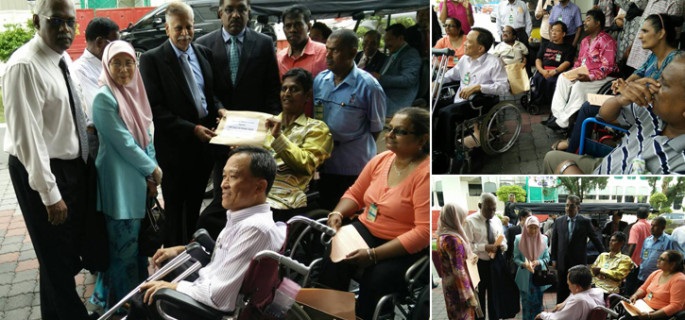


 Many more: Henry and Lisa with some of the ordinary wheelchairs that they want to give away.
 Second runner-up: Siow showing off her bronze medal upon arrival at the KLIA Friday night. — Bernama
  It will take a lot more education before we can expect drivers to show more consideration for the needs of the handicapped.
 Selayang councillor Gurdip Kaur @ Rina Pritam Singh (second left) directing enforcement officers to tear down posters in Rawang. — Picture by P.C. Lim

 Enjoying their time: Gurdip and her husband, Francis Siva, enjoying a moment in their garden at the ILTC in Taman Garing, Rawang.
 (From left) Oscar Pistorious of South Africa, Heros Marai of Italy and Christoph Bausch of Switzerland in the heats of the men’s 100m T44 classification race at the 2008 Beijing Paralympic Games.
  Tear them down: Enforcement officers dismantling illegal billboards and banners along Jalan Kuala Garing while Gurdip (second from left) looks on.
  Apply now: Yeoh showing the stickers for the disabled while Adnan looks on.


