NEW MINISTER FOR WELFARE MINISTER OF MALAYSIA

NEW MINISTER FOR WELFARE MINISTER OF MALAYSIA
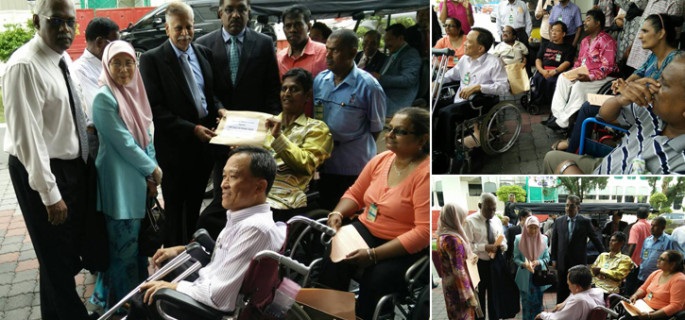
Badan Latihan dan Hidup Berdikari Malaysia (ILTC) pada 23hb Mac 2016 menyerahkan memorandum kepada ahli-ahli parlimen mendesak supaya golongan orang kurang upaya (OKU) dikecualikan daripada cukai barangan dan perkhidmatan (GST).

Disabled Members Protest

Disabled Members Protest
Disabled Members Protest at JPJ Wangsa Maju

ILTC Malaysia members staged a protest outside JPJ Wangsamaju KL.

ILTC Malaysia members staged a protest outside JPJ Wangsamaju KL.
Disabled group’s protest disabled drivers required to produce doc's medical report.

Friday, 5 December 2008

Failure to fill form costs disabled jobs

2008/12/04

Failure to fill form costs disabled jobs


BANGI: Almost all of the 1,000 disabled who sought government jobs between July and this month were unsuccessful because of their failure to fill a compulsory form.

They had failed to submit a form issued by the Public Services Commission, completing only a form issued by the Social Welfare Department.This led to only five successfully obtaining jobs.

Social Welfare Department division for the development of people with disabilities director Jayalatchumy Cumaraswamy said many applicants were not aware they had to fill out the form issued by the commission.She said this after the launch of a job expo for the disabled.

The form issued by the commission will be available online at www.spa.gov.my. from Jan 1.

Include The Disabled In All Development Efforts - UN Sec-Gen

December 03, 2008 18:41 PM

Include The Disabled In All Development Efforts - UN Sec-Gen
By: Ramjit

By Muin Abdul MajidDUBAI, Dec 3 (Bernama) -- United Nations (UN) secretary-general Ban Ki-moon has urged governments and all stakeholders to ensure the disabled and their organisations are an integral part of all development processes.

"In this way, we can promote integration and pave the way for a better future for all people in society," he said in his message to mark International Day Of Persons with Disabilities on Wednesday.

According to Ban, the UN General Assembly had stressed that to achieve the Millennium Development Goals (MDGs), those with disabilities must be included in all processes.

"With 80 per cent of the disabled -- more than 400 million people -- living in poor countries, we need to do much more to break the cycle of poverty and disability," he said.

Ban said this year's celebration came just a week before the 60th anniversary of the Universal Declaration of Human Rights, and the UN was commemorating both under the theme, 'Dignity and Justice for All of Us'.

"We have much to celebrate this year. The entry into force of the Convention on the Rights of Persons with Disabilities in May was a turning point."

When the first Conference of the Parties convened in October, participants immediately began considering how the Convention can serve as a tool to achieve the MDGs."

This progress has been made possible, thanks to the active participation and leadership of persons with disabilities, by ensuring that they have access to -- and are included in -- all aspects of our work," said the head of the world body.

Noting that the UN remained committed to this approach, Ban said the renovation of the UN headquarters complex would bring its facilities up to the latest standards of accessibility.

"These advances are long overdue," he added.

BERNAMA
Thursday December 4, 2008

- Lifestyle > Focus


Better facilities
WHEEL POWER
BY ANTHONY THANASAYAN

INTERNATIONAL Day of Persons with Disabilities (IDPD), which was observed yesterday, turned out to be quite a memorable event for a number of disabled persons in the Klang Valley. The theme for this year’s celebrations was Dignity and Justice – two words which matter a great deal to disabled communities all over the world.

On Monday, I was invited as a Majlis Bandaraya Petaling Jaya speaker to a road safety awareness campaign at the MPS stadium in Selayang, Selangor. The event brought together more than a hundred disabled motorists. The campaign, held in conjunction with the UN international disabled day, was targeted at disabled drivers, and organised by the Selayang Municipal Council, together with the Malaysian Road Safety Department and the Independent Living and Training Centre (ILTC).

Francis Siva, president of ILTC, said: “Because of the lack of disabled-friendly public transportation, the handicapped have to find ways to acquire vehicles on their own to earn a living or for hospital visits. As cars are expensive, many of the disabled resort to buying bikes, which are not exactly safe.”

These bikes are modified into four-wheelers or three-wheelers. The four-wheeler looks like a normal bike except that it has three wheels at the back with the usual one wheel in front. The disabled can tie their foldable wheelchairs at the backend of their seats. The three-wheelers come with an attached sidecar. Although the wheelchair can be placed in the sidecar, it would take a strong disabled motorcyclist to lift the wheelchair into the sidecar. Riders with poor balance also risk falling off their bikes.

“There are no driving schools which provide disabled-friendly cars or motorcycles for the handicapped,” said Francis, who became disabled in a driving accident more than 20 years ago.

That did not stop him from driving again 10 years later. He uses a hand-powered car that allows him to control the pedals with his hands. He said the only centre that has two modified cars for disabled persons to learn to drive is at the government Bangi training centre in Kajang, Selangor.

“I often receive complaints that the centre has no instructors to teach disabled drivers,” he said, adding that all driving schools should provide at least one modified car and motorbike for handicapped students.

Francis has a couple of suggestions:

>Make special concessions: Many disabled persons are illiterate because they have not been to school. Others were forced to drop out because schools refused to provide disabled-friendly facilities or there was no transportation available. Special training to handle such persons is required for all staff.

>Many PJ buildings are not disabled-friendly. Its offices in Padang Jawa, Selangor, and Wangsa Maju, Kuala Lumpur, provide services at the disabled car parks. However, there are complaints from the handicapped that the allocated parking lots are not next to entrances, security personnel are never around, and the handicapped are being charged for parking.

Helping hand for the handicapped

Monday December 1, 2008

Helping hand for the handicapped


LIKE most parents, lottery ticket seller Ramesh Moses has many worries concerning his children.

However, his worries are over simple, yet essential, matters like having enough food on the table each day.

The 44-year-old is wheelchair-bound and was handicapped by polio at the age of two. He earns about RM550 a month through the ticket sales.Feeling the pinch: (From left) K. Kaliamma, her son M. Muhilan with Mary and her husband Ramesh at their home in Sri Johor flats in Cheras during the visit by Azman.

His wife R. Mary, 43, is a housewife and they have four children aged between 11 and 18 years old.

They have been living at a Kuala Lumpur City Hall (DBKL) flat in Cheras for about 20 years now.

The church they attend also helps out with some RM200 each month.

However, the total is hardly sufficient for a family of four with children in school and other expenditures like the flat rental and utility bills.

“My flat rental is overdue by about 12 months. I only sell tickets three times a week and I go to work at nearby areas such as Maluri and Pandan Jaya, within Cheras so that my cab fare does not exceed RM8 to and fro each time,” he said during a visit to his flat by Bandar Tun Razak MP Tan Sri Khalid Ibrahim’s personal assistant Azman Abidin.

Azman also visited a handicapped boy, M. Muhilan, 19, in the area. Muhilan was accompanied by his mother K. Kaliamma Thevi, 44.

Kaliamma said Muhilan and his younger brother M. Anbarasan, 16, were born with Down Syndrome.

“I can’t work because I have to be here and take care of Muhilan while my sister takes care of Anbarasan. Sending them to a day-care centre would be too expensive for me.

“I cannot leave them alone as they need attention all the time, especially since they occasionally have seizures,” she said, adding that her husband, who works for Alam Flora, was a diabetic and was also often ill.

Azman, who provide some monetary help to the two families on behalf of the MP’s office, said there were many low-income, handicapped people living in the DBKL flats.

“The cost of living in KL is quite high and especially during this time of economic crisis, the low-income groups feel the pinch the most.

“I suggest that the government waives the rental for certain low-income, handicapped groups to help them in the long-run and think of ways of helping them sustain themselves,” he said during the visit.

To make contributions to these families call the MP’s office at 03-9172 1200/ 4200.

Ministry To Get Equal Recognition For Disabled Athleles

December 01, 2008 16:10 PM


Ministry To Get Equal Recognition For Disabled Athleles

BERA, Dec 1 (Bernama) -- The Youth and Sports Ministry is trying to get equal recognition for disabled athletes to enjoy the rights and privileges received by their normal counterparts.

Its Minority Sports Development Director, Kamaruzaman Hassan Mansor, said Monday the ministry hoped that the disabled athletes would receive the same incentives because they too had struggled to put Malaysia's name in the world sports arena.

"If a normal athlete gets RM1 million if he or she wins a gold medal in the Olympics, we hope the same reward will be given to the disabled athlete for a gold medal at the Paralympic Games," he said at the closing of the national-level Tasek Bera Kayaking Expedition for the Disabled Challenge 2008, here.

Kamaruzaman Hassan said the ministry would also try to secure pension for disabled athletes who win medals at international sports meets.

He also called for a sports and recreation association for the disabled to be set up soon in each state to take care of the welfare and interests of disabled athletes.

BERNAMA

Tuesday, 2 December 2008

Segerakan kemudahan bas untuk OKU

Selasa 2-12-2008


Segerakan kemudahan bas untuk OKU

BANDAR BARU SELAYANG – Ahli Parlimen Selayang, William Leong Jee Keen menggesa pihak kerajaan melalui Kementerian Kerja Raya menyegerakan penyediaan kemudahan pengangkutan bas awam untuk golongan orang kurang upaya (OKU) bagi memudahkan kehidupan harian mereka sama seperti masyarakat sempurna fizikal yang lain.

“Pada pandangan saya, kemudahan ini bukanlah sesuatu yang sukar disediakan. Kementerian boleh memanggil semua pihak berkenaan bagi membincangkan perkara ini, termasuk syarikat bas yang boleh mengeluarkan bas khas ini untuk memberikan kemudahan kepada OKU.

“Lihat contoh di Singapura, mereka boleh menyediakan kemudahan bas untuk OKU dan tidak mustahil kita juga boleh meluaskan penggunaan bas berkenaan,” katanya ketika berucap merasmikan Kempen Keselamatan dan Kesedaran Kemalangan Jalan Raya sempena Hari OKU Sedunia di sini, semalam.

William berkata demikian berikutan masih kurangnya kemudahan pengangkutan untuk golongan tersebut, walaupun terdapat kemudahan pengangkutan awam seperti transit aliran ringan (LRT) dan teksi.

Sementara itu mengulas manfaat kempen anjuran Majlis Perbandaran Selayang itu William berkata, usaha Majlis Keselamatan Jalan Raya yang sudi menyumbang sebanyak 120 jaket keselamatan dan topi keledar kepada OKU yang hadir pada majlis tersebut diharap dapat memberikan kesedaran kepada golongan berkenaan mengenai kepentingan mengamalkan pemanduan berhemah dan mengambil langkah terhadap keselamatan di jalan raya.

Katanya, program sebegini amat digalakkan kerana ia secara tidak langsung dapat menerapkan nilai-nilai murni kepada generasi baru supaya tidak mengabaikan tanggungjawab mereka terhadap OKU sekali gus dapat merapatkan hubungan antara masyarakat awam dan pihak berkuasa tempatan (PBT).

“Saya berharap agar lebih ramai pertubuhan bukan kerajaan (NGO) dan syarikat-syarikat swasta untuk tampil memberikan bantuan yang terdaya dan saya sentiasa membuka ruang kepada warga OKU untuk sama-sama berkongsi masalah dan pandangan,” katanya.

Friday, 28 November 2008

INTERNATIONAL DAY OF DISABLED PERSONS

INTERNATIONAL DAY OF DISABLED PERSONS - 3RD DECEMBER 2008

Theme: "Convention on the Rights of Persons with Disabilities : Dignity and Justice for All of Us"

Don’t turn a blind eye to them


Friday November 28, 2008

Don’t turn a blind eye to them
Story and photos by OH ING YEEN


WHAT do you do when a blind candidate attends your company’s job interview?

In conjunction with the International Disabled Day (Hari OKU) on Dec 3, the Society of the Blind in Malaysia held a press conference on “How to interview the visually impaired”.

According to the society’s Employee and Computer Deve-lopment Committee member Dr Wong Huey Siew, 39, the Women, Family and Community Develop-ment Ministry announced that 1% of jobs available in the public sector must be allocated to people with disabilities (PWDs) to ensure that they have equal access to employment.

“There will also be tax incentives for employers to buy suitable support equipment for their workers who are disabled.”

Technology to the rescue: Wong using a computer with a special software that reads out the document for the user.

The objective of the press conference was to inform the blind about the job opportunities available, to raise awareness on how to hire those who are visually-impaired, and to encourage future employers to contact the relevant organisations for more information.

“Many people do not know how to interact with disabled people. At an interview, it’s wrong for interviewers to keep quiet just because they have no experience in interacting with PWDs,” said Wong.

“In order to establish rapport, they should introduce themselves and other interviewers.

“Get to know the candidate. Some interviewers tend to focus on the interviewee’s disabilities instead of their capabilities and strengths. They should access the candidate’s skills, motivation level, past working experiences as well as ask them how they can contribute to the company,” he said in the interview at the society’s headquarters in Brickfields, KL.

He added that the employers should also identify the support systems needed.

“They would need to install a software imported from the United States, which costs about RM4,000, into any computer to enable us to decipher and type documents,” said Wong who uses the system to prepare his lecture notes and write and send e-mails.

“Some employers fear for the disabled person’s safety especially where staircases are concerned.
Going up and down the stairs is not a problem, just give them a day to walk around the office and get accustomed to it,” he said.

On transportation to work, he said, “Almost 100% of the visually-impaired take the public transport to work and they can make it there on time.”

Speaking from personal experience, Wong recalled the disappointment he faced as a visually-impaired person when seeking for jobs before landing his current job as a lecturer.

“I spent three years looking for a job after I completed my master’s and have sent out around 1,000 resumes, some to well-established companies, but I was only called for less than 20 interviews.

He added that among the job options available for the visually-impaired were lawyer, legal adviser, trainer, counsellor, telemarketer, telephonist, editor, writer, lecturer, school teacher and government agency officer.

For details, visit the Malaysian Association for the Blind (MAB) http://www.mab.org.my/ or call the Society of the Blind in Malaysia at 03-2274 6162.

DEWAN RAKYAT: No special car stickers

NST Online » Local News

2008/11/26

DEWAN RAKYAT: No special car stickers

THE government has no plan to issue special car stickers for handicapped motorists, Deputy Transport Minister Datuk Seri Lajim Ukin said yesterday.

However, a vehicle that had been modified for use by a disabled person was allowed to display a sign -- For Disabled Use. This sign would tell the police, Road Transport Department officers and the public that the vehicle was used by a disabled person, Lajim said in reply to a question by Abd Rahman Bakri (BN-Sabak Bernam)

Make workplace more disabled-friendly


Monday November 24, 2008

Make workplace more disabled-friendly

KUCHING: Infrastructure and an environment that is not disabled-friendly is the reason why many employers find it difficult to hire the disabled, said Sarawak Welfare Department director Kendy Edward.

He said an environment that was not disabled-friendly restricted the movement of this group of people.

“The problem is not the qualifications or job offers, but the lack of a disabled-friendly environment, which should be addressed.

“Many employers are keen to hire the disabled, but the environment is not suitable for them,” she told reporters after the closing the Bicara Bestari smart talk programme on the topic Empowering the Disabled, Outlining Success, Proving Ability here recently.

Edward urged employers to provide disabled-friendly facilities to allow them to carry out their tasks with ease, instead of only offering jobs.

She said the employers must provide facilities such as barrier-free zones, ICT facilities and support equipment to allow them to move freely and do their work well.

“I hope those in the public and private sectors will provide the disabled with suitable jobs based on their qualifications and degree of disability as well as access to the workplace,” she said.

To encourage the private sector to hire more disabled persons, Kendy said the state allowed tax reductions for renovations to make offices disabled-friendly.

There are 19,857 disabled people registered with the Sarawak Welfare Department of whom 2,006 are blind, 2,647 deaf, 7,072 physically disabled, 7,196 slow learners and 936 with cerebral palsy.

The Bicara Bestari programme will present its findings to instil care and respect and promote acceptance and openness towards the disabled. – Bernama

D-Day checklist

Thursday November 27, 2008

The Star - Lifestyle

D-Day checklist
WHEEL POWER WITH ANTHONY THANASAYAN


INTERNATIONAL Day of Persons with Disabilities (IDPD) falls on Dec 3 next week. This year’s theme is Dignity and Justice.

Here’s a checklist to help us make Dec 3 a special day.

Sensitive terminology: Say “persons with disabilities” or “disabled persons”. The latter is based on the position taken by many international disabled activists who see themselves as people who are disabled by society because of the lack of disabled-friendly facilities rather than by their medical conditions.

Never use the word “normal” when referring to yourself if you are not a disabled person. Use “non-disabled” instead. Ban all negative labels such as “deformed” and “crippled” from your vocabulary.

Cope vs cure: Except for those who have been disabled recently, most disabled persons are not looking for a cure to their conditions because there is no cure for the majority of disabilities.

Acceptance of one’s condition is the key to positive living with disabilities. Rather than a cure, for instance, the handicapped want jobs so that they can live like anyone else.

Be careful when referring to disabilities as a “tragedy” or an “unfortunate state”. Disabled people do not feel that they are second to non-disabled persons. Many of them even celebrate being disabled, which is what IDPD is all about.

Be a pal: Befriend a disabled person today. Not only will he or she be thrilled when you approach them, the experience will enrich you, too. Don’t ask him about his disability. Save that question for later. By then, it probably won’t matter to you.

There are things you can do such as help them pay their utility bills, collect their medication and clean their room or home periodically.

Service providers: Phone companies, how about coming up with a package for the handicapped? How about free calls or low flat rates? Phones are not a luxury item but a basic necessity for the disabled. They are also life-savers during emergencies.

As for the Internet, how about a RM1 token monthly fee? Helping the handicapped to get online will significantly up their chances to get educated and find jobs that they can do at home.

Others: Banks, why don’t you reserve the parking lot nearest to your entrance for disabled and elderly customers? Please make it a covered facility so that they can also perform quick transactions on the site. The provision will be a temporary measure as you upgrade your banks in stages to become disabled-friendly.

The UN says about 10% of the world’s population, or 650 million people, live with disabilities.
About 80% to 90% of disabled persons of working age in developing countries like Malaysia are unemployed.

According to Unesco, 90% of children with disabilities also do not attend school.

With such stark realities, it is imperative that countries the world over take three significant steps to improve the lives of disabled persons in their nations. They must sign, ratify and implement the UN Convention on the Rights of Persons with Disabilities and its Optional Protocol.

To my knowledge, Malaysia has to date made the first move only in this all-important pathway that will make a great difference to all disabled Malaysians.

Saturday, 22 November 2008

Independent travel


Thursday November 20, 2008

Independent travel
By VIVIENNE PAL

One man’s effort in making Malaysia an ideal holiday destination for the disabled.
ASK Helen Jones about one of her most eventful moments in 2003 and, chances are, the Mangrove Swamp Excursion will rank top of her list.

This “excursion” could not be less accessible for Jones; getting into and out of a speedboat and up wet wooden steps proved extremely challenging.

Here’s why: Jones, who has cerebral palsy, is wheelchair-bound.

Accessibility makes touring the Great Wall of China possible for this disabled traveller.

Jones was in Malaysia as part of a team comprising Disability View and representatives from a host of disability organisations based in Britain to inspect how welcoming Malaysia was to disabled travellers.

Disability View, an organisation which provides current and useful information on disability in Britain, had sent its editorial representative to Malaysia on an educational trip jointly organised by Wings on Wheels, a specialist travel company for people with special needs, Malaysia Airlines and Malaysia-based travel agency Diethelm Travel Management.

In its September/October 2003 issue, Disability View’s magazine reported that although it took a considerable amount of “woman-handling” to get Jones in and out of the boat and to lunch, the excursion at the mangrove swamp was “worth the effort” and, according to Jones, “the boat ride to look at some of the country’s marine life was ‘just amazing’.”

The trip, while having assessed at that time the accessibility of most five-star hotels in the heart of Kuala Lumpur (door widths, colour contrasts, ramp gradients, room layouts and positioning of facilities and equipment: all check; with Equatorial Hotel offering the best quality of access), and that transfers from the lifts to their coach were more accessible than the regular train shuttle into the heart of the city, also showed the potential the country has as a tourist destination for the disabled, and how much the disabled want – and should be entitled to – their fun.

But that’s only possible if they are given the means to be independent.

“We usually prefer to be independent when we go on trips so we won’t slow down the group,” says Antony Leopold, who is himself disabled after having been struck with post-poliomyelitis of both legs since 1953. He has moved around with walking aids or on a wheelchair since.

While first-world countries like the United States and many European countries have proven to be accessible holiday destinations, Malaysia still has some way to go.

“Malaysia is quite far from being ‘travel accessible’ although the concept of barrier-free tourism is now gradually being implemented.

“Initially, I thought accessibility elsewhere was like how it is in Malaysia, but when I discovered just how accessible other countries were in comparison, I was inspired to do something,” Leopold says, adding that the disabled include both the handicapped and the elderly who rely on help to move around.

Married with three children, and able to move around independently in his own car, Leopold, 56, wishes to afford the same kind of experience to as many in the disabled tourist community as possible. And W what better way than to use his business as the platform to offer such value-added services?

In 2004, Leopold set up Ace Altair Travels Sdn Bhd after having been in the travel business in various capacities for some 15 years. Besides attending to able-bodied customers, he is determined that the company would realise his dream of providing meaningful holidays for the disabled.

“I’ve always loved travelling. This is the extension of my dream. Initially, I thought travelling would be impossible in the light of my disability because so many places weren’t disabled-friendly.”

As far as Leopold knows, there are no other providers of accessible travel in the country although he knows of cases of disabled travellers being handled by other agents.

He seems to be travelling a lonely road, considering the odds stacked against him.

“If you want to do something, you have to start by doing it on your own,” he replies with spirit.

Leopold developed Travel Assist, a niche value-added service specially designed to identify hotels with rooms for the disabled, and accessible places of interest and attractions, as well as provide transportation and transfers, and accompaniment by specially trained personnel upon request.

Providing such highly specialised services, especially when it’s new, can be tough. In order to market Travel Assist effectively, Leopold has subscribed to Malaysian Tourism Online Unified Reservation System (myTours), a system developed by Creative Advances Technology Sdn Bhd,

A consolidated tourism e-business platform that will unite government agencies, various sectors of the travel industry, and consumers, myTours includes components such as Hotels2Go and Flights2Go, and other travel-related technology integral to the entire supply chain of the tourism industry.

“I believe in the power of technology. The Commerce platform helps me jump-start my online travel business. It helps me connect with other travel agents and suppliers, whether they are inside or outside of Malaysia. This is a great way to promote my service,” he says.

One can rest assured the destinations he recommends are places that he and his family have personally scouted. In terms of accessible accommodation, Leopold says that most five- and four-star hotels in major cities in Malaysia have one or two handicapped user-friendly rooms with wider doors, accessible ramps, hand railings and some with roll-in showers.

Some of his trips have turned up unexpected surprises: some small towns offer disabled-friendly accommodation, like the 100-room Hotel Flamingo in the quiet town of Sitiawan!

Apart from the services, Leopold also provides other necessities.

“We will provide crutches and basic wheelchairs in case tourists do not bring their own, and we are planning to get motorised wheelchairs and a specially equipped van for wheelchair-bound travellers. I recently found a travel company that has a 28-seater coach which has a wheelchair lifter. They are very keen to work with me on my proposed services for disabled travel.

“We’ve also ordered portable ramps and I am in touch with an orthopaedic specialist who will advise me on how to best service disabled tourists,” he says, adding that he hoped to cater to small groups of four or five initially.

Leopold estimates start-up costs at RM300,000. He agrees that the infrastructure has to be in place for his venture to be successful.

“If you have the facilities, and help from the Government, the tourists will come. I have the contacts to provide a holiday for disabled travellers – I’ve made it possible for disabled tourists to ride an elephant in Thailand or even go scuba-diving.

“Having said that, we are realistic – there are some places we can’t go; for instance, I couldn’t walk up the Taj Mahal when I was on holiday in India, but being there and seeing it was wonderful enough for me. But, in certain instances, things can be improved. A holiday can be made a little better for the disabled with a ramp placed here or there, or resorts taking that extra step by constructing lanes near pools or by the beach for the disabled to move on.

“I’ll make sure something happens in my lifetime, regardless of whether every other entity comes in to play its part or not,” he says, adding that he hopes Travel Assist would be fully operational by next year.

■ Ace Altair Travels Sdn Bhd is located at Suite 1.12, 1st floor, The AmpWalk, 218, Jalan Ampang, KL. For details, call 03-2166 3755/ 4755.
Public transport: Don't leave disabled out


Public transport: Don't leave disabled out
Sam Wong Nov 21, 08 3:52pm

At last, we are happy to hear that the Selangor government has initiated the transport fund to improve the publish transport in the state. This has shown the state government’s keen interest to increase the rate of people using public transport.

The target is seeing people using public transport go up from 11 percent to 30 percent and setting another goal to reduce the private car to public transport ratio to at least 30:70.

Nevertheless, in the report on this transport fund, we did not see any statement regarding people with disabilities. People with disabilities make up of almost 10 percent of our nation’s population.

They have been the larger marginalised group in our country even though they can contribute to the national economy. Perhaps it is this disabled environment or disabled unfriendly environment that makes them disabled after all.

We should not neglect the ability of people with disabilities; they have long been marginalised in our country. They are eager to contribute to the nation and have even foregone their personal well-being.

However, the environment surrounding has always been unkind. They do not have access to the public areas because these public areas are not designed to be disabled friendly.

I am one of those disabled people. When staying at Petaling Jaya few years ago, I found none of the public amenities were disabled friendly. The public transport services, both in design and in routes, were not accessible to me.

Even normal people found it hard to access to the services. The roads were not jept in good condition with constant digging going on from day to night while the public transport infrastructure itself was more often than not an inconvenience.

The Selangor government has said that it would work together with developers to push the federal government to develop the state’s public transport infrastructure. But I do hope the development will also include the rural areas such as Kuala Selangor, Sungai Besar and Sabak Bernam.

Those areas are also part of Selangor and the state government should also develop the public transport infrastructure there. There should be a plan for all, not only for some areas; we are not building up a Lego city here.

The government must not overlook the needs of people with disabilities. The transport fund has to take into account the community of people with disabilities in Selangor.

When developing public transport infrastructure please please ensure that they are accessible to the disabled.

The increasing ratio of members of the public using public transport always includes the population of people with disabilities. In Hong Kong, 90 percent of population use public transport and this includes people with disabilities.

Finally and just as importantly, some disabled are fortibate enough to have their won personal transport but we need to remember that when they age they may have to depend on public transport more and more.

All the more reson that our public transport infrastructure be holistically demand to cater for the needs of the entire population, disabled included.

Thursday, 20 November 2008

An unexpected bouquet

An unexpected bouquet
Tuesday November 18, 2008
Truly an eye-opening read

I WISH to thank The Star for giving the opportunity to columnist Anthony Thanasayan who writes the Wheel Power column.

I have no idea when Anthony first started writing. I must have been too busy with my career and everything around me because I was an able-bodied person who could go anywhere at any time.

Then suddenly my lifestyle changed. Due to disease, disability slowly crept in since 2001. I don’t remember when I started reading Anthony’s articles but I know that it was definitely after 2002 when I started using his articles to teach my students.

Anthony being disabled, writes about the disabled and describes everything so vividly about the life of the disabled, the challenges they go through and the insensitivities they put up with, so much so, I feel he is talking about me. But then again, I know that many other disabled people feel that Anthony is talking about them, too.

If The Star has not given such an opportunity to a disabled columnist, many people like me would be voiceless. That is the power of the pen.

So, thank you for making the disabled community come to light instead of being shunned like lepers. I am sure The Star has contributed in the making of a MBPJ councillor.

I hope more disabled people will start living their life with whatever disability they have. I have been going through a lot of frustrations especially caused by able-bodied people who just don’t seem to care or understand what I am going through.

Many times, I just gave up. I felt unwanted, useless, and have no purpose in living. But Anthony’s articles are an eye-opener. They make me realise that the disabled have a right to learn, to work and to be independent.

I reckon that, all of us, the disabled, do not want sympathy or donations. What we want is the right to live among the able-bodied people.

I hope educators, employers, colleagues, family members, relatives and friends will always pave the way for the disabled to live independently. I know many able-bodied people read Anthony’s articles and some of them even use the articles when teaching.

Such people, unlike me, need not wait to be disabled in order to discover about the disabled world. They discovered Anthony instead.

JANET KOCHAPPAN,
Seri Kembangan
, Selangor.

Monday, 17 November 2008

Their ‘Dream’: China Disabled People’s Performing Arts Troupe

Their ‘Dream’: One World One Dream - China Disabled People’s Performing Arts Troupe

In Malaysia, THE China Disabled People’s Performing Art Troupe who recently performed at the KLCC Convention Centre on Nov 8 and 9, Plenary Hall, Kuala Lumpur. The audience turnout was great.

The charity show performed from China and our very own Malaysian disabled, DeafBeat from YMCA Kuala Lumpur, the Independent Living and Training Centre and the Creative Stars.

The “My Dream” featuring singing, dance, acrobatics and music and poetry communicated through sign language.

It is possible that many members of the Malaysian community still have not heard of the troupe, nor know how surprisingly high its artistic skills are, with or without disabilities. This troupe has performed in over 50 countries and often to full houses.

Dancers from the China Disabled People's Performing Art Troupe await their turn to raise and move their arms during a dance on stage in KLCC on November 08, 2008.

Dancers from the China Disabled People's Performing Art Troupe - the unique troupe features a cast of more than 30 dancers and performers with physical disabilities, some who cannot hear.


Dancers from the China Disabled People's Performing Art Troupe performed the "Thousand-hand Avalokitesvara Bodhisattva".

Sunday, 16 November 2008

Handicapped duo show they can, despite the odds


Thursday November 13, 2008

Handicapped duo show they can, despite the odds

PEKAN: Parents with disabled children are bound to despair over their future.
Thoughts of the hardships awaiting their children will haunt them.

Such was the predicament for Othman Ali, 75, and his wife Juliah Ismail, 71, from Kampung Tanjong Pulai, whose son Mohd Khairi was born with incomplete limbs.

Now aged 31 years, Mohd Khairi is physically challenged with stunted hands and legs.
Great dexterity: Mohd Khairi carring a feed container to feed the fish in Kampung Tanjong Pulai, Pekan, recently.

He has proved to his parents that they have no reason to worry over his future.

His parents sigh in relief as their son is not only able to take care of himself, but is also a promising entrepreneur.

One may be surprised by how a man with physical limitations can venture into aquaculture, which involves significant physical ability.

It started eight years ago when Mohd Khairi was persuaded by his cousin Abdul Rashid Nordin to try aqua farming in Sungai Pahang.

His love for angling spurred him to borrow a fish enclosure from his cousin to breed tilapia.

Mohd Khairi continued in this undertaking and today owns 17 enclosures full of tilapia and ikan patin.

He said, on every breeding cycle, he could harvest 600kg to 700kg of fish worth RM4,000.

The fish is sold at markets in Pekan, and each cycle takes five months.

Though his average monthly income is only RM800, it makes a big difference for Mohd Khairi as he has an income to help him and his aged parents.

His daily routine begins with a wheelchair ride to the riverbank, where he uses his arms and thighs to descend the steps into the water and reach the enclosures.

He feeds the fishes by holding a food-pallet container under his armpit. He even carries the sacks of food pallets to the enclosures.

Other than feeding the fishes, he cleans the breeding area of debris washed into the enclosure.

The feeding and cleaning is conducted daily in the mornings and evenings.

“Due to my physical limitations, there are many hurdles to overcome, but I’m used to it,” said Mohd Khairi.

He seeks assistance from friends and relatives in harvesting and selling the fish.

Another disabled person, Mohamed Mahidin, 38, from Kampung Kiambang in Ganchong near here does not see his disability as an impediment to venturing into aquaculture.

A former silver-medal winner in the high jump event at the 1998 Asian Paralympics in Bangkok, he has 18 enclosures with tilapia and patin.

Mohamed, who has a deformed right leg, took up the venture six years ago and earns between RM1,000 and RM1,500 monthly.

He said his fishes were in demand, especially in the Kuantan wet market.

Speaking about enduring hardships, Mohamed said he had no choice but to face it.

“I was brought up in a kampung environment and am used to rivers,” he said.

The biggest challenge, he added, was the wet spell when aqua farming had to be stopped temporarily.

Mohd Khairi’s and Mohamed’s achievements stand as testimony that being handicapped poses no hindrance in getting on with life.

Their venture has received the attention of the Malaysian Fisheries Department.

On Oct 23, the department’s aquaculture development division director Ismail Abu Hassan provided the duo with assistance through the Aquaculture Support Services Scheme.

The aid will not only help them alleviate their financial burdens but also expand their venture through better infrastructure and support services.

Mohd Khairi is confident that he is on a better footing to increase his fish output while Mohamed is planning to venture into downstream activities like frozen fish products, pekasam (fish pickled in brine) and keropok (fish fritters).
Both of them overcame their physical shortcomings and turned into successful entrepreneurs as described by the adage: Where there is a will, there is a way. — Bernama
But he has never been deterred by his limitations in leading an independent life.

Getting in and out of buses a breeze for the disabled


Thursday November 13, 2008

Getting in and out of buses a breeze for the disabled
Story and photos by CHARLES FERNANDEZ

FIFTEEN new Nadi Putra buses fitted with special lifters for the disabled or orang kurang upaya (OKU) were recently added to the current fleet of 55 buses servicing Putrajaya.

The newly-introduced buses will display the OKU sticker for easy identification and they come in four colours.

Federal Territories Minister Datuk Seri Zulhasnan Rafique received the buses on behalf of the Putrajaya Corporation (PJC), witnessed by PJC president Tan Sri Samsuddin Osman, FT Deputy Minister Datuk M. Saravanan and FT Ministry secretary-general Datuk Ahmad Phesal Talib.
Boost for disabled: A passenger is being lifted onto the bus.

The lifter is placed at the back door and is controlled by the driver and the whole proceeding is viewed via a CCTV network fitted in the bus.

“Before the delivery of the new buses, Nadi Putra had 55 buses with 51 powered by NGV and four diesel-driven ones. Since June 2006 we use NGV for all buses operating here,’’ said Zulhasnan.

He said the 15 buses would service new housing areas in Precincts 5, 6, 15 and 18 to complement the current fleet of buses running the routes in Precincts 9 and 14.

“However, the numbers are still not enough to satisfy the needs of the residents and working community here who are encouraged to use the ‘Park and Ride’ system already in place,’’ added Zulhasnan.

As for long-term plans, Zulhasnan said the government had approved RM70mil for the purchase of another 104 buses which would be introduced in stages within the next two years.

When asked if the disabled community could use the services for free, Samsuddin said for the moment it was free.

“The fare is already subsided. It is only 50 sen,’’ he said.
Samsuddin added that the number of passengers using the Nadi Putra services had also increased from 100,000 in May last year to 230,000 until the end of October this year.

Thursday, 13 November 2008

Hospital visit

Thursday November 13, 2008

The Star - Online - Lifestyle
Home > Lifestyle > Living

Hospital visit
WHEEL POWER WITH ANTHONY THANASAYAN

Councillors, politicians and government officials should reach out to their constituents who are in hospital.

RECENTLY a friend of mine was alarmed when I told her I was going to the hospital. However, the purpose of my trip was to visit some disabled persons who were admitted there. It was part of my job as a Petaling Jaya city councillor, I explained to my friend.

“Why?” she blurted out. “Surely that’s not part of your duties?”

Her remark had me thinking about our attitude towards visiting the sick in hospital. Why can’t it be part of the responsibility of local councillors, politicians and government officials to reach out to their constituents who are in hospital?

I’m not talking about making visits to individuals during a national disaster, which is common practice.

A private visit is more effective as I discovered during my trip last week.

The hospital had only one disabled-friendly parking lot at the entrance. For an institution where persons with wheelchairs are bound to frequent, this is inadequate. To make matters worse, the slot was occupied by a sleek BMW. I was told that the car belonged to a doctor at the hospital.

I wasn’t surprised. I know of a posh private hospital in Kuala Lumpur that allows its director to park his car in one of the two disabled parking lots at the entrance of the hospital.

This is ridiculous. Directors of institutions – and certainly doctors – who cater and care for sick, elderly and disabled ought to be the last people on earth to need education on how essential disabled-friendly features are for people who need them.

There is no point in providing such facilities if we do not ensure they are utilised accordingly.

I complained to the PR team and they wasted no time in getting the offending vehicle out of the box.

Despite this unpleasant encounter, I learnt a lot by meeting some of the patients at the hospital. I met an active paraplegic who had to lie in bed and on his stomach for a month (or more) because of a pressure sore. There was also another gentleman who dislocated his hip.

Even as they, and several others who are disabled, wait eagerly to be discharged, they are worried about the kind of bill the hospital will slap on them.

It has often been said that disabled persons are entitled to free medical treatment in government hospitals. Ironically, the policy doesn’t apply for admissions.

Something is very wrong here, and it needs to be fixed.

Tuesday, 11 November 2008

Power of will

Sunday November 9, 2008

The Star - Metro

Power of will
Sunday with T.SELVA

No doubt about it: where there’s a will, there’s a way.

WILLPOWER is a self-discipline energy which every individual possesses. It is not something that is reserved for a few special people only.

To learn to invoke this inner power is vital because every person can improve his or her well-being when the energy is roused.

In self-improvement studies, the hidden strength is regarded as the success tool in all areas of life.

All of us have it and awakening it is important so that we are able to cope with the various challenges because our life is not a bed of roses nor it is full of thorns either.

The ups and downs we experience should be viewed as an art of living because our existence is a lifelong learning process.

We should face all challenges using our strong willpower and without giving up.

I have a high regard for people who have strong willpower, determination and the force to overcome all shortcomings and obstacles in life because they are successful in whatever they undertake.
Mesmerising: The charity performance Awakening showcases talents from the China Disabled People’s Performing Art Troupe.

I am writing this because I was particularly moved and mesmerised last night after watching the charity performance Awakening, which showcased the talents of 27 Chinese performers from the China Disabled People’s Performing Art Troupe in Kuala Lumpur.

Despite being deaf and dumb, the talented dancers had the power to evoke in each of us a deeper understanding of our lives and of the world around us.

They portrayed independence, enhanced our sense of self-worth, and provided an avenue for everyone to learn and develop creative talents and skills.

And, perhaps most importantly, the artistes made the audience at the Plenary Hall in the KL Convention Centre realise that nothing is impossible in life if you have the willpower.

The extraordinary troupe reflected both the capabilities of people with disabilities and the power of will to transcend all barriers in the quest to reach their full potential.

Two friends whom I had invited for the show turned down the invitation saying that the show would make them feel gloomy because they would not be able to handle seeing the handicapped performing.

I felt sad for them because they could have been inspired by the performances and not otherwise because the world-class dancers displayed their superb art just like able people, if not better.

How one perceives a handicapped person is a reflection of one’s own attitude towards them and this is unfair to the impaired people whom I think should be seen with ordinary eyes.

We should be sensitive and respect people who are disabled and also understand their feelings, culture, heritage, and the language unique to deaf people of the world.

The show was unique and dazzling both visually and musically and the Chinese artistes also challenged us to recognise outmoded stereotypes and destructive attitudes that too often hinder people with disabilities in the aim to reach their goals.

They left a lasting impression in the hearts of the spectators to understand and appreciate life and mankind’s diversity as well as the goals and values we share.

I strongly feel that there is a need to integrate the able with the disabled to create better understanding, love and compassion.

People with special needs should not feel imprisoned because of their disability.

They should not feel shy about what they are and they should feel confident and that their disability does not mean they are worth less than other people.

The truth is that everyone can reach high levels if they have the willpower to make a decision, take action, and handle and execute any task until it is accomplished, regardless of inner and outer resistance, discomfort or difficulties.

The will is so powerful that it has the ability to overcome laziness, temptations and negative habits, and to carry out actions, even if they require effort, are unpleasant and tedious or are contrary to one’s habits.

T. Selva, The Star’s Sunday Metro editor, says the handicapped should be seen as a reflection of life as to how fortunate we are.

Tips on tapping into your inner strength

  • Play soothing music and calm yourself and stay away from noisy places and disturbing sounds.
  • Distance yourself from anger, frustrations, negativity and things that upset you.
  • When faced with difficult situations, remind yourself that tough times do not remain but tough people do.
  • Maintain a positive attitude no matter how difficult the situation and remain focused and clear.

Sunday, 9 November 2008

Special children have a splashing time under new programme


Friday November 7, 2008

Special children have a splashing time under new programme
By JADE CHAN

THE 11 special children from the Malaysian Association of Guardians for the Intellectually Challenged (Magic) had a splashing good time at a local club’s pool as they worked their way to learn the basics of swimming.

Magic administrator Elizabeth Perera explained that they got to know Dr Rekha Ramachandran, who recommended a swimming programme for special children taught by Sridhar.

“Dr Rekha is the Down’s Syndrome Association of Tamilnadu chairperson in Chennai and a parent of a Down’s Syndrome child.

“She met with some parents at Magic and shared the activities her association does, including Sridhar’s swimming programme.

For special children: MAGIC (Malaysian Association of Guardians for the Intellectually Challenged) is a modern resource centre that offers an alternative form of education for intellectually challenged students. It is located in a quiet residential environment in Section 16, PJ

“The children were taught simple step-by-step techniques on how to swim freestyle and coordinate their hand-leg movements. It was also an opportunity for them to exercise and have fun.

“Sridhar felt that some of the children were quick to pick up on their swimming skills and most weren’t afraid of the water.

“They were all very determined and managed to swim within two weeks,” said Perera.

She pointed out that the coach, who was assisted by several volunteers and teachers, had to be very patient and have the ability to work with children of different learning levels.

“The children were sad when the programme ended and are keen to practise what they learnt.

“We will write to the Kelab Golf Perkhidmatan Awam, which allowed us to use their pool for free during our programme, to see if we can continue the swimming lessons with their coach and learn other strokes.”

Magic president Nerin Yusop said that swimming offered a great form of exercise that helped control her daughter’s blood sugar level.

“Sarah, 17, loves it so much that she’s declared it her new hobby. She’s eager to practise swimming and this shall be our new Saturday morning activity,” said Nerin.

Perera herself was thrilled that her daughter, 22-year-old Marie Anne, was able to swim within three days and hopes she would continue swimming to shed some weight. Introduction to swimming: Sridhar (second from right) guiding the children through the swimming programme through a step-by-step method, including how to kick and coordinate their hand-leg movements

Magic is a non-profit organisation conceptualised in 2000 by a group of parents whose own children are intellectually challenged and decided to start a special needs resource centre.

It offers an alternative form of education for students who have been diagnosed with Down’s Syndrome, Developmental Delay, Global Delay, autism and learning disabilities.

The swimming programme is part of Magic’s integration programmes and curriculum to cater to the students’ needs.

Other activities include arts and craft, cooking and baking, riding for the disabled, drama and body movements, and school-to-work transition programme.

An intensive life skill programme that covers areas like personal and home maintenance, budgeting and shopping, vocational skills and organised class trips is conducted to provide a more hands-on form of learning.

“Our focus is on independent, social and domestic living skills. A lot of the lessons have to be repeated and conducted through role-playing for the children to understand better,” said Perera.

“The difference with Magic is that the parents are personally involved in their children’s development and education, hence providing a heart and soul to the organisation.

“It takes longer for special children to learn, but with a lot of patience and repetition, they can.”

She advised parents to not underestimate their children’s capabilities and said that given a chance, they can excel in anything they set their minds to.

“Our vision is to have a community group home, similar to the one in Australia. It is a place where special people who are young working adults can live independently within a community.”

For more information, contact Magic at 03-7957 3082 or magiceducationcentre@yahoo.com.

Stipend of RM150 for special children in Johor


Friday November 7, 2008

Stipend of RM150 for special children in Johor

MUAR: Special children in primary and secondary schools in Johor will receive a monthly allowance of RM150, said the Mentri Besar’s special officer Datuk Mohd Ismail Mohd Shah.

Speaking to parents of 63 special children from the Parit Keroma in-community rehabilitation centre, he said that parents should register their children with the state Education Department before December.

“I have been informed that the allowance is in the 2009 Budget and the state needs to know who are eligible for next year’s school term.

“I hope parents will register the children soon as the department has to submit the list before 2009,” he said after treating the children to a Hari Raya meal recently.

Mohd Ismail said parents should realise that children with physical, muscular or mental disorders needed to learn in schools.

They should not prevent their special children from learning and give them every opportunity to go to school, he said.

Mohd Ismail said, besides knowledge, such children needed care and parents as well as relatives should be more committed in helping them.

“I hope that those yet to send their special children to in-community rehabilitation centres will do so now and not feel ashamed of such children.

“The state is providing all the necessary aid and we should play our parts in ensuring they receive the aid,” he added.

Friday, 7 November 2008

Thursday November 6, 2008

Ideal class
WHEEL POWERBY ANTHONY THANASAYAN

RECENTLY I received flak from some parents of learning disabled (LD) children and young adults. They were upset with me for not giving my support as a disabled city councillor (MBPJ) to a centre in Petaling Jaya, where their children were studying.

The trouble is, the centre in question is a business set-up; it is not registered as a non-profit association with the Registrar of Societies, which should be the case.

As a disabled person, I would be the last to go against anything that would benefit the disabled.

Despite the apparent negativity of it all, I believe the issue has raised healthy debate over services provided to the disabled in our country.

Here is a brief checklist that Puan Sariah Amirin and I worked on, which will hopefully be a useful guide for anyone intending to work with people with LD.

Sariah is president of the Dyslexia Association of Malaysia. She also sits on the expert committee on disability in MBPJ.

Understand the basics: There is a wide range of learning disabilities that affect people from birth to adulthood. They encounter significant difficulties in their ability to listen, speak, read, write and reason like other people. However, with proper training, they can study in a regular school setting with a special education teacher. If given a chance, they can even hold jobs.

Know your target group and their needs: Never lump various types of LD groups together. Each category has specific needs. Teachers must possess special education qualifications. The ideal ratio is one teacher to four students.

A roomy environment is essential: Bungalows or corner lot double- or single-storey terraces are best. Children with behavioural issues like attention deficit disorder, attention deficit hyperactivity disorder or autism can get very upset and claustrophobic with the way furniture is arranged. Thus centres should provide an open space where such children can go to calm down.

Where they study: Classrooms must be equipped with suitable eating areas, outdoor playground, gym (for physiotherapy) and clean and safe toilets. Special diets which are sugar-free or caffeine-free are a must for all LD children.

Further requirements: Students must be assessed for their chronological and mental age to enable proper grouping for effective education. An individual education plan should be structured. This should include the curriculum set by the Education Ministry’s Special Education Department.

In addition to academic achievements for highly-functioning LD students, daily living skills and behaviour management programmes are needed for those with moderate and profound disabilities. Vocational training geared towards job placements should be provided for those 16 and above.

Other prerequisites for setting up an LD centre include having medical professionals – from neurologists to speech therapists – to ensure holistic care for each child. A centre should be operated by a board of directors which includes at least one or more of such experts in the team.

All LD centres must conduct examinations to give every child the same opportunities as non-disabled students.

For more information, contact Puan Sariah Amirin (03-4025 5109).

Thursday, 6 November 2008

Centre given three months to comply

Wednesday, November 05, 2008

Centre given three months to comply
Sariah Amirin (left) and Derek Fernandez

PETALING JAYA: Kiaros, a learning disability centre, has been given three months to submit supporting documents for operating in its current residential premises in SS1.

The decision was made by PJ City Council secretary Puasa Md. Taib during a meeting held between the council and the management of the centre for children with learning disabilities.

Sariah Amirin, President of Dyslexia Association of Malaysia, mentioned a list of criteria that a centre needs to meet before approval or accreditation is given.

Among the criteria are proper learning tools, a suitable evaluation system before and after joining the programme, a special doctor to attend to immediate needs of the children, smart partnership with NGOs or other welfare related departments.

The centre, which has been operating in the past eight years without any form of approval by the city council, was ordered to stop its operation.

Councillors Mak Khuin Weng, Tiew Way Keng and Derek Fernandez said that there may be not enough suitable centres for children with learning disabilities and urged Kiaros and the council to work closely and legalise matters soon.

The centre's head Rev. Rudy Lui said: "We want to abide by the law and will cooperate with the city council by providing proper documentation of the centre."Let's take it from here and work towards legalising this centre in the rightful manner."

We will compile our approval documents from the fire and health department and submit them to the council."

All Petaling Jaya Residents Association Coalition head Liew Wei Beng said: "We will assist the organisation and work closely with them. Parents who send their children to the centre have approached us and highlighted their plight.

"They are happy to send their children to the centre and are satisfied with the services offered."

Tuesday, 4 November 2008

Reaching Out Club of Sri KDU Secondary School donated Two Units of Motobikes

Reaching Out Club of Sri KDU Secondary School donated 2 units of Three Wheeler Motorbikes to Marry Franchis and Honasekaran from ILTC members Oct 21, 2008.

I as the President of ILTC would like to wish my heartful thanks to the Organizing Committees of this event. Keep up your good and meaningful work for the needys always
Below you can see some photo's of the cheerful event.

Monday, 3 November 2008

Reaching out

Sunday November 2, 2008


Reaching out

FOR Marry Franchis and Honasekaran, Oct 21 will be forever etched in their memories as a momentous day because that morning, they were given motorbikes, courtesy of the Reaching Out Club of Sri KDU Secondary School (Sri KDU).

However, these were no ordinary machines – they were Honda EX-5 motorbikes modified for the use of the disabled and presented to the young men as a symbol of friendship.

Marry and Honasekaran are members of the Independent Living and Training Centre (ILTC), an organisation which aims to change the way people with disabilities view themselves as well as the way the community responds to their needs.

One of the bikes donated by Sri KDU Secondary School.

Honasekaran, 20, was involved in an accident four years ago which left him paralysed from the waist down.

Marry, 28, was born with cerebral palsy and is also a paraplegic.

What is admirable about these young men is their courage to face the challenges of life.

They are determined to be independent despite their disabilities and needed a vehicle to be more mobile.

Through a chance meeting with the founder of ILTC, the Reaching Out Club came up with the idea of raising funds to purchase the motorbikes for Marry and Honasekaran.

For more than six months, enthusiastic members organised various activities to raise funds to buy the bikes.

Parents, staff and students did their bit to make this commitment a reality and by October, had managed to raise a total of RM11,500.

The bikes were modified and sent to Puspakom for inspection and approval.

Marry and Honasekaran have plans to start a small business. They realise that the way forward is for them to take fuller control of their lives.

They have resolved to be independent and work hard to realise their potential.

A fine example

Thursday October 30, 2008

The Star - Wheel Power

A fine example
WHEEL POWERBY ANTHONY THANASAYAN


Well-organised event a model for future programmes.

I HAD a super time on Sunday. And apparently so did more than 30 other Malaysians with disabilities and their caregivers. We were all at the Sri Jugra Hall in Kuala Langat, Selangor, attending a Deepavali gathering hosted by the district council (MDKL).

I was there as the main speaker in my capacity as a disabled councillor for the Petaling Jaya City Council (MBPJ). There were two other speakers – Gurdip Kaur, the councillor with disability for the Selayang local council, and Francis Siva, a tetraplegic who is president of the self-help NGO called Independent Living and Training Centre in Rawang, Selangor.

We were invited to instil confidence among local residents, but as it turned out, we were the ones who were truly inspired. Kudos to Kuala Langat councillor Janarthani Arumugam who put the whole event together.

Here are some of the exemplary things that they achieved.

1. Excellent turnout: Only two invitees did not show up. The organisers were meticulous with their homework. Their personal visits to their guests weeks before the event to encourage them to attend paid off.

2. People with disabilities were the focus and priority: The majority of people in the hall were those with physical and developmental handicaps. The speeches highlighted the capabilities of Malaysians with handicaps.

3. The disabled were active participants: In addition to the three of us, the organisers picked a local disabled woman with muscular dystrophy to present a session. Even though her talk and video presentation lasted only a few minutes, I am glad that the MDKL thought that it was important to include her.

4. There was great sensitivity to the disabled: Even though there was a stage, the organisers conducted everything off the platform. Words such as “normal”, “unfortunate/fortunate”, and “tragedy” were not uttered as these are offensive to many handicapped people.

5. Caregivers and parents were recognised: The best part of the whole event for me was watching the smiles on the faces of the parents going up to the front to accept the RM50 Deepavali ang pows for their children.

Each of their children’s names was read out loud – and in full – as they were wheeled, carried or helped forward. The children also seemed excited, although some of them did not fully understand what was going on.

For many, this was an opportunity to meet other disabled persons. Realising that they are not alone in their struggles must be wonderful encouragement.

The able-bodied VIPs who were presenting the gifts made it a point to shake each recipient’s hand.

In addition, wheelchairs were given free to the needy. Those who didn’t have one were promised the next available wheelchair that was donated.

MDKL president Mohd Ahir Zawawi said he would look into getting a van for the disabled community in his district and work towards making the Sri Jugra Hall and other buildings accessible to the disabled.

At the event, I saw that there were many other things that the disabled still needed. These ranged from shoes to moisturising cream. They also need regular transportation to a government specialist.

For more information, call Janarthani at 016-436 2301 .