April 13, 2009 09:45 AM
"This Parking Lot Is For The Disabled"
By Zulkiple Ibrahim
KUALA LUMPUR, April 13 (Bernama) - Recently a daily reported the claim of a wheelchair-bound man about an unpleasant treatment that he encountered during a trip to a commercial bank in Subang Jaya near here.
In the report, the physically-handicapped man claimed that he had to wait for some 45 minutes outside the bank before getting assistance, as there was no facility for a wheelchair-bound person to get into the premises.
"No need to go to the bank lah. Ask your wife lah," said a friend in colloquial English.
Earlier, this writer who is a person with disability (PWD) and previously wheelchair-bound, had related the above experience to the friend.
"What ever happens to the Persons with Disabilities Act 2008?" queried academician Fatimah Mansur.
She said even though the Persons with Disabilities Act came into force in July last year, this legislation has yet to show how effective it is in protecting the rights of disabled people.
Fatimah said: " Where is the justice for disabled people when even the parking spaces for the PWDs are being abused? Is it the case of public apathy against the disabled?"
A check at several public spots confirmed Fatimah's views.
At the North-South Highway's Sungai Buloh rest area, all the three parking bays reserved for vehicles of the PWDs were observed to be frequently full with motorcycles.
The same goes for parking lots reserved for the handicapped at several shopping complexes in the city where they are utilised by vehicles with non-handicapped drivers and occupants.
FIRST CLASS TREATMENT
Still smarting from a similar distasteful experience in 2006, this writer who is wearing a prosthetic leg hesitantly hobbled into a bank in Petaling Jaya recently as he had to settle an outstanding bill.
The electronic queue number board showed '5041' and this writer's heart sank as a glance at the queue number slip in his hand revealed that his turn at the counter was after another 60 clients.
Then a pleasant surprise happened!"Can I help you sir?" A bank officer who appeared out of now where, asked.
The writer was assisted to a counter and his transaction was done within minutes.
The day turned out to a very thrilling and enjoyable for this writer as he experienced 'first-class' treatment at the Employees Provident Fund (EPF) office at Jalan Gasing in Petaling Jaya and Inland Revenue Board (IRB) office in Shah Alam, Selangor.
At the EPF office, this writer was ushered to a counter and the officer there settled his request for certain documents within mere minutes.
At the Shah Alam IRB office, he enjoyed 'green lane' and VIP treatment where he did not have to pick a queue number and an officer even invited him to a counter to entertain his request for a refund.
Now, that is first-class treatment for a PWD.
PEOPLE WITH DISABILITIES ACT
The Persons With Disabilities Act came into force on July 7, 2008. This is the first rights-based legislation for people with disabilities (PWD).
Former Women, Family and Community Development Minister Datuk Dr Ng Yen Yen was reported to have said that with the enforcement of the Act, people with disabilities would be able to enjoy better public transport facilities, amenities and services.
They will also have equal opportunities to health, education, information, communication and technology, habilitation and re-habilitation, improved employment opportunities as well as sports, leisure and cultural life, she said.
This act provides for the registration, protection, rehabilitation, development, and well being of people with disabilities along with the establishment of National Council for People with Disabilities.
However the then president of the Malaysian Bar Council Datuk Ambiga Sreenevasan noted that:
"There is no provision for any penalty for any party who does not live up to the obligations under the Act".
She was reported as saying that although the Act stated that persons with disabilities have the right to enjoy the benefits of public transport, housing, education, employment and healthcare, it did not offer remedies if they face discrimination in these areas.
BERNAMA
NEW MINISTER FOR WELFARE MINISTER OF MALAYSIA
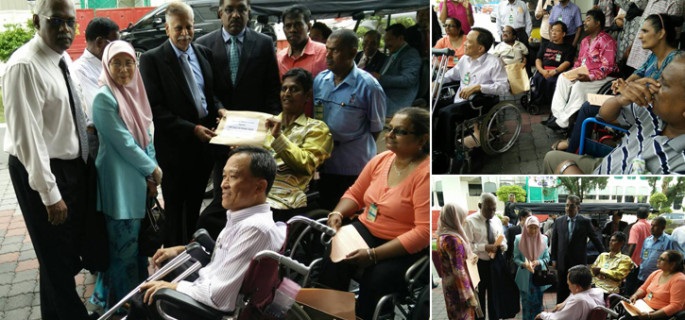
Badan Latihan dan Hidup Berdikari Malaysia (ILTC) pada 23hb Mac 2016 menyerahkan memorandum kepada ahli-ahli parlimen mendesak supaya golongan orang kurang upaya (OKU) dikecualikan daripada cukai barangan dan perkhidmatan (GST).
Disabled Members Protest

Disabled Members Protest at JPJ Wangsa Maju
ILTC Malaysia members staged a protest outside JPJ Wangsamaju KL.

Disabled group’s protest disabled drivers required to produce doc's medical report.
Monday, 13 April 2009


Thursday, 9 April 2009
Not Accessible - New Bus Terminal for Rawang
Not Accessible for the disabled - New Bus Terminal for Rawang
THE new bus and taxi terminal at Pusat Bandar Baru Rawang will begin operations next month not accessible at all for the disabled.


 We discovered that the developer were not comply with MS1184 accessible facilities.


 Utilities in the toilets were fitted at the wrong places. Wheelchair users should be able to use accessible facilities independently and able to move conveniently inside without assistance.
THE new bus and taxi terminal at Pusat Bandar Baru Rawang will begin operations next month not accessible at all for the disabled.
Recently, ILTC visited the newly-completed bus and taxi terminal located along the Federal trunk road was build with poor accessible facility and would be opened in the middle of May.
New landmark: Construction work on the new terminal is almost complete.
We discovered that the developer were not comply with MS1184 accessible facilities. The ramps to the food court are too steep for the wheelchair users and accessible parking spaces were not reserved for disabled people.
Utilities in the toilets were fitted at the wrong places. Wheelchair users should be able to use accessible facilities independently and able to move conveniently inside without assistance.After observing tightly the bus and taxi terminal, the Selayang Municipal Councilor Ms. Rina will be taking a serious action very soon to update all the facilities to be disabled friendly.
She also has arrange an urgent meeting with the Mahumas Sdn Bhd management soon.
Thursday, 2 April 2009
Living with floods for six long years
Thursday April 2, 2009

Living with floods for six long years
Story and photo by STUART MICHAEL
FOR six long years, residents of Taman Garing in Rawang have had to bear with flash floods in their area with water reaching almost 0.7m into their houses. They are hopeful the ordeal is over now.
Taman Garing was first hit by floods on Aug 13, 2003. Two years later, on April 30, 2005, it was flooded again. Then, on Oct 26, 2006, the area was again inundated. On April 13, 2007, and July 21, 2007, the deluge came again.
For the last two years, flood water continued to enter the houses whenever there is a heavy downpour, and the residents are fed up with the Selayang Municipal Council (MPS) for not doing anything to relieve their suffering.

Living with floods for six long years
Story and photo by STUART MICHAEL
FOR six long years, residents of Taman Garing in Rawang have had to bear with flash floods in their area with water reaching almost 0.7m into their houses. They are hopeful the ordeal is over now.
Taman Garing was first hit by floods on Aug 13, 2003. Two years later, on April 30, 2005, it was flooded again. Then, on Oct 26, 2006, the area was again inundated. On April 13, 2007, and July 21, 2007, the deluge came again.
For the last two years, flood water continued to enter the houses whenever there is a heavy downpour, and the residents are fed up with the Selayang Municipal Council (MPS) for not doing anything to relieve their suffering.
 Close watch: Gurdip Kaur (in a wheelchair) checking on the cleaning up of the monsoon drain in Taman Garing by workers from the MPS Health and Licensing Department.
The residents blamed the floods on the Kota Emerald housing project at the top of a nearby hill.
However, it is actually the MPS which is to blame for not cleaning up the monsoon drain that is filled with trees, tall grass and weeds and that caused the floods to occur frequently.
The rubbish trapped in the drain is also causing a foul smell and attracting flies.
According to MPS councillor Gurdip Kaur, the drain has not been cleared for the last eight years. However, the MPS Health and Licensing Department cleared the weeds, trees and tall grass in the drain recently.
“With the drain cleared, we hope the flood woes in Taman Garing will end,’’ Gurdip Kaur said.
Wednesday, 1 April 2009
Visit To ILTC By Sinclair Knight Merz Sdn. Bhd.
Visit To ILTC By Sinclair Knight Merz Sdn. Bhd
Date: 28th March 2009
Time: 11.00AM – 1.00PM
Venue: Independent Living & Training Centre
 On behalf of ILTC, I the President of ILTC take this opportunity to wish my personal thank to Mr. Micheal & his organizing team which has put a lot of afford to make this event a very successful one.
 During their visit they also contributed some Electrical items, Lightweight Wheelchairs, Stationary items & Provision.
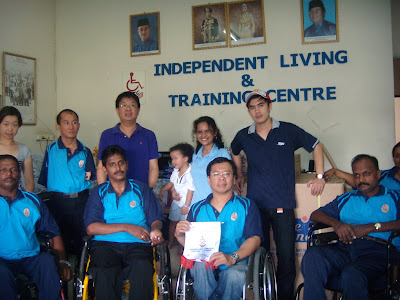
 ILTC members who participated were very happy with this event and looking forward for many more events like this.
Date: 28th March 2009
Time: 11.00AM – 1.00PM
Venue: Independent Living & Training Centre
On behalf of ILTC, I the President of ILTC take this opportunity to wish my personal thank to Mr. Micheal & his organizing team which has put a lot of afford to make this event a very successful one.During their visit they also contributed some Electrical items, Lightweight Wheelchairs, Stationary items & Provision. ILTC members who participated were very happy with this event and looking forward for many more events like this.Wednesday, 25 March 2009
Monday March 23, 2009
The Star - Lifestyle
Against all odds
By WONG LI ZA
Jessica Cox inspires audiences around the world with her spunk and indomitable spirit.
JESSICA Cox is a superwoman of sorts. She may not be saving victims from burning buildings, but she is a heroine in the hearts of many.
 Born without arms, Cox used to watch with envy as other kids swung about on the monkey bars in elementary school while she was limited to the swings.
Frustrated, she would envision herself flying over the playground like Superwoman while everyone watched in disbelief. “I would imagine taking people up one at a time to experience my super powers. Years later, I realised that my imagination had become a reality,” said Cox at a media interview.
"It’s only human to have low moments in life because if you don’t, then you won’t feel the high, exciting times"- JESSICA COX
Cox, 26, is the first woman pilot in aviation history to fly without arms. She was invited to Kuala Lumpur recently to speak at the Women of Independence Conference organised by Intelligence Business Networks.
The two-day conference, to commemorate International Women’s Day, gathered successful women from all over the world, who are leaders in their respective fields.
Wearing dark-rimmed glasses and a grey vest over white blouse, Cox was a petite picture of confidence as she took to the stage.
The motivational speaker articulately delivered her speech entitled Architecturing Your Destiny – Disarming Fears, sharing about her life growing up and how she overcame various obstacles.
Cox said one of the challenges she faced when she first learnt flying was how to tie the seatbelt in the aircraft.
To demonstrate, she climbed onto a chair that was on stage and slipped down into an attached, pre-buckled seatbelt, immediately drawing warm applause from an awe-inspired audience.
 In control: Cox is the first woman pilot in aviation history to fly without arms. She earned her US Federal Aviation Administration sport pilot licence in October last year.
“I may not have arms but that does not determine who I am or who I can become,” she said.
Her favourite quote is one by spiritual teacher Marianne Williamson: “Our deepest fear is not that we are inadequate; it is that we are powerful beyond measure.”
Disabling norms
Cox, the middle of three siblings, was born to an American father and a Filipino mother in Tuscon, Arizona.
Doctors could not explain her rare congenital condition as sonogrames and other prenatal tests did not reveal any defect.
However, the spunky lady’s indomitable spirit overrides what she may lack physically.
Standing at a mere 5’ 1” tall (155cm), Cox holds a sport pilot licence, has a double black belt in taekwando and is an active swimmer. (She is the first person without arms to get a black belt in the American Taekwando Association.)
When she first learnt to drive a car, she was encouraged to use special modifications. However, after she had her car modified, she decided to remove the modifications and now holds an unrestricted driver’s licence.
The University of Arizon psychology graduate still draws stares when she pumps petrol at the gas station. She can type 25 words a minute, blow dry her hair, and put on her makeup and contact lenses with as much ease as anyone else.
On Mother’s Day in May last year, Cox flew solo over San Manuel, Arizona, wearing a T-shirt that aptly read: “Look Ma, No Hands!”
She earned a US Federal Aviation Administration sport pilot licence last October. (This type of licence does not require a medical examination, only a valid US driver’s licence, an oral and written exam, and a certificate to fly solo.)
Due to airplane logistics, it took Cox three years, instead of the average six months, before she got her licence. It also required four Ercoupe planes (a type of light aircraft originally built without rudder pedals), three certified flight instructors and 89 hours of flight training in three different states.
“When I fly, I have the greatest feeling of freedom, independence and power,” said Cox, who controls the throttle with her left foot and the yoke with her right.
So far, she has clocked in about 130 hours of solo flights, impressive since flying in commercial planes was her greatest fear since childhood. Needless to say, piloting an aircraft was never on her to-do list.
However, that changed when a member of Wright Flight, a Tucson-based non-profit group, approached her after a Rotary Club talk she gave in 2005. The group uses aviation as motivation.
A fighter pilot named Robin Stoddard who represented the group asked if she would like to fly an airplane.
Being the achiever and optimist that she is, Cox decided to give it a try and was instantly hooked.
“Sometimes fear is rooted in a lack of knowledge and the unknown. When I first started flying, I realised my fear was because I did not know much about it.
“A universal fear people have is a fear of inadequacy and lack of faith in ourselves,” said Cox, who also appeared on the Ellen Degeneres Show in December last year.
Growing pains
Confident, poised and ambitious, Cox has come a long way to become who she is today.
Besides being a motivational speaker (details at rightfooted.com), she has also been mentoring children with the International Child Amputee Network for the past five years.
However, getting to this stage in her life was not an overnight process, nor a walk in the park.
When she was young, she often got angry, kicking and screaming in her tantrums.
“As a child, there was no way to understand why I did not have arms like everyone else. It was difficult being different,” said Cox, her voice softening.
Nevertheless, she still took part in various activities such as gymnastics and tap dancing, often performing on stage.
She wore prosthetic arms from the ages of three to 14, but hated them and was more comfortable using her feet.
“In fact, I often wished the prosthetic arms would break so I wouldn’t have to use them!” said Cox with a chuckle.
On her first day of eighth grade, she finally decided to take off her prosthetics before boarding the school bus. “As the bus door closed behind me, I felt freer and independent. Since that day, I never wore the prosthetics again.”
For Cox, the greater challenge of being born without arms is the constant stares rather than the physical adversity.
“I used to get very irritated when people stared, especially when I’m walking down the street or eating with my feet. But I’ve learnt to turn that into something positive and use that opportunity to channel positive vibes and be an example of optimism.
“Accepting myself is an ongoing journey. It’s difficult to keep your spirits up all the time but I rely on my faith to carry me through the rough times.
“It’s only human to have low moments in life because if you don’t, then you won’t feel the high, exciting times.”
Cox credits her parents for being her role models and pillar of support. Her mother is a nurse and her father, a retired music teacher.
“My mum left the Philippines and came to the States without knowing anyone here when she was 22. She is my role model and always tells me I can do anything I’ve set my mind to.
“My dad never once shed a tear when I was born because he did not see me as a victim. It is hard being a parent to a disabled child. He was my rock during the difficult times and that has shaped me into the person I am today,” she said.
At the moment, there are two things that Cox is still trying to achieve – how to tie her hair into a ponytail and do rock climbing, although she can water ski and snow ski.
She also hopes to get certified as a pilot instructor and teach people with disabilities.
“Once you have a taste of something so great, you want to share it with everyone.”
At present, Cox is not seeing anyone but she has no intention of jumping into just any relationship.
“One good thing about not having arms is I can filter out a guy who is superficial and someone who is genuine. If a guy can really see me for who I am despite how I might look, then he is really worth pursuing,” she said.
Eventually, Cox hopes to get married and have kids. “I know it will be difficult to have a family but I know I am going to be a good mum. I don’t think I will be limited in being that and things like carrying the baby will come naturally.”
Her mother, who was also at the conference, said the word “disability” is alien to her daughter, just as alien as having upper limbs would be.
“This is just to show that there’s always more than one way to accomplish a task.
The Star - Lifestyle
Against all odds
By WONG LI ZA
Jessica Cox inspires audiences around the world with her spunk and indomitable spirit.
JESSICA Cox is a superwoman of sorts. She may not be saving victims from burning buildings, but she is a heroine in the hearts of many.
Born without arms, Cox used to watch with envy as other kids swung about on the monkey bars in elementary school while she was limited to the swings.Frustrated, she would envision herself flying over the playground like Superwoman while everyone watched in disbelief. “I would imagine taking people up one at a time to experience my super powers. Years later, I realised that my imagination had become a reality,” said Cox at a media interview.
"It’s only human to have low moments in life because if you don’t, then you won’t feel the high, exciting times"- JESSICA COX
Cox, 26, is the first woman pilot in aviation history to fly without arms. She was invited to Kuala Lumpur recently to speak at the Women of Independence Conference organised by Intelligence Business Networks.
The two-day conference, to commemorate International Women’s Day, gathered successful women from all over the world, who are leaders in their respective fields.
Wearing dark-rimmed glasses and a grey vest over white blouse, Cox was a petite picture of confidence as she took to the stage.
The motivational speaker articulately delivered her speech entitled Architecturing Your Destiny – Disarming Fears, sharing about her life growing up and how she overcame various obstacles.
Cox said one of the challenges she faced when she first learnt flying was how to tie the seatbelt in the aircraft.
To demonstrate, she climbed onto a chair that was on stage and slipped down into an attached, pre-buckled seatbelt, immediately drawing warm applause from an awe-inspired audience.
In control: Cox is the first woman pilot in aviation history to fly without arms. She earned her US Federal Aviation Administration sport pilot licence in October last year.“I may not have arms but that does not determine who I am or who I can become,” she said.
Her favourite quote is one by spiritual teacher Marianne Williamson: “Our deepest fear is not that we are inadequate; it is that we are powerful beyond measure.”
Disabling norms
Cox, the middle of three siblings, was born to an American father and a Filipino mother in Tuscon, Arizona.
Doctors could not explain her rare congenital condition as sonogrames and other prenatal tests did not reveal any defect.
However, the spunky lady’s indomitable spirit overrides what she may lack physically.
Standing at a mere 5’ 1” tall (155cm), Cox holds a sport pilot licence, has a double black belt in taekwando and is an active swimmer. (She is the first person without arms to get a black belt in the American Taekwando Association.)
When she first learnt to drive a car, she was encouraged to use special modifications. However, after she had her car modified, she decided to remove the modifications and now holds an unrestricted driver’s licence.
The University of Arizon psychology graduate still draws stares when she pumps petrol at the gas station. She can type 25 words a minute, blow dry her hair, and put on her makeup and contact lenses with as much ease as anyone else.
On Mother’s Day in May last year, Cox flew solo over San Manuel, Arizona, wearing a T-shirt that aptly read: “Look Ma, No Hands!”
She earned a US Federal Aviation Administration sport pilot licence last October. (This type of licence does not require a medical examination, only a valid US driver’s licence, an oral and written exam, and a certificate to fly solo.)
Due to airplane logistics, it took Cox three years, instead of the average six months, before she got her licence. It also required four Ercoupe planes (a type of light aircraft originally built without rudder pedals), three certified flight instructors and 89 hours of flight training in three different states.
“When I fly, I have the greatest feeling of freedom, independence and power,” said Cox, who controls the throttle with her left foot and the yoke with her right.
So far, she has clocked in about 130 hours of solo flights, impressive since flying in commercial planes was her greatest fear since childhood. Needless to say, piloting an aircraft was never on her to-do list.
However, that changed when a member of Wright Flight, a Tucson-based non-profit group, approached her after a Rotary Club talk she gave in 2005. The group uses aviation as motivation.
A fighter pilot named Robin Stoddard who represented the group asked if she would like to fly an airplane.
Being the achiever and optimist that she is, Cox decided to give it a try and was instantly hooked.
“Sometimes fear is rooted in a lack of knowledge and the unknown. When I first started flying, I realised my fear was because I did not know much about it.
“A universal fear people have is a fear of inadequacy and lack of faith in ourselves,” said Cox, who also appeared on the Ellen Degeneres Show in December last year.
Growing pains
Confident, poised and ambitious, Cox has come a long way to become who she is today.
Besides being a motivational speaker (details at rightfooted.com), she has also been mentoring children with the International Child Amputee Network for the past five years.
However, getting to this stage in her life was not an overnight process, nor a walk in the park.
When she was young, she often got angry, kicking and screaming in her tantrums.
“As a child, there was no way to understand why I did not have arms like everyone else. It was difficult being different,” said Cox, her voice softening.
Nevertheless, she still took part in various activities such as gymnastics and tap dancing, often performing on stage.
She wore prosthetic arms from the ages of three to 14, but hated them and was more comfortable using her feet.
“In fact, I often wished the prosthetic arms would break so I wouldn’t have to use them!” said Cox with a chuckle.
On her first day of eighth grade, she finally decided to take off her prosthetics before boarding the school bus. “As the bus door closed behind me, I felt freer and independent. Since that day, I never wore the prosthetics again.”
For Cox, the greater challenge of being born without arms is the constant stares rather than the physical adversity.
“I used to get very irritated when people stared, especially when I’m walking down the street or eating with my feet. But I’ve learnt to turn that into something positive and use that opportunity to channel positive vibes and be an example of optimism.
“Accepting myself is an ongoing journey. It’s difficult to keep your spirits up all the time but I rely on my faith to carry me through the rough times.
“It’s only human to have low moments in life because if you don’t, then you won’t feel the high, exciting times.”
Cox credits her parents for being her role models and pillar of support. Her mother is a nurse and her father, a retired music teacher.
“My mum left the Philippines and came to the States without knowing anyone here when she was 22. She is my role model and always tells me I can do anything I’ve set my mind to.
“My dad never once shed a tear when I was born because he did not see me as a victim. It is hard being a parent to a disabled child. He was my rock during the difficult times and that has shaped me into the person I am today,” she said.
At the moment, there are two things that Cox is still trying to achieve – how to tie her hair into a ponytail and do rock climbing, although she can water ski and snow ski.
She also hopes to get certified as a pilot instructor and teach people with disabilities.
“Once you have a taste of something so great, you want to share it with everyone.”
At present, Cox is not seeing anyone but she has no intention of jumping into just any relationship.
“One good thing about not having arms is I can filter out a guy who is superficial and someone who is genuine. If a guy can really see me for who I am despite how I might look, then he is really worth pursuing,” she said.
Eventually, Cox hopes to get married and have kids. “I know it will be difficult to have a family but I know I am going to be a good mum. I don’t think I will be limited in being that and things like carrying the baby will come naturally.”
Her mother, who was also at the conference, said the word “disability” is alien to her daughter, just as alien as having upper limbs would be.
“This is just to show that there’s always more than one way to accomplish a task.
Boy gets wheelchair worth RM9,000
Saturday March 21, 2009

Boy gets wheelchair worth RM9,000
IT WAS a day of joy for Adam Firdaus, nine,who received a custom-made wheelchair worth RM9,000 from Resorts World Bhd.
The company’s deputy chairman, Tun Hanif Omar, presented the wheelchair to Adam who has cerebral palsy and is a quadriplegic.
 For you: Hanif Omar (right) and Resorts World Bhd corporate services vice-president Kay Prakash (left) with Adam (centre) and his family members.
His mother, Marlina Ab Rashid, said ordinary wheelchairs were not suitable for him due to his curved spine.
“His old wheelchair did not provide enough security for Adam and whenever he experienced convulsions, he tends to fall off the wheelchair,” said Marlina, who is a teacher at the Sekolah Menengah Sains Shah Alam.
Marlina, who has two other children, added that she had been looking for a donor to buy the wheelchair for her son for more than a year.
“My family and I are grateful to the company and will forever cherish this act of kindness.” she said.
At the brief wheelchair-presentation ceremony, Hanif said: ”We are happy to be of assistance to the family.
Adam’s condition is severe as he only had a small part of his right brain and the rest of it is filled with water.
He had difficulty in carrying out daily routines such as cleaning himself, feeding and moving.
Adam attends a special school and undergoes medical treatment once every two weeks.
The new wheelchair was custom-made to suit Adam’s condition with an adjustable firm back, seat board and a trunk support to prevent body collapse.

Boy gets wheelchair worth RM9,000
IT WAS a day of joy for Adam Firdaus, nine,who received a custom-made wheelchair worth RM9,000 from Resorts World Bhd.
The company’s deputy chairman, Tun Hanif Omar, presented the wheelchair to Adam who has cerebral palsy and is a quadriplegic.
For you: Hanif Omar (right) and Resorts World Bhd corporate services vice-president Kay Prakash (left) with Adam (centre) and his family members. His mother, Marlina Ab Rashid, said ordinary wheelchairs were not suitable for him due to his curved spine.
“His old wheelchair did not provide enough security for Adam and whenever he experienced convulsions, he tends to fall off the wheelchair,” said Marlina, who is a teacher at the Sekolah Menengah Sains Shah Alam.
Marlina, who has two other children, added that she had been looking for a donor to buy the wheelchair for her son for more than a year.
“My family and I are grateful to the company and will forever cherish this act of kindness.” she said.
At the brief wheelchair-presentation ceremony, Hanif said: ”We are happy to be of assistance to the family.
Adam’s condition is severe as he only had a small part of his right brain and the rest of it is filled with water.
He had difficulty in carrying out daily routines such as cleaning himself, feeding and moving.
Adam attends a special school and undergoes medical treatment once every two weeks.
The new wheelchair was custom-made to suit Adam’s condition with an adjustable firm back, seat board and a trunk support to prevent body collapse.
Thursday, 19 March 2009
Wednesday March 18, 2009


Respect differences
ChildwiseBy
RUTH LIEW
Teach children to see beyond physical disability.
CHILDREN absorb their parents’ attitudes. They learn how to love and how to hate the differences in people from observing their parents. Sometimes children have a limited view of other people and their beliefs. Their parents try to “protect” them, fearing they may “catch” what others have.
Living in a diverse society, we should bring up our children to respect and value people who are different from us. We need to practise the good values we want our children to inherit.
Preschoolers have very little problem playing with physically challenged children. They do not really care what the less able-bodied cannot do. They are more interested in what they would like to do with them. They are eager to play with the physically disabled and enjoy their companionship.
Children are curious. They want to know why the other child is wearing a leg brace or not able to hear what they are saying. They will ask questions. Parents should help them understand that physical and mental abilities are only part of a person. There’s more to the person than what appears to be. It is important to remind children that all people have abilities. Children can focus on what their friends can do rather than what they cannot do.
It is up to parents to do the right thing by their children. Many adults can trace their own prejudices to their childhoods because their parents and care providers impressed upon them negative messages regarding people who looked different from them.
As psychoanalyst Carl Gustav Jung said: “If there is anything we wish to change in the child, we should first examine it and see whether it is not something that could be better changed in ourselves.”
Be honest with yourself and your children by examining your own prejudices and biases. If you are ignorant about people with physical or mental disabilities, find out more about them. Better still, take the opportunity to volunteer in communities where there is an integrated programme for people of all abilities. According to The Anti-Defamation League’s Hate Hurts. How Children Learn and Unlearn Prejudice by Caryl Stern-LaRosa and Ellen Hofheimer Bettmann, parents must treat children’s questions with respect and seriousness.
Use age-appropriate language and offer correct facts about disabilities. Answer matter-of-factly without being too lengthy in your explanations.
For example, if your child asks about someone who is in a wheelchair without legs or arms, you can tell him that some people are born without limbs and others may have lost them in accidents or in sickness.
Reassure your child that people who have physical disabilities are capable of doing many things in life. Whenever it is possible, read books on stories about children who have disabilities and their success stories.
Do not cloud your child’s perception of people with disabilities with emotions such as pity and fear. Your child should be kind to people of all abilities and disabilities. Discuss with your child how he can play with his friend with a disability. Explore different ideas on doing activities that are best suited for everyone.
More importantly, use respectful language when referring to people from all backgrounds and abilities. No matter what race, creed, religion or disability, the person has a name and should be referred with respect. I remember a four-year-old Korean-American girl who had just met me in her day-care programme, calling out, “Hey, Chinese girl.” The assistant nursery teacher immediately reminded her that I have a name and she should use that instead of calling me “Chinese girl”.
If you are uncomfortable when children ask why some people are born with disabilities, or you are unable to reply, find someone who is confident to answer. You may make a mistake and say the wrong thing. Don’t cover it up. You should admit your mistakes and help the child learn that they can do the same when necessary.
Avoid using words like “us” and “them”. Instead of “We can do this but they cannot”, try saying “We can all do this together.” In your family conversations, offer more positive statements on people with diverse backgrounds and interests. This way when children start making statements of their own, they can find the right words to use.
We fear what we do not know. If children have positive experiences with diversity, they will be accepting and respectful towards people who are different from them. Parents must learn an important lesson together with their children that all people are unique and valuable.
Tuesday, 17 March 2009
Selangor to introduce parking privileges for the disabled
Tuesday March 17, 2009

Selangor to introduce parking privileges for the disabled
THE Selangor Government will offer car stickers as a special parking privilege for the disabled.
State welfare and womens affairs chairman Rodziah Ismail said the move was in line with the state’s caring policy towards the underprivileged.
She said those who wished to obtain the stickers would be required to register themselves.
“This will enable the disabled to enjoy free parking at public parking bays in the state.
“The stickers will be launched soon,’’ she told the assembly.
Rodziah said the state had ordered local authorities to impose stricter enforcement against motorists who abused the special parking allocated for the disabled.
She said the state was also looking into easier accessibility for the disabled at public areas including temples, surau and markets.
“We also want public transportation, especially buses, to be disabled-friendly,’’ she said in her reply to a written question from Wong Koon Mun (PR-Kuala Kubu).
Rodziah said the state also offered micro- credit loans of between RM500 and RM5,000 to the disabled.

Selangor to introduce parking privileges for the disabled
THE Selangor Government will offer car stickers as a special parking privilege for the disabled.
State welfare and womens affairs chairman Rodziah Ismail said the move was in line with the state’s caring policy towards the underprivileged.
She said those who wished to obtain the stickers would be required to register themselves.
“This will enable the disabled to enjoy free parking at public parking bays in the state.
“The stickers will be launched soon,’’ she told the assembly.
Rodziah said the state had ordered local authorities to impose stricter enforcement against motorists who abused the special parking allocated for the disabled.
She said the state was also looking into easier accessibility for the disabled at public areas including temples, surau and markets.
“We also want public transportation, especially buses, to be disabled-friendly,’’ she said in her reply to a written question from Wong Koon Mun (PR-Kuala Kubu).
Rodziah said the state also offered micro- credit loans of between RM500 and RM5,000 to the disabled.
Monday, 16 March 2009
RM200 Million Will Be Used To Upgrade JKM - Ng Yen Yen
March 12, 2009 21:35 PM
RM200 Million Will Be Used To Upgrade JKM - Ng Yen Yen

RM200 Million Will Be Used To Upgrade JKM - Ng Yen Yen
By: Ramjit
KUALA LUMPUR, March 12 (Bernama) -- The RM200 million the Women, Family and Community Development Ministry will get from the Second Economic Stimulus Package will be used to upgrade the Welfare Department (JKM) and hire more staff, said its minister Datuk Seri Dr Ng Yen Yen.She said JKM offices nationwide would be upgraded to be more people and disabled-friendly, which would involve a cost of RM45 million.
"The ministry will also give more attention to old folks homes, especially in Sabah and Sarawak," she told a press conference at the pre-launch of the Purple Ribbon Movement, which will officially launched at the Sunway Resort in Petaling Jaya on March 21.
Ng said RM10 million would be set aside to purchase four-wheel-drive vehicles to facilitate JKM's services for old folks in rural areas while another RM10 million would be spent for hiring new staff to beef up JKM's work force.
BERNAMA
Friday, 13 March 2009
Helping hand
Thursday March 12, 2009

Helping hand
WHEEL POWER
By ANTHONY THANASAYAN
Crash course gives disabled group a head start.
IT IS always encouraging to hear how Malaysians with disabilities are being helped. The latest news I received is a wonderful initiative to help about 30 disabled women familiarise themselves with computers. This is to empower them to have a better quality of life through information technology.
Wheel Power spoke to Thomas Low last week.
Thomas became disabled after he was accidentally dropped as a child. The fall caused him to suffer from a condition called juvenile stroke which affected the right side of his body, causing a limp in his right leg.
Thomas is the project manager of an intensive three-month programme called Small Office Home Office (Soho).
The pilot project was organised and sponsored by eHomemakers and the Women, Family and Community Development Ministry. eHomemakers is an NGO which assists single mothers to work from home to enable them to become self-reliant. Thomas’s job is to oversee the training of the 30 participants in the project which ended early this year.
“There were so many challenges to overcome before the training could even start,” he said.
First, he had to find and identify women who were wheelchair users. Soho was also keen on working with people who use crutches for mobility.
“Finding them was not easy,” Thomas recalled. “I did some active canvassing and approached disability organisations, attended functions for the handicapped, and made call after call to recruit participants for the course.”
The initial reaction from the women wasn’t welcoming either. Many were sceptical about the training.
“Some even thought I was a conman,” said Thomas, with a laugh.
The training was free, with meals and refreshments included.
A daily transport allowance was also given to each participant. The course included soft skills training to give the women a better chance of securing jobs.
Areas covered included confidence-building and phone etiquette.
The programme also covered stuff such as Office, Skype, Facebook, blogging and e-mail. The participants were also taught about nasty viruses that could invade computers and how to prevent such virus attacks.
Locating a disabled-friendly venue with 30 units of computers with Internet facilities was another major hurdle.
“I approached cyber cafes and computer training centres but almost all of them gave me the cold shoulder,” said Thomas.
Finally, it was the Young Women Christian Association (YWCA) Kuala Lumpur that rallied to their aid.
“They had the right place, ample parking space, and disabled-friendly facilities in their building,” said Thomas.
“They had a large classroom with as many as 30 computers at our disposal. They even had a spacious bedroom for those who wished to stay in. The YWCA staff were very accommodating, making changes here and there to suit the participants’ special needs,” he added.
Participants came from as far as Kajang, Bangi and Rawang in Selangor.
All 30 disabled women are now looking for job openings.
If you can help these women, please contact eHomemakers ( 03-7726 5271 ).

Helping hand
WHEEL POWER
By ANTHONY THANASAYAN
Crash course gives disabled group a head start.
IT IS always encouraging to hear how Malaysians with disabilities are being helped. The latest news I received is a wonderful initiative to help about 30 disabled women familiarise themselves with computers. This is to empower them to have a better quality of life through information technology.
Wheel Power spoke to Thomas Low last week.
Thomas became disabled after he was accidentally dropped as a child. The fall caused him to suffer from a condition called juvenile stroke which affected the right side of his body, causing a limp in his right leg.
Thomas is the project manager of an intensive three-month programme called Small Office Home Office (Soho).
The pilot project was organised and sponsored by eHomemakers and the Women, Family and Community Development Ministry. eHomemakers is an NGO which assists single mothers to work from home to enable them to become self-reliant. Thomas’s job is to oversee the training of the 30 participants in the project which ended early this year.
“There were so many challenges to overcome before the training could even start,” he said.
First, he had to find and identify women who were wheelchair users. Soho was also keen on working with people who use crutches for mobility.
“Finding them was not easy,” Thomas recalled. “I did some active canvassing and approached disability organisations, attended functions for the handicapped, and made call after call to recruit participants for the course.”
The initial reaction from the women wasn’t welcoming either. Many were sceptical about the training.
“Some even thought I was a conman,” said Thomas, with a laugh.
The training was free, with meals and refreshments included.
A daily transport allowance was also given to each participant. The course included soft skills training to give the women a better chance of securing jobs.
Areas covered included confidence-building and phone etiquette.
The programme also covered stuff such as Office, Skype, Facebook, blogging and e-mail. The participants were also taught about nasty viruses that could invade computers and how to prevent such virus attacks.
Locating a disabled-friendly venue with 30 units of computers with Internet facilities was another major hurdle.
“I approached cyber cafes and computer training centres but almost all of them gave me the cold shoulder,” said Thomas.
Finally, it was the Young Women Christian Association (YWCA) Kuala Lumpur that rallied to their aid.
“They had the right place, ample parking space, and disabled-friendly facilities in their building,” said Thomas.
“They had a large classroom with as many as 30 computers at our disposal. They even had a spacious bedroom for those who wished to stay in. The YWCA staff were very accommodating, making changes here and there to suit the participants’ special needs,” he added.
Participants came from as far as Kajang, Bangi and Rawang in Selangor.
All 30 disabled women are now looking for job openings.
If you can help these women, please contact eHomemakers ( 03-7726 5271 ).
Thursday, 12 March 2009
MINI BUDGET 2009 SPEECH BY MALAYSIAN DEPUTY PRIME MINISTER YAB DATO' SRI MOHD NAJIB TUN ABD RAZAK IN THE DEWAN RAKYAT ON 10 MARCH 2009
MINI BUDGET 2009 SPEECH BY MALAYSIAN DEPUTY PRIME MINISTER YAB DATO' SRI MOHD NAJIB TUN ABD RAZAK IN THE DEWAN RAKYAT ON 10 MARCH 2009
SPEECH BY
YAB DATO’ SRI MOHD. NAJIB TUN ABDUL RAZAK
DEPUTY PRIME MINISTER AND
MINISTER OF FINANCE
IN INTRODUCING
THE SUPPLEMENTARY SUPPLY (2009) BILL 2009
IN THE DEWAN RAKYAT
10 MARCH 2009
Creating Job Opportunities in the Public Sector
25. The Government will recruit 63,000 staff to fill vacancies and serve as contract officers in various Government agencies. For this, the Government will:
First: Expedite recruitment for 50,000 vacant posts at the support and professional level in the Federal civil service. For vacancies in the support group, the Public Services Commission will delegate authority to recruit to the relevant agencies; and
Second: Create additional 13,000 jobs for officers on a contract basis in Government agencies, as follows:
1. Recruit 4,000 officers on short-term service with minimum Sijil Pelajaran Malaysia qualification and monthly salary of RM1,200;
2. Recruit 1,000 graduates as school teachers on contract basis with monthly salary of RM2,000;
3. Recruit a total of 800 contract workers to strengthen the implementation of Program Cari under the Ministry of Women, Family and Community Development for a period of six months to a year;
4. Recruit 1,000 Public Health Assistants on contract basis in local authorities for control and prevention of infectious diseases, such as dengue;
5. Recruit a total of 4,500 contract officers as enumerators in the Department of Statistics to carry out population census; and
6. Recruit 1,700 nurses and health support staff in the Ministry of Health.
Assisting the Less Fortunate
42. In Budget 2009, an allocation of RM830 million was provided to implement social safety net programmes to ensure the well-being of the less fortunate, including the elderly, disabled and single mothers. The Government will increase financial assistance and support staff to manage the welfare of this group. In the Second Package, an additional allocation of RM20 million will be provided to improve the facilities of daycare centres for the elderly, strengthen the management of women shelter homes and increase facilities for childcare centres.
SPEECH BY
YAB DATO’ SRI MOHD. NAJIB TUN ABDUL RAZAK
DEPUTY PRIME MINISTER AND
MINISTER OF FINANCE
IN INTRODUCING
THE SUPPLEMENTARY SUPPLY (2009) BILL 2009
IN THE DEWAN RAKYAT
10 MARCH 2009
Creating Job Opportunities in the Public Sector
25. The Government will recruit 63,000 staff to fill vacancies and serve as contract officers in various Government agencies. For this, the Government will:
First: Expedite recruitment for 50,000 vacant posts at the support and professional level in the Federal civil service. For vacancies in the support group, the Public Services Commission will delegate authority to recruit to the relevant agencies; and
Second: Create additional 13,000 jobs for officers on a contract basis in Government agencies, as follows:
1. Recruit 4,000 officers on short-term service with minimum Sijil Pelajaran Malaysia qualification and monthly salary of RM1,200;
2. Recruit 1,000 graduates as school teachers on contract basis with monthly salary of RM2,000;
3. Recruit a total of 800 contract workers to strengthen the implementation of Program Cari under the Ministry of Women, Family and Community Development for a period of six months to a year;
4. Recruit 1,000 Public Health Assistants on contract basis in local authorities for control and prevention of infectious diseases, such as dengue;
5. Recruit a total of 4,500 contract officers as enumerators in the Department of Statistics to carry out population census; and
6. Recruit 1,700 nurses and health support staff in the Ministry of Health.
Assisting the Less Fortunate
42. In Budget 2009, an allocation of RM830 million was provided to implement social safety net programmes to ensure the well-being of the less fortunate, including the elderly, disabled and single mothers. The Government will increase financial assistance and support staff to manage the welfare of this group. In the Second Package, an additional allocation of RM20 million will be provided to improve the facilities of daycare centres for the elderly, strengthen the management of women shelter homes and increase facilities for childcare centres.
Wednesday, 11 March 2009
Decision on disabled-friendly bus stops next month
Tuesday March 10, 2009

Decision on disabled-friendly bus stops next month
THE Penang Government will decide in a month’s time whether to give the green light to Rapid Penang for the construction of disabled-friendly bus stops once the company submits its proposal.
Penang Local Government, Traffic Management and Environment Committee chairman Chow Kon Yeow said the bus stops needed to have proper facilities to complement the new 200 disabled- friendly buses which would arrive in bat-ches from May until the end of the year.
On Rapid Penang’s predicament over the uncertainty of whether the state authorities would approve the use of five new depots to place its new fleet of buses, he said the matter was negotiable and that he would follow up on the matter.
Rapid Penang chief executive officer Azhar Ahmad had said that the company had not received a reply from the autho-rities.
Chow told newsmen yesterday that Rapid Penang was currently using the Sungai Nibong bus terminal and three other areas belonging to the Penang Municipal Council located in Lorong Kulit, Balik Pulau and Tanjung Bungah as its depots.
“All the 200 buses are not going to arrive in May and therefore I feel the existing sites can still accommodate the buses.
“If I’m not mistaken, the company is in the final stage of looking at a piece of land belonging to the Malaysian Resources Corp Bhd,” he said.
He said Rapid Penang had asked the state government to lease these areas for a long period (30 years) before it builds a proper depot.
“The company is also asking for a nominal fee to be charged and we understand that in order to subsidise public transportation, costs need to be cut,” he said, ad-ding that Rapid Penang had not paid rental for its existing depots since July 2007.
Chow said the state had put on hold the idea to set up its own bus company.
“Now, only 8% of the people use buses. It is not advisable to compete with another company until the percentage rises to 35%,” he said.

Decision on disabled-friendly bus stops next month
THE Penang Government will decide in a month’s time whether to give the green light to Rapid Penang for the construction of disabled-friendly bus stops once the company submits its proposal.
Penang Local Government, Traffic Management and Environment Committee chairman Chow Kon Yeow said the bus stops needed to have proper facilities to complement the new 200 disabled- friendly buses which would arrive in bat-ches from May until the end of the year.
On Rapid Penang’s predicament over the uncertainty of whether the state authorities would approve the use of five new depots to place its new fleet of buses, he said the matter was negotiable and that he would follow up on the matter.
Rapid Penang chief executive officer Azhar Ahmad had said that the company had not received a reply from the autho-rities.
Chow told newsmen yesterday that Rapid Penang was currently using the Sungai Nibong bus terminal and three other areas belonging to the Penang Municipal Council located in Lorong Kulit, Balik Pulau and Tanjung Bungah as its depots.
“All the 200 buses are not going to arrive in May and therefore I feel the existing sites can still accommodate the buses.
“If I’m not mistaken, the company is in the final stage of looking at a piece of land belonging to the Malaysian Resources Corp Bhd,” he said.
He said Rapid Penang had asked the state government to lease these areas for a long period (30 years) before it builds a proper depot.
“The company is also asking for a nominal fee to be charged and we understand that in order to subsidise public transportation, costs need to be cut,” he said, ad-ding that Rapid Penang had not paid rental for its existing depots since July 2007.
Chow said the state had put on hold the idea to set up its own bus company.
“Now, only 8% of the people use buses. It is not advisable to compete with another company until the percentage rises to 35%,” he said.
Tuesday, 10 March 2009
LIVE Interviewed on The Breakfast Show
Tuesday, March 10, 2009
LIVE Interviewed on The Breakfast Show On 9th March 2009 at NTV7, Sri Pentas Damansara.
Theme: How Disabled Friendly Are We?
NTV7 Interviewed Mr. Francis Siva (President of Independent Living & Training Centre) & Mr. Anthony Thanasayan (Councillor, Petaling Jaya City Council) were invited to discuss the issue of environmental barriers faced by disabled people in Malaysians society and the basic facilities needed to build for easier access.
During the interview, we also highlighted PLUS had at allocated accessible parking spaces for the disabled. Most of the time these facilities are misused and occupied by normal person.
Here to view the photos of live interview..


LIVE Interviewed on The Breakfast Show On 9th March 2009 at NTV7, Sri Pentas Damansara.
Theme: How Disabled Friendly Are We?
NTV7 Interviewed Mr. Francis Siva (President of Independent Living & Training Centre) & Mr. Anthony Thanasayan (Councillor, Petaling Jaya City Council) were invited to discuss the issue of environmental barriers faced by disabled people in Malaysians society and the basic facilities needed to build for easier access.
During the interview, we also highlighted PLUS had at allocated accessible parking spaces for the disabled. Most of the time these facilities are misused and occupied by normal person.
Here to view the photos of live interview..
Friday, 6 March 2009

2009/03/04
ASEAN PARA GAMES: Be the best overall, says Ismail Sabri
 Sports Minister Datuk Seri Ismail Sabri Yaakob (right) shakes hand with powerlifter Cheok Kon Fatt at the pre-launch of the 5th Asean Para Games in Putrajaya yesterday. Pic: IZHARI ARIFFIN
MALAYSIA should be applauded for saving the fifth Asean Para Games after Laos withdrew as hosts but they, said Sports Minister Datuk Seri Ismail Sabri Yaakob, must also aim to become the overall champions of the event to be in Kuala Lumpur on Aug 15-19.
Malaysia stepped in after Laos, already burdened with the December's Sea Games, were undone by financial constraints to stage the paralympics involving 11 South East Asian countries.
Ismail Sabri also confirmed that the government had approved a budget of RM4 million to host the Games where 11 sports will be contested and the minister wanted the athletes try to become overall champions.
Malaysia, who organised the inaugural Games in 2001, were crowned overall champions that year but have only managed to finish second since.
"The government has allocated RM4 million to host the Asean Para Games but don't just be the best hosts but try to become the best contingent," said Ismail Sabri.
"This event is important as the government has also approved to have the centre of excellence for paralympic athletes in Kampung Pandan.
"This proves that we are not neglecting them, so they must justify the government's support by doing well in the Games."
The Games could have been bigger had it not been for several sports being scratched when the minimum of athletes, which is four, was not fulfilled.
"We are the only country to host the Games twice, and having become champions on the first attempt as hosts, we should be aiming for similar success."
Besides Malaysia, the other nations competing are Thailand, Indonesia, Singapore, Philippines, Myanmar, Brunei, Cambodia, Vietnam, Laos and Timor Leste.Malaysia are traditionally strong in athletics and swimming which helped them clinch the overall crown in 2001 when only these two sports were contested.
The hosts will again be banking on the two events as well as badminton and powerlifting this year. Table tennis, chess, bowling, sailing, wheelchair tennis, wheelchair basketball and volleyball are the other sports which will be contested.
Looking for toilets
Thursday March 5, 2009

Looking for toilets
WHEEL POWER
By ANTHONY THANASAYAN
The search for a model disabled-friendly rest room yielded some interesting results.
I WAS involved in an unusual assignment a week ago. Together with another gentleman in a wheelchair, and accompanied by a team of experts from the Petaling Jaya City Council (MBPJ), our motley crew went out as “roving investigators” in Petaling Jaya.
We went to look at, of all things, toilets. And we were only interested in loos that were user-friendly for disabled and elderly individuals.
The purpose of our trip was to come up with a good prototype design of a restroom that would be user-friendly for the handicapped.
Our first stop was a well-known hotel. We oohed and aahed at most of the outfit’s disabled-friendly designs. The most impressive was the entry/exit door of the loo, which was an electronic one.
All a patron in a wheelchair needed to do was press a button with one finger and presto: it would open for him. Once inside, he has only to push another button. The door closes, offering him all the privacy he needs.
If only all other hotels in the country would follow the good example of the hotel we visited and provide electronic doors as well, it would make the lives of disabled and elderly persons much easier when they visit such outfits.
Even though posh hotels may have disabled-friendly loos, little attention is given to the doors. The doors are often so heavy that we have a hard time trying to open them.
Not everything was smooth-sailing during our assignment. Together with the good came the not-so-good.
We had a lesson on how important it was to train everyone to handle an emergency.
When we tried to get into the loo for the first time, it suddenly got locked and refused to open until 20 minutes later. None of the staff knew how to open the door.
They claimed the person in charge was not around. Fortunately, this was not a real emergency.
We dreaded to think of what could have happened if a disabled person had fallen inside the loo and needed help.
It was disappointing too that the five-star hotel had a steep ramp at its entrance which disabled guests were forced to use to access the building.
The reserved parking lot for the disabled was located far from the entrance to the building.
The management promised to rectify the situation soonest possible.
Our journey also took us to Ikea and Ikano shopping centres in Mutiara Damansara.
No sooner had we arrived when we were greeted by smiling security guards at the generously-sized parking lots for the disabled. These people are so serious about their car parks for the handicapped that they clamp any unauthorised cars and make them pay a fine for abusing the facilities.
The money collected is donated to a local charity for the disabled.
I was shocked to hear about the reactions of some people who misuse the disabled parking bays.
One or two of them even resorted to violence when their cars were clamped, I was told.
The majority, however, were apologetic when they realised the error of their ways.
As for the toilets, especially Ikea’s, I think they have close to the perfect one I’ve seen so far.
The toilet is spacious enough for a helper to accompany a disabled person. There’s an alarm bell (panic button) in case of an emergency and even a face mirror that leans slightly downwards from a strategic height to allow a wheelchair-user to view his upper body.
We were all touched by the willingness of these two shopping centres to improve on what they were providing for shoppers.

Looking for toilets
WHEEL POWER
By ANTHONY THANASAYAN
The search for a model disabled-friendly rest room yielded some interesting results.
I WAS involved in an unusual assignment a week ago. Together with another gentleman in a wheelchair, and accompanied by a team of experts from the Petaling Jaya City Council (MBPJ), our motley crew went out as “roving investigators” in Petaling Jaya.
We went to look at, of all things, toilets. And we were only interested in loos that were user-friendly for disabled and elderly individuals.
The purpose of our trip was to come up with a good prototype design of a restroom that would be user-friendly for the handicapped.
Our first stop was a well-known hotel. We oohed and aahed at most of the outfit’s disabled-friendly designs. The most impressive was the entry/exit door of the loo, which was an electronic one.
All a patron in a wheelchair needed to do was press a button with one finger and presto: it would open for him. Once inside, he has only to push another button. The door closes, offering him all the privacy he needs.
If only all other hotels in the country would follow the good example of the hotel we visited and provide electronic doors as well, it would make the lives of disabled and elderly persons much easier when they visit such outfits.
Even though posh hotels may have disabled-friendly loos, little attention is given to the doors. The doors are often so heavy that we have a hard time trying to open them.
Not everything was smooth-sailing during our assignment. Together with the good came the not-so-good.
We had a lesson on how important it was to train everyone to handle an emergency.
When we tried to get into the loo for the first time, it suddenly got locked and refused to open until 20 minutes later. None of the staff knew how to open the door.
They claimed the person in charge was not around. Fortunately, this was not a real emergency.
We dreaded to think of what could have happened if a disabled person had fallen inside the loo and needed help.
It was disappointing too that the five-star hotel had a steep ramp at its entrance which disabled guests were forced to use to access the building.
The reserved parking lot for the disabled was located far from the entrance to the building.
The management promised to rectify the situation soonest possible.
Our journey also took us to Ikea and Ikano shopping centres in Mutiara Damansara.
No sooner had we arrived when we were greeted by smiling security guards at the generously-sized parking lots for the disabled. These people are so serious about their car parks for the handicapped that they clamp any unauthorised cars and make them pay a fine for abusing the facilities.
The money collected is donated to a local charity for the disabled.
I was shocked to hear about the reactions of some people who misuse the disabled parking bays.
One or two of them even resorted to violence when their cars were clamped, I was told.
The majority, however, were apologetic when they realised the error of their ways.
As for the toilets, especially Ikea’s, I think they have close to the perfect one I’ve seen so far.
The toilet is spacious enough for a helper to accompany a disabled person. There’s an alarm bell (panic button) in case of an emergency and even a face mirror that leans slightly downwards from a strategic height to allow a wheelchair-user to view his upper body.
We were all touched by the willingness of these two shopping centres to improve on what they were providing for shoppers.
Saturday, 28 February 2009
Pengumuman - Majlis Perbandaran Selayang
Pengumuman - Majlis Perbandaran Selayang
Garis panduan pengurangan bayaran cukai taksiran bagi Pemilik pegangan orang kurang upaya (OKU)
Mesyuarat jawatankuasa kecil kewangan MPS telah membincangkan dan bersetuju memberi pengurangan cukai taksiran kepada pemilik pegangan orang kurang upaya sebanyak 90% dan minimun rm5.00 ke atas cukai taksiran sahaja. Oleh yang demikian, permohonan yang lengkap sahaja akan diproses oleh jabatan penilaian dengan syarat-syarat seperti berikut:-
Garis panduan pengurangan bayaran cukai taksiran bagi Pemilik pegangan orang kurang upaya (OKU)
Mesyuarat jawatankuasa kecil kewangan MPS telah membincangkan dan bersetuju memberi pengurangan cukai taksiran kepada pemilik pegangan orang kurang upaya sebanyak 90% dan minimun rm5.00 ke atas cukai taksiran sahaja. Oleh yang demikian, permohonan yang lengkap sahaja akan diproses oleh jabatan penilaian dengan syarat-syarat seperti berikut:-
- Mengemukakan dokumen-dokumen yang ditetapkan/disyaratkan oleh jabatan penilaian & pengurusan harta MPS.
- Pegangan tersebut merupakan harta pertama dan diduduki sendiri (bukan tujuan disewakan).
- Pegangan tersebut dimiliki oleh pemohon atau suami/isteri pemohon.
- Hanya pemohon atau suami/isteri yang mempunyai kad oku berdaftar sahaja.
- Memperolehi pendapatan kurang dari rm1,500.00 sebulan.
- Permohonan hendaklah mendapat kelulusan daripada Yang Dipertua MPS,
- Permohonan hendaklah diperbaharui sekali setiap tahun iaitu sebelum 1hb Disember.
Ahli Majlis, Majlis Perbandaran Selayang 2008-2009
Ahli Majlis, Majlis Perbandaran Selayang 2008-2009
 Barisan Di Belakang Dari Kiri :-
YBhg. Prof Madya Sr. Dr. Hj. Husin b. Mohd Dini , En. Hasbullah b. Mohd Ridzwan , En. Samsudin b. A.Rahman , En. Zulnizam b. Shahrani , En. Chee Chu Sang , Tn.Dr. Ramli b. Jusoh , Tn. Nanto Gopalan Krishnan a/l Rajoo , En. Zulkifli b. Hamzah, En.Tan Kian Boo , En. Lim Ching How , En. Md Sabri b. Md. Taib , Pn. Maznah bt. Abd Aziz, Pn. Khatifah Zamani bt. Sulong, Pn. Lim Jit Lee
Barisan Di Hadapan Dari Kiri :-
Pn. Gurdip Kaur a/p Pritam Singh (Secretary of ILTC), En.Murugan @ Murugeshu a/l Arumugam , Tn.Hj Mohamad b. Abdul Rahman , En. Abdul Rahim b. Abdul Wahab, YAD Dato' Paduka Raja Dato' Haji Wan Mahmood bin Pa'Wan Teh, YBhg.Dato' Zainal Abidin bin Azim ( Yang Dipertua ), Tn. Haji Jamri b. Basni ( Timbalan Yang Dipertua ), En. Kuan Perk Siong, YBhg. Dato' Hj Mazlan b. Hassan , En. A.Rahim b. Ahmad Kasdi , YBhg Dato' Ir.A.Rashid b. Omar.
Tiada Dalam Gambar :-
En.Tan Hui Chuan
Barisan Di Belakang Dari Kiri :-YBhg. Prof Madya Sr. Dr. Hj. Husin b. Mohd Dini , En. Hasbullah b. Mohd Ridzwan , En. Samsudin b. A.Rahman , En. Zulnizam b. Shahrani , En. Chee Chu Sang , Tn.Dr. Ramli b. Jusoh , Tn. Nanto Gopalan Krishnan a/l Rajoo , En. Zulkifli b. Hamzah, En.Tan Kian Boo , En. Lim Ching How , En. Md Sabri b. Md. Taib , Pn. Maznah bt. Abd Aziz, Pn. Khatifah Zamani bt. Sulong, Pn. Lim Jit Lee
Barisan Di Hadapan Dari Kiri :-
Pn. Gurdip Kaur a/p Pritam Singh (Secretary of ILTC), En.Murugan @ Murugeshu a/l Arumugam , Tn.Hj Mohamad b. Abdul Rahman , En. Abdul Rahim b. Abdul Wahab, YAD Dato' Paduka Raja Dato' Haji Wan Mahmood bin Pa'Wan Teh, YBhg.Dato' Zainal Abidin bin Azim ( Yang Dipertua ), Tn. Haji Jamri b. Basni ( Timbalan Yang Dipertua ), En. Kuan Perk Siong, YBhg. Dato' Hj Mazlan b. Hassan , En. A.Rahim b. Ahmad Kasdi , YBhg Dato' Ir.A.Rashid b. Omar.
Tiada Dalam Gambar :-
En.Tan Hui Chuan
Friday, 27 February 2009
Thursday February 26, 2009

Much more to be done
WHEEL POWER By ANTHONY THANASAYAN
CAPTAIN A.K.S. Russell, a retired master mariner from Seremban, wrote to this column recently to share his thoughts on the disabled-friendliness of the town in which he has lived since 1985.
Russell began his e-mail by asking: “Is Seremban town accessible to everyone?”
“The simple answer: it is definitely not,” he wrote, adding that the only accessible building is the Jaya Jusco Shopping Centre at Seremban Two.
“Jaya Jusco sets a good example in Seremban by being fully accessible to all patrons,” said Russell.
The building has an adequate number of car parks for the disabled. These are all well sited, with the right size and are constantly monitored to ensure that they are not misused by the non-disabled. There are lifts to all the floor levels. At least half of the lifts are disabled-friendly and all the floors are level without any steps.
“There are properly designed toilets for the disabled too,” Russell pointed out.
He observed that the security personnel appear to be well-trained and ready to assist any disabled or elderly person requiring assistance. But alas, not all of Seremban is that way, he said.
“Many disabled, elderly, pregnant women and families with children often have a difficult time when crossing roads and entering buildings.”
However, the good news is that the Seremban Railway Station is showing signs of becoming accessible to more people.
Lifts and ramps are being constructed to provide access to the platforms. But sad to say, some of the ramps are too steep for wheelchairs.
Although guide markings to help the blind are being constructed, Russell notes that normal tiles are being used and specifications do not follow the requirements for tactile flooring for the blind.
As for the disabled and elderly, they will soon be able to board and disembark from every train at Seremban Railway Station. However, they will be confronted with insurmountable difficulties the moment they arrive in town.
“Once out of the station, there are no proper footpaths for anyone, let alone the disabled,” Russell said.
“Although there is a pedestrian traffic light crossing from the roadside not far from the station to the General Post Office, access to the GPO is not possible to those using wheelchairs.”
Russell cautioned that crossing from the GPO to the nearby Seremban Parade is too hazardous.
There is no pedestrian crossing, making the Seremban Parade inaccessible to the disabled.
“There are few footpaths in Seremban. Flooding from Sungai Temiang is common with many shops building high flood barriers around their shop fronts. These give even the hale and hearty a tough time.”
Russell cited the lack of pedestrian crossings along Jalan Dato’ Bandar Tunggal, Jalan Yam Tuan and other roads in Seremban town, making it unsafe for most people.
“Money should not be an issue for the Seremban Town Council. All that is required is the will and the commitment to make Seremban a town which is accessible to everyone,” added Russell.

Much more to be done
WHEEL POWER By ANTHONY THANASAYAN
CAPTAIN A.K.S. Russell, a retired master mariner from Seremban, wrote to this column recently to share his thoughts on the disabled-friendliness of the town in which he has lived since 1985.
Russell began his e-mail by asking: “Is Seremban town accessible to everyone?”
“The simple answer: it is definitely not,” he wrote, adding that the only accessible building is the Jaya Jusco Shopping Centre at Seremban Two.
“Jaya Jusco sets a good example in Seremban by being fully accessible to all patrons,” said Russell.
The building has an adequate number of car parks for the disabled. These are all well sited, with the right size and are constantly monitored to ensure that they are not misused by the non-disabled. There are lifts to all the floor levels. At least half of the lifts are disabled-friendly and all the floors are level without any steps.
“There are properly designed toilets for the disabled too,” Russell pointed out.
He observed that the security personnel appear to be well-trained and ready to assist any disabled or elderly person requiring assistance. But alas, not all of Seremban is that way, he said.
“Many disabled, elderly, pregnant women and families with children often have a difficult time when crossing roads and entering buildings.”
However, the good news is that the Seremban Railway Station is showing signs of becoming accessible to more people.
Lifts and ramps are being constructed to provide access to the platforms. But sad to say, some of the ramps are too steep for wheelchairs.
Although guide markings to help the blind are being constructed, Russell notes that normal tiles are being used and specifications do not follow the requirements for tactile flooring for the blind.
As for the disabled and elderly, they will soon be able to board and disembark from every train at Seremban Railway Station. However, they will be confronted with insurmountable difficulties the moment they arrive in town.
“Once out of the station, there are no proper footpaths for anyone, let alone the disabled,” Russell said.
“Although there is a pedestrian traffic light crossing from the roadside not far from the station to the General Post Office, access to the GPO is not possible to those using wheelchairs.”
Russell cautioned that crossing from the GPO to the nearby Seremban Parade is too hazardous.
There is no pedestrian crossing, making the Seremban Parade inaccessible to the disabled.
“There are few footpaths in Seremban. Flooding from Sungai Temiang is common with many shops building high flood barriers around their shop fronts. These give even the hale and hearty a tough time.”
Russell cited the lack of pedestrian crossings along Jalan Dato’ Bandar Tunggal, Jalan Yam Tuan and other roads in Seremban town, making it unsafe for most people.
“Money should not be an issue for the Seremban Town Council. All that is required is the will and the commitment to make Seremban a town which is accessible to everyone,” added Russell.
RM39 Million Sports Centre For The Disabled
February 23, 2009 14:43 PM

RM39 Million Sports Centre For The Disabled
By: Ramjit
KUALA LUMPUR, Feb 23 (Bernama) Work on a sports centre of excellence for the disabled (OKU) costing RM39 million will start by the middle of the year.
Deputy Youth and Sports Minister Wee Jeck Seng said the high performance sports centre to be built in Kampung Pandan was needed to prepare athletes for sports championships at home and abroad.
Wee was replying to a question by Datuk Baharum Mohamed (BN-Sekijang) on the ministry's plan to build a sports centre for the disabled in Dewan Rakyat here Monday.
He said the ministry and consultants had sought views of the Malaysian Paralympic Council in preparing the centre's design to meet the needs of disabled athletes.
The sports centre to be built on a 1.84 hectare (9.2acre) site will comprise an administration block, hostel for 300 people, swimming pool, archery range and other infrastructure.
BERNAMA

RM39 Million Sports Centre For The Disabled
By: Ramjit
KUALA LUMPUR, Feb 23 (Bernama) Work on a sports centre of excellence for the disabled (OKU) costing RM39 million will start by the middle of the year.
Deputy Youth and Sports Minister Wee Jeck Seng said the high performance sports centre to be built in Kampung Pandan was needed to prepare athletes for sports championships at home and abroad.
Wee was replying to a question by Datuk Baharum Mohamed (BN-Sekijang) on the ministry's plan to build a sports centre for the disabled in Dewan Rakyat here Monday.
He said the ministry and consultants had sought views of the Malaysian Paralympic Council in preparing the centre's design to meet the needs of disabled athletes.
The sports centre to be built on a 1.84 hectare (9.2acre) site will comprise an administration block, hostel for 300 people, swimming pool, archery range and other infrastructure.
BERNAMA
Tuesday, 24 February 2009
Dr Ng: Aid for the needy has been increasing
Monday February 23, 2009


Dr Ng: Aid for the needy has been increasing
By SIMON KHOO
RAUB: Financial assistance given to the poor, handicapped and senior citizens has been increased in tandem with modern times, says Women, Family and Community Development Minister Datuk Seri Dr Ng Yen Yen.
Dr Ng said the Government had agreed to increase the amount allocated to the needy from RM350mil to RM500mil this year.
She said the Government was aware of the difficulties faced by these categories of people in meeting their daily needs.
“Despite the global economic situation, we will try to achieve our target of eradicating hardcore poverty.
“I am aware of the rise in the cost of living and this may burden those in the lower income group.
“As the minister, I will not shun my responsibility and do my best to provide assistance to the needy,” she said after presenting monthly aid from the Welfare Department to residents of Kampung Sungai Klau, Kampung Sungai Chalit and Kampung Sungai Ruan.
Present were state director Shamsiah Hussin, district welfare officer Mohd Tajul Aris Hassan and state Wanita MCA chief Lim Nget Yoon.
Dr Ng, who is also Raub MP, assured the needy in her constituency that they would be given due attention and not be left out when monetary aid was disbursed.
She said the department provided other assistance like vocational training for single mothers and the physically challenged.
“We also provide allowances to handicapped people who earn less than RM1,200 to encourage them to find permanent jobs without depending on Government aid,” she said.
Department Urged To Beef Up Registration Of Disabled People
February 21, 2009 14:11 PM


Department Urged To Beef Up Registration Of Disabled People
By: Ramjit
KOTA KINABALU, Feb 21 (Bernama) Community Development and Consumer Affairs Minister Datuk Azizah Mohd Dun today urged the Welfare Services Department to beef up efforts to register disabled people in the state.
Speaking at a forum and workshop on accessibility entitled "Inclusion, Barrier-free and Rights-based Society for Persons with Disabilities" here, Azizah highlighted that the number of disabled people registered in the country was still low compared to their estimated number.
She said that based on an estimate by the World Health Organisation (WHO), there could be as high as 2.7 million disabled people in the country or 10 per cent of Malaysia's total population of 27 million.
As of May 2008, however, only 229,325 disabled people were registered with the Social Welfare Department, accounting for only 0.81 per cent of their estimated number, she said.
She said that in Sabah, the number of disabled peopled registered with the Welfare Services Department as of December last year was 16,814.
"Again, if the WHO's estimation is taken into consideration, Sabah could have up to 260,000 people with disabilities as the estimated population of Sabah in 2008 is 2.6 million."
Hence, the number of disabled peopled registered in Sabah is only 0.64 per cent of their total number," she said.
She added that the registration of disabled people were ongoing either at the state or federal level.
She also urged members of the public who had disabled people in their families to come forward and register them with the department "to make sure that not a single disabled person will be left out."
BERNAMA
Wednesday, 18 February 2009
Buses for the disabled
Monday February 16, 2009

 Passengers trying out the Rapid Penang bus service in Pekan Darat.
“The GPS is rented from a service provider.
“It will improve route frequency and enable the company to provide better service to commuters,” he told reporters in Butterworth yesterday after launching Rapid Penang’s new Butterworth – Pekan Darat route in Tasek Gelugor.
Nor Mohamed said the company hoped to break even in three years despite the losses it suffered since beginning operations in July 2007.
It is learnt that the company has recorded losses of about RM7mil.
Nor Mohamed said the company projected to serve 40,000 passengers daily when the new buses were put on the road.
“The current fleet of 150 is serving about 25,000 passengers daily,” he added.
He said more routes would be introduced, especially in rural areas on the Penang mainland, when the new buses begin ope-rations.
Rapid Penang is a subsidiary of RapidKL which is 100% owned by the Ministry of Finance Inc.
Nor Mohamed said the company was set up to improve public transportation in Penang and was not purely profit-driven.
“The responsibility of serving the people was on our minds when we introduced Rapid Penang,” he added.

Buses for the disabled
ALL the 200 new buses to be added to the Rapid Penang fleet would be disabled-friendly, Second Finance Minister Tan Sri Nor Mohamed Yakcop said.
He said the buses would be delivered by June, bringing the total number of buses owned by the company to 350.
He said the new buses would be fitted with a ramp each to enable wheelchair-bound passengers to board them.
Nor Mohamed added that Rapid Penang had also installed the Global Positioning System (GPS) on all its buses to monitor their movements.
Passengers trying out the Rapid Penang bus service in Pekan Darat.“The GPS is rented from a service provider.
“It will improve route frequency and enable the company to provide better service to commuters,” he told reporters in Butterworth yesterday after launching Rapid Penang’s new Butterworth – Pekan Darat route in Tasek Gelugor.
Nor Mohamed said the company hoped to break even in three years despite the losses it suffered since beginning operations in July 2007.
It is learnt that the company has recorded losses of about RM7mil.
Nor Mohamed said the company projected to serve 40,000 passengers daily when the new buses were put on the road.
“The current fleet of 150 is serving about 25,000 passengers daily,” he added.
He said more routes would be introduced, especially in rural areas on the Penang mainland, when the new buses begin ope-rations.
Rapid Penang is a subsidiary of RapidKL which is 100% owned by the Ministry of Finance Inc.
Nor Mohamed said the company was set up to improve public transportation in Penang and was not purely profit-driven.
“The responsibility of serving the people was on our minds when we introduced Rapid Penang,” he added.
Rehab centre for injured workers biggest in region
2009/02/17


Rehab centre for injured workers biggest in region
KUALA LUMPUR: The Human Resources Ministry is planning to build its first rehabilitation centre for the Socso Return-to-Work (RTW) programme for injured and disabled workers.
The state-of-the-art one-stop centre in Malacca will be one of the biggest in the region.
To be ready in two years, the 150-bed facility on a 24.28ha site will provide comprehensive rehabilitation programmes for about 200 injured and disabled workers.
Minister Datuk Dr S. Subramaniam said the centre will provide physical and psychological rehabilitation, vocational preparation and job-training to maximise independence and help people adapt and rebuild their lives, either at their existing work place or in a new work environment.
"We believe that people disabled by work-related injuries or illnesses can still be productive if given innovative care.
They can return to work if taught new skills appropriate to their new reality," he told the New Straits Times.
He said the ministry was focusing on the RTW programme as many injured people, given proper rehabilitation and job skills training, could return to work.
Socso is spending almost RM300 million a year on permanent disability claims, with the bill rising by 10 to 15 per cent a year. Temporary disablement benefit payouts total RM94 million a year.
Socso is spending almost RM300 million a year on permanent disability claims, with the bill rising by 10 to 15 per cent a year. Temporary disablement benefit payouts total RM94 million a year.
Subramaniam said 731 workers who applied for permanent and temporary disablement benefits last year were placed on the RTW programme with 339 returning to work.
"The others are still being motivated and trained," he said, adding that of the 339 workers, 242 went back to their original employer, while the rest were working with new employers.
The RTW programme was launched in 2005 with a pilot project involving 127 workers -- 70 completed the programme and 49 returned to work.
Currently, Socso sends workers to government hospitals or private centres for rehabilitation programmes.
Socso is also increasing the number of case managers from eight to 25, to identify suitable rehabilitation centres for workers nationwide to enable them to return to work, and to manage injury and disease.
Kalliyaney's tale of inspiration
2009/02/17

Kalliyaney's tale of inspiration
By : Annie Freeda Cruez

Kalliyaney's tale of inspiration
By : Annie Freeda Cruez
 KUALA LUMPUR: Kalliyaney Kuppan's world came crashing down when she was paralysed after an accident in 1989.
The quadriplegic felt that life would never be the same again and that she would have to be at the mercy of others for life.But there were things in store for her that went beyond her imagination.
She came to know about the Human Resource Ministry's "Return to Work" programme and her life has never been the same again.
Today, she runs a hawker stall at Pusat Penjaja Bagan Lalang where she is known for her never-give-up spirit that has encouraged many.
Kalliyaney set up the stall last October with grants from the Gujarati Association Wilayah Persekutuan & Selangor and the Vijayaratnam Foundation.
"I was determined to get my life going, and the programme helped me become what I am today," she said."I feel great. I can earn a living despite being a quadriplegic. If I can do it, why not others?"
Mohan Letchumanan, a steriliser operator at Tennamaram palm oil mill, has a similar tale to tell.
He fractured a leg while at work and expected the worst as he could not walk properly after the injury healed.
"I thought I'd no longer be able to work. But I am at work today," said Mohan, who wears an ankle brace to provide stability while walking.
Socso case managers sought the cooperation of his superiors to offer him a suitable job that would take his disability into account."My employers were very supportive.
They even provided transport to the Rawang Socso office when I was on medical leave to take part in the RTW rehabilitation programme," he said.
For Pisallulhakimi Abd Rahman, the RTW programme was a lifesaver after he suffered a fracture of the leg.
He was given light duties at LSG SKY Chefs Brahim after the injury with time spent at RTW learning to adapt to normal working life.
"After my accident in 2006, I had physiotherapy, electrotherapy, therapeutic exercises besides doing a home exercise programme," he said.
A. Anbuchelvan, 36, who suffered a stroke in 2006, is back at work as a cleaner with Alam Flora after a programme that included neurological and musculosketal rehabilitation at the Sau Seng Lum Rehab centre.
MPAJ beri pendedahan bantu OKU
Rabu 18-2-2009

MPAJ beri pendedahan bantu OKU
PANDAN PE RDANA -Orang kurang upaya (OKU) mem-punyai hak kemanusiaan dan peluang untuk menyertai masyarakat seperti mana dasar OKU yang telah ditubuhkan bagi memberi pengiktirafan serta penerimaan prinsip bahawa OKU bebas daripada halangan fizikal, sosial, ekonomi, budaya dan sikap.
Dasar OKU juga bertujuan untuk menghapuskan diskriminasi terhadap golongan OKU atas sebab ketidakupayaan mereka dan mendidik serta meningkatkan kesedaran masyarakat mengenai hak kelompok tersebut.
Timbalan Yang Dipertua Majlis Perbandaran Ampang Jaya (MPAJ), Abdul Hamid Hussain berkata, kemudahan infrastruktur dalam kalangan OKU telah disediakan di pusat-pusat membeli belah dan beberapa kawasan lain.
“Di dewan-dewan MPAJ juga telah disediakan kemudahan kepada golongan OKU. Selain itu, di Pandan Indah juga turut disediakan tempat letak kenderaan yang dikhaskan.
Bagaimanapun, penyediaan infrastruktur itu masih belum menyeluruh dan agak terhad di beberapa tempat sahaja di bawah kawasan pentadbiran MPAJ.
“Oleh itu, kami mengadakan seminar dan sesi dialog ini bertujuan memberi pendedahan kepada peserta untuk pelaksanaannya pada masa akan datang.
Peserta juga turut didedahkan betapa pentingnya peranan MPAJ dan agensi-agensi lain di dalam memastikan pelaksanaan pembangunan yang tidak mengabaikan golongan OKU,” katanya ketika Sidang Media di dalam Majlis Seminar dan Sesi Dialog OKU, Agensi Kerajaan dan Swasta di Pandan Lake Club di sini, semalam.
Seramai 80 peserta terdiri daripada Jabatan Kebajikan Malaysia (JKM), ahli-ahli majlis MPAJ, pihak pemaju dan persatuan-persatuan OKU hadir bagi membantu MPAJ melaksanakan dasar OKU mengikut garis panduan dan peraturan-peraturan yang telah ditetapkan dengan kerjasama semua.
Menurutnya, seminar itu bertujuan bagi mengkaji dan menangani masalah berkaitan hak dan kepentingan golongan OKU dengan cara yang lebih sistematik.
“Melalui program ini, kami akan mengenal pasti cadangan dan idea yang dikemukakan untuk pelaksanaan.
Ia melibatkan jangka masa yang panjang kerana untuk dilaksanakan segera ia agak sukar.
“MPAJ tiada peruntukan khusus untuk menyediakan infrastruktur kepada golongan OKU tetapi jika ia perlu disediakan kami akan mendapatkan peruntukan daripada kementerian yang terlibat untuk direalisasikan pelaksanaannya,” katanya.
Abdul Hamid berkata, pihaknya akan mendapatkan data lengkap jumlah penduduk OKU di kawasan pentadbirannya bagi mengkaji penyesuaian pelaksanaan akses OKU tersebut.
MPAJ bersedia melak-sanakan kemudahan kepada golongan OKU setelah adanya cadangan dan pandangan ia perlu dilaksanakan melalui pelan pembangunan baru.
“Kemudahan tersebut sebenarnya memberi kepentingan kepada semua pihak antaranya ibu mengandung, orang tua, dan OKU sendiri. Saya melihat ia wajar dilaksanakan kerana memberi manfaat kepada semua.
“Terlebih dahulu, kita akan menilai keperluan utama yang diperlukan oleh golongan OKU. Kita juga akan melihat semula infrastruktur yang sedia ada, setakat ini ia tidak mendatangkan masalah, jika ubah sedikit ia sudah boleh digunakan oleh semua pihak,” katanya.
Menurut beliau, Akta OKU telah diwujudkan bagi menyediakan peruntukan pendaftaran, perlindungan, rehabilitasi, pembangunan dan kesejahteraan OKU.
Oleh itu, apabila akta itu sudah dikuatkuasakan, MPAJ akan memastikan setiap pihak terlibat melaksanakan sebaik mungkin dan jika perlu MPAJ juga akan bertindak mengeluarkan arahan supaya mereka mengikut akta yang ditetapkan.

MPAJ beri pendedahan bantu OKU
PANDAN PE
 RDANA -Orang kurang upaya (OKU) mem-punyai hak kemanusiaan dan peluang untuk menyertai masyarakat seperti mana dasar OKU yang telah ditubuhkan bagi memberi pengiktirafan serta penerimaan prinsip bahawa OKU bebas daripada halangan fizikal, sosial, ekonomi, budaya dan sikap.
Dasar OKU juga bertujuan untuk menghapuskan diskriminasi terhadap golongan OKU atas sebab ketidakupayaan mereka dan mendidik serta meningkatkan kesedaran masyarakat mengenai hak kelompok tersebut.
Timbalan Yang Dipertua Majlis Perbandaran Ampang Jaya (MPAJ), Abdul Hamid Hussain berkata, kemudahan infrastruktur dalam kalangan OKU telah disediakan di pusat-pusat membeli belah dan beberapa kawasan lain.
“Di dewan-dewan MPAJ juga telah disediakan kemudahan kepada golongan OKU. Selain itu, di Pandan Indah juga turut disediakan tempat letak kenderaan yang dikhaskan.
Bagaimanapun, penyediaan infrastruktur itu masih belum menyeluruh dan agak terhad di beberapa tempat sahaja di bawah kawasan pentadbiran MPAJ.
“Oleh itu, kami mengadakan seminar dan sesi dialog ini bertujuan memberi pendedahan kepada peserta untuk pelaksanaannya pada masa akan datang.
Peserta juga turut didedahkan betapa pentingnya peranan MPAJ dan agensi-agensi lain di dalam memastikan pelaksanaan pembangunan yang tidak mengabaikan golongan OKU,” katanya ketika Sidang Media di dalam Majlis Seminar dan Sesi Dialog OKU, Agensi Kerajaan dan Swasta di Pandan Lake Club di sini, semalam.
Seramai 80 peserta terdiri daripada Jabatan Kebajikan Malaysia (JKM), ahli-ahli majlis MPAJ, pihak pemaju dan persatuan-persatuan OKU hadir bagi membantu MPAJ melaksanakan dasar OKU mengikut garis panduan dan peraturan-peraturan yang telah ditetapkan dengan kerjasama semua.
Menurutnya, seminar itu bertujuan bagi mengkaji dan menangani masalah berkaitan hak dan kepentingan golongan OKU dengan cara yang lebih sistematik.
“Melalui program ini, kami akan mengenal pasti cadangan dan idea yang dikemukakan untuk pelaksanaan.
Ia melibatkan jangka masa yang panjang kerana untuk dilaksanakan segera ia agak sukar.
“MPAJ tiada peruntukan khusus untuk menyediakan infrastruktur kepada golongan OKU tetapi jika ia perlu disediakan kami akan mendapatkan peruntukan daripada kementerian yang terlibat untuk direalisasikan pelaksanaannya,” katanya.
Abdul Hamid berkata, pihaknya akan mendapatkan data lengkap jumlah penduduk OKU di kawasan pentadbirannya bagi mengkaji penyesuaian pelaksanaan akses OKU tersebut.
MPAJ bersedia melak-sanakan kemudahan kepada golongan OKU setelah adanya cadangan dan pandangan ia perlu dilaksanakan melalui pelan pembangunan baru.
“Kemudahan tersebut sebenarnya memberi kepentingan kepada semua pihak antaranya ibu mengandung, orang tua, dan OKU sendiri. Saya melihat ia wajar dilaksanakan kerana memberi manfaat kepada semua.
“Terlebih dahulu, kita akan menilai keperluan utama yang diperlukan oleh golongan OKU. Kita juga akan melihat semula infrastruktur yang sedia ada, setakat ini ia tidak mendatangkan masalah, jika ubah sedikit ia sudah boleh digunakan oleh semua pihak,” katanya.
Menurut beliau, Akta OKU telah diwujudkan bagi menyediakan peruntukan pendaftaran, perlindungan, rehabilitasi, pembangunan dan kesejahteraan OKU.
Oleh itu, apabila akta itu sudah dikuatkuasakan, MPAJ akan memastikan setiap pihak terlibat melaksanakan sebaik mungkin dan jika perlu MPAJ juga akan bertindak mengeluarkan arahan supaya mereka mengikut akta yang ditetapkan.
Plight of the disabled
Saturday February 14, 2009

Plight of the disabled
By LOOI SUE-CHERN
TOILETS for the disabled are often too small or are locked.
These are some of the problems faced by the disabled at some places in Penang, said Society of Disabled Persons (Penang) former president Tan Kuan Aw.
Tan, who is wheelchair-bound, said there were also toilets for the disabled which had been turned into storerooms because the managements of buildings where these toilets are located think not many people use them.
He said there were specifications that must be complied with when facilities for the disabled are provided such as handrails for ramps.
But after studying the situation in Penang for a decade, Tan did not think the local authorities were serious when it came to ensuring that these specfications were adhered to.
“The setting up of a barrier-free facility like a toilet for people with disabilities just for the sake of it is a misunderstood concept. There are Sirim standards and requirements that need to be followed,” he said in an interview.
A check by The Star in public places around Penang proved Tan’s descriptions of several public toilets accurate.
One such toilet in a building along the Jelutong Expressway was so small that a disabled person in a wheelchair would find great difficulty to close the toilet door from the inside.
 Tight space: A woman in wheelchair demonstrating how difficult it is to use the cramped toilet for disabled persons.
 Stumbling block: A ramp with handrails is provided at Taman Sri Pinang but disabled persons, especially those in wheelchairs, cannot proceed further with the locked crossbars blocking the building's entrance.
Although the ramp has handrails, it is not barrier-free as there are crossbars at the bottom to prevent motorcyclists from using the ramp.
Women’s Centre for Change (WCC) committee member Lim Kah Cheng, who is an ardent activist for people with special needs, said the bars could also be a hindrance during emergencies like fires.
She said ramps could be designed in a way that motorcyclists could not misuse them, adding that the Penang Municipal Council (MPPP) had agreed to look into the matter.
“Instead of a ramp, a winding path that motorcyclists will find difficult to manoeuvre their vehicles on can be considered. The council already has the design which is not costly to follow,” said Lim, who is also an MPPP councillor.
Her other complaints include the putting up of signboards, road signs, advertisement boards and other obstructing objects in the middle of pavements or walkways; and high pavements.
Lim said the trick would be to get things right the first time - constructing buildings and providing public facilities that were universal.
“If you build a ramp, build one that is for everybody. What is good for the disabled is good for everyone else,” she added.

Plight of the disabled
By LOOI SUE-CHERN
TOILETS for the disabled are often too small or are locked.
These are some of the problems faced by the disabled at some places in Penang, said Society of Disabled Persons (Penang) former president Tan Kuan Aw.
Tan, who is wheelchair-bound, said there were also toilets for the disabled which had been turned into storerooms because the managements of buildings where these toilets are located think not many people use them.
He said there were specifications that must be complied with when facilities for the disabled are provided such as handrails for ramps.
But after studying the situation in Penang for a decade, Tan did not think the local authorities were serious when it came to ensuring that these specfications were adhered to.
“The setting up of a barrier-free facility like a toilet for people with disabilities just for the sake of it is a misunderstood concept. There are Sirim standards and requirements that need to be followed,” he said in an interview.
A check by The Star in public places around Penang proved Tan’s descriptions of several public toilets accurate.
One such toilet in a building along the Jelutong Expressway was so small that a disabled person in a wheelchair would find great difficulty to close the toilet door from the inside.
Tight space: A woman in wheelchair demonstrating how difficult it is to use the cramped toilet for disabled persons.The reason for this, apart from the size of the toilet, is that the toilet door opens the wrong way. It opens inward, instead of outward or sliding.
Another toilet for the disabled persons in a shopping mall is occasionally locked and those who want to use the facility must find the cleaner who has the key, as instructed by a sign stuck to the door.
As for ramps, Tan said some were built without handrails. But in the case of the ramp at the Taman Sri Pinang flats on River Road, it was crossbars that has become a barrier for the disabled.
Stumbling block: A ramp with handrails is provided at Taman Sri Pinang but disabled persons, especially those in wheelchairs, cannot proceed further with the locked crossbars blocking the building's entrance. Although the ramp has handrails, it is not barrier-free as there are crossbars at the bottom to prevent motorcyclists from using the ramp.
Women’s Centre for Change (WCC) committee member Lim Kah Cheng, who is an ardent activist for people with special needs, said the bars could also be a hindrance during emergencies like fires.
She said ramps could be designed in a way that motorcyclists could not misuse them, adding that the Penang Municipal Council (MPPP) had agreed to look into the matter.
“Instead of a ramp, a winding path that motorcyclists will find difficult to manoeuvre their vehicles on can be considered. The council already has the design which is not costly to follow,” said Lim, who is also an MPPP councillor.
Her other complaints include the putting up of signboards, road signs, advertisement boards and other obstructing objects in the middle of pavements or walkways; and high pavements.
Lim said the trick would be to get things right the first time - constructing buildings and providing public facilities that were universal.
“If you build a ramp, build one that is for everybody. What is good for the disabled is good for everyone else,” she added.
 Danger lurks: This bus stop at Jalan Dr Lim Chwee Leong is unsafe for disabled persons, especially for the visually impaired and those in wheelchairs.
MPPP president Datuk Zainal Rahim Seman, when contacted, said the council would take serious note of the problems faced by the disabled with the existing facilites.
“Our officers will conduct checks on these facilities to see if they comply with the required standards. If developers do not comply with building requirements, we will not grant them the CFs,” he added.
Saturday, 14 February 2009
2009/02/12 

PUTRAJAYA: The government will spend RM158 million this year, compared with RM102 million last year, for disabled children.
Education director-general Datuk Alimuddin Mohd Dom said yesterday this was because the disabled children's special allowance was being increased from RM50 to RM150 a month this year.
"We would also be spending RM35 million on upgrading 701 schools with special education facilities," he said after attending a function where Tenaga Nasional Bhd adopted Putrajaya Special Education Service Centre (3PK) at the Education Ministry yesterday.
He said RM440 million had been allocated under the Ninth Malaysia Plan for 3,532 projects to improve and build new institutes for disabled children."Some of the projects include building two vocational special education schools in Merbok, Kedah, and in Kuantan, Pahang."
Earlier, TNB chairman Tan Sri Amar Leo Moggie handed a cheque for RM492,500 to 3PK patron Tengku Datin Seri Marsilla Tengku Abdullah, wife of Education Minister Datuk Seri Hishammuddin Hussein.
New member of the family
Thursday February 12, 2009

New member of the family
WHEEL POWERBy ANTHONY THANASAYAN
The passing of a faithful service dog ... and the arrival of a new one.
A FORTNIGHT ago, I wrote about the death of my first service dog Vai, I never imagined the response the article would elicit from readers. My e-mail, Facebook and blog were inundated with messages of condolences and words of comfort.
Among the first to react to Vai’s passing were the heads and staff of the planning and health departments of the Petaling Jaya Town Council (MBPJ).
Even though many of them have never kept dogs as pets, they deeply sympathised with my loss. They had seen Vai in action on video, helping me to get out of my bed in the morning, opening the door for me, and running up and down the stairs as he carried important items in his mouth at my instruction.
The video was screened at MBPJ’s board meeting shortly after I became councillor.
The video screening was used to highlight the special role that canines play in the lives of the handicapped. Dogs with special training can help the disabled achieve a higher quality of life through animal-assisted therapy.
My dream is to see people with disabilities being accompanied by their service dogs in public so that they do not have to depend on human help all the time.
These canines should be regarded with the same respect and rights given to police dogs, search-and-rescue, and drug-sniffing dogs.
MBPJ is looking into giving free dog licences to the disabled and elderly whose pets play a therapeutic role in their lives. The Shah Alam Town Council is giving disabled pet owners free dog licences and a 50% discount for the elderly.
Many advised me that one of the best ways to work through the grief of losing a pet is to get another one. The process of healing is faster if we focus our attention on caring for a new dog.
Last week, I drove down to Seremban to visit a dog farm. It was love at first sight when I met a four-month-old Alsatian whose parents are German imports. Named Zeus VK Haras, I could tell that this was the one for me. Except that he wasn’t going to be all mine, but shared with my pal Andrew Martin.
Zeus will play a dual role of being with Andrew during the night, and staying with me during the day. For more than a week now, the pup has taken to his new job brilliantly.
He is currently attending wheelchair-etiquette classes in my home. This includes getting out of the path of my wheelchair but staying close by me at all times. He is also learning to pick up all sorts of things, including my valuables which he quickly hides in his crate.
When Zeus is not looking, Biman III, my now senior service dog, will dash into his crate and retrieve all the items for me. Each time he does that, it will be accompanied by vehement protests from the pup.
Soo, my Golden Retriever, is happy to have a new pal as long as he doesn’t occupy his favourite place in my room, which is under my bed.
Reba, Andrew’s Shetland Sheepdog which I babysit daily for him whilst he is at work, is thrilled to have a new “boyfriend” to take home with her each night.
Vai had been her companion over the past six years after I retired him from his service dog duties.
Reba is, however, cautious about Zeus’ size. The pup is almost as tall as Soo. In order to sniff at him when she checks on him, Reba has to wait till the pup is asleep.
Sleep on, Zeus, my little pal. There is a great task ahead of you as you learn to fit into the giant paws of Vai, my canine hero.

New member of the family
WHEEL POWERBy ANTHONY THANASAYAN
The passing of a faithful service dog ... and the arrival of a new one.
A FORTNIGHT ago, I wrote about the death of my first service dog Vai, I never imagined the response the article would elicit from readers. My e-mail, Facebook and blog were inundated with messages of condolences and words of comfort.
Among the first to react to Vai’s passing were the heads and staff of the planning and health departments of the Petaling Jaya Town Council (MBPJ).
Even though many of them have never kept dogs as pets, they deeply sympathised with my loss. They had seen Vai in action on video, helping me to get out of my bed in the morning, opening the door for me, and running up and down the stairs as he carried important items in his mouth at my instruction.
The video was screened at MBPJ’s board meeting shortly after I became councillor.
The video screening was used to highlight the special role that canines play in the lives of the handicapped. Dogs with special training can help the disabled achieve a higher quality of life through animal-assisted therapy.
My dream is to see people with disabilities being accompanied by their service dogs in public so that they do not have to depend on human help all the time.
These canines should be regarded with the same respect and rights given to police dogs, search-and-rescue, and drug-sniffing dogs.
MBPJ is looking into giving free dog licences to the disabled and elderly whose pets play a therapeutic role in their lives. The Shah Alam Town Council is giving disabled pet owners free dog licences and a 50% discount for the elderly.
Many advised me that one of the best ways to work through the grief of losing a pet is to get another one. The process of healing is faster if we focus our attention on caring for a new dog.
Last week, I drove down to Seremban to visit a dog farm. It was love at first sight when I met a four-month-old Alsatian whose parents are German imports. Named Zeus VK Haras, I could tell that this was the one for me. Except that he wasn’t going to be all mine, but shared with my pal Andrew Martin.
Zeus will play a dual role of being with Andrew during the night, and staying with me during the day. For more than a week now, the pup has taken to his new job brilliantly.
He is currently attending wheelchair-etiquette classes in my home. This includes getting out of the path of my wheelchair but staying close by me at all times. He is also learning to pick up all sorts of things, including my valuables which he quickly hides in his crate.
When Zeus is not looking, Biman III, my now senior service dog, will dash into his crate and retrieve all the items for me. Each time he does that, it will be accompanied by vehement protests from the pup.
Soo, my Golden Retriever, is happy to have a new pal as long as he doesn’t occupy his favourite place in my room, which is under my bed.
Reba, Andrew’s Shetland Sheepdog which I babysit daily for him whilst he is at work, is thrilled to have a new “boyfriend” to take home with her each night.
Vai had been her companion over the past six years after I retired him from his service dog duties.
Reba is, however, cautious about Zeus’ size. The pup is almost as tall as Soo. In order to sniff at him when she checks on him, Reba has to wait till the pup is asleep.
Sleep on, Zeus, my little pal. There is a great task ahead of you as you learn to fit into the giant paws of Vai, my canine hero.
Subscribe to:
Posts (Atom)