NEW MINISTER FOR WELFARE MINISTER OF MALAYSIA

NEW MINISTER FOR WELFARE MINISTER OF MALAYSIA
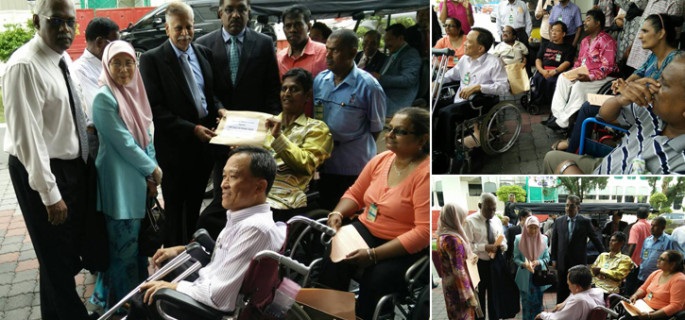
Badan Latihan dan Hidup Berdikari Malaysia (ILTC) pada 23hb Mac 2016 menyerahkan memorandum kepada ahli-ahli parlimen mendesak supaya golongan orang kurang upaya (OKU) dikecualikan daripada cukai barangan dan perkhidmatan (GST).

Disabled Members Protest

Disabled Members Protest
Disabled Members Protest at JPJ Wangsa Maju

ILTC Malaysia members staged a protest outside JPJ Wangsamaju KL.

ILTC Malaysia members staged a protest outside JPJ Wangsamaju KL.
Disabled group’s protest disabled drivers required to produce doc's medical report.

Monday, 1 June 2009

Menara MPAJ to be more disabled-friendly

Monday June 1, 2009


Menara MPAJ to be more disabled-friendly
Story and photo by FAZLEENA AZIZ

THE Ampang Jaya Municipal Council (MPAJ) carried out a disability awareness simulation programme at its building in Pandan Indah recently.

The programme was held to give the council an overview of how disabled-friendly Menara MPAJ is.

It came after a discussion at the People with Disability dialogue held on Feb 17.
Uphill task: Mohammad making his way up the ramp in Menara MPAJ.

MPAJ president Datuk Mohammad Yacob and the councillors got a first-hand experience as they made their way to different places in the building in wheelchairs.

Mohammad said the MPAJ had plans to build a ramp in accordance with specifications on the needs of disabled people, as well as other facilities.

“This is an old building that was built in 1994 and is not sensitive to the needs of the disabled.

“So this exercise will help us fill in any gaps we may have pertaining to being more disabled-friendly,” he said.

He added that the council would take the necessary action on the matter.

The specifications are from the Guidelines on Building Requirements for Disabled Persons issued by the Local Government and Housing Ministry.

Mohammad said that new commercial buildings had implemented the specifications.

“Our advice is that other building owners should make their premises more disabled-friendly.

“If we want to make this mandatory, then we will have to make a new policy,” he said.

The MPAJ has prepared a separate checklist on the needs of people with disability that plans for housing and commercial developments must comply with before approvals are given.

This is one of the ways to ensure that the disabled community will enjoy the same facilities as others.

The MPAJ has also placed two wheelchairs on level 4 of the building for the use of people who need them.

Thursday, 28 May 2009

NOTICE OF THE 7TH ANNUAL GENERAL MEETING OF ILTC

Warm greetings from ILTC Malaysia

To All Members of ILTC

Dear Sir / Madam:

RE: NOTICE OF THE 7TH ANNUAL GENERAL MEETING OF ILTC

Notice is hereby given that the 7th Annual General Meeting of the Independent Living & Training Centre of Selangor & Wilayah Persekutuan Kuala Lumpur will be held on 31st of May 2009 (Sunday), at 10.00am, Venue: Independent Living & Training Centre, Taman Garing, 48000 Rawang, Selangor Darul Ehsan.

We hope all members will be able to attend this meeting and your presence at the AGM will be highly appreciated.

If you have any enquires please contact President or Secretary at 03-6091 2531 or 03-6093 6292

I look forward to meeting you again on 31st May 2009

Thank you,

Ms. Gurdip Kaur @ Rina
Secretary of the ILTC

Like a stroll in the park


Thursday May 28, 2009

Like a stroll in the park
WHEEL POWERBy ANTHONY THANASAYAN

Local councils step up drive to provide access for the disabled.

HAVE you noticed the increasing number of disabled-friendly facilities in Selangor?

This clearly demonstrates that the local governments – in the Klang Valley for a start – are beginning to view with seriousness, building by-laws gazetted years ago to ensure access for the disabled.

I was delighted when I visited my hometown in Klang last week and discovered a number of disabled-friendly car parks in town. At the Klang City Council, there was one situated at the entrance of the building. And not far away were several wheelchairs awaiting disabled visitors.

What a positive change this is compared to a few years ago when it would have been impossible to find even one car park – or wheelchair – in public view in the royal town.

The provision of wheelchair ramps and special car parks by our local councils sends a strong and encouraging message to all disabled Malaysians that they do not need to feel shy or afraid about going out in their wheelchairs.

Like our non-disabled counterparts, we too can now enjoy the experience of being able to interact with society.

Disabled residents in Subang Jaya, and particularly in Shah Alam, can look forward to seeing more disabled-friendly car parks in the area.

This was revealed to Wheel Power recently during a conversation with Rodziah Ismail, the Selangor State Welfare, Women Affairs, Science, Technology and Innovation Committee chairman.

She pointed out that the car parks would be provided free of charge, and reserved only for the disabled.

The Petaling Jaya City Council (MBPJ) is going one step further in its commitment to provide access for the disabled.

The MBPJ is presently expanding its disabled car parks which will all be fully covered to protect the handicapped from the sun and rain.

These car parks will be accessible to disabled drivers and caregivers. This will make it easier for parents of disabled children, and those with elderly disabled parents who wish to take their loved ones out. The Selayang Municipal Council (MPS), one of the pioneer local councils to introduce disabled-friendly parking lots, is taking its social responsibility to a higher level.

The MPS is working on setting up a special disability technical team over the next few weeks.

The team will be headed by disabled councillor Gurdip Kaur who mooted the idea.

The council will handpick persons with various handicapping conditions as well as those from non-governmental organisations for the disabled, to sit in a committee as expert advisers. The team of experts will include heads of the various departments of the MPS and other relevant bodies.

The MPS disability technical committee will be tasked with looking into the needs of disabled residents, and ways in which they can have a better quality of life.

The committee will look into accessibility issues in buildings before they are approved by the main council. The committee will also set out to raise the standard of services provided by homes for the disabled and the elderly in Selayang.

Wednesday, 27 May 2009

Rehab effort helps injured employees return to work


Wednesday May 27, 2009


Rehab effort helps injured employees return to work

By PRIYA MENON

THE recent economic downturn has made it tough on those seeking employment, more so for those who have lost a limb or two in an accident.

For this reason, the Social Security Organisation (Socso) has come up with a rehabilitation programme to help those who were rendered helpless after an accident to find suitable jobs.

The Return to Work (RTW) programme, which began in 2007, has certainly changed the lives of these people who would usually find it tough to return to the job market.

Since its inception, 441 out of 566 employees who joined the programme have gone back to work as of March this year.

Checking it out: Two DBC physiotherapists demonstrate how an assessment is done.

Each case received by the Socso is handed over to case managers who take the time and initiative to ensure that the cases are genuine and deserved aid.

Gayathri Vadivel, a case manager, said upon receiving a case, an initial assessment was carried out to verify the extent of the injuries and disability.

Her colleague, Rosmawati Mat, 37, said the case managers worked on the strengths of the patients to ensure they received either rehabilitation or vocational skills.

This will help the patients become economically independent.

“Most of the time, these people are afraid that they may not be hired again by their employers or other companies so we have to find a way to ensure that they do get a job after the programme,” Rosmawati said.

The steps taken by the case managers include talking to the previous employers and convincing them to retain the employees with adjustments to their job scope.

“The employers are afraid that the disabled employees can no longer work as well as when they were able bodied but statistics show that a disabled employee is more loyal,” Gayathri said.

In the case of Low Yew Loi, 32, who was involved in an accident at his work place early this year, he managed to continue with his job after recuperating from his injuries over a six-month period.

Low, a site supervisor, lost his right leg after he was run over by an excavator during the construction of the Duta Ulu Kelang (DUKE) highway.

“I lost all hope of retaining my job. That is when Socso stepped in and bought a prosthetic leg for me,” he said.

“They also spoke to my employer and ensured adjustments were made so that I could continue working for them,” added Low who is now confined to office work.

At the RTW National Seminar 2009 held recently, Human Resources Minister Datuk Dr S. Subramaniam said more case managers would be hired to help workers who had sustained injuries.

“For now, there are only nine case managers in the country but by the end of the month we hope to employ 34 more,” he said.

Besides the case managers, the rehabilitation centres also play an important role in ensuring that the patients receive proper rehabilitation and are fit to work again.

One such centre is the Document Based Care (DBC) company that has been working with Socso since its pilot project in February 2005.

DBC chief executive officer Wee Hock Kee said DBC was the only service provider with the capacity to support the Socso RTW project nationwide.

“We have successfully treated 500 Socso patients so far nationwide and we have a success rate of more than 30% for the pilot project and for RTW early intervention, it is 63%,” he said.

DBC has back, neck, shoulder and knee protocol and assessment and it covers the psycho-social assessment of the patient and follows an approach called the “Cognitive Behaviour Approach”.

“Each rehabilitation programme lasts for 12 weeks and includes two physical examinations and 24 sessions of physiotherapy and muscle reconditioning sessions,” Wee said.

Disabled buddies find their niche at hypermart

2009/05/23

Disabled buddies find their niche at hypermart

Sahril Adamuddin (left) and Mat Jamil Ramli are part of the 60 people with disability who are employed at Carrefour Malaysia.

KUALA LUMPUR: Twenty- five-year-old Mat Jamil Ramli spends his day at Carrefour creating press advertisements and leaflets on his computer.

Employed as a graphic designer, Mat Jamil would otherwise go unnoticed at the sprawling Carrefour head office floor in Subang, where hundreds of employees move around like bustling bees, but for the fact that the metre-tall lad uses his toes to type on his keyboard.

Born without hands, Mat Jamil counts himself lucky to have secured a job at Carrefour two years ago.

"Everyone here is friendly and helpful. It's like being part of a big family."

Sahril Adamuddin, 26, is Mat Jamil's lunch buddy, who sometimes helps the latter cut up his meat during meals. Wheelchair-bound Sahril works as a pricing clerk at Carrefour and, like Mat Jamil, he feels he is at the "right place".

Mat Jamil and Sahril are not the only people with disability (PWD) who work at Carrefour Malaysia.

There are currently 60 PWD who make up two per cent of Carrefour's 3,423 workforce.

According to Carrefour human resource director Mohamad Fauzi Hassan, the company implemented the hiring policy two years ago when it employed 20 PWD at its stores nationwide.

The hypermarket hopes to hire about 400 PWD by 2012, making up five per cent of its expected 8,000 workforce.

Carrefour became part of the United Nations Development Programme's pilot project called Employment Model for PWD last year, under an agreement where UNDP provides job coaches for Carrefour to train the PWD.

Carrefour has also, on its own initiative, trained job coaches among its staff to cater to the hypermarket chain's expansion, Fauzi said.

These coaches are given special training, such as sign language and systematic instruction.

"To help them, the PWD are partnered with a Carrefour 'buddy' each.

They are given on-the-job training under supervision until they are able to perform the tasks on their own.

" He added that there were hardly any disciplinary problems among the PWD."

They are enthusiastic and passionate about their work. Once, one of them fell ill but he insisted on coming to work. His parents, however, refused to allow him.

"So he made them come and explain to us that he was indeed ill. I told them they didn't have to come and that they only needed to call."

Fauzi said there were no restrictions as to where the PWD were placed in the hypermarket. They work in the head office as marketing executives, graphic designers, accounts executives and data entry clerks. At the store front, they are hired as clerks, security personnel and call centre and customer service representatives, among others.

While Carrefour's disabled personnel are independent, where they travel to and from work on their own, Carrefour is planning to provide accommodation and transportation in the future, through its Yayasan Carrefour.

Thursday, 21 May 2009

A fair picture?


Thursday May 21, 2009
A fair picture?
WHEEL POWER
By ANTHONY THANASAYAN

Do TV shows represent how the disabled wish to be protrayed?

I WAS delighted to read the recent comments by Information, Communications and Culture Minister Datuk Seri Dr Rais Yatim. He called on television and radio stations to provide fair coverage of the various communities in Malaysia.

The minister, referring to on-air shows such as sitcoms, serials and local films, urged those who produce them to ensure that they reflect the culture and aspirations of Malaysians.

I couldn’t agree more with the minister. Although Dr Rais did not specifically mention it, I have no doubt that he would feel the same for broadcast shows that depict the marginalised communities, namely the disabled. Do shows on the handicapped truly represent how they wish to be portrayed? Not too long ago, I caught a local show where “a tragedy” occurred in a family.

A couple rushed to a hospital when they heard that their son was involved in a car crash.

After hours of waiting at the surgery and fearing the worst, the couple met the grim-faced surgeon when he finally emerged from the operation theatre. The distraught parents looked at the doctor who shook his head and said: “I’m sorry. Although your son has survived, he will be paralysed for the rest of his life.”

The parents hugged each other and wept, as if to show that it would have been better for their child if he had not survived at all than to spend the rest of his life as a handicapped person.

Such a portrayal of the disabled by the media is not at all helpful nor is it accurate about the disabled community in Malaysia.

When someone becomes crippled, the most important thing is to give them hope and show them that life is worth living – because it really is.

What is tragic is not that one becomes disabled but rather that we still live in a society that has way to go before becoming fully inclusive of all types of persons. Inclusivity means building ramps for wheelchairs and guiding blocks for the blind, and providing special education for the learning disabled and electronic signboards for the Deaf.

Many of us (especially the non-disabled) place too much emphasis on one’s ability to walk, see, hear or think in a certain way. By doing this, we end up marginalising others that do not fit into the picture.

I happen to know quite a few non-disabled people with all of the so-called “positive abilities”. And yet, they are not content with their lives. Some are depressed, others even suicidal. I am happy that my job as a Petaling Jaya City Councillor (MBPJ) is paying off.

We in MBPJ are doing a lot of things to make a difference to the disabled, for example, by providing user-friendly facilities like wheelchair accessible rest-rooms, car parks, pavements and buildings – new and old – and even some form of public transportation.

All these features offer hope and help to the disabled.

I had quite a shock last week. A private TV station that had wanted to do a story on my life suddenly gave up on me. They turned me down because they wanted me to cry on television. The editor apparently thought a good sob was the best way for someone in a wheelchair to get sympathy from the public.

I simply refused to shed a tear in front of the camera. As a result, I lost a chance to go on national TV. But I managed to keep my dignity, and that to me is more important.

Make changes to fit in disabled, bosses told

Tuesday May 19, 2009

Make changes to fit in disabled, bosses told

KUALA LUMPUR: Employers should make adjustments to absorb employees who become disabled after work accidents, Human Resources Minister Datuk Dr S. Subramaniam said.

He said employers must take up this social obligation, and the adjustments could involve changing job specifications, creating flexi-time or making changes to work surroundings, for those still able to work.

“For the preservation of human dignity, it’s important for us, as a nation, and employers to bring these changes to the community,” he said.

Dr Subramaniam said that since the Social Security Organisation’s (Socso) “Return to Work” rehabilitation programme started in 2007, and until March this year, 441 of 566 employees who joined the programme had gone back to work.

The rest, he said, were still seeking jobs, or undergoing rehabilitation or medical treatment.

He said 868 work accident cases had been referred to the programme during the period but only 566 joined the programme.

He was speaking at Socso’s “Return to Work” National Seminar 2009 yesterday.

The ministry was also setting up a rehabilitation centre in Malacca, which would be ready in two years, he said, adding that the RM80mil project was in the preliminary stage of construction.

Currently, the Government was using public and private facilities for the “Return to Work” programme, he said.

Socso board chairman Datuk Hong Lee Pee said they were initially sceptical about the programme succeeding in Malaysia.

However, the response from employers and employees has been good, he added.

Assets of disabled not a consideration

Tuesday May 19, 2009

Assets of disabled not a consideration

THE Government will no longer consider the assets of the physically disabled when processing their application for aid.

Women, Family and Community Development Minister Datuk Seri Shahrizat Abdul Jalil said this was because the problem faced by each applicant differs.

“The Welfare Department will look at these applications on a case-by-case basis. I hope this will allay the worries of the disabled people as the Government will do its best to ensure that there will be less red tape.

“It is unfair if we disapprove their applications for aid just because they own a motorcycle or a television,” she told reporters after presenting aid to poor families in Kampung Sungai Lembu, Bukit Mertajam, recently.

Shahrizat was accompanied by state Unity and Welfare Council chairman Datuk Arif Shah Omar Shah who is also Seberang Jaya assemblyman.

She added that the disabled must be registered with the Welfare Department of their respective areas before their applications can be processed.

More Disabled-friendly Komuter Stations By 2010

May 19, 2009

More Disabled-friendly Komuter Stations By 2010
By: Ramjit

KUALA LUMPUR, May 19 (Bernama) -- More Komuter stations in the Klang Valley will be equipped with facilities for the disabled by the middle of next year.

Keretapi Tanah Melayu Berhad (KTMB) managing director Datuk Abdul Radzak Abdul Malek said, the government had allocated RM10 million under the Ninth Malaysia Plan (9MP) to install five KTM stations with facilities for the disabled at the Rawang, Sungai Buloh, Bandar Tasik Selatan, Serdang and Shah Alam stations.

"This fund would be used to build two lifts, ramps at the station entrance and at platforms, creating a passage incorporating tactile indicators, disabled toilets and special parking bays at each station involved," he said at a briefing ceremony for media at the KTMB headquarters here.

Abdul Razak said so far seven stations were already equipped with basic facilities for the disabled which are the Sentral Kuala Lumpur, Midvalley, Kepong Sentral, Bank Negara, Subang Jaya, Seremban and Kajang stations.

He said besides facilities at the station, the disabled were also provided special seats and space in trains.

"We will also make it a requirement for frontliners to learn how to handle emergencies and the disabled in stations and trains," he said.

Abdul Razak added that KTMB also planned to hold a Disabled-Friendly Day to foster closer ties and ensure the group also enjoyed public transportation.

After the briefing session, members of the media and the disabled were shown disabled-friendly facilities at the Subang Jaya komuter station.

BERNAMA

Monday, 18 May 2009

Wesak Celebrations 2009

Metta Forest Hermitage - Wesak Celebrations 2009 on 9 May 2009 at No. 1 Jalan Angkasa, 48100 Batu Arang Selangor D.E. Malaysia. It is located on a hill with a forest setting, about twenty minutes from the Rawang toll plaza of Malaysia's North-South Expressway, and can be approached by car.
Guru Lingam
Metta Forest Hermitage
Many thanks to Metta Hermitage and well wishers who generously donated towards ILTC for the Wesak 2009 celebrations.
After Wesak Puja, they hosted a sumptuous vegetarian lunch for the disabled, elderly and orphans. Provisions such as rice, cookies, cash donations and other necessities were also distributed to the needy.
The guest of honour, Bro. Quek, gave a speech on Buddhist living. To round off the celebrations, Buddhist songs were presented by Guru and Bro. Chong, editor-in-chief of Dharma Tunes.

No more red tape in government aid


Saturday May 16, 2009

No more red tape in government aid

GONE are the days when less fortunate members of society seeking government aid are confronted with lots of red tape or simply do not know who to turn to.

Instead, under the new ‘Projek Cari’ (Lookout Project), the government will actively seek them out and provide them with financial aid.

The project is targeted at the elderly, disabled, sickly and hardcore poor families with school-going children, and is open to all Malaysians.

The programme was initiated by the Women, Family and Community Development Ministry and is also a joint effort with the MCA Bukit Gelugor division, Social Welfare Department and Special Affairs Department.

To qualify for assistance, one needs to be a Malaysian citizen and residing in the country, have a combined family income of less than RM700 per month, or is disabled and have special needs.

Several other factors are also taken into consideration including number of offspring, age of applicant, deformities or disease-related disabilities as well as dwelling conditions.

State Social Welfare Department community development assistant Wong Kok Wai said that needy people could obtain and fill in application forms from their respective Rukun Tetangga.

“The applications will then be forwarded to the department which will in turn send officers to the respective applicants for follow-up evaluation.

“In the past six months from November 2008 to May 2009, a total of RM135,420 has been disbursed to 78 applicants in the Bukit Gelugor parliamentary constituency,” he said.

A special ceremony will be held this Sunday from 4pm to 6pm at the community hall in Block 9/11, Taman Terubong Jaya to raise public awareness on the programme.

Paya Terubong MCA service team chief and project advisor Koh Wan Leong hoped this would help inform the public about the existence of such a programme, as many were still unaware of it.
Good service: Koh (centre) helping disabled Farlim resident Dass Anthony (right) to fill out an application form. With them is Wong (left).

He also urged people to spread the word so that those really in need could come forward and apply while those approved would usually be notified within several weeks.

“In the past, the poor and needy need to look for the government.

“But now, the government will look out for them instead, as we are very concerned about their welfare. This is in line with the government’s efforts of promoting 1Malaysia,” Koh added.

He reminded applicants to bring along two passport-sized photos, photocopied MyKad (front and back), disability card (if any) as well as a referral letter from government doctors (for medical cases).

Disabled Owning Vehicles Are Eligible For Aid

May 15, 2009

Disabled Owning Vehicles Are Eligible For Aid
By: Ramjit

BUTTERWORTH, May 15 (Bernama) Handicapped people who own a car or other facilities are still eligible to apply for aid from the Social Welfare Department, said Women, Family and Community Development Minister Datuk Seri Shahrizat Abdul Jalil.

She said they need not hesitate to apply for aid allocated by the government because the facilities they own do not affect their eligibility.

"The disabled or their families who own a car, motorcycle, television, refrigerator and other such items are not part of the criteria in giving out the aid," she said after a visit to Kampung Sungai Lembu, near here, Friday.

She said the government has provided assistance to the disabled under various categories, including the Disabled Worker Allowance, which offers RM300 per month to the disabled who earns not more than RM1,200 monthly.Other than that, those disabled who are not able to work and do not have individual income but receive donations from sources such as insurance, pension, derivative pension and other assistance amounting to not more than RM720 a month in the peninsula, Sarawak (RM830) and Sabah (RM960) can receive aid of RM150 monthly.

"Those caring for bed-ridden handicapped patients with a monthly family income of not more than RM3,000 are also eligible to receive aid of RM300 a month," she said.

Shahrizat said another requirement is that the disabled is a Malaysian citizen residing in the country, and has registered with the Welfare Department.

She added that the ministry is still actively tracking down those disabled who are eligible for aid, but have not registered with the department.

BERNAMA

Thursday, 7 May 2009

Ring the bell


Wednesday May 6, 2009


Ring the bell
By CHRISTINA CHIN,
Photos by WAN MOHIZAN WAN HUSSEIN

PENANG can soon boast having a disabled-friendly bus system as Rapid Penang’s new fleet of 200 buses will be just that – disabled-friendly!

There are currently two prototypes plying the streets for the past month, and more are arriving in stages from Sweden.

“So far, the response we’ve received for the two that are currently running has been positive. We will continue to work closely with non-governmental organisations (NGOs) and the state to cater to the disabled community’s needs,” said Rapid Penang chief executive officer Azhar Ahmad.
Purpose-built: The bus' hydraulic system will lower the bus before the ramp is extended out for wheelchair users to board the bus and (bottom pic) Azhar showing off the special seat belts for the disabled.
The prototypes are equipped with seat belts, special bells, ramps and a hydraulic system that can lower the bus by 50mm for the wheelchair-bound.

“Our bus captains were all trained by University Sains Malaysia on how to assist these special passengers. There is a special button outside the bus for the wheelchair-bound to press when they want to get on,” he told StarMetro in an interview.

Fleet to boast of: The bell located outside the bus is specially for wheelchair users. At the sound of the special chime, the bus captain will come down and assist the disabled passenger up the bus.

We will launch a campaign to create awareness among the disabled community on the availability of these buses next month.

He said the new aluminium-structure buses were much lighter and hence, saved up to 20% in fuel usage, compared to the company’s existing buses which were made in China.

The Swedish made buses, however, were twice the price of the buses from China, Azhar.

“In Kuala Lumpur, there are only 30 disabled-friendly RapidKL buses,” Azhar said.

The company currently has 150 buses plying routes in Penang with 110 on the island and 40 on the mainland, and the new buses will be a full complement.

Azhar also said the company wanted to adopt all the 303 bus stops in Penang to make them “more comfortable and disabled-friendly” but would have to wait until the state’s advertising contracts with other companies expired.

“About 80% of the bus shelters have been taken up by advertisers so we have to wait for a few years but we are willing and committed,” he added.

On the free shuttle bus service within George Town’s inner city, Azhar said a recent survey revealed that it was well received by students, office workers and tourists who want to get to the Komtar bus interchange.

The cost of running the service which operates from 6am to midnight daily, is paid for by the Penang Municipal Council.

“Some 1,500 passengers take the free shuttle daily. About 80% to 90% of them are happy but have requested for more frequent trips,” he said, adding that the company was in talks to provide bus shuttle services in the Bayan Lepas free industrial zones.

He also said Rapid Penang was awaiting the state’s decision on its RM20mil depot proposals for Sungai Nibong and Weld Quay.

“We spoke to State Local Government and Traffic Management Committee chairman Chow Kon Yeow Chow last week and he was keen on our proposal for Sungai Nibong.

“Hopefully, we’ll receive a favourable reply for the Sungai Nibong depot by mid-May.

“The Sungai Nibong depot will have a four-storey administration building, 145 bus parking bays, workshop and hostel.

“The Weld Quay proposal may take longer to work out because several tenants as well as Penang Port are involved,” Azhar said, adding that the company had requested a 30-year lease at nominal fee as it would be used for “public service”.

As part of the company’s service enhancement and expansion plans, he said sub-depots would be built in Balik Pulau, Nibong Tebal, Kepala Batas, Teluk Bahang and Bayan Baru.

Azhar urged the state government and relevant authorities to develop a public transportation master plan that includes a traffic, landscaping as well as housing and commercial development studies.

“With a master plan in place, strict enforcement on illegal hawkers and double-parked vehicles along the road, and an efficient public transportation system, we can reduce traffic jams in the state by at least 40%,” he said.

Wednesday, 6 May 2009

‘Do more for the disabled’


Wednesday May 6, 2009


‘Do more for the disabled’

KUALA LUMPUR: The Government should not be exempted from the provisions of the Persons with Disabilities Act 2008.

“The Federal Government is exempted from any wrongdoing, and this casts serious doubt on its commitment to the rights of the disabled,’’ Ragunath Kesavan, president of the Malaysian Bar, noted.

The Act, which came into force on July 7 last year, also lacked penalties for any party failing to comply with its obligations.

Ragunath said that although the Government had signed the United Nations Convention on the Rights of Persons with Disabilities last year, it had yet to ratify it.

“We strongly urge the Govern­ment to immediately ratify the convention and take measures to implement its obligations,’’ he said in a press statement yesterday.

Ragunath said disabled people faced unacceptable barriers in their daily lives due to the lack of proper infrastructure for them.

The shortcomings clearly showed up when Karpal Singh fell from his wheelchair at the Kuantan High Court recently, he said.

Ragunath said existing laws to protect the rights of the disabled and to improve their quality of life were still lacking enforcement.

The Malaysian Bar urged the Government to ensure facilities for the disabled and to improve and enforce the existing laws pertaining to their rights.

Sunday, 3 May 2009

University aids disabled


Thursday April 30, 2009

University aids disabled

DISABLED students at Universiti Utara Malaysia (UUM) in Sintok, Kedah, received a big morale boost when the university introduced a disabled-friendly van recently to help them move about in campus.

The van, costing RM140,000, is fitted with hydraulic gadgets to enable wheelchair bound students to get in and out of the vehicle.

Disabled students will be able to use the van, managed by UUM’s Student Affairs Welfare Unit, throughout their stay in the university.

Muhammad Ihsan Abdullah, 23, a third year information technology student, said it was a great relief to have such a facility.

“I can now arrive at my destination on time for classes. I used to take about 30 minutes to wheel myself from my hostel to the lecture theatre and at times when it rains heavily, I had to skip classes.

Another disabled student, Mazlina Mohd Madlan, 21, said the facility was a positive move by the university to assist students like her.

Student Affairs and Alumni deputy vice chancellor Datuk Dr Ahmad Faiz Hamid said the university was always concerned with the welfare of its students, especially those who are disabled.

Friday, 1 May 2009

Out of touch


Thursday April 30, 2009

Out of touch

WHEEL POWER
By ANTHONY THANASAYAN

Do the authorities really understand the needs of the disabled?

HAVE you had one of those mornings when you wake up and the first thing that you read in the newspapers is a really silly remark that is bound to get everyone upset?

Well, last week was one such occasion.

A front-page story in a local newspaper on April 22 quoted the Welfare Department as saying that Malaysians with disabilities who come under the very poor category wanting aid of RM150 a month won’t be qualified to get it if they have Astro.

The guideline is said to apply even for someone who lives in another person’s house, whether temporarily or otherwise.

In other words, those who came up with such a ruling seem to think that the disabled who can afford pay TV are not poor. And, according to them, welfare aid should only be given to those requiring food, clothing and shelter, and certainly never for entertainment.

This reminds me of a similar situation a few weeks ago that had disabled dog owners howling in protest.

A local council decided against giving disabled residents free dog licences. The reason for doing so was purportedly to “teach the handicapped about the need for administration costs”.

They reckoned that if a disabled person can keep a dog, why can’t he pay RM10 a year?

It makes me wonder how truly in touch are the authorities with what people with disabilities go through daily in their lives, and especially in their homes which are often concealed from the public eye.

Take, for example, a man who became disabled following a car crash a few months ago, and is suffering from depression. Why would he want to learn about processing fees when he is thinking about ending his life?

Becoming paralysed for life is never an easy thing to accept. It is especially hard for those who have been very independent.

Not only does disability rob a person of his dignity to do things for himself, the situation often results in the disabled losing his job as well.

Despite the Welfare Department’s noble efforts in trying to help disabled Malaysians find jobs so that they can be self-sufficient, not many people want to hire the handicapped.

Many people are still bound by negative stereotypes about the disabled. Life is especially hard for the bedridden. Many of them hardly have any opportunity to go out.

Quite a few of them have no one strong enough to carry them out of their beds and back again.
They have to depend on others for everything. Their only “entertainment” is often to stare at the four walls of their room.

For those who have pets, these pets serve to divert them from their depression. By stroking and bonding with their pets, the disabled receive unconditional love and acceptance.

In the area of entertainment, Astro offers the disabled a window to the outside world and keeps them updated on what is happening around the world.

It is important for disabled Malaysians who are locked inside their homes to realise they are not alone in their struggles.

I have watched health shows which offer the latest information on all types of disabilities. Such information is helpful to the handicapped.

Watching how others cope with their disabilities and live positive lives in other countries, helps motivate people with handicaps in our country.

Even the blind “watch” TV. I know many who tune in daily to international news channels on pay TV to keep abreast of news-breaking events around the world.

Isn’t access to information and education also a basic human right? Would the Welfare Department stop aid for disabled people with computers and Internet access as well?

Something is obviously very wrong with the guideline. Instead of appearing to crack down on the helpless disabled poor, the Welfare Department should really be working hard to help all disabled persons in Malaysia to have such facilities.

The department should engage in talks with Astro to provide free subscription to the disabled as part of the company’s social responsibility.

On the day that the article came out, about 20 disabled people in wheelchairs – including me – met up with Women, Family and Community Development Minister Datuk Seri Shahrizat Abdul Jalilf.

She promised us that she would look into the matter and come up with realistic solutions to our problems.

Monday, 27 April 2009

Women, Family and Community Development Minister Senator Datuk Seri Shahrizat Abdul Jalil Listen's to ILTC

Women, Family and Community Development Minister Senator Datuk Seri Shahrizat Abdul Jalil Listen's to ILTC

2009/04/27


Welfare Dept to set realistic criteria for aid

KLANG: The Welfare Department will introduce more realistic criteria for dispensing aid by not looking at assets such as television sets and refrigerators as reasons for disqualification.

Women, Family and Community Development Minister Senator Datuk Seri Shahrizat Abdul Jalil said television, refrigerator and Astro service could no longer be considered luxury items.

"Even a car is no longer a luxury as it has become a necessity now. The system we intend to introduce will be more effective and realistic and reach our target group without giving them a hard time," Shahrizat said after closing a community programme at Taman Sri Menegun hall here yesterday.

"We no longer want welfare aid to be restricted by bureacracy which creates trouble for our target group, especially the elderly and the disabled.

"Imagine they have to spend a lot of money to rent a car just to go to the office to apply and bring back between RM200 and RM300."

Saturday, 25 April 2009

Disabled want a rep in Welfare Dept


2009/04/23

Disabled want a rep in Welfare Dept

KUALA LUMPUR: A RM500 monthly payment to all registered disabled and at least one disabled person to be represented in the Welfare Department committee handling them.

These requests were made by a group of disabled that met Women, Family and Community Development Minister Senator Datuk Seri Shahrizat Abdul Jalil yesterday.

Malaysian Animal-Assisted Therapy for the Disabled and Elderly Association president Anthony Siva Balan Thana-sayan, who spoke on behalf of the group, said every disabled person deserved a decent standard of living.

"We hope and pray that you can give us RM500 per month. But there should not be any restrictions.

If the recipients want to spend the money on stupid things, like cigarettes, let them," he said.

Disabled registered with the ministry currently get bet-ween RM150 and RM300. He said owning a television set was no longer a luxury.

"Are you now going to stop giving us money because we have computers or the Internet at home?"Or if we eat Baskin Robbins ice-cream with the money?

"Stanley Anthony, 60, who had a total hip replacement in 1988 after an accident, said he had been appealing for the past two years against the Welfare Department ruling that those disabled having Astro satellite service should not be given aid.

The New Straits Times reported yesterday that this rule applied even if one lived in someone else's house, temporarily or otherwise.

The disabled say TV programmes were the only entertainment they had

Friday, 24 April 2009

‘OKU tak kaya kalau ada TV'

Jumaat, 24 April 2009


‘OKU tak kaya kalau ada TV'

BINCANG...Shahrizat mengadakan rundingan dengan golongan OKU yang mengadakan bantahan, semalam.

KUALA LUMPUR: Tindakan Jabatan Kebajikan Masyarakat (JKM) menarik semula bantuan kepada orang kurang upaya (OKU) hanya kerana di rumah mereka terdapat televisyen dan Astro disifatkan sebagai satu tindakan keterlaluan.

Berikutan itu, seramai 15 OKU berkumpul di hadapan pejabat Kementerian Pembangunan Wanita, Keluarga dan Masyarakat (KPWKM) di sini untuk bertemu Menterinya, Senator Datuk Seri Shahrizat Abdul Jalil bagi meluahkan rasa tidak berpuas hati mereka berhubung tindakan berkenaan.

Dalam kejadian kira-kira jam 3 petang itu, semua peserta bantahan terbabit memegang sepanduk sambil melaungkan ‘kami mahukan pembelaan...jangan tindas kami’ kira-kira 10 minit di hadapan bangunan itu sebelum bergerak masuk.

Pengerusi Persatuan Badan Latihan dan Hidup Berdikari, G Francis Siva, berkata pihaknya amat terkilan dengan tindakan itu dan ia satu diskriminasi kepada mereka yang tidak berupaya.

“Hanya kerana kami memiliki Astro dan televisyen mereka mahu menarik semula bantuan yang disalurkan selama ini. Ini adalah tindakan mengarut dan lebih kepada penindasan.

“Mereka sepatutnya berbincang dengan mana-mana wakil OKU terlebih dulu sebelum mengambil tindakan seumpama itu bagi mengelakkan keadaan menjadi lebih buruk,” katanya ketika ditemui di sini, semalam.

Menurutnya, golongan OKU hanya mampu mendapatkan maklumat dengan menonton televisyen manakala segelintir saja daripada mereka mempunyai Astro bertujuan untuk berhibur. “Semua orang tahu peralatan elektronik kini dijual pada harga murah dan saya yakin pemilikan televisyen dan Astro bukanlah menandakan kami berkemampuan ataupun hidup mewah.

Sebaliknya, kami juga manusia biasa dan punya naluri untuk berhibur dengan cara tersendiri.

“Lagipun fasiliti di negara ini tidak berpihak kepada golongan OKU untuk berhibur seperti menonton wayang. Inilah (televisyen dan Astro) satu-satunya ruang untuk kami berbuat demikian,” katanya.

Sharizat yang ditemui selepas perjumpaan dengan wakil OKU kira-kira lebih 20 minit berkata pihaknya mengalu-alukan maklum balas seumpama itu daripada orang ramai dan berjanji akan mengambil tindakan susulan.

“Tujuan kita bertindak demikian bukanlah untuk menindas mana-mana pihak sebaliknya dilakukan bagi memastikan ketelusan selain bersifat lebih adil kepada mereka yang lebih memerlukan,” katanya.

Peraturan sekat elaun OKU dikaji

Jumaat, 24 April 2009


Peraturan sekat elaun OKU dikaji
SHAHRIZAT bertemu OKU yang tidak puas hati mengenai penarikan semula bantuan kewangan bagi golongan OKU di Kuala Lumpur, semalam.

KUALA LUMPUR: Kementerian Pembangunan Wanita, Keluarga dan Masyarakat memberi jaminan akan mengkaji semula peraturan menyekat orang kurang upaya (OKU) menerima elaun kebajikan sekiranya mereka memiliki televisyen atau Astro.

Menterinya, Senator Datuk Seri Shahrizat Abdul Jalil memberi jaminan itu selepas berbincang dengan sekumpulan 12 OKU yang mengunjungi pejabatnya di sini, semalam.

"Anda memberitahu saya untuk melihat semula peraturan ini, saya akan melihatnya... saya berasakan permintaan ini adalah wajar dan saya akan melihatnya kembali. Kita akan kembali dengan jawapan yang realistik," kata Shahrizat. Beliau turut menegaskan peraturan itu tidak bertujuan untuk mendiskriminasi OKU.

Shahrizat berkata demikian mengulas laporan akhbar New Straits Times, semalam, bahawa golongan OKU yang memiliki televisyen atau Astro di rumah masing-masing disekat daripada menerima bantuan kebajikan.

Beliau kemudian menjelaskan, peraturan itu hanya dikuatkuasakan terhadap mereka yang tergolong di bawah skim OKU yang tidak mampu bekerja dan diberi bantuan RM150 sebulan.

"Apabila OKU mempunyai kemudahan Astro di rumah mereka... ini ditakrifkan sebagai petanda OKU sudah mampu berbelanja lebih... dalam konteks ini untuk hiburan. "Tindakan menggunakan Astro dianggap sebagai perbelanjaan bulanan tambahan yang mengurangkan penggunaan wang bantuan untuk keperluan asas," katanya.

Bagaimanapun, Shahrizat menegaskan peraturan itu tidak menjejaskan dua lagi skim kebajikan untuk pekerja kurang upaya dan penjaga OKU lumpuh yang menerima bantuan bulanan RM300.

"Mereka yang masih menguat kuasa peraturan ini terhadap dua kategori OKU terbabit boleh diambil tindakan. Bagaimanapun, saya akan mengkaji semula peraturan berkaitan pemilikan Astro dan televisyen," katanya.
Terdahulu, keadaan agak tegang di ruang menunggu kementerian terbabit dengan beberapa individu membawa sepanduk mengutuk peraturan itu tetapi suasana kembali tenang sebaik Shahrizat tiba.

Beliau kemudian berjabat tangan dengan semua OKU yang berada di ruang menunggu kementeriannya sambil bertanya nama dan latar belakang sebelum menarik sebuah kerusi duduk bersama mereka untuk mendengar masalah dibangkitkan.

Disabled folk protest against Astro ruling


Thursday April 23, 2009

Disabled folk protest against Astro ruling

KUALA LUMPUR: About 20 disabled people turned up at the Women, Family and Community Develop-ment Ministry yesterday to protest against the ruling barring those with Astro from receiving welfare aid.

The wheelchair-bound protesters were led by Independent Living and Training Centre president Francis Silva, who urged the ministry to reconsider its ruling. Silva said the ruling was a clear indication of discrimination against the disabled.

“The RM50 subscription fee is minimal. Astro channels have become a source of information and knowledge for our children. We don’t want the Welfare Department to withdraw the allowance which we are entitled to,” he said.

The group later met Minister Datuk Seri Shahrizat Abdul Jalil for 30 minutes.

In a statement, Shahrizat said the aid was meant to assist the poor and needy with basic needs such as food, clothing and shelter.

“Subscribing to Astro for an entertainment channel is considered a monthly expense that would reduce the amount of welfare aid,” she said, adding that there would also be more dialogues and reviews of legislation, policies and regulations to enhance the quality of the lives of the disabled.

Shahrizat to review Astro ruling, brings hopes to disabled

Thursday, April 23, 2009


Shahrizat to review Astro ruling, brings hopes to disabled
Senator Datuk Seri Shahrizat Abdul Jalil meeting with representatives from three organisations for the disabled yesterday. — NST picture by Yazit Razali

Minister meets disabled reps, promises to come up with realistic solutions to meet their needs.

KUALA LUMPUR: The disabled may yet get to enjoy Astro satellite programmes together with Welfare Department aid.

Women, Family and Community Development Minister Senator Datuk Seri Shahrizat Abdul Jalil said the department would be reviewing the ruling that bars the disabled from getting aid if they had a television set or Astro service at home.

She said this at a meeting with 12 disabled people who came to see her at her ministry yesterday over the issue.

The disabled, who came in wheelchairs, were from the Disabled Persons Integrated Family Services (KIOKU), Independent Living and Training Centre and the Malaysian Animal-Assisted Therapy for the Disabled and Elderly Association.

"You are telling me to look at it, which I will. I think it's a reasonable request and I will look at it," she said, adding the ruling did not constitute discrimination against the disabled."

We will come back with realistic answers."Shahrizat was responding to a report in the New Straits Times yesterday on the disabled being barred from getting welfare aid if they had a TV set or Astro at home.

She said the ruling only applied to those under the Disabled Persons Unable to Work scheme, who were being given RM150 per month in aid.

"The underlying principle for welfare aid to the poor and needy is to ensure that their basic needs, such as food, clothing and shelter, are met."As such, the ruling on Astro is applicable because it gives an indication of the affordability of the applicant to spend on something extra, in this case entertainment."

She said Astro was considered a monthly expense that would reduce welfare aid being used for basic needs.

Shahrizat said the ruling did not affect the other two welfare schemes for disabled workers and people caring for a bedridden disabled person, who get RM300 a month.


She said action would be taken against officers who imposed the ruling on people in these two schemes.

Earlier, the mood in the waiting room at the ministry was dark, with the disabled carrying placards condemning the ruling.

But the atmosphere changed when Shahrizat entered and shook hands with them, asked their names and their backgrounds before pulling up a chair to sit with them.

She said she understood the predicament of the disabled, with most lying on a bed the whole day, with nothing to do but stare at empty walls.

Shahrizat said she would also speak to Astro to provide free services to the disabled as part of the company's corporate social responsibility.
There are 28,608 disabled people registered with the ministry.

Wednesday, 22 April 2009

Got Astro or TV? Sorry, no welfare aid for you


2009/04/22
Got Astro or TV? Sorry, no welfare aid for you
By : Suganthi Suparmaniam

KUALA LUMPUR: The words "disabled, Astro" and "aid" cannot occur in the same sentence, as far as the Welfare Department is concerned.

The department bars the disabled from getting welfare aid if they have Astro or a television set at home.The rule applies even if one lives in someone else's house, temporarily or otherwise.

S. Karupanan, 73, found this out the hard way three months ago when the department cut the RM200 aid to him as he was temporarily staying in a house which "had Astro service".

The department had paid for surgery on one knee and promised to underwrite the cost of the operation on the other knee.

But while awaiting the second surgery, he moved into his daughter's house and his troubles began.

Welfare officers who came to visit him saw red when they chanced upon the Astro connection and immediately withdrew the aid.

For K. Shanmugam, 51, who applied for welfare assistance in 2005 on becoming paralysed, it has been a string of "no's" from the department for aid.

His mistake, he believes, was his honest reply when asked if he had a television set and Astro at home."That's the first question they asked.

When I said I had both, they immediately said that I was not eligible for assistance as there were others poorer than me.

" The former crane driver, who was earning RM2,000 in Singapore when a motorcycle accident four years ago left him paralysed, was baffled by the department's decision.

He said that the bills of the family of six were paid by relatives who realised that he only had Astro to keep him company when the children were out of the house."

I cannot work. The only pleasure in my life now is the Astro service," he said.

Another extreme case is that of a a disabled 40-year-old, paralysed from the neck downwards, who lives with he partly-paralysed mother.

The disabled woman, who declined to be identified, decided against applying for an Astro connection after being warned by a welfare officer that they would cut aid to them if she did so.

What she cannot understand is why they would do so as Astro was the "only" company she and her mother could have at home.

"We cannot leave our house and we live on donations and welfare aid. What's wrong if some people who sympathise want to get us an Astro connection?"

Welfare director-general Datuk Meme Zainal Rashid could not be reached for comment.

Monday, 20 April 2009

A Serious Discussion - Mahumas Sdn Bhd

Not Accessible for the disabled - New Bus Terminal for Rawang

THE new bus and taxi terminal at Pusat Bandar Baru Rawang will begin operations next month not accessible at all for the disabled.


Recently, ILTC visited the newly-completed bus and taxi terminal located along the Federal trunk road was build with poor accessible facility and would be opened in the middle of May.

Last week, we had a serious discussion with the Mahumas Sdn Bhd management. The management willing to up grade all the facilities for the disabled people as soon as possible. In the mean time we will be monitoring the the developer to comply with MS1184 accessible facilities.

NEW MALAYSIAN CABINET APRIL 2009

NEW MALAYSIAN CABINET APRIL 2009

Sunday, 19 April 2009

Computer Class For The Term 2009

Computer Class For The Term 2009 Begins From April

A group of fresh disabled members have started their Computer Training Programme for this year 2009 with the help of new computers donated by RENTWISE SDN BHD.

Tuesday, 14 April 2009

Happy Tamizh New Year. ( இனிய தமிà®´் புத்தாண்டு நல்வாà®´்த்துக்கள்)

ILTC Wishing You & Your Family A Prosperous Happy Tamizh New Year. ( இனிய தமிà®´் புத்தாண்டு நல்வாà®´்த்துக்கள்)

From President & All ILTC Members


May your touch - is Midas

May your words - is Mantras

May your heart - is Pure

May you concious - is Clear

Monday, 13 April 2009

Public transport needs to be more disabled-friendly: Ong

Published: Monday April 13, 2009 MYT 2:20:00 PM


Public transport needs to be more disabled-friendly: Ong
By NG SI HOOI

KUALA LUMPUR: Public transport needs to be more disabled-friendly and moves are being made to improve facilities, said Transport Minister Datuk Seri Ong Tee Keat.

“We are aware that a lot of facilities do not take into consideration their needs.

“In the fourth quarter of last year, I instructed several agencies under my ministry to take into account of the needs of the physically challenged individual especially in public transport,” he told reporters after opening the KKAJ Vocational Centre for the Disabled in Bandar Baru Ampang here Monday.

Ong, who is the patron of the centre, said he had instructed the agencies to speed up the process and make this their main challenge.

“I know it is not easy and there are lots of obstacles. We must endeavour to overcome the challenges,” he said.

Ong said he had come across cases where physically-challenged individuals had struggled to get on public transport.

“This renders them less mobile. I do not think it is fair,” he said.

Earlier in his speech, Ong said physically-challenged individuals needed assistance but not in the form of welfare.

“They need help in the form of training opportunities, to excel in life and to compete with others.

“These are the key parameterd that we should set our sight on,” he said.

The KKAJ Vocational Centre for the Disabled is set up by Resorts World Bhd and Kelab Kercergasan Ampang Jaya to give disabled-people a chance to learn skills and generate income for themselves.

The centre will provide training and facilities such as paper lamination, document binding and food packaging.

This Parking Lot Is For The Disabled

April 13, 2009 09:45 AM

"This Parking Lot Is For The Disabled"
By Zulkiple Ibrahim

KUALA LUMPUR, April 13 (Bernama) - Recently a daily reported the claim of a wheelchair-bound man about an unpleasant treatment that he encountered during a trip to a commercial bank in Subang Jaya near here.

In the report, the physically-handicapped man claimed that he had to wait for some 45 minutes outside the bank before getting assistance, as there was no facility for a wheelchair-bound person to get into the premises.

"No need to go to the bank lah. Ask your wife lah," said a friend in colloquial English.

Earlier, this writer who is a person with disability (PWD) and previously wheelchair-bound, had related the above experience to the friend.

"What ever happens to the Persons with Disabilities Act 2008?" queried academician Fatimah Mansur.

She said even though the Persons with Disabilities Act came into force in July last year, this legislation has yet to show how effective it is in protecting the rights of disabled people.

Fatimah said: " Where is the justice for disabled people when even the parking spaces for the PWDs are being abused? Is it the case of public apathy against the disabled?"

A check at several public spots confirmed Fatimah's views.

At the North-South Highway's Sungai Buloh rest area, all the three parking bays reserved for vehicles of the PWDs were observed to be frequently full with motorcycles.

The same goes for parking lots reserved for the handicapped at several shopping complexes in the city where they are utilised by vehicles with non-handicapped drivers and occupants.

FIRST CLASS TREATMENT

Still smarting from a similar distasteful experience in 2006, this writer who is wearing a prosthetic leg hesitantly hobbled into a bank in Petaling Jaya recently as he had to settle an outstanding bill.

The electronic queue number board showed '5041' and this writer's heart sank as a glance at the queue number slip in his hand revealed that his turn at the counter was after another 60 clients.

Then a pleasant surprise happened!"Can I help you sir?" A bank officer who appeared out of now where, asked.

The writer was assisted to a counter and his transaction was done within minutes.

The day turned out to a very thrilling and enjoyable for this writer as he experienced 'first-class' treatment at the Employees Provident Fund (EPF) office at Jalan Gasing in Petaling Jaya and Inland Revenue Board (IRB) office in Shah Alam, Selangor.

At the EPF office, this writer was ushered to a counter and the officer there settled his request for certain documents within mere minutes.

At the Shah Alam IRB office, he enjoyed 'green lane' and VIP treatment where he did not have to pick a queue number and an officer even invited him to a counter to entertain his request for a refund.

Now, that is first-class treatment for a PWD.

PEOPLE WITH DISABILITIES ACT

The Persons With Disabilities Act came into force on July 7, 2008. This is the first rights-based legislation for people with disabilities (PWD).

Former Women, Family and Community Development Minister Datuk Dr Ng Yen Yen was reported to have said that with the enforcement of the Act, people with disabilities would be able to enjoy better public transport facilities, amenities and services.

They will also have equal opportunities to health, education, information, communication and technology, habilitation and re-habilitation, improved employment opportunities as well as sports, leisure and cultural life, she said.

This act provides for the registration, protection, rehabilitation, development, and well being of people with disabilities along with the establishment of National Council for People with Disabilities.

However the then president of the Malaysian Bar Council Datuk Ambiga Sreenevasan noted that:

"There is no provision for any penalty for any party who does not live up to the obligations under the Act".

She was reported as saying that although the Act stated that persons with disabilities have the right to enjoy the benefits of public transport, housing, education, employment and healthcare, it did not offer remedies if they face discrimination in these areas.

BERNAMA