INDEPENDENT LIVING & TRAINING CENTRE MALAYSIA - (BADAN LATIHAN & HIDUP BERDIKARI MALAYSIA) LOT NO. 112, KG. SG. DUA TAMBAHAN, JALAN BATU ARANG, MUKIM RAWANG, 48000 RAWANG SELANGOR DARUL EHSAN TEL: 03-6093 6292 TEL/FAX: 03-6091 2531 Email: iltcmalaysia@gmail.com
NEW MINISTER FOR WELFARE MINISTER OF MALAYSIA
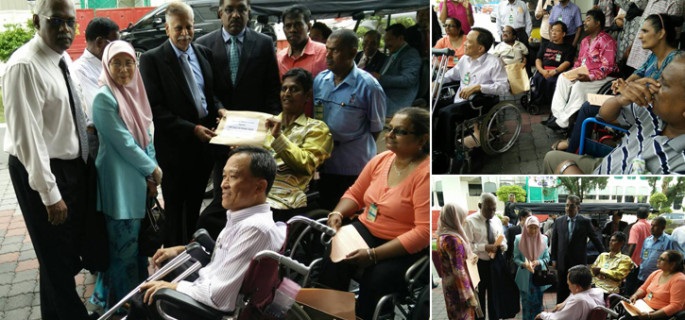
Badan Latihan dan Hidup Berdikari Malaysia (ILTC) pada 23hb Mac 2016 menyerahkan memorandum kepada ahli-ahli parlimen mendesak supaya golongan orang kurang upaya (OKU) dikecualikan daripada cukai barangan dan perkhidmatan (GST).
Disabled Members Protest
Disabled Members Protest at JPJ Wangsa Maju
ILTC Malaysia members staged a protest outside JPJ Wangsamaju KL.
Disabled group’s protest disabled drivers required to produce doc's medical report.
Wednesday, 8 July 2009
Mismanagement And Abuse Of Taman Sinar Harapan Inmates Intolerable: Sec-Gen
‘Ray of hope’ that turned out to be a nightmare
ly 5, 2009Ray of hope’ that turned out to be a nightmare
KUALA KUBU BARU: We were hit by the stench of faeces and urine the minute we walked into the men’s block at Taman Sinar Harapan located in a secluded area of the town here.
Mr A, a volunteer from a non-governmental organisation who goes to the home every Sunday to clean and feed the residents, opened the locked door at the back of the block and we were stunned by what greeted us.
About 30 stark naked men were inside the room, either lying down or sitting on the wet marble floor. In one part of the room, we saw a pool of blood, still fresh and red, on the floor.
Half of the men were locked behind bars like animals in a zoo while the others were able to move about in the front portion of the room. Those in the “jail cells” were segregated so that they would not harm their non-violent roommates.“Those who are accidentally placed inside the cells with the more aggressive residents would be beaten or abused,” the volunteer revealed.
Most of them looked no older than 50 but they were just skin and bones and some looked extremely frail. One resident was lying on his stomach on a wooden bench and had passed motion; we almost gagged at its stench.
Fans were installed inside the room for better ventilation but that was the only luxury the men had. There were no beds, no toilets and not even blankets to keep them warm on cold rainy nights.
Those who were not in the “jail cells” were given beds but without any mattresses or pillows.
They were, however, chained to the bed frame with metal chains and a steel lock.
We were told by a volunteer that they were restricted to prevent them from hurting themselves. The volunteer also shared that the men were not given any clothing as they had used their shirts to strangle themselves or the other men in the past.
After a briefing by Mr A, we got down to work. We were put in charge of spreading mats and towels on the floor.
The volunteers were all given different tasks. A group of about six or seven men were in charge of bathing the locked-up residents, the women were in charge of preparing the food and feeding the residents while the rest (there were two children in the volunteer group) were in charge of cleaning up the place and washing their clothes.
The residents were hosed down with water and soap by volunteers dressed in construction boots and a water proof apron.
After that, the male volunteers carried the naked men to the front part of the building for us to towel dry them.After sensing our discomfort, a female volunteer nearby said: “It’s okay, they’re just like babies, you know, they don’t know anything.”
We proceeded to wipe them dry one by one before we were told to feed them with the yong tau foo bought by one of the volunteers.
The food was mashed to bits and mixed with soup to minimise the need to chew and to make feeding an easier task. so that the residents only needed to swallow them.
As we fed them, some ate obediently while others were greedy and stuffed their hands inside the bowls to take out larger portions of the food.
Some volunteers reprimanded the greedy ones who crawled towards the table to help themselves to more food.
We noticed that some of the mentally disabled residents liked to hit themselves repeatedly. When we tried to stop them, they would fight back or just hit their body against the floor.
Mid-way through feeding, some volunteers suddenly rushed over to a young resident whose head was bleeding profusely. We were told that the boy had slipped and fell.
The volunteers immediately dressed him up, put him on a wheelchair and sent him to a hospital nearby.
After mopping the floor, we took a break and noticed that the residents were taken back into their cells to be locked up again.
It was nearly 4pm when everything was done. The residents were all bathed, fed and the place was clean enough.
We asked the volunteers what would happen to the residents on weekdays when the group was not there to offer their help.
The naked truth: Some of the inmates who were caged up in the home.“The caretakers don’t do much. There are only two of them while there are 50 residents. If it’s time to feed them, they would just walk one round with a bowl and feed whoever wants to eat.
Those who don’t are left alone,” answered a volunteer.
She divulged that another charitable organisation had brought food for the residents but it was thrown away.
“When the group asked why they did such a thing, the caretakers said that the residents would create a bigger mess if there was more food because they would defecate more often,” she said.
After the voluntary group had left, we stayed back to check out the other blocks.
The women’s wing looked cleaner and did not smell as bad but a handful of the women were seen walking about in the nude.
The two caretakers stationed at the block were seen watching TV and chatting.
We noticed that the women’s clothes were laid out to dry on a dirty floor caked with fungus. We walked over to the children’s block which seemed to be the best kept part of the home. It was decorated and there were proper beds. But the children were curiously quiet.
A volunteer claimed that the children were fed with cough syrup so that they would be sleepy and docile.
A govt-run shelter for the disabled has, instead, become their jail
By YUEN MEIKENG and ZALINAH NOORDI
Caged life: An inmate crawling on the floor, hardly aware of his naked existence at the Taman Sinar Harapan home in Kuala Kubu Baru. — SAM THAM / The StarEqual standing

Equal standing
WHEEL POWER WITH ANTHONY THANASAYAN
The disabled deserve the same rights as the able-bodied.
I WAS delighted to be invited to speak on social justice and people with disabilities at a two-day seminar organised by the Institute of Islamic Understanding Malaysia in Kuala Lumpur last week.
There were three other speakers. Their focus was on children and the elderly, indigenous communities and foreign or “guest workers” in Malaysia.
In my talk, I pointed out to the audience which was made up of mostly professionals, that it was essential to have a proper understanding of disability before one can start to tackle the issue of social justice. Another key consideration is the person affected by disability.
Judging from the nods from the audience, I was glad that I managed to drive home the point that disability is everyone’s issue. Common diseases like heart attack, cancer and diabetes can lead to handicapping conditions. Disability not only affects us but also our loved ones, friends, colleagues and employers.
Once we understand this, we will be in a better position to discuss the issue of social justice when it comes to Malaysians with disabilities.
This was the main reason why I, as an MBPJ councillor, embarked on a project recently to build a universal design pavement along a 500m stretch of Jalan Gasing in Petaling Jaya, Selangor.
In keeping with international and local standards, the design includes tactile markings on the floor to help the blind get around.
The pavement will also be wheelchair-friendly. Mothers with prams, pregnant women and the elderly will be able to walk on it safely.
The unique design will prevent cars from accessing the special pavement. Street furniture will also be removed for unimpeded access.
If proven successful, the design will be used in all of Petaling Jaya’s pavements.
I was saddened by certain quarters who rushed to criticise the project even before it was completed.
Someone asked if a “proper study” was done to see if there were disabled people in the area. The argument implies that disabled people are only found in a certain part of town. This kind of thinking clearly stereotypes people with disabilities.
I have seen elderly persons with walking sticks going to the local shops, park, church or temple.
And on every occasion they chose to walk on the road and court danger instead of on the pavement.
The reason they avoid the pavements is obvious. It is too high for them to negotiate. The pathway also narrows down suddenly next to large open drains.
I guess the lesson here for all of us is to stop labelling and stereotyping the disabled in our community.
It this attitude that has kept them locked away from society.
Let us never forget that they are people like us. And they are entitled to the same rights and privileges as citizens. The best thing we can do for them is to offer our unflinching support.
Saturday, 27 June 2009
ஊனத்தை வென்றவர்கள்
Vanakkam Malaysia
விரிவான செய்திகள்
ஊனத்தை வென்றவர்கள்
27-06-2009 (14:20:58)
ஊனத்தை வென்றவர்கள் 'ஊனம்...ஊனம்...ஊனம் இங்கே ஊனம் யாருங்க...உடம்பில் உள்ள குறைகளெல்லாம் ஊனமில்லேங்க. உள்ளம் நல்லாருந்தா ஊனம் ஒரு குறையில்லை. உள்ளம் ஊனப்பட்டா உடம்பிருந்தும் பயனில்லை'.
இந்தப் பாடலுக்கு உதாரணமாக இருக்கிறார் பிரான்சிஸ் சிவா என்பவர்.
இவருடைய வாழ்க்கை எல்லாம் ஒரு சக்கர நாற்காலியில்தான். அவரின் சோதனையான அனுபவங்களையும் அதைச் சாதனையாக்கியது எப்படி என்றும் கேட்டோ ம். இதோ அவரே விவரிக்கிறார்.
'எனக்கு 26 வயசு இருக்கும். அப்போது ஓர் இஞ் சியனியரிங் கம்பெனியில் வேலை பார்த்தேன். அப் போதே எனக்கு 3 ஆயிரம் வெள்ளி சம்பளம்.ஒரு நாள் காரில் போகும்போது பகாவ் அருகே விபத்துக்குள்ளானேன். முதுகுத் தண்டில் அடிபட்டு கால்கள் நடக்க முடியாமல் போய் விட்டதுஐந்து ஆண்டுகள் மருத்துவமனைப் படுக்கையில் கழிந்தன.
ஒரு வருடம் இந்தியாவில் சிகிச்சை பெற் றேன். எந்தப் பயனும் இல்லை.அப்புறம் வாழ்க்கையே சக்கர நாற்காலி யில்தான். 23 வருடங்களை கடத்தி விட் டேன்.
ஆரம்ப காலத் தில் நான் பட்ட வேத னையை விவரிக்க முடியாது. பிறக்கும் போதே ஊனமாக இருந்திருந்தால் ஒன்றும் தெரியாது. நன்றாக நடந்து ஓடி ஆடி திரிந்த பின்னால் ஓய்ந்திருப்பதைப் போல் கொடுமை உலகத்தில் வேறு எதுவும் இல்லை.
சொந்தமாக இஞ்சினியரிங் கம்பெனி திறக்க வேண்டும் என்பது என்னுடைய வெறி.
ஆனால் ஊன முற்றவர்களுக்கு சேவை செய்ய வேண்டும் என்று இறைவன் நினைத்து விட்டான் போலும். சொக்சோ பணம் வருகிறது. இன்சூ ரன்ஸ் கிடைத்தது. அதனால் வாழ்க்கையை சமாளிக்க முடிகிறது. ஆனால் இப்படியே வாழ்க்கையக் கழிக்க விரும்பவில்லை.
விபத்தில் சிக்கி நடமாட இயலாமல் போய் விட் டால் இத்தோடு வாழ்க்கை அஸ்தமனம் ஆகிவிட்டது எனக் கருதி பலர் மனம் ஒடிந்து போய் மன நோயா ளிகள் போல் ஆகிவிடுகிறார்கள்.
மருத்துவமனையில் இருந்து வந்த பிறகு நானே வீட்டிற்குள் ஒழிந்து கொண்டுதான் இருந்தேன். யாரையும் பார்க்க மாட்டேன். வெட்கப்பட்டுக் கொண்டு வெளியே வரமாட்டேன்.
அதனால்,அவர்கள் வாழ்க்கையில் மறுமலர்ச் சியை ஏற்படுத்த வேண்டும் என நினைத்தேன்.
அத னால் என்னைப் போன்ற சில நண்பர்களை சேர்த்து ஊனமுற்றோர் தன்னிலைப் பயிற்சி மையம் என்ற ஓர் அமைப்பை ரவாங்கில் நடத்தி வருகிறேன்.
விபத்தில் சிக்கி ஆதரவில்லாமல் இருப்பவர்கள், குடும்பத்தினரால் கைவிடப்பட்டவர்களை எங்கள் மையத்திற்கு அழைத்து வந்து தங்க வைக்கிறோம். எங்களை பார்த்தவுடன் அவர்களுக்கு தன்னம்பிக்கை வந்து விடுகிறது. எப்படி வாழப்போகிறோம் என தவித் தவர்களுக்கு இப்படியும் வாழலாம் என கற்றுக் கொடுக்கிறோம்.எங்கள் அமைப்பில் 165 பேர் உறுப்பினர்கள்.
புதி தாக வருபவர்களுக்கு நாங்கள் ஒரு முன்மாதிரியாக இருக்கிறோம். நம்மாளும் வாழ முடியும் என்ற தன்னம் பிக்கையை ஏற்படுத்துகிறோம். சுயமாக வேலை களைச் செய்து கொள்வதற்கு பயிற்சி கொடுக்கி றோம்.
ஊனமுற்றவர்களுக்கு அரசாங்கம் நிறைய சலுகை அளிக்கிறது. இது நிறையப்பேருக்கு தெரியாது. இந்தச் சலுகைகளை எப்படி பெறுவது என்ற வழி முறைகளைச் சொல்லிக் கொடுக்கிறோம்.
எந்தவித சிரமமும் இல்லாமல் எங்கள் அமைப்பு இயங்கிக் கொண்டிருந்தது. அரசாங்கம் உதவி செய் கிறது. சில நிறுவனங்கள் உதவி செய்கின்றன. இரக்க மனம் உள்ளவர்கள் இயன்றதை கொடுக்கி றார்கள்.
இருந்தாலும் பொருளாதார மந்த நிலை நாட்டில் ஏற்பட்டதால் பணப்பற்றாக்குறை எழுந் துள்ளது. அதைச் சமாளிக்க தடுமாறுகி றோம். அதற்காக ஒரு நிகழ்ச்சியை ஏற்பாடு செய்து நடத்தி நிதி திரட்டும் நோக்கத்தில் இருக்கிறோம்.
மின்னல் எப்.எம்.மின் இசைப்பயணம் என்ற கலைநிகழ்ச்சி நடைபெறும். காலை 9 மணியில் இருந்து இரவு 11.30 மணிவரை பல நிகழ்ச்சிகள் நடைபெறும்.
இந்த நிகழ்ச்சியின் மூலமாக கணிசமான நிதி திரட்ட திட்டமிட்டிருக்கிறோம்.
பலர் எங்களுக்கு ஆதரவுக் கரம் நீட்டி இருக்கிறார்கள். மலேசிய நண்பன் நிர்வாக இயக்குனர் ஷபி சிறப்பு வருகை தருகி றார். எங்களுக்கு உதவ நினைக்கின்ற நல்லுள்ளங்கள் நிகழ்ச்சி நாளன்றும் செய்ய லாம்.
ரவாங் கோலகாரிங் பள்ளி மைதானத் தில் நிகழ்ச்சி நடைபெறவிருக்கிறது. கால்கள் செய லிழந்து இருந்தாலும் குறிக்கோள்களில் வெற்றி கண்ட நாங்கள் படைப்பு கண்டு ஊக்கம் அளிக்க உங்களை அழைக்கிறோம்.
இவ்வாறு ஊனமுற்றோர் தன்னிலை பயிற்சி மையத்தின் தலைவர் பிரான்சிஸ் சிவா குறிப்பிடுகி றார். மேல் விவரங்களுக்கு தொலைபேசி: 03-60936292, 019-3385959
Jalan Gasing project to test viability of barrier-free access
By TAN KARR WEI

A MBPJ engineering department representative said that the pavement along the 500m stretch of road was upgraded at a cost of RM180,000, including railings installation and covering up of the drains.
Thanasayan also said that the approach of conducting studies to find out the number of disabled people in an area was outdated and added that it was a misconception that the disabled were only centred in one place. Back in 2000, the then Petaling Jaya Municipal Council (MPPJ) had chosen Section 52 (PJ New Town) as a pilot project to build more disabled-friendly facilities.
The disabled all for facility to ease mobility

By YIP YOKE TENG
Thursday, 25 June 2009
Australia Launches Global Info Service For Disabled
June 24, 2009 12:47 PMCANBERRA, June 24 (Bernama) -- A global information service to help people with disabilities find the right mobile phone for their needs is launched here on Wednesday, reports China's Xinhua news agency.
Saturday, 20 June 2009
ILTC CHARITY BAZAAR - FOOD, FUNFAIR & CHARITY SHOW

“PLEASE HELP US TO HELP THE NEEDY”
Majlis Perbandaran Selayang (MPS) in collaboration with Independent Living & Training Centre (ILTC) are Jointly Organizing “ Charity Carnival Bazaar Food & Funfair 2009” and a Charity Show on Saturday, 4th July 2009 between 10.00am to 11.50pm at Sekolah Kebangsaan Rawang, Jalan Kuala Garing, 48000 Rawang, Selangor Darul Ehsan
ILTC CHARITY BAZAAR – FOOD & FUN FAIR 2009
(Together With A blood Donation Campaign and FREE health screening to the public)
With reference to the above-mentioned event,
I / my company would be willing to help the disabled with the following donation / sponsorship/ Coupons for the food & fun fair are RM10 per booklet
口 RM 5,000 口 RM 3,000 口 RM 2,000
口 RM 1,000 口 RM 500 口 RM ______________
Cheque No: _______________________________
Please send us your crossed cheque made payable to
“INDEPENDENT LIVING & TRAINING CENTRE”
Or Bank in your donation to our Bank Account at Affin Bank, Rawang Branch
Account Number 10-043-001007-8
Please Fax your bank in slip & address to 03-6091 2531, we will send you the tax-exemption receipt.
· I / my company wish to sponsor the following for Charity Sales
Items: _______________________Quantity: _________________ boxes / cartons / pieces
Name/Company:_____________________
Address:___________________________
Person Contact: ______________
Tel: _______________________
Email: _____________________
.jpg)
.jpg)
Karpal all praise for disabled-friendly facilities

Karpal all praise for disabled-friendly facilities
KARPAL Singh (DAP - Bukit Gelugor) is all praise for the newly modified ramp and special lift meant for the disabled at Parliament House.
“This is a good development. It’s good for disabled visitors who come to Parliament, and not only for me.
“It’s a necessity now as many were unable to come due to the lack of facilities,” said Karpal, who was wheeled into the building from the back entrance via the new low-gradient ramp.
The new ramp at the back of the main building comes with an overhead roof.
He then took the lift to the first floor where the Dewan Rakyat is located.
Karpal said that in April, he fell forward from his wheelchair while using the ramp at the front of the tower block because it was quite steep.
Only half helpful

Only half helpful
Wheel Power by ANTHONY THANASAYAN
Ivory towers and red tape must be done away with if we really want to help the disabled.
LAST week, a woman with walking difficulties came to see me for help. She wanted to set up a food stall so that she could support her two young kids. Her abusive husband offered no financial help for the family.
A week earlier, I visited a man who suddenly became blind from a hereditary disorder. Without a job, he had little cash in his hands. His only support was RM90 a month from the Government, plus some extras donated by one or two well-wishers. He lives in a dirty flat with his brother who is also losing his sight.
I was also referred to a deaf-mute young man who yearns for work.
Several others told me they did not know how to approach the welfare departments in their locality, whilst others who did so said they were put off by unfriendly staff or officers who did not give them full information.
Trying to help all these people, I discovered, can be frustrating.
Early this week, I received an e-mail from a friend, Captain A.K.S. Russell from Seremban, who shared with me the experience he and his wife went through when they visited the Social Welfare Department in Kuala Lumpur.
“We went up to the 9th floor of the Grand Seasons Avenue in Jalan Pahang – a place where we had to go to try to find out what was needed to apply for a grant for a voluntary welfare organisation,” explained Russell, 61. “We did this after receiving two letters pertaining to a KL-based society where we serve as volunteers.”
Russell said although the Welfare Department is a large office that is accessible to wheelchair users, it is difficult to get there using public transport.
Russell noted that many of the handicapped who were present – together with the elderly and the poor – had no choice but to resort to taxis to get there.
When the couple arrived, they had to go through an initial screening before being given a number and told to wait.
Although the waiting room was large and clean, with plenty of seats, it was insufficient to accommodate the large number of people who were present.
“Whilst waiting, I overheard some of the people being told by the staff: ‘You need to go to such-and-such a place before we can attend to you ...’ or ‘you will need to come back again another time’.
“Such treatment only puts these people through further hardship instead of helping them,” said Russel.
Many of them, however, patiently suffered in silence.
“What the Welfare Department should do is streamline efforts by going out of their offices and meeting the handicapped in their homes, at local community centres, and elsewhere, to ensure that their services are expediently carried out.
“Websites should tell visitors everything. This includes all the necessary forms, criteria and information needed for the various people in the target group that the Welfare Department is trying to help instead of only providing telephone numbers and addresses of the respective departments,” said Russell.
“This information should include a map on how to get to the building proper and the various departments, not forgeting details of access inside the builing for wheelchair users and the blind,” added Russell
Lift for wheelchair-bound MPs and visitors ready


Convenience: Norizan trying out the lift for the disabled at the parliament building yesterday.
He said the proposal was to accommodate wheelchair-bound MPs like veteran DAP MP Karpal Singh and other visitors.
Wheelchair-bound Norizan Kasbi was pleasantly surprised when he saw the lift during a visit to Parliament yesterday.
The former Johor Umno Youth information chief was the first disabled person to use the lift.
“This is thoughtful of the Parliament administration,” said Norizan, 47, who became paralysed after a road accident in Sabah in 1999.
Monday, 15 June 2009
Use 'People With Special Ability' Instead Of 'Disabled People': Ahmad Shabery
June 13, 2009 18:38 PMSunday, 14 June 2009
Come Join The Fun!
Sunday, June 14, 2009
To Whom It May Concern;
Dear Sir/Madam,
ILTC CHARITY BAZAAR – FOOD & FUN FAIR 2009:
(Together With A Blood Donation Campaign and FREE health screening to the public)
APPEAL FOR DONATION & SPONSORSHIP
Independent Living and Training Centre is a charitable organization, which was formed BY the disable and FOR the disable to provide free services for their members who are living throughout the county. These services are carried out with the main objective to teach, guide and assist disable members to lead an independent live and face daily challenges with self confidence and esteem.
We provide the following services to the disable members and community;
- Counseling and Personal Motivation
- Disability Information and Advice
- Computer Training
- Self Development Programs
- Technical Assistance and Training
- Making of Handicrafts and Sewing
- Motivation
- Job Identification and Placements
Through these programs we have achieved numerous successes. Many disabled members have gained confidence and technical knowledge and so far thirty two (32) of them have been successfully employed
In addition to the above services we provide, we also emphasize in educating the immediate family members of the disabled, the manner to handle and care for a disabled person at home. These services are presently being provided free to more than one hundred and sixty (160) non-resident trainees whom we are assisting to lead an independent live. Besides those regular training programs, we also provide food and lodging to fifteen (15) resident-trainees.
The current economic downturn has affected the inflow of regular donations we receive from our well wishers. We therefore need to raise funds approximately RM 120,000 to maintain and continue the programs and training to the disabled community.
We have planned to organize a “Charity Bazaar – Food & Fun Fair 2009” & Charity Concert at evening (together with a blood donation campaign and FREE health screening to the public) event on Saturday, 4th July 2009 between 10.00am to 11.50pm at Padang Sekolah Kebangsaan Rawang in Jalan Kuala Garing, 48000 Rawang, Selangor Darul Ehsan
At the school field, we are putting up forty (40) to fifty (50) stalls offering local food and drinks, books, ornaments, souvenirs, handicrafts, antiques and various products contributed by trading and marketing companies and manufacturers to raise fund in the Charity Bazaar. To make the event more exiting we are organizing games for adults and children, lucky draws, and entertainment.
We would appreciate if your esteemed organization could support us by making donation in cash or products that can be sold in the charity bazaar or offer prizes for the various games, entertainment and lucky draw.
Should you have any further enquiries or require more details please do not hesitate to contact Ms. Rina at 03-6091 2531, 03-6093 6292 or 012-695 6786. You may also visit our website at: http://www.iltcmalaysia.org.my/ and for details of our latest development/activities are at the blog: http://iltcmalaysia.blogspot.com/
The ILTC is a non-profit organization, and is entirely run on charity and is therefore always seeking funds and volunteers to help us to achieve our aims and objectives.
TAX-EXEMPTED
Your donation to the Independent Living & Training Centre is exempted from Income Tax under the Provision of Section 44(6) of the Income Tax Ordinance. Ref. No. LHDN.01/35/42/51/179-6.5732
We hope that our appeal will meet your consideration and looking forward for a favorable reply from your esteemed organization.
Thanking you in advance,
Yours sincerely,
Ms. Rina
Secretary of ILTC &
Councilor for Selayang Municipal Council's (MPS)
“PLEASE HELP US TO HELP THE NEEDY’S”
Thursday, 11 June 2009
Growth of two NGOs

Growth of two NGOs
Wheel PowerBy ANTHONY THANASAYAN
TWO organisations which support Malaysians with disabilities held their annual general meeting on the same day last week.
The first was the Independent Living and Training Centre (ILTC) in Rawang, Selangor. About 90 members turned up on May 31 at the society’s premises in Taman Garing.
The focus of the AGM was a food and funfair fund-raiser that ILTC is organising for July 4. It will be held at a school near the centre. There will be several concerts featuring disabled performers.
“There is no point in holding concerts in aid of disabled people if they can’t be part of the occasion,” said ILTC president Francis Siva. “We should stop our culture of putting the handicapped in the spectator’s chair. It’s time we made them stars, too.”
The ILTC will be commemorating its seventh anniversary in September. It currently has 12 physically handicapped residents who receive living skills training which includes computer classes, cooking lessons and personal grooming tips. The services are provided free.
The centre requires RM10,000 a month for its operations. ILTC is looking forward to building a disabled-friendly training centre in Rawang. The centre has, to date, raised 45% of the RM1.5mil needed for the building.
Meanwhile, the Malaysian Animal-Assisted Therapy for the Disabled and Elderly Association (Petpositive) held its fourth AGM last month. The association turned four last Sunday.
The AGM was held at the Petpositive Therapy Centre (PTC) in Jalan Carey, Petaling Jaya.
The PTC was recently fitted with up-to-date facilities for the disabled.
“The elderly will find railings designed to help them walk into our centre through a gentle ramp,” said Petpositive’s assistant secretary Shenaaz Khan. She added that the main attraction of the PTC is a special therapy room for clients of Petpositive and their pets.
There is a corner for marine therapy as well as an indoor fish pond that is accessible to wheelchair users.
PTC provides free services for the elderly and disabled visitors. The centre requires RM5,000 a month for its rental and other expenses.
For more information on ILTC, visit http://www.iltcmalaysia.blogspot.com/or call 03-6093 6292.
To know more about Petpositive, visit http://www.petpositive.blogspot.com/ or call 012-012-220 3146 .
Wednesday, 10 June 2009
Johor council employs 15 disabled persons

Monday, 8 June 2009
Facelift for Section 52, PJ

He was speaking after attending the cleaning up session of the complex yesterday.
Cleaning up: Thanasayan (on wheelchair) helping out during the cleaning up exercise at the food court in Complex C, PJ New Town. Also present during the event were the council’s town planning department deputy director Khairunnisa Haron, Health Department assistant officer Low Ching Keat and the complex’s trader representative Mohamad Shuffie Hassan.
Thanasayan said they had decided to kickstart the programme at the premises because of its potential and the need for its revival.
Traders who are operating on the ground floor of the premises have been complaining about poor business, especially in the past four years. Most of the stall owners have decided to close their business. Currently, only 25 of the 70 stalls are still operating.
“This was one of the most happening places in the area.
“But now things have changed and not many people know about this place any more,” said Thanasayan.
He said when he was younger, he used to go to the food court for a meal after a swim in the public swimming pool nearby. The swimming pool was closed about four years ago.
He added that a meeting was also held with the traders recently to listen to their grouses.
The traders had also complained about cleanliness of the place and lack of promotion to boost business.
“We are planning to make this place friendly for patrons including having an open-air eating concept on the front area and have more greenery to attract customers.
“The council is also tackling the pest problem faced by the traders and educating them on the importance of keeping their place clean,” he said.
Ramps will also be built to make the place more accessible for the wheelchair-bound and special toilets for the disabled.
Meanwhile, Mohamad Shuffie said they were planning to organise various activities at the premises to attract customers.
“We are planning to hold a Father’s Day celebration here this month and we welcome everyone. There will also be a chess competition.
“At the same time we are also planning to put up a stage and maybe have a live entertainment for our customers,” he said.
Thursday, 4 June 2009
Monday, 1 June 2009
THE 7TH ANNUAL GENERAL MEETING OF ILTC
I the President of Independent Living & Training Centre of Selangor & Wilayah Persekutuan Kuala Lumpur would like to take this opportunity to personally thanks to all of you for making this THE 7TH ANNUAL GENERAL MEETING OF ILTC a very successful one and I would like to welcome the new Central Committee's and members to joint hand together for the success and betterment of coming year 2009 - 2010


Menara MPAJ to be more disabled-friendly

Uphill task: Mohammad making his way up the ramp in Menara MPAJ.Thursday, 28 May 2009
NOTICE OF THE 7TH ANNUAL GENERAL MEETING OF ILTC
To All Members of ILTC
Dear Sir / Madam:
RE: NOTICE OF THE 7TH ANNUAL GENERAL MEETING OF ILTC
Notice is hereby given that the 7th Annual General Meeting of the Independent Living & Training Centre of Selangor & Wilayah Persekutuan Kuala Lumpur will be held on 31st of May 2009 (Sunday), at 10.00am, Venue: Independent Living & Training Centre, Taman Garing, 48000 Rawang, Selangor Darul Ehsan.
We hope all members will be able to attend this meeting and your presence at the AGM will be highly appreciated.
If you have any enquires please contact President or Secretary at 03-6091 2531 or 03-6093 6292
I look forward to meeting you again on 31st May 2009
Thank you,
Ms. Gurdip Kaur @ Rina
Secretary of the ILTC
Like a stroll in the park

WHEEL POWERBy ANTHONY THANASAYAN
The MPS disability technical committee will be tasked with looking into the needs of disabled residents, and ways in which they can have a better quality of life.
Wednesday, 27 May 2009
Rehab effort helps injured employees return to work


Checking it out: Two DBC physiotherapists demonstrate how an assessment is done.
Each case received by the Socso is handed over to case managers who take the time and initiative to ensure that the cases are genuine and deserved aid.
Gayathri Vadivel, a case manager, said upon receiving a case, an initial assessment was carried out to verify the extent of the injuries and disability.
Her colleague, Rosmawati Mat, 37, said the case managers worked on the strengths of the patients to ensure they received either rehabilitation or vocational skills.
This will help the patients become economically independent.
“Most of the time, these people are afraid that they may not be hired again by their employers or other companies so we have to find a way to ensure that they do get a job after the programme,” Rosmawati said.
The steps taken by the case managers include talking to the previous employers and convincing them to retain the employees with adjustments to their job scope.
“The employers are afraid that the disabled employees can no longer work as well as when they were able bodied but statistics show that a disabled employee is more loyal,” Gayathri said.
In the case of Low Yew Loi, 32, who was involved in an accident at his work place early this year, he managed to continue with his job after recuperating from his injuries over a six-month period.
Low, a site supervisor, lost his right leg after he was run over by an excavator during the construction of the Duta Ulu Kelang (DUKE) highway.
“I lost all hope of retaining my job. That is when Socso stepped in and bought a prosthetic leg for me,” he said.
“They also spoke to my employer and ensured adjustments were made so that I could continue working for them,” added Low who is now confined to office work.
At the RTW National Seminar 2009 held recently, Human Resources Minister Datuk Dr S. Subramaniam said more case managers would be hired to help workers who had sustained injuries.
“For now, there are only nine case managers in the country but by the end of the month we hope to employ 34 more,” he said.
Besides the case managers, the rehabilitation centres also play an important role in ensuring that the patients receive proper rehabilitation and are fit to work again.
One such centre is the Document Based Care (DBC) company that has been working with Socso since its pilot project in February 2005.
DBC chief executive officer Wee Hock Kee said DBC was the only service provider with the capacity to support the Socso RTW project nationwide.
“We have successfully treated 500 Socso patients so far nationwide and we have a success rate of more than 30% for the pilot project and for RTW early intervention, it is 63%,” he said.
DBC has back, neck, shoulder and knee protocol and assessment and it covers the psycho-social assessment of the patient and follows an approach called the “Cognitive Behaviour Approach”.
“Each rehabilitation programme lasts for 12 weeks and includes two physical examinations and 24 sessions of physiotherapy and muscle reconditioning sessions,” Wee said.
Disabled buddies find their niche at hypermart
Sahril Adamuddin (left) and Mat Jamil Ramli are part of the 60 people with disability who are employed at Carrefour Malaysia.KUALA LUMPUR: Twenty- five-year-old Mat Jamil Ramli spends his day at Carrefour creating press advertisements and leaflets on his computer.
Employed as a graphic designer, Mat Jamil would otherwise go unnoticed at the sprawling Carrefour head office floor in Subang, where hundreds of employees move around like bustling bees, but for the fact that the metre-tall lad uses his toes to type on his keyboard.
Born without hands, Mat Jamil counts himself lucky to have secured a job at Carrefour two years ago.
"Everyone here is friendly and helpful. It's like being part of a big family."
Sahril Adamuddin, 26, is Mat Jamil's lunch buddy, who sometimes helps the latter cut up his meat during meals. Wheelchair-bound Sahril works as a pricing clerk at Carrefour and, like Mat Jamil, he feels he is at the "right place".
Mat Jamil and Sahril are not the only people with disability (PWD) who work at Carrefour Malaysia.
There are currently 60 PWD who make up two per cent of Carrefour's 3,423 workforce.
According to Carrefour human resource director Mohamad Fauzi Hassan, the company implemented the hiring policy two years ago when it employed 20 PWD at its stores nationwide.
The hypermarket hopes to hire about 400 PWD by 2012, making up five per cent of its expected 8,000 workforce.
Carrefour became part of the United Nations Development Programme's pilot project called Employment Model for PWD last year, under an agreement where UNDP provides job coaches for Carrefour to train the PWD.
Carrefour has also, on its own initiative, trained job coaches among its staff to cater to the hypermarket chain's expansion, Fauzi said.
These coaches are given special training, such as sign language and systematic instruction.
"To help them, the PWD are partnered with a Carrefour 'buddy' each.
They are given on-the-job training under supervision until they are able to perform the tasks on their own.
" He added that there were hardly any disciplinary problems among the PWD."
They are enthusiastic and passionate about their work. Once, one of them fell ill but he insisted on coming to work. His parents, however, refused to allow him.
"So he made them come and explain to us that he was indeed ill. I told them they didn't have to come and that they only needed to call."
Fauzi said there were no restrictions as to where the PWD were placed in the hypermarket. They work in the head office as marketing executives, graphic designers, accounts executives and data entry clerks. At the store front, they are hired as clerks, security personnel and call centre and customer service representatives, among others.
While Carrefour's disabled personnel are independent, where they travel to and from work on their own, Carrefour is planning to provide accommodation and transportation in the future, through its Yayasan Carrefour.
Thursday, 21 May 2009
A fair picture?

WHEEL POWER
By ANTHONY THANASAYAN
Do TV shows represent how the disabled wish to be protrayed?
I WAS delighted to read the recent comments by Information, Communications and Culture Minister Datuk Seri Dr Rais Yatim. He called on television and radio stations to provide fair coverage of the various communities in Malaysia.
The minister, referring to on-air shows such as sitcoms, serials and local films, urged those who produce them to ensure that they reflect the culture and aspirations of Malaysians.
I couldn’t agree more with the minister. Although Dr Rais did not specifically mention it, I have no doubt that he would feel the same for broadcast shows that depict the marginalised communities, namely the disabled. Do shows on the handicapped truly represent how they wish to be portrayed? Not too long ago, I caught a local show where “a tragedy” occurred in a family.
A couple rushed to a hospital when they heard that their son was involved in a car crash.
After hours of waiting at the surgery and fearing the worst, the couple met the grim-faced surgeon when he finally emerged from the operation theatre. The distraught parents looked at the doctor who shook his head and said: “I’m sorry. Although your son has survived, he will be paralysed for the rest of his life.”
The parents hugged each other and wept, as if to show that it would have been better for their child if he had not survived at all than to spend the rest of his life as a handicapped person.
Such a portrayal of the disabled by the media is not at all helpful nor is it accurate about the disabled community in Malaysia.
When someone becomes crippled, the most important thing is to give them hope and show them that life is worth living – because it really is.
What is tragic is not that one becomes disabled but rather that we still live in a society that has way to go before becoming fully inclusive of all types of persons. Inclusivity means building ramps for wheelchairs and guiding blocks for the blind, and providing special education for the learning disabled and electronic signboards for the Deaf.
Many of us (especially the non-disabled) place too much emphasis on one’s ability to walk, see, hear or think in a certain way. By doing this, we end up marginalising others that do not fit into the picture.
I happen to know quite a few non-disabled people with all of the so-called “positive abilities”. And yet, they are not content with their lives. Some are depressed, others even suicidal. I am happy that my job as a Petaling Jaya City Councillor (MBPJ) is paying off.
We in MBPJ are doing a lot of things to make a difference to the disabled, for example, by providing user-friendly facilities like wheelchair accessible rest-rooms, car parks, pavements and buildings – new and old – and even some form of public transportation.
All these features offer hope and help to the disabled.
I had quite a shock last week. A private TV station that had wanted to do a story on my life suddenly gave up on me. They turned me down because they wanted me to cry on television. The editor apparently thought a good sob was the best way for someone in a wheelchair to get sympathy from the public.
I simply refused to shed a tear in front of the camera. As a result, I lost a chance to go on national TV. But I managed to keep my dignity, and that to me is more important.
Make changes to fit in disabled, bosses told
Tuesday May 19, 2009
Make changes to fit in disabled, bosses told
KUALA LUMPUR: Employers should make adjustments to absorb employees who become disabled after work accidents, Human Resources Minister Datuk Dr S. Subramaniam said.
He said employers must take up this social obligation, and the adjustments could involve changing job specifications, creating flexi-time or making changes to work surroundings, for those still able to work.
“For the preservation of human dignity, it’s important for us, as a nation, and employers to bring these changes to the community,” he said.
Dr Subramaniam said that since the Social Security Organisation’s (Socso) “Return to Work” rehabilitation programme started in 2007, and until March this year, 441 of 566 employees who joined the programme had gone back to work.
The rest, he said, were still seeking jobs, or undergoing rehabilitation or medical treatment.
He said 868 work accident cases had been referred to the programme during the period but only 566 joined the programme.
He was speaking at Socso’s “Return to Work” National Seminar 2009 yesterday.
The ministry was also setting up a rehabilitation centre in Malacca, which would be ready in two years, he said, adding that the RM80mil project was in the preliminary stage of construction.
Currently, the Government was using public and private facilities for the “Return to Work” programme, he said.
Socso board chairman Datuk Hong Lee Pee said they were initially sceptical about the programme succeeding in Malaysia.
However, the response from employers and employees has been good, he added.


