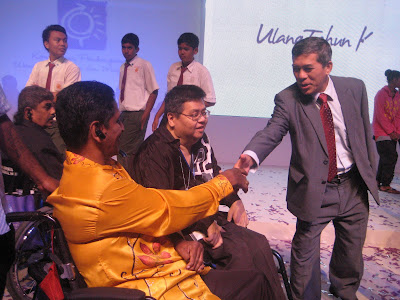
NEW MINISTER FOR WELFARE MINISTER OF MALAYSIA

NEW MINISTER FOR WELFARE MINISTER OF MALAYSIA
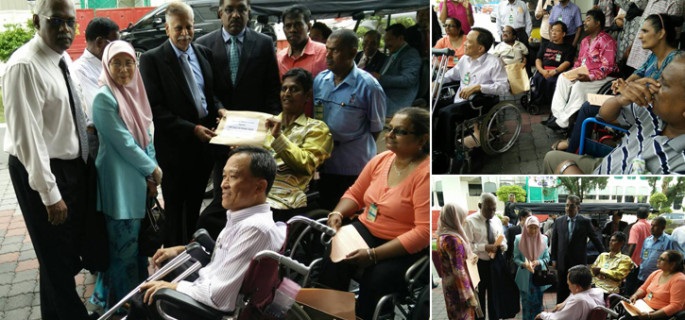
Badan Latihan dan Hidup Berdikari Malaysia (ILTC) pada 23hb Mac 2016 menyerahkan memorandum kepada ahli-ahli parlimen mendesak supaya golongan orang kurang upaya (OKU) dikecualikan daripada cukai barangan dan perkhidmatan (GST).

Disabled Members Protest

Disabled Members Protest
Disabled Members Protest at JPJ Wangsa Maju

ILTC Malaysia members staged a protest outside JPJ Wangsamaju KL.

ILTC Malaysia members staged a protest outside JPJ Wangsamaju KL.
Disabled group’s protest disabled drivers required to produce doc's medical report.

Friday, 21 January 2011

Good move by Sri Maha Mariamman Devastha­nam

Dear Folks,

In the respect, the latest move by Sri Maha Mariamman Devastha­nam chairman Datuk R.Nadarajah for the setting up of a cable car system from the base of the caves to the top of the temple has been approved, and it could be operational by 2012 and welcome the idea by ILTC Malaysia.

The service, to be operational in time for Thaipusam next year, will benefit not only Hindu devotees but also local and foreign tourists.

One can reach the top of the 272 steps leading to the Sri Maha Mariamman Temple in Batu Caves in about 10 minutes, and that too without sweat.

ILTC hope that, Dawnlee Management Services Sdn Bhd managing director Derrick Skelchy make ensure that its development agenda will benefit all sections of the society including people with disabilities and the elderly.

Once completed, the Malaysian people with disabilities will able to enjoy the ride on cable car.

The temple at Batu Caves often attracts over one million devotees and tens of thousands of tourists.

Mr. G. Francis Siva

President of ILTC Malaysia

PM: Malaysia has achieved highest level of appreciation for diversity

Make hospitals disabled-friendly

Thursday January 20, 2011

Access denied

Hospitals and clinics should be accessible to the disabled.

ALL of us know what to do when we fall ill – go and see the doctor, of course.

However, if you happen to be in a wheelchair like me, doing exactly that may not be as easy as one might imagine.

Hardly a fortnight into a brand new year, I found myself being confronted by the first major challenge of 2011. The lower part of my left jaw had swelled up. The gums, teeth and throat in the same area were painful, too. When the pain started to spread to my left ear and slowly towards my eye, I got worried. I realised I had to seek medical attention at once.

Hospitals and clinics need to be more disabled-friendly.

My first instinct was to go and see a general practitioner at a nearby clinic. However, even before one is able to do that, a wheelchair-user will need some kind of assistance to get into a car to go to the clinic for treatment.

I was lucky. My pal Andrew Martin rushed to my assistance.

But my problems were far from over. At the clinic, all the parking lots outside were taken by nondisabled drivers patronising the shops and cafes in the area.

It is sad to note that a clinic that is supposed to serve sick people, including the elderly and the disabled, had not thought of reserving a parking lot for such patients. This can be easily arranged for between the Petaling Jaya local council (MBPJ) and the clinics. Clinics can readily obtain the exact specifications for a disabled-friendly parking lot from MBPJ’s planning and engineering departments.

Access into the building was a nightmare as there were no wheelchair ramps. The doctor, however, was an angel. Realising that his outfit did not cater to wheelchairs, he came into our car to examine me.

This may have worked for the both of us there and then, but all medical clinics really ought to look into providing wheelchair access for their patients.

Failure to do so would deny disabled and elderly patients access to medical treatment.

My problem didn’t clear up after seeing the GP. Apparently it turned out to be a job for the dentist.

Looking for a dentist who was situated on the ground floor was like looking for a needle in a haystack. Nearly all the dentists that I called up had their practices on the first floor. The only one I discovered on the ground floor had a steep and dangerous ramp leading into the clinic.

There was another clinic with disabledfriendly facilities in Kuala Lumpur. However, the fees were beyond my budget.

It seems very wrong to me that one has to pay through his nose for some basic wheelchair-friendly facilities that stand to benefit all types of people. How would these doctors and dentists meet the needs of an ever-growing population of elderly and disabled persons in our society?

I finally found a ground floor dental clinic in Klang, Selangor, about 30km from my home.

Unlike most dental clinics, the treatment room was spacious,with easy manoeuvrability for wheelchairs.

My problem was over as soon as the offending tooth was extracted. But I couldn’t believe I had to travel all the way when the dentistry department of University Malaya Medical Centre is just five minutes away from my house.

Trying to get there in a wheelchair is a “hell-on-earth” experience.

There are no clear signs inside the main hospital to lead a patient to the department. One has to be a paralympian to push one’s wheelchair – without assistance – for what seems like forever to access the new building from the old one.

There are some places where the pathways are deserted.

Imagine suddenly facing a crisis there with no one to help you.

There are also heavy doors that a wheelchair-user has to wrestle with, in order to get in and out.

The pathway also brings the patient out onto the road before they can enter into the clinic.

Those who try to access the direct way are forced to look for a security guard located on another level to get him to come and open a gate to the department. The only lift to the department is just as elusive as the guard. It is concealed in the basement.

I brought these problems up to the public relations department a number of times over the years but I’m told the same story: the matter will be resolved once a new renovation takes place.

Well, try telling that to a pusfilled, decaying tooth that urgently needs to be extracted !
Wednesday, 19 January 2011

CONFERENCE ON THE FUTURE OF MARGINALIZED & MINORITY COMMUNITIES IN MALAYSIA. 23/1/11 Kuala Lumpur

1st NATIONAL HUMAN RIGHTS CONFERENCE ON THE FUTURE OF MARGINALIZED & MINORITY COMMUNITIES IN MALAYSIA. 23/1/11 Kuala Lumpur

January 18, 2011 // s.jayathas // Events, Law, Justice and Federal constitution

1stHR M'sia

For the first time in Malaysia, marginalized and minority communities are getting together to make a joint statement about the centrifugal forces in the race based majoritarian system marginalizing them and about how the time has come for the realignment of the forces to create a new and more vibrant Malaysia.

This conference is jointly organized by:

• Common Interest Group (CIGMA) of Sabah and Sarawak

• Borneo Resources Institute (BRI)

Sarawak Dayak National Union (SDNU)

Sarawak Dayak Iban Association (SADIA)

• HINDRAF

• Human Rights Foundation, London


Also participating:-


Jaringan Kampung Orang Asli Semenanjung Malaysia (JKOASM)


Independent Living & Training Centre (ILTC)- Physically challenge communities.


The express purpose of this conference is to review and assess progress that has been made and not made in the protection and development of the marginalized and minority communities in Malaysia since independence and the root causes of these marginalizing tendencies.

Six papers will be presented along with live testimonies.


Notable personalities including Dr Jeffrey Kitingan, Dr John Brian, Mr. Sambulingam (HINDRAF National Coordinator) and Mr.Mark Bujang will be delivering papers.


This is an open invitation to all to come and be part of creating something uniquely Malaysian.


Venue: KL Chinese Assembly Hall No participation fees

1 Jalan Maharajalela,

50150 Kuala Lumpur


Time : 9.00am to 3.00pm


Date: 23rd January 2011.


Further info: 010 277 4096


Be a participant in the making of Malaysian history. Watch the remaking of an aspect of Malaysian Society so far regarded as peripheral. Come and listen to and contribute to these groups as they come together to assume their rightful place.


“Rights not Mercy”


S.JAYATHAS

National Information Coordinator

HINDRAF Makkal Sakthi

IMG_4333

E-poster rev3

Tuesday, 18 January 2011

Najib: Mindset change our nation’s biggest challenge

10th anniversary celebration of the ministry at the Putra World Trade Putra.

Yesterday, I was invited to participate at the 10th anniversary celebration of the ministry at the Putra World Trade Putra.
The Women, Family and Community Development Ministry has placed welfare transformation as its main agenda in improving the services and professionalism in social activities.

Its minister, Datuk Seri Shahrizat Abdul Jalil said the ministry would continue to ensure that the people, especially the target groups would enjoy a comfortable and well-balanced life.

She said the ministry was determined to ensure that disabled people would be able to participate in the community.

"In this case, the struggle to provide infrastructure and facilities for them become one of the ministry's agendas. It is my fervent hope that accessibility for the disabled to public utilities, education and employment can be enhanced while the family institution strengthened," she said at the 10th anniversary celebration of the ministry at the Putra World Trade Putra here yesterday.

The celebration was launched by Prime Minister Datuk Seri Najib Tun Razak.

Monday, 17 January 2011

Shahrizat: RM1bil spent on welfare last year


Monday January 17, 2011

Shahrizat: RM1bil spent on welfare last year

She said the aid recipients comprised 117,510 senior citizens, 109,782 low-income families, 93,646 children, 89,461 disabled and 3,724 victims of disasters.

Shahrizat said the Government had used the allocations to improve the living standards of the less fortunate in addition to efforts in eradicating poverty.

“Schemes under the department allow us to provide assistance of at least RM100 or up to a maximum of RM450 per month, which is allowed by the Treasury depending on the eligibility of the recipient.

“For 2010, the allocation to help the target groups was higher than RM760mil in 2009 because we focused on helping the elderly as they are often neglected by their families and left to fend for themselves without proper care,” she said in a press conference.

“It is a hefty bill. If we withdraw this safety net, the effect will be great.

“However as a caring Govern­ment, we will not do so,” she said.

Shahrizat said this year, the ministry had introduced the Productive Welfare, an initiative under the Government Transformation Prog­ramme (GTP)’s Low-Income House­holds National Key Results Area (NKRA) called 1AZAM, designed to help participants lift themselves out of poverty through employment, entrepreneurship, agricultural activities and services.

“Under the NKRA, we help them through 1AZAM with seed money that will help them become independent within three months.

“The ministry will go all out with the programme as we want to help the poor become more independent,” she said.

Parking bays for the disabled taken up


Monday January 17, 2011

Parking bays for the disabled taken up

PARKING bays reserved for the disabled are being taken up by able-bodied motorists, leaving the group frustrated and helpless.

A disabled resident from Petaling Jaya, N. Balasubrama-niam, expressed his frustration that parking bays reserved for the handicapped near Maybank in PJ New Town are often occupied by others.

“The motorcycles are parked all over the place and even on the five-foot ways where pedestrians walk.

Not for all: Motorcycles parked close to a bay reserved for the disabled.

“How can a disabled person park when the motorcycles are all over the place. We are also not able to push the machines away,” said Balasubramaniam, 72.

“I know this is a busy business district where parking can be difficult but I really hope there is more consideration from the public for the disabled community,” he said.

He added that although cones were usually placed on parking bays for the disabled, selfish able-bodied motorists sometimes removed the cones to park their cars in these specially designated bays.

“I noticed that enforcement used to be stricter in the past but has become lax now,” he said.

A signboard put up by the Petaling Jaya City Council (MBPJ) is placed in front of the parking bay, stating that it is strictly for the disabled.

Friday, 7 January 2011

APAC Lambasted By MBPJ Councillor

APAC Lambasted By MBPJ Councillor

APAC seeking cheap publicity

A RESIDENTS COALITION HAS COME UNDER FIRE FROM A LOCAL COUNCILLOR.

DATELINE: PETALING JAYA

THE ALL PETALING JAYA RESIDENTS ASSOCIATION COALITION or APAC has been taken to task for not taking responsibility for the conduct of one of its members under its sub-committee at a disabled seminar organised by the Petaling Jaya City Council (MBPJ), last month.

Called, "Moving Forward, Keeping The Promise", the organising chairman and MBPJ Councillor, Anthony SB Thanasayan - who is also in charge of Section 52 where the seminar was held - had written a letter to APAC president Johan Tung on January 1st this year.

In it he strongly protested against the actions by Miss Bathmavathi Krishnan, a subcommittee member of APAC in a wheelchair who, together with three other persons also in wheelchairs, gatecrashed into the seminar that was held in PJ's Civic Centre on December 29, 2010.

Some of the mixed participants

Their purpose, he said, was to clearly try and derail the discussions with their very personal caustic criticisms and baseless arguments.

"Not only that, the subcommittee member took her wild concocted tirade of distortions and half truths about the MBPJ seminar to the media (see report below)," he told PET+BLOGSPOT yesterday.

He then went on to refute each one of them that were made in the newspaper.

His points were also included in his protest letter to Tung, he said.

Describing the complaints as "a mischievous attempt to discredit all the good work that MBPJ had initiated since (Thanasayan) became councillor in 2008" he said:

The speakers on disability were disabled themselves

A) Lie No 1: "The disabled were not invited to the seminar".

1) First and foremost; it is not only the organiser's prerogative to decide on the purpose and agenda of an event; but they also reserve the right to choose who they wish to invite as participants in order to meet the objectives of the event.

2) Second, the event was a closed-door affair and not for the public meeting.

3) Third, it was specifically targeted at the able-bodied community - NOT people with disabilities.

Its focus was on the present key stakeholders such as resident association leaders, heads of religious organisations and places of worship, architects, local councillors and their heads of departments - all who have the power and influence in their positions to make a qualitative difference in the lives of disabled persons.

The seminar was geared to educate them and get them talking about how they can play their parts in creating a barrier-free society.

B) Lie No 2: "APAC was not invited"

1) Tung was not only one of the first participants to be sent an invitation to but also the first to acknowledge receipt of the invitation.

Signing for Deaf particants

This was expressed personally to Thanasayan through the several calls made to him to confirm his attendance.

2) Tung was also briefed that the seminar was targeted at the non disabled only.

3) Tung who turned up at the event, took part in the floor discussions and publicly announced that APAC was pleased with the seminar.

C) Lie No 3: "The disabled were sidelined at the seminar."

1) This gives a cunning impression as if there were no disabled persons or their organisations present at the seminar at all.

There were in fact four officially registered disability societies at the seminar.

Two of them were the Dyslexic Association of Malaysia (PDM) and the Malaysian Animal Assisted Therapy for the Disabled and Elderly Association (PETPOSITIVE).

Both of them are national based non profit NGOs from Kuala Lumpur.

The other two were the Society for the Interpreters for the Deaf or SID and the Independent Living and Training Centre (ILTC) - a self help organisation run by people with disabilities themselves.

Both organisations are Wilayah and Selangor societies with the former based in KL and the latter in Rawang, Selangor.

All of them have disabled and elderly members living in the city of PJ as well as nationwide.

2) The speakers also came from the above organisations to express the views of the blind, Deaf, people with physical disabilities and the elderly at the seminar.

The speakers included a tetraplegic, an expert in the field of learning disabilities, a blind speaker and a Deaf.

There was also a carer for an elderly gentleman who was struck with stroke recently.

By contrast, the gatecrashers were only wheelchair users.

3) Each of the organisations are also council members of MBPJ's disability technical team that is responsible for their input in making PJ disabled-friendly.

4) Invitations were also given out to organisations that represent people with mental illness, People with Parkinson's, stroke and others who were unable to make it for the session.

D) Lie No 4: "The disabled were denied their right of say"

1) Each of the four gatecrashers not only got to speak at almost every session, and also at length, but they even tried to divert the flow of the discussions to bring up their petty and personal issues which should have been raised in another platform or to the departments directly responsible for them.

2) One of them used a vulgar term at the planning director at the seminar to run down MBPJ's award-winning disability projects.

3) Others tried potshots at the distinguished speakers for the day with accusations of hypocrisy to playing with ridiculous language semantics.

4) From feedback received afterwards, most of the participants including the speakers were totally put off by their conduct as well as that of APAC's.

Complaints about their conduct - as well as APAC's role in the incident - were made to Thanasayan before he took the matter up in writing with the association.

However, Thanasayan received a response from Tung four days later, brushing aside the incident and stating that the matter as far as they are concerned is "closed".

In a fresh reply to Tung on January 5, Thanasayan expressed his shock and disappointment with the APAC president's handling of the matter.

He wrote:

"From your response it is clear that APAC is only capable of operating on half-truths and downright lies just to get cheap publicity from the media.

"(It) is the lowest (rung of the ladder) that your organisation has nosedived to," he added.

"(I could never) work with APAC; as being unethical and totally irresponsible have never been the aims of achievements of my (character), work and mission," concluded Thanasayan.

Write to us. Tell us what you think. Was APAC right in handling the issue? Does APAC really represent all persons in PJ? What about the disabled? Does being disabled give one the right to do what one likes including gatecrash an event? Was it fair to bash the MBPJ when it seems to be the only council that is doing its best for the disabled?

PET+BLOGSPOT reserves the right to edit comments or to not print them. Please be polite and constructive in what you say. Thank you!

Click HERE for a previous story on the disability seminar.


The Malay Mail report:

All Petaling Jaya Residents Association Coalition

Disabled sidelined


Associations cross with council's disregard for forum invites by A. Fuad Paiz

Thursday, December 30th, 2010 11:12:00

PETALING JAYA: Associations for the disabled felt sidelined by Petaling Jaya City Council (MBPJ) as they were not invited to a forum yesterday on improving facilities for the group.

The "Real World Challenges and Opportunities for the Disabled" forum was held at Dewan Banquet MBPJ yesterday morning, commemorating World Disabled Day.

All Petaling Jaya Residents Association Coalition and Subcommittee for Elderly and Disabled Residents (APAC-SEDAR) chairman Bathmavathi Krishnan said the council denied them the right to have their say at the forum.

"Why did they not invite us? I was not informed until this morning when the resident association president from my area sent me an email regarding the forum. Only then did I drive to the venue."
Anthony Siva Balan
She claimed the council had not invited disabled folk to avoid them "bashing" ordinary folk at the forum.
PJ councilor Anthony Siva Balan (pic), also the event organiser, brushed off Bathmavathi's allegations as a misunderstanding.

"Previously, MBPJ had organised a similar event for them. I would like to clarify this forum was only targeting able bodies to persuade them to join the council's efforts to provide the best amenities for the disabled."
He assured representatives of disabled people had been invited to the forum.

Bathmavathi, however, was unconvinced.

"We are part of residents living in Petaling Jaya. Therefore, they are obligated to invite us to this event. I saw a lot of empty seats. Why couldn't they just fill it with representatives from the the disabled society?"

The Malay Mail also found attendance at the forum was disappointing.

Echoing Bathmavanthi's statement, Damai Disabled Persons Association of Selangor and Wilayah Persekutuan Malaysia (Damai) president V. Murugeswaran hoped the council would not repeat the mistake in future.

"It is a good idea to bring in the able-bodied to exchange ideas but the council should have known that we are the major players. It must keep us informed of these kind of events so we can give our input."

Thursday, 6 January 2011

Give them a hand

Thursday January 6, 2011

Give them a hand

Do your bit for the disabled and elderly.

IT may be almost a week into the new year but it is never too late to work on our resolutions for 2011.

Here’s a list to help you along, especially if you want to make a difference in the lives of the disabled and the elderly.

Some of them may take a little time and effort on our part. Others, however, are quite simple to accomplish; they call for consideration and kindness to our fellowmen. Here are some things that we can do:

In the home:

> Be a friend to a disabled or elderly person. Most people may not realise it but it isn’t easy to find friends when you have a handicapping condition. People who are not disabled may avoid persons with disabilities for a number of reasons. Some of them do so for reasons of awkwardness – they do not know what to say for fear of hurting the person with some insensitive remarks. Others just fear disabilities. And others still, do not like to be reminded that they themselves may become handicapped one day through illness, an accident or old age. It is important to remember that people with disabilities are just like any other person. Many disabled people, especially those living alone, would greatly benefit from having a friend.

> Offer to collect their medication or do their marketing when you do yours. Take an elderly person in a wheelchair for a stroll in the nearest park. If the park is not wheelchair-friendly, write a complaint letter to the local council and then follow up on it until the problem is fixed. You can also offer to help bathe a bedridden patient, especially if the caregiver is a woman and finds it a gargantuan task to get her loved one out of the bed. Other areas where you can help: help walk the dog, feed the cat or clean the aquarium.

In public:

> “Never park in a disabled car park if you are able-bodied unless you want to also take the disabled driver’s handicapping condition with you,” says a local council notice at a parking spot for the disabled.

> When you see a person in a wheelchair or on crutches trying to cross the road, stop your car. Try doing that some time and see how good it feels, especially when they give you a big smile of thanks afterwards.

> If you are in a packed lift in a shopping complex and notice a disabled person in a wheelchair waiting outside, offer him or her your space. Use the stairs instead. This actually happens often in countries outside of Malaysia – and frequently by people from such countries when they visit ours.

In government outfits:

> Can we please go back to the time when counters were set up for the disabled and elderly? They were a big help then but now even hospitals and buildings which used to have such counters, have done away with them.

> Can we have sign language interpretation for more programmes on RTM instead of only the prime-time news? And when are the other television stations going to follow RTM’s fine example and start making their news accessible to the Deaf?

> Let us not forget the blind. They need talking lifts (to tell them which floor they are at), equal access to automated bank teller machines, and tactile flooring (those yellow tiles with grooves that we see in some places). Let’s not forget that these need to be built inside the buildings as well as outside. It is most frustrating when you manage to find your way to a particular building, and then have no clue as to where the information centre, toilets or lifts are.

Have a great year ahead!

Monday, 3 January 2011

Dr Xavier And Dr Chandra At MBPJ Event To Tackle Disability Issues

Story & Pictures Courtesy from Petpositive

Monday, January 03, 2011

Dr Xavier And Dr Chandra At MBPJ Event To Tackle Disability Issues

Dr Chandra with Councillor Richard Yeoh as moderator
DATELINE CIVIC CENTRE, PETALING JAYA

(Pictures by PET+BLOGSPOT & MBPJ)

ALMOST THREE HUNDRED participants, most of them able-bodied, attended a first-ever seminar on disabilities held by the Petaling Jaya City Council (MBPJ) here last Wednesday.

Dr Xavier: "More needs to be done for the disabled."
Called "Moving Forward, Keeping the Promise", the closed-door event was launched by YB Dr A Xavier Kumar, chairman of Selangor state's Health, Plantation Workers, Poverty and Caring Government Committee.

Shaking hands with aNt whilst Tuan Puasa looks on
In his speech, Dr Xavier praised MBPJ for its outstanding work for the disabled community. He called on other councils to follow their example.

Noordin Sopiee Professor of Global Studies at the Science University of Malaysia (USM) and PETPOSITIVE adviser Dr Chandra Muzaffar was the first to speak as a speaker at the seminar.

He touched on the need for humanity to be compassionate for those who had been marginalised by our society, namely the disabled and the elderly.

The VVIPs: Noraini (left) YB Haniza (right)
"It is very sad that religion has failed our community with all its meaningless rituals," said Dr Muzaffar. "It is time for us all to return to being compassionate for others," he added.

For respected local conservationist Jeffrey Phang it was imperative for our society to share the forests with everyone instead of some people.

Conservationist Jeffrey Phang
"The disabled and the older generation need to get into the forest too rather than just be spectators from the outside," he said in his passionate presentation.

He went on to point out a very regretful incident recently when funds set aside for disabled access in the Kota Damansara Community Forest was suddenly channeled to a non disabled project.

Phang is co-chairman of Friends of Kota Damansara (FoKD), a conservation group that fought for the gazettement of the Kota Damansara forest in PJ.

Dato Professor Dr Patrick Tan driving home the point.
Dato Professor Dr Patrick Tan from the University Malaya Medical Centre gave the sobering facts about how PJ was turning into an elderly society and appealed to all the planners and engineers of the city to prepare for this important new generation in the near future.

One of the most interesting sessions was the one featuring disabled persons and their caregivers as speakers.

Voices of the disabled
The physically disabled, Deaf, blind, a representative of persons with learning disabilities and a caregiver of an elderly man with stroke told of their courageous stories trying to live as a citizen with their conditions.

It was an unanimous outcome that all local councils need to do much more to integrate people with disabilities into the city.

Question/comment time from the floor
The full-day seminar was closed by Taman Medan assemblyman Haniza Talha.

"With such a good response, we are thinking of a repeat session sometime in the mid of 2011," said a beaming Anthony SB Thanasayan to PET+BLOGSPOT after the event.

"When it comes to doing disability work, there's always more and more awareness that needs to be created in order to create a barrier free society for the disabled." He concluded.

Apart from Petpositive, other NGOs that participated in the seminar as speakers were the Dyslexic Association of Malaysia, Sign Language Interpreters for the Deaf and Independent Living and Training Centre.

The seminar was held in celebration of International Day of Persons with Disabilities that fell on December 3, 2010.