NEW MINISTER FOR WELFARE MINISTER OF MALAYSIA

NEW MINISTER FOR WELFARE MINISTER OF MALAYSIA
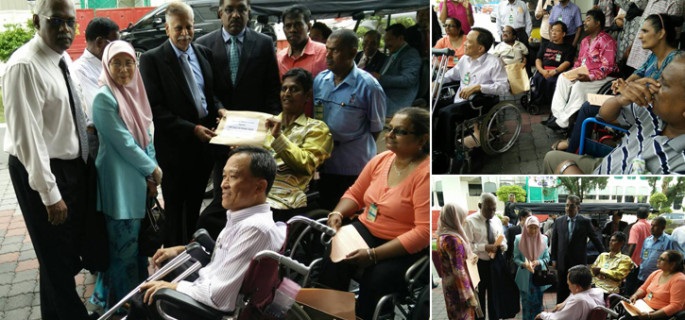
Badan Latihan dan Hidup Berdikari Malaysia (ILTC) pada 23hb Mac 2016 menyerahkan memorandum kepada ahli-ahli parlimen mendesak supaya golongan orang kurang upaya (OKU) dikecualikan daripada cukai barangan dan perkhidmatan (GST).

Disabled Members Protest

Disabled Members Protest
Disabled Members Protest at JPJ Wangsa Maju

ILTC Malaysia members staged a protest outside JPJ Wangsamaju KL.

ILTC Malaysia members staged a protest outside JPJ Wangsamaju KL.
Disabled group’s protest disabled drivers required to produce doc's medical report.

Thursday, 28 July 2011

Enough homes for abused children

'Enough homes for abused children'
Thursday, July 28th, 2011 12:20:00

PETALING JAYA: The Welfare Services Department (JKM) has enough shelter homes for abused children, says its public relations officer Nurul Insyirah Mohd Ishak.

She was commenting on an incident on July 15 when a JKM staff in Subang told a family that their shelters for abused children are all full.

"It is the department's responsibility to accept children at any time. We have enough homes for abused children," Nurul told The Malay Mail.

"We urge the family to file an official complaint for us to investigate further."

Nurul said not all abused children are placed in shelter homes.

"In some cases, the abused children may be better off staying with a relative or another family member," she said, adding that some abused or neglected children are temporarily placed at shelter homes while awaiting a court order in appointing a guardian.

"In urgent cases, we quickly take the child away from the abuser while providing the necessary protection and medical care."

Nurul said children who need protection are also placed in private shelter homes run by non-governmental organisations (NGOs) registered with JKM.

"Currently, there are 1,240 children under the protective custody at 11 shelter homes around the country," she said.

"The number of child abuse and neglected reports has increased, from 1,197 cases in 2008, more than doubling to 2,789 in 2009, and 2,960 last year."

Nurul said to combat the increasing number of child abuse and neglect cases, JKM launched Talian Nur 15999 to encourage public tip-offs.

"We investigate each tip-off and take the appropriate action, including temporarily placing an endangered child in a shelter home," she said, adding that JKM has also established a child protection team.

"We also have a Kami Prihatin programme to create greater public awareness on being pro-active on child abuse and neglect."

Monday, 25 July 2011

Easy on the disabled


Easy on the disabled

LRT stations plan facilities for the handicapped
Friday, July 22nd, 2011 12:28:00

Ampang LRT

UPLIFTING: Arnold demonstrates using a wheel chair on the platform lift — Pic: Samsul Said

AMPANG: There are close to 15,000 disabled persons (OKU) travelling the Ampang Line LRT every month since the service was introduced in 1996.

This was a long time for them to go without proper facilities when commuting on the LRT.

To ensure the disabled have equal rights to proper facilities, Syarikat Prasarana Negara Berhad (Prasarana) has undertaken upgrading works since February of last year.

Prasarana infrastructure development group director Nor Hassan Ismail, said RM60 million was allocated to build disabled-friendly facilities at the 24 stations along the Ampang Line.

However, he said the upgrading work should have been done some 10 years ago.

"I admit when the Ampang line was taking route, not enough consideration was given to make the stations disabled-friendly," he said after taking newsmen on a tour of the newly-upgraded Cempaka station yesterday.

Besides Cempaka station, upgrading works at the Pandan Jaya station was completed last March. Cahaya and Pandan Indah stations are nearcompletion soon.

The other stations include Plaza Rakyat, Maluri, Miharja, Chan Sow Lin, Pudu, Cheras, Sentul, Salak South, Bandar Tun Razak, Sentul Timur, Sg Besi, Bukit Jalil, Sri Petaling, Ampang, Bandar Tasik Selatan, Bandaraya, Sultan Ismail and PWTC.

New disabled-friendly facilities were incorporated into stations were ramps, lifts, platform wheelchair lifts, tactile floors for the blind and proper toilets.

Other facilities for members of the public include escalators, surau and rain protectors to ensure commuters' comfort.

Nor Hassan said the upgrading process was targeted to be completed next year.

"Our main challenge in upgrading the stations while people were still using them."

Earlier, Euro Asia Access Solutions managing director Richard Arnold demonstrated to the Press and the public the use of the platform wheelchair lift. The company is responsible for providing disabled-friendly facilities at the stations.

Meanwhile, when asked on special coaches for the OKUs, Nor Hassan said they do not have plans for that yet.

"Our focus now is completing the upgrading work. Currently, the disabled are held in the coach behind the LRT driver," he said, adding if there is a need to group OKUs together in a coach, station staff can arrange for them to be placed in one coach for their convenience.

Thursday, 14 July 2011

Concerns of the disabled


Thursday July 14, 2011

Concerns of the disabled

Wheel Power
By Anthony Thanasayan

The lack of sensitivity surrounding people with handicapping conditions is not just limited to the general public.

A MAJOR seminar involving local councils in Selangor took place in Petaling Jaya last month. The focus was on how to improve the quality of lives of Malaysians with disabilities in their constituencies.

Here are some of the chief concerns raised by the participants who included persons with disabilities in the round table discussions.

Lack of awareness

Despite a significant increase in awareness regarding disabled people over the past few years, participants felt that there was plenty of room for more non-disabled people to get to know about disability issues.

It was noted that the lack of sensitivity surrounding people with handicapping conditions was not just limited to the general public.

The Government, in particular the local authorities, have far to go in understanding and appreciating the needs of residents with disabilities, including the elderly.

The private sector is not much better. Businesses, developers and even professionals are also out of touch with disability issues. It was pointed out that this was obviously one of the main reasons why the needs of the disabled community were often sidelined.

Because of this complete disregard of disabled people’s basic needs such as access to buildings and the outside built environment, many of these vital facilities are not put in place.

Adding such facilities to buildings now can be expensive. However, that should not deter anyone or be used as an excuse for not righting a wrong.

With this background, the discussion groups stressed that the needs of the disabled should be an essential consideration in all the planning departments, especially among the local councils.

Monitoring and enforcement

Once the necessary disabled-friendly facilities are in place, there should be follow-ups to check for non-compliance. Local councils must ensure that new buildings without disability access are not approved. Parking lots for the disabled should only be used by physically disabled drivers. The authorities should take prompt action against abusers of such facilities by slapping the maximum compound. No discounts should be given. Vehicles of offenders should be towed away. Otherwise, there is no need to provide such facilities in the first place when the disabled themselves can’t use them.

Budget for the disabled

All local councils should set aside a generous budget for the needs of disabled residents. This is only fair considering that this important community has been left out for so long. Only with enough funds and prompt action will our society be able to “turn back the clock” in making things right for the handicapped in the area of development.

Get the designs right

Redevelopment projects for the handicapped should be comprehensive. Great care must be taken to ensure that all designs are uniform in terms of standards. For example, toilets for the disabled which carry different designs will only confuse users and stress them out. Every effort should be made to ensure that older designs are improved to meet present-day needs.

Feedback should be obtained from people with a wide variety of disabilities, to have a better understanding of their needs. Special attention should be given to pavements which must be friendly to both wheelchairs-users and the blind. This is a common oversight as some local councils only cater to one category of disability.

Connectivity of accessible points should also be carefully observed. It is common to find one stretch of pavement made for the disabled, and another neglected.

Maintenance of facilities for the handicapped is imperative in ensuring a barrier-free environment for all.

Feedback needed

Set up a technical disability group comprising end users. This is the most effective way to get projects going within a local council.

Ensure that there are representatives from a wide range of disabilities, for example, the blind, Deaf, wheelchairs users, people with walking difficulties, little people and Parkinson’s patients.

There is nothing like getting the proper input direct from the horse’s mouth. The committee must meet at least once a month to get the momentum going.

The Petaling Jaya City Council is, to my knowledge, the only local authority with this model. Efforts are currently underway to have similar committees in Selayang, Subang Jaya, Shah Alam and Klang soon.

Tuesday, 12 July 2011

709-This is Our Land

Truth that Cannot Be Covered - Bersih 2.0 09/07/2011

Bersih rally revealed lots of truth


Bersih rally revealed lots of truth

Jeswan Kaur
| July 10, 2011

Going into denial seems to be the only way Najib could think of in reacting to the Bersih 2.0 rally.


COMMENT

The rakyat who turned up for the Bersih 2.0 rally yesterday were no criminals. Yet, the police and the Federal Reserve Unit officers treated them as such, kicking and punching some of the supporters of the rally.

An eyewitness shared an incident where a young man in his 20s was pounced upon by no less than 10 policemen who wrestled him down, twisting his arm.

The ambience that day was one of fright and intimidation with the police going berserk in preventing the huge crowd from walking up to the rally venue, the historical Stadium Merdeka.

Everywhere, the environment was polluted with tear gas and water cannon which the cops splashed with gay abandon at the crowd to force them to disperse. But all these failed to scare the people.

Indeed, conundrum would best describe the July 9 scenario in the city centre of Kuala Lumpur. The palpable chaotic situation was certainly not the people’s doing. The rakyat had turned up in good faith to support the Bersih 2.0 ‘Walk for Democracy’. The event was messed up by none other than the police.

Bersih 2.0 in respecting the Yang di-Pertuan Agong Tuanku Mizan Zainal Abidin’s call to maintain peace and harmony agreed to keep away from the streets and take the rally indoor, to Stadium Merdeka. But no thanks to the lies and manipulation by Prime Minister Najib Tun Razak, the Bersih 2.0 organisers were refused all access to the stadium.

The police meanwhile at the 11th hour offered to issue Bersih 2.0 a permit for the rally provided it was held outside Kuala Lumpur. Why did Najib and his ‘boys’ stab Bersih 2.0 in the back, an act typically reserved for the cowards?

It is not the Bersih 2.0 coalition but the Barisan Nasional government under Najib and the police who are to be blamed for the chaos that shrouded Kuala Lumpur for over eight hours on July 9.

From the streets to a closed environment – Bersih 2.0 was cooperating with the call to stay away from the roads. In fact, Ambiga even asked the police to map out the routes for it to walk on July 9 but the thuggie-styled police refused to cooperate.

Was Bersih 2.0 asking for much by requesting that the police cooperate with it? Why did Najib turn the entire rally into a topsy-turvy affair and get the Bersih 2.0 key players including chairperson Ambiga Sreenevasan arrested?

Had Ambiga harboured malicious intentions, she could have ambushed the government and sprung a surprise by bringing her supporters to the streets to rally.

However, for all intent and purposes, the ‘Walk for Democracy’ was paved with good intentions, that of wanting to raise public awareness and call for a reform of the electoral system.

Stop blaming Bersih 2.0 The mainstream media went to town reporting how businesses in the city centre were paralysed because of the rally. Motorists stuck in traffic jams were quick to blame Bersih 2.0 for the endless hours of delay they had to endure.

The truth is Bersih 2.0 is not to blame. The truth also is that the entire scenario was scarred by the police, when it blocked all entry points to Kuala Lumpur.

How could Najib forget that all Bersih 2.0 wanted was to walk in solidarity and hand over their memorandum for reforms to the electoral system Yang di-Pertuan Agong?

The fact of it all is that all that happened on July 9 was dictated by fear, that too on the part of the BN government and Najib. The fear of not being able to manipulate the electoral process and find themselves losing out to their arch enemy, the opposition Pakatan Rakyat prompted Najib to undertake the least intelligent measure to halt the rally.

Had the coalition been allowed to use the Stadium Merdeka, there would have been no complaints from traders of businesses being affected. Why then conveniently pass the blame to Bersih 2.0 and ask the coalition if it would shoulder the losses suffered by the traders?

Also, had the police the decency to oblige Ambiga and plan out the route for the walk, the supporters of democracy could have been spared the tear gas, water cannons, punching and kicking. Bersih 2.0 rally a success

The Bersih 2.0 steering committee estimated that 50,000 people had turned up for its ‘Walk for Democracy’. Maybe such a huge turnout is too much of a failure for the Inspector-General of Police Ismail Omar to admit, so he went on to claim it was a mere 6,000 who showed up.

To Najib, the number was small. Just how did he deduce this, when the entire city of Kuala Lumpur had come to a standstill and the IGP had to bring in just about all his men to unleash their terror on the supporters?

Going into denial seems to be the only way Najib could think of in reacting to the Bersih 2.0 rally. Instead, he heaped praise on participants of the National Cooperatives Day 2011 held in Putrajaya and said:

“It’s obvious that the thousands present today are against the illegal rally planned by a section of our community. If there are people who want to hold the illegal rally, there are even more who are against their plan.”

But what a surprise that the premier could not even reveal the number of participants who attended the National Cooperatives Day 2011. Yet, it pleased him that they stayed put in Putrajaya, maybe against their will.

A lot of the truth which the Bersih 2.0 rally has revealed will never be acknowledged by the Najib administration. One truth is that the Bersih 2.0 rally succeeded in getting its message across to the rakyat.

The other truth is that the people are no willing to tolerate the abuse and corruption the BN government indulges in during elections.

Another truth is that the persecution and repression used by Najib to get things his way is now passé. The rakyat is all out to seek the truth and as the July 9 walk showed, the truth is out there.

The chaos and fear of July 9 was all Najib’s doing. His band of Umnoputeras were out to create nothing less than ruckus, as seen from the showdown at Menara Maybank between Umno Youth and Bersih 2.0 on the day of the rally.

Likewise, all talks that the ‘Walk for Democracy’ was spearheaded by the opposition leader Anwar Ibrahim is bullocks. It was a walk to reclaim what rightfully belongs to the people, an electoral system free of manipulation.

As far as Bersih 2.0 is concerned, it is innocent. And it has succeeded in its mission, all thank you to the rakyat who turned up in full force yesteday.

Friday, 1 July 2011

Paralympics RM4 million poser

Paralympics RM4 million poser

RM4m 'investment' comes as surprise to many

Wednesday, June 29th, 2011 11:27:00

PETALING JAYA: Why was a staggering RM4 million invested by the Malaysian Paralympics Council (MPC) in a company helmed by its president and his sons?

This is the poser raised by several council members upon learning of the investment recently.

A probe by The Malay Mail revealed that in 2008, MPC had invested RM4 million in an events management company, Paralimpik Ventures Sdn Bhd.

Our investigations showed a cheque for RM2 million was issued on April 4, 2008, and another RM2 million was transferred about two weeks later, on April 17, 2008.

The cheque and telegraphic transfer were allegedly signed off by MPC president Datuk Zainal Abu Zarin and its then treasurer, Liew Yoon Loy.

It is understood the money was derived from donations and fund-raising activities carried out by the MPC over the years. Sources claimed nothing on the hefty investment had been heard of since.

A check with the Companies Commission of Malaysia revealed Zainal and his sons, Idi Irwan and Ilia Ikhwan, were listed as the directors of Paralimpik Ventures.

One person not amused by this episode was MPC council member Prof M. Chandra Sekaran, who said the issue had raised more questions than answers.

"Who allowed the investment? Was it documented? How much have we made? Most importantly, who will be held responsible if the investment goes wrong?" he asked.

Chandra claimed he was approached by Zainal to invest some money in the company in 2008. Chandra was the treasurer for the Malaysian Association for the Blind (MAB) then.

"We were told it was a new scheme by Bank Negara Malaysia that promises to double the investment within a year but we at the MAB did not agree to it.

"Millions have been channelled out of MPC but it has not been documented. Such an investment requires the approval of two-thirds of the council, not just a handful of people."

He said there was no letter of undertaking by Bank Negara on the investment. "The manner the investment was done is unethical and we have been kept out of the loop for far too long.

"Now, where is the money?"

Chandra said he was eager to raise this issue at the much-awaited annual general meeting (AGM), which could be held soon.

It was learnt the MPC had not conducted its AGM since 2005 and was only registered with the Sports Commissioner’s office in May 2008.

MPC executive board member Lee Sheng Chow, a blind national para athlete, said the revelation caught him by surprise. "This is news to me. We had had many meetings in the past, yet this was never brought up," Lee, who is also founder and president of the Malaysian Disabled Persons Sports Association, said.

"This has to be clarified. Such dealings must be done in a transparent manner."

Zainal, however, maintained the money was secure and kept aside for the possible construction of MPC’s new headquarters.

Meanwhile, Sports Commissioner Datuk Yassin Salleh said MPC would be hauled up to explain the matter.

"We were not privy to such information before but once this is reported to us or even published in the newspapers, we will surely investigate.

"I don’t want to jump the gun but we need to know why such a thing was done in the first place and who had consented to the deal."

This latest controversy has been deemed a "double whammy" for the MPC, which was in the limelight earlier this month after several national para athletes cried foul when their monetary rewards were significantly "slashed".

On June 16, The Paper That Cares front-paged a report on Malaysia's paralympic athletes, whom despite finishing sixth out of 51 countries in last year's Asian Para Games in Guangzhou, China, only received 30 per cent of what able-bodied athletes got in cash incentives.

Special athletes used to earn RM80,000 for a gold medal, RM40,000 for silver and RM20,000 for bronze at the regional games but when the incentives were presented to them in April, the winners only received RM24,000 for gold, RM12,000 silver and RM6,000 bronze.

The National Sports Council (NSC) clarified, however, that the para athletes would be better taken care of under an incentive scheme introduced this year.

'Cash in good hands'

MALAYSIAN Paralympics Council (MPC) president Datuk Zainal Abu Zarin admitted to having channelled RM4 million to Paralimpik Ventures Sdn Bhd in 2008.

However, he was quick to add it was for a good cause.

"We were promised a plot of land by the government a couple of years ago but we were informed last year the land is actually a forest reserve and we would be given another suitable location.

"We invested the money as we needed the cash to grow. We just can’t dump the money in fixed deposit as the interest rates are ridiculously low."

Zainal admitted there was some form of “deal with regards to the RM4 million but declined to elaborate. He also did not mention the government agency that had promised the land.

"Our members are well aware of this project. This is an internal matter which we plan to make public once we get the approval (on the land) from the government. The money is there, rest assured. In fact, it has grown."

He did not specify the amount of money projected from the investment, but acknowledged it was obtained through donations and other MPC activities in the past.

"Let this not be a situation where a good deed will be seen as bad. I assure you the money is there and has grown. This will be a starting point for our building committee. Four million ringgit is not enough to build a headquarters in Kuala Lumpur."

When told several MPC members claimed they were unaware of the matter, Zainal said: "We have just obtained the approval from the Sports Commissioner’s office after rectifying our constitution two months ago and will be holding our annual general meeting soon. We will discuss this matter."

Zainal said MPC had been struggling to find its "own place". It is renting an office block in Brickfields now.

"We want our new place to be a symbol of Malaysian para athletics," he said.