NEW MINISTER FOR WELFARE MINISTER OF MALAYSIA

NEW MINISTER FOR WELFARE MINISTER OF MALAYSIA
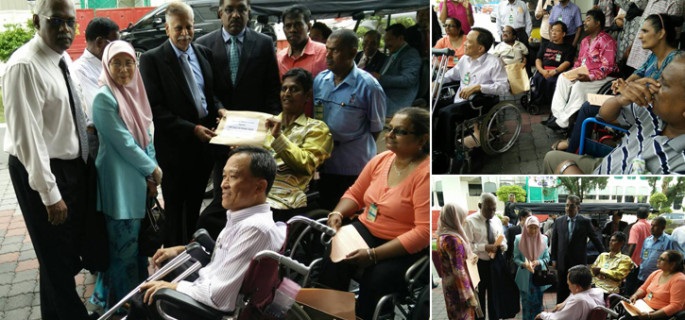
Badan Latihan dan Hidup Berdikari Malaysia (ILTC) pada 23hb Mac 2016 menyerahkan memorandum kepada ahli-ahli parlimen mendesak supaya golongan orang kurang upaya (OKU) dikecualikan daripada cukai barangan dan perkhidmatan (GST).

Disabled Members Protest

Disabled Members Protest
Disabled Members Protest at JPJ Wangsa Maju

ILTC Malaysia members staged a protest outside JPJ Wangsamaju KL.

ILTC Malaysia members staged a protest outside JPJ Wangsamaju KL.
Disabled group’s protest disabled drivers required to produce doc's medical report.

Saturday, 8 October 2011

‘Worst budget for the disabled’

'Worst budget for the disabled’

G Vinod
| October 8, 2011

Several disabled groups say Najib's budget has ignored the disabled even though he is calling it a caring budget .

PETALING JAYA: Several disabled groups are so unhappy with the budget that they even have gone to the extent of calling it the worst budget they have seen for many years.

The Animal-Assisted Therapy for the Disabled and Elderly Association (Petpositive) president Anthony Thanasayan said he had expected more from Prime Minister Najib Tun Razak who had termed the budget as a caring budget.

“We hardly got anything. The disabled need at least RM500 monthly to sustain a decent living,” said Thanasayan.

Yesterday, Najib announced Budget 2012 at the Parliament, dispensing various goodies especially to the civil servants and the low income earners.

Among others, he announced salary revision for civil servants and higher employer contribution to the EPF for workers earning less than RM5,000 monthly.

Thanasayan said the disabled groups have put in request for additional aid to the Women, Family and Community Development Ministry for many years but received lukewarm response.

What the government should do, Thanasayan said, was to provide care-givers to those disabled who are bedridden and paralysed.

He said this was important as not many of the bedridden people were taken care of by own their family members.

“In the US, the state hires personal attendants to assist bedridden people. Singapore even has a law to compel family members to look after their aged or sickly elders. This is what we need in Malaysia,” said Thanasayan who is also Petaling Jaya City Hall councillor.

Echoing Thanasayan’s sentiments, Independent Living and Training Centre advisor Francis Siva said it was unthinkable that Najib had left out the disabled community in his budget speech.

“It shows how sincere the government is in taking care of our needs,” said Siva .

He also said that this was not the first time the government had shortchanged the underprivileged group as it happened before when allocation for the disabled did not reach the target group.

“Few months back, the government announced additonal funds for the disabled group but till today none of us know how to go about getting the aid due to heavy bureucracy,” said Siva.

All the disabled want, Siva added, was to have a quality life by having a decent shelter and better access to public transport.

“Most disabled are living in a bad shape. It’s not like we enjoy living on charity but is it too much for us to ask for a little dignity?” asked Siva.

He said there was no point for the government to spend huge sums of money for mega projects when the disabled are living in bad conditions.

“We will arrange for a meeting with the prime minister soon to put in our requests,” he said.

Saturday, 1 October 2011

Losing their way


Losing their way

The blind struggle to navigate Brickfields after traders take up sidewalk space
Friday, September 30th, 2011 11:52:00
Brickfields

BARRIER: The visually-impaired fighting for space with stalls at the Jalan Tun Sambathan sidewalk — Pic: SAMSUL SAID

KUALA LUMPUR: Brickfields — for so long the home of the visually-impaired — has now become a "no man's land" for the blind.

It used to be a walk in the park to and from the Malaysian Association of the Blind (MAB) headquarters but had since become almost impossible to navigate after traders were allowed to park their stalls on the Jalan Tun Sambanthan sidewalk to ply their Deepavali wares.

Fully-blind George Wong, 75, now faces a hellish situation during his weekly visits to the MAB. The Semenyih resident is at a loss when attempting to locate the KL Monorail station, his "landmark" to get to KL Sentral to catch his bus home.

As the walkway in front of the station has been taken over by the stalls, he has to gingerly make his way around. "This scares me as the sidewalk is close to the busy road.

"Sometimes, I go the wrong way and have to make the long way back to MAB to start over."

Mohd Haris Fadzilah Ahmad, 32, said a friend was not as lucky, as his walking stick was almost hit by a car before he fell down, injuring himself.

"Are the authorities waiting for someone to die before acting?" said the partially-blind masseuse who commutes to Brickfields daily.

Blind student Afendi Adlun, 20, said he almost fell on the road while on his way to MAB recently. "I can normally walk unaccompanied but with the traders on the pavement, I missed my mark, missed a step and almost tripped on the road."

MAB's Zalina Hassan, 37, said complaints to City Hall had fallen on deaf ears.

"The blind having no proper facilities is not something new here. Our needs are constantly being put on hold."

She said at the corner of a bus stop in front of the YMCA building in Jalan Thambipillay, there used to be a pole to stop the blind from using the route. "Some of my friends were hurt badly after bumping into the pole, which was only removed much later."

Partially-blind Mohd Zuhairi Abdul Hamid said indiscriminate motorcycle parking on pavements designated for the visually-impaired was also another headache.

"Besides expanding the pavements, the authorities should make clearer signs for the public to identify areas meant for the blind."

KL mayor asks for tolerance in Brickfields


KL mayor asks for tolerance in Brickfields

Friday, September 30th, 2011 12:11:00

KUALA LUMPUR: KL mayor Tan Sri Ahmad Fuad Ismail said stalls in Brickfields would be allowed to continue operating for another month.

He was responding to a query by The Malay Mail on traders in Brickfields hogging walkways along Jalan Tun Sambathan, making it difficult for pedestrians, especially the blind, to move around the area.

He said while he understood the plight of pedestrians, traders should also be given a chance to do business.
“Give them a month. Give them a chance to work," he said.

He said tourists and locals flock to Little India in Brickfields, especially during Deepavali, and that City Hall had to allow the traders to set up stalls there.

“We allow this at other places during the Ramadan month and if we don’t do the same during Deepavali, people will complain and say we are being unfair.”

The walkways around Brickfields are marked extensively with raised lines and dots for the blind.

The Malay Mail had also received calls from the public claiming stalls in the area were causing traffic congestion as unloading of goods were done by the roadside.

Shahrizat: Show the blind some respect


Shahrizat: Show the blind some respect

Friday, September 30th, 2011 12:14:00

KUALA LUMPUR: Women, Family and Community Development Minister Datuk Seri Shahrizat Abdul Jalil will sit with City Hall to discuss how to tackle the issue of petty traders taking up walkways in front of shop lots in Brickfields, a norm when Deepavali is just around the corner.

"City Hall must take necessary action on this matter and we will inform them about this," she said.

Shahrizat expressed her disappointment with Malaysians when it comes to respecting the disabled community.

"It is important everybody is aware of this. Traders cannot do this. That's why advocacy is important. I am disappointed Malaysians are not considerate enough about the disabled.

"Ordinary citizens must have respect and consideration for the disabled as we want to be a barrier-free country.

"There needs to be more advocacy and awareness. Mindsets must change."

Welfare benefit for all visually-impaired


Friday, September 30th, 2011 12:11:00

KUALA LUMPUR: Beginning tomorrow, individuals who are blind in one eye will be classified as a disabled person and can receive privileges under the Social Welfare Department.

Women, Family and Community Development Minister Datuk Seri Shahrizat Abdul Jalil said the decision was made at a meeting of the National Council for the Disabled.

"This will enable the people who fall under this category to get the same privileges enjoyed by other disabled people when they register with the Social Welfare Department," she said at a Press conference after launching the 60th Anniversary of the Malaysian Association for the Blind (MAB), yesterday.

Shahrizat added local authorities throughout the nation are required to include a representative from the disabled community in their planning and development committee.

"This is part of the ministry's effort to mainstream the disabled community's issues into the development of the nation towards ensuring that Malaysia is a barrier free country."

Local authorities will be required to set up an audit access unit to ensure all public facilities are properly monitored and maintained.

Mixed reactions by disabled-friendly NGOs

THE Women, Family and Community Development Ministry's move to classify individuals who are blind in one eye under the disabled (OKU) category, requiring local authorities to elect a disabled representative to sit in their planning and development committee and to set up an audit access unit, received mixed reactions from several non-governmental organisations (NGOs) championing the cause.

Malaysian Association for the Blind (MAB) president Datuk Dr Abdullah Malim Baginda said categorising those blind in one eye as OKU would help them tremendously, especially if they are poor.

"They will receive OKU cards and get discounts for medical treatments and free medical check-ups," he said.
Dr Abdullah Malim said electing an OKU representative to sit in local authorities' planning and development committee would ensure the needs of their community were met.

"At the moment, we do sit in committee meetings but only informally. Sometimes, we also get called in for audit checks by several companies," he said.

One such company he cited was Keretapi Tanah Melayu Berhad, to which he tested their disabled-friendly facilities two weeks ago.

For Independent Living and Training Centre (ILTC) president Francis Siva, he opined the move should have been done 15 years ago.

"We also need to know who will monitor the committee and ensure this policy is carried out. There has to be a proper mechanism," he said.

However, Francis felt the efforts would not solve all problems faced by the disabled community unless "a disabled person is elected as a councilor in every local council.

"This would be more effective as our suggestions can be discussed at full board meetings and have a budget allocated for it."

Persatuan Kurang Upaya Anggota Melayu Malaysia (Permata) president Suhairi Abdullah, was unhappy those blind in one eye were categorised as OKU.

"Why does the government want to help people who are still able-bodied? They are not completely blind.

"If this is the case, soon, people who are deaf in one ear or people who do not have one leg will also be under the disabled category," he said.

"Currently, OKUs with a salary of RM1,200 are eligible to receive a monthly disabled worker allowance of RM300. If the partially-blind are considered OKUs, the government might have to fork out more."

Thursday, 29 September 2011

Bernama - Disabled people category extended to those 'blind in one eye'

Published: Thursday September 29, 2011 MYT 3:02:00 PM
Updated: Thursday September 29, 2011 MYT 4:21:45 PM

Disabled people category extended to those 'blind in one eye'


KUALA LUMPUR: Individuals who are blind in only one eye will be classified under the disabled people category from Saturday.

Women, Family and Community Development Minister Datuk Seri Shahrizat Abdul Jalil said the decision was made at a meeting of the National Council for the Disabled on Tuesday to enable this category of people to receive the same privileges as other disabled persons when they register with the Social Welfare Department.

In addition, she said, local authorities throughout the nation were required to include a representative from the disabled community in their planning and development committee. Bernama

PROGRESS REPORT:Updates - Photos of Construction Progress at ILTC Project on 29/09/2011


Saturday, 24 September 2011

Helping disabled drivers in a breakdown


Thursday September 22, 2011

Helping disabled drivers in a breakdown


Suggestions for vehicle breakdown services on handling emergencies involving disabled drivers.

A FORTNIGHT ago I wrote about a horrible encounter I had at a hypermarket in Shah Alam.

Despite the store being equipped with disabled-friendly car parks and toilets, the experience was still a nightmare.

As a wheelchair user I found much to my chagrin that I was not able to use the facilities.

This was because the management had failed to ensure that the handicapped-friendly facilities in their premises were not abused by non-disabled shoppers.

The car parks were all taken up by non-disabled drivers and I had to wait for a young able-bodied man to finish up before I could use the loo for the disabled.

And even when my car battery suddenly went flat, I was not able to get the help that I so desperately needed, even though I was in the company of scores of shoppers around me.

It was a wake-up call for me to not take things for granted in future.

Just because I happened to be in a disabled-friendly building didn’t necessarily mean that the people there would be as friendly or helpful to a disabled person.

It ought to have happened that way of course, but sadly it didn’t.

And the way I see it, the problem was clearly with the management.

If they had provided the proper training for their front desk staff, the situation would have been different.

Even the rescue team from the Automobile Association of Malaysia (AAM), of which I am a member, treated my SOS call as a normal routine alert when I rang them up.

When I told them I was a disabled driver, it made no difference to them. They just told me what they would say to anyone: “We’ll get to you in about 45 minutes.”

They only arrived about an hour and a half later, blaming the delay on heavy traffic. It was a disappointment that they made no follow-up calls to me during the waiting period to inform me of the delay.

Looking back on what happened, here are some suggestions to AAM and other vehicle breakdown services on how they can be more professional and helpful when it comes to handicapped drivers who are left stranded:

1. Check whether the driver is safe.

Instead of giving handicapped drivers the standard “45-minute” waiting time, find out first if they are safe. A handicapped driver could be stuck in the middle of the highway against speeding traffic. Are they alone or do they have someone who could help them?

In emergencies where one’s vehicle has stalled in the middle of the road or even on the fast lane, rescue services should link up with the traffic police to intervene.

Remember, a person in a wheelchair can’t get out of the car and even call for help from other drivers.

2. Find out more about the drivers’ disabilities.

Are they totally unable to walk? Or do they have walking difficulties? Do they use crutches, walking sticks, etc, for mobility? Do they have a wheelchair in the car or in the back seat? Can they get out of the car by themselves? Can they take out their wheelchair by themselves?

It is also helpful to ask if they are on any medication, suffer from asthma, etc, as all this can be triggered when one is in a panicked situation.

In such situations, personnel manning the call centre should have some knowledge about disabilities so that they can deal with handicapped callers more effectively.

Please note that for the able-bodied, they can just get out of their car and get to a safe place. People with disabilities often don’t have such options.

3. Speak calmly and confidently to the driver.

This will make them less nervous. Try to understand the great vulnerability that the disabled driver would be feeling at that time, especially if they are alone. They could also be sitting ducks for robbers who might take advantage of their situation.

In my case, AAM could have called the hypermarket’s customer service and informed them about where I am so that they could come to my aid.

4. Keep up the communication.

All rescue services should not merely inform that help is on the way but also keep in constant contact with the handicapped caller in distress to help him or her remain calm until service arrives.

This would be professionalism at its best.