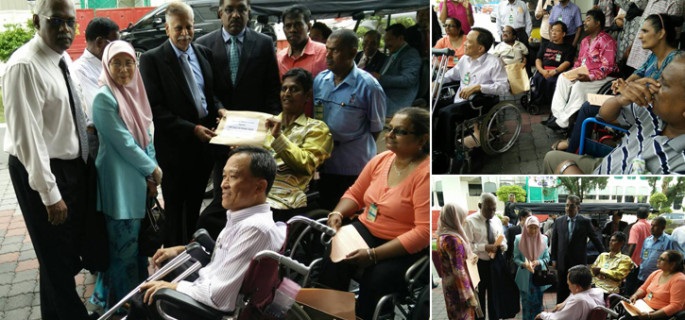
NEW MINISTER FOR WELFARE MINISTER OF MALAYSIA

NEW MINISTER FOR WELFARE MINISTER OF MALAYSIA
Badan Latihan dan Hidup Berdikari Malaysia (ILTC) pada 23hb Mac 2016 menyerahkan memorandum kepada ahli-ahli parlimen mendesak supaya golongan orang kurang upaya (OKU) dikecualikan daripada cukai barangan dan perkhidmatan (GST).

Disabled Members Protest

Disabled Members Protest
Disabled Members Protest at JPJ Wangsa Maju

ILTC Malaysia members staged a protest outside JPJ Wangsamaju KL.

ILTC Malaysia members staged a protest outside JPJ Wangsamaju KL.
Disabled group’s protest disabled drivers required to produce doc's medical report.

Wednesday, 12 October 2011

Giving a high-five. Rubbing his girlfriend's hand. Such ordinary acts — but a milestone for a paralyzed man.


From The Associated Press:
PITTSBURGH — Giving a high-five. Rubbing his girlfriend's hand. Such ordinary acts — but a milestone for a paralyzed man.

True, a robotic arm parked next to his wheelchair did the touching, painstakingly, palm to palm. But Tim Hemmes made that arm move just by thinking about it.

Emotions surged. For the first time in the seven years since a motorcycle accident left him a quadriplegic, Hemmes was reaching out to someone — even if it was only temporary, part of a monthlong science experiment at the University of Pittsburgh.

"It wasn't my arm but it was my brain, my thoughts. I was moving something," Hemmes says. "I don't have one single word to give you what I felt at that moment. That word doesn't exist."

The Pennsylvania man is among the pioneers in an ambitious quest for thought-controlled prosthetics to give the paralyzed more independence — the ability to feed themselves, turn a doorknob, hug a loved one.

The goal is a Star Trek-like melding of mind and machine, combining what's considered the most humanlike bionic arm to date — even the fingers bend like real ones — with tiny chips implanted in the brain. Those electrodes tap into electrical signals from brain cells that command movement. Bypassing a broken spinal cord, they relay those signals to the robotic third arm.

This research is years away from commercial use, but numerous teams are investigating different methods.

At Pittsburgh, monkeys learned to feed themselves marshmallows by thinking a robot arm into motion. At Duke University, monkeys used their thoughts to move virtual arms on a computer and got feedback that let them distinguish the texture of what they "touched."

Through a project known as BrainGate and other research, a few paralyzed people outfitted with brain electrodes have used their minds to work computers, even make simple movements with prosthetic arms.

But can these neuroprosthetics ever offer the complex, rapid movements that people would need for more practical, everyday use?

"We really are at a tipping point now with this technology," says Michael McLoughlin of the Johns Hopkins University Applied Physics Laboratory, which developed the humanlike arm in a $100 million project for DARPA, the Pentagon's research agency.

Pittsburgh is helping to lead a closely watched series of government-funded studies over the next two years to try to find out. A handful of quadriplegic volunteers will train their brains to operate the DARPA arm in increasingly sophisticated ways, even using sensors implanted in its fingertips to try to feel what they touch, while scientists explore which electrodes work best.

"Imagine all the joints that are in your hand. There's 20 motions around all those joints," says Pittsburgh neurobiologist Andrew Schwartz. "It's not just reaching out and crudely grasping something. We want them to be able to use the fingers we've worked so hard on."

The 30-year-old Hemmes' task was a much simpler first step. He was testing whether a new type of chip, which for safety reasons the Food and Drug Administration let stay on this initial volunteer's brain for just a month, could allow for three-dimensional arm movement.

He surprised researchers the day before the electrodes were removed. The robotic arm whirred as Hemmes' mind pushed it forward to hesitantly tap palms with a scientist. Then his girlfriend beckoned. The room abruptly hushed. Hemmes painstakingly raised the black metal hand again and slowly rubbed its palm against hers a few times.

These emotional robotic touches have inspired researchers now recruiting volunteers for soon-to-start yearlong experiments.

"It was awesome," is the decidedly unscientific description from the normally reserved Dr. Michael Boninger, rehabilitation chief at the University of Pittsburgh Medical Center. "To interact with a human that way. ... This is the beginning."

___

Hemmes' journey began in 2004. He owned an auto-detailing shop and rode his motorcycle in his spare time. Then one summer evening he swerved to miss a deer. His bike struck a guardrail. His neck snapped.

His determination didn't. Paralyzed below the shoulders, he's tried other experimental procedures in hopes, so far unrealized, of regaining some arm function.

"I always tell people your legs are great ... but they just get you from here to there," Hemmes says as his caregiver waits to feed him a bite of a cheeseburger near his home in Butler, north of Pittsburgh. "Your arms and fingers and hands do everything else. I have to get those back, I absolutely have to."

His ultimate goal is to hug his 8-year-old daughter. "I'm going to do whatever it takes, as long as it takes, to do that again."

Hemmes entered an operating room at UPMC with a mix of nerves and excitement.

"It's good anxiety," he says. "There is so much riding on this."

___

Think "I want that apple," and your arm reaches out and grasps it. You're not aware that neurons are instantaneously firing in patterns that send commands down the spinal cord — make the shoulder raise the arm, extend the elbow, flex the wrist and all five fingers.

A very similar firing occurs when you imagine movement or watch the movement you'd like to perform, explains Boninger, who with Schwartz is leading the Pittsburgh research together with a team of bioengineers, neuroscientists and physicians.

The DARPA arm was developed primarily for amputees. Separate research is under way to help them move it by using transplanted nerves to sense those brain commands. The paralyzed pose a more difficult challenge: getting those signals around a broken spinal cord.

For quadriplegic patients, scientists use implanted electrodes, called a "brain-computer interface" or BCI, to record that electrical activity. The signals move down through wires that tunnel under the skin and out by the collarbone, and are plugged into a computer or a robotic arm.

Until now, researchers mostly have tested miniature electrodes that poke inside the brain's motor cortex and record from individual cells, presumably allowing for precise movements. Pittsburgh's next test-patient will have two penetrating grids implanted in different parts of the cortex for a year to record from 200 cells altogether.

In contrast, Hemmes' chip sat on the surface of his motor cortex, a less invasive method that records from groups of cells. The size of two postage stamps, it's based on a kind of electrical signal mapping used to track seizures in epilepsy patients.

Both approaches need study, says Daofen Chen of the National Institutes of Health, who oversees neurorehabilitation research. He compares the options to eavesdropping on a party by sending in individual microphones or setting up a recorder at the window.

Boninger adds that scar tissue can blunt the penetrating electrodes over time, and the surface chips may be easier to convert to a wireless system, which is important for commercial use.

___

Hemmes' operation took two hours. He had practiced imagining arm movements inside brain scanners, to see where the electrical signals concentrated. That's where neurosurgeon Elizabeth Tyler-Kabara cut, attaching the chip through an inch-wide opening on the left side of Hemmes' skull.

Two days later, Hemmes was hooked to a computer, beginning simple cursor movements. The next week, it was time to test if he could trigger real-life movement using the DARPA arm.

Hemmes reclined in his wheelchair, the robot arm bolted to a steel rod nearby. The task: make the arm reach out to grasp a ball mounted on a board.

The arm whirs forward, then stops, then goes again, then suddenly pulls back.

"It's doing the opposite of what I ask it do," Hemmes says in frustration. "When I think about reaching back, it goes forward."

Dr. Wei Wang, a member of the research team, watches Hemmes' brain patterns on a nearby computer screen, trying to match them to the robotic movements. Focus on your elbow, Wang advises.

Hemmes takes a deep breath and tries. The arm whirs forward this time, reaching the ball. The fingers clench around it.

"There's no owner's manual," Hemmes says, thrilled that the back-and-forth pays off. "I'm training my brain to figure how to do all this."

Letting go is harder, the motor growling as the arm tugs backward before the fingers fully release. Hemmes starts imagining his hand relaxing before pulling backward, and the robot hand follows.

___

Sure, a robotic hand that one day mounts to a wheelchair could be useful. But no matter how well today's prosthetics move, they've got a problem: They don't sense what they touch. Normally, instant messages flash from the skin up to the brain to say "squeeze tighter" so we don't drop that coffee cup, or "tight enough" so we don't hug too hard.

Besides, Hemmes shares the dream of many quadriplegics. He doesn't want a bionic third hand. He wants to move his own hands again.

"These are all scientific goals that are very real," Boninger says.

Recreating sensation means crafting a two-way highway with those brain chips. That's what Duke University, in a study published last week in the journal Nature, did with its two monkeys. When the animals "touched" objects on a computer screen with their video game-like arms, electrical signals flashed back up to implanted electrodes — different signals for different textures, to tell the objects apart.

Sensors in the DARPA arm's fingertips allow for that same kind of feedback. McLoughlin says the plan is for one of the Pittsburgh study patients to begin testing touch capability next year, with a similar attempt at the California Institute of Technology to follow.

What about moving paralyzed limbs? Duke's plan is to turn its research into a robotic exoskeleton that would help the paralyzed move their bodies.

Hemmes is more intrigued by what's called functional electrical stimulation, zapping muscles with electrical currents to make them move. At Hemmes' request, Boninger's team attempted to fit his hand with a stimulator glove that might be linked to his electrode, but it was unsuccessful. The NIH's Chen says still other researchers are working on that kind of approach.

___

Hemmes likened moving the DARPA arm to learning to drive a car with a manual transmission. It took practice, but by week four he was moving the arm sideways as well as back and forth.

The fingers still clenched pretty tight, though. So when his girlfriend Katie Schaffer spoke up — "I want to hold your hand," she said on his last day of testing — Hemmes didn't dare bend them.

The two met after his accident, so he'd never before reached out to her.

"I was just trying to be gentle. I didn't want to hurt her, and I finally got there," Hemmes says. "Definitely the tears were flowing."

He says he was ready for a break after almost daily scientific testing, so removing the electrode and wires the next day wasn't a disappointment. He's confident the researchers will call him back once the technology advances.

"I believe this is the future," he says. "Just let people know there's hope."

Saturday, 8 October 2011

‘Worst budget for the disabled’

'Worst budget for the disabled’

G Vinod
| October 8, 2011

Several disabled groups say Najib's budget has ignored the disabled even though he is calling it a caring budget .

PETALING JAYA: Several disabled groups are so unhappy with the budget that they even have gone to the extent of calling it the worst budget they have seen for many years.

The Animal-Assisted Therapy for the Disabled and Elderly Association (Petpositive) president Anthony Thanasayan said he had expected more from Prime Minister Najib Tun Razak who had termed the budget as a caring budget.

“We hardly got anything. The disabled need at least RM500 monthly to sustain a decent living,” said Thanasayan.

Yesterday, Najib announced Budget 2012 at the Parliament, dispensing various goodies especially to the civil servants and the low income earners.

Among others, he announced salary revision for civil servants and higher employer contribution to the EPF for workers earning less than RM5,000 monthly.

Thanasayan said the disabled groups have put in request for additional aid to the Women, Family and Community Development Ministry for many years but received lukewarm response.

What the government should do, Thanasayan said, was to provide care-givers to those disabled who are bedridden and paralysed.

He said this was important as not many of the bedridden people were taken care of by own their family members.

“In the US, the state hires personal attendants to assist bedridden people. Singapore even has a law to compel family members to look after their aged or sickly elders. This is what we need in Malaysia,” said Thanasayan who is also Petaling Jaya City Hall councillor.

Echoing Thanasayan’s sentiments, Independent Living and Training Centre advisor Francis Siva said it was unthinkable that Najib had left out the disabled community in his budget speech.

“It shows how sincere the government is in taking care of our needs,” said Siva .

He also said that this was not the first time the government had shortchanged the underprivileged group as it happened before when allocation for the disabled did not reach the target group.

“Few months back, the government announced additonal funds for the disabled group but till today none of us know how to go about getting the aid due to heavy bureucracy,” said Siva.

All the disabled want, Siva added, was to have a quality life by having a decent shelter and better access to public transport.

“Most disabled are living in a bad shape. It’s not like we enjoy living on charity but is it too much for us to ask for a little dignity?” asked Siva.

He said there was no point for the government to spend huge sums of money for mega projects when the disabled are living in bad conditions.

“We will arrange for a meeting with the prime minister soon to put in our requests,” he said.

Saturday, 1 October 2011

Losing their way


Losing their way

The blind struggle to navigate Brickfields after traders take up sidewalk space
Friday, September 30th, 2011 11:52:00
Brickfields

BARRIER: The visually-impaired fighting for space with stalls at the Jalan Tun Sambathan sidewalk — Pic: SAMSUL SAID

KUALA LUMPUR: Brickfields — for so long the home of the visually-impaired — has now become a "no man's land" for the blind.

It used to be a walk in the park to and from the Malaysian Association of the Blind (MAB) headquarters but had since become almost impossible to navigate after traders were allowed to park their stalls on the Jalan Tun Sambanthan sidewalk to ply their Deepavali wares.

Fully-blind George Wong, 75, now faces a hellish situation during his weekly visits to the MAB. The Semenyih resident is at a loss when attempting to locate the KL Monorail station, his "landmark" to get to KL Sentral to catch his bus home.

As the walkway in front of the station has been taken over by the stalls, he has to gingerly make his way around. "This scares me as the sidewalk is close to the busy road.

"Sometimes, I go the wrong way and have to make the long way back to MAB to start over."

Mohd Haris Fadzilah Ahmad, 32, said a friend was not as lucky, as his walking stick was almost hit by a car before he fell down, injuring himself.

"Are the authorities waiting for someone to die before acting?" said the partially-blind masseuse who commutes to Brickfields daily.

Blind student Afendi Adlun, 20, said he almost fell on the road while on his way to MAB recently. "I can normally walk unaccompanied but with the traders on the pavement, I missed my mark, missed a step and almost tripped on the road."

MAB's Zalina Hassan, 37, said complaints to City Hall had fallen on deaf ears.

"The blind having no proper facilities is not something new here. Our needs are constantly being put on hold."

She said at the corner of a bus stop in front of the YMCA building in Jalan Thambipillay, there used to be a pole to stop the blind from using the route. "Some of my friends were hurt badly after bumping into the pole, which was only removed much later."

Partially-blind Mohd Zuhairi Abdul Hamid said indiscriminate motorcycle parking on pavements designated for the visually-impaired was also another headache.

"Besides expanding the pavements, the authorities should make clearer signs for the public to identify areas meant for the blind."

KL mayor asks for tolerance in Brickfields


KL mayor asks for tolerance in Brickfields

Friday, September 30th, 2011 12:11:00

KUALA LUMPUR: KL mayor Tan Sri Ahmad Fuad Ismail said stalls in Brickfields would be allowed to continue operating for another month.

He was responding to a query by The Malay Mail on traders in Brickfields hogging walkways along Jalan Tun Sambathan, making it difficult for pedestrians, especially the blind, to move around the area.

He said while he understood the plight of pedestrians, traders should also be given a chance to do business.
“Give them a month. Give them a chance to work," he said.

He said tourists and locals flock to Little India in Brickfields, especially during Deepavali, and that City Hall had to allow the traders to set up stalls there.

“We allow this at other places during the Ramadan month and if we don’t do the same during Deepavali, people will complain and say we are being unfair.”

The walkways around Brickfields are marked extensively with raised lines and dots for the blind.

The Malay Mail had also received calls from the public claiming stalls in the area were causing traffic congestion as unloading of goods were done by the roadside.

Shahrizat: Show the blind some respect


Shahrizat: Show the blind some respect

Friday, September 30th, 2011 12:14:00

KUALA LUMPUR: Women, Family and Community Development Minister Datuk Seri Shahrizat Abdul Jalil will sit with City Hall to discuss how to tackle the issue of petty traders taking up walkways in front of shop lots in Brickfields, a norm when Deepavali is just around the corner.

"City Hall must take necessary action on this matter and we will inform them about this," she said.

Shahrizat expressed her disappointment with Malaysians when it comes to respecting the disabled community.

"It is important everybody is aware of this. Traders cannot do this. That's why advocacy is important. I am disappointed Malaysians are not considerate enough about the disabled.

"Ordinary citizens must have respect and consideration for the disabled as we want to be a barrier-free country.

"There needs to be more advocacy and awareness. Mindsets must change."

Welfare benefit for all visually-impaired


Friday, September 30th, 2011 12:11:00

KUALA LUMPUR: Beginning tomorrow, individuals who are blind in one eye will be classified as a disabled person and can receive privileges under the Social Welfare Department.

Women, Family and Community Development Minister Datuk Seri Shahrizat Abdul Jalil said the decision was made at a meeting of the National Council for the Disabled.

"This will enable the people who fall under this category to get the same privileges enjoyed by other disabled people when they register with the Social Welfare Department," she said at a Press conference after launching the 60th Anniversary of the Malaysian Association for the Blind (MAB), yesterday.

Shahrizat added local authorities throughout the nation are required to include a representative from the disabled community in their planning and development committee.

"This is part of the ministry's effort to mainstream the disabled community's issues into the development of the nation towards ensuring that Malaysia is a barrier free country."

Local authorities will be required to set up an audit access unit to ensure all public facilities are properly monitored and maintained.

Mixed reactions by disabled-friendly NGOs

THE Women, Family and Community Development Ministry's move to classify individuals who are blind in one eye under the disabled (OKU) category, requiring local authorities to elect a disabled representative to sit in their planning and development committee and to set up an audit access unit, received mixed reactions from several non-governmental organisations (NGOs) championing the cause.

Malaysian Association for the Blind (MAB) president Datuk Dr Abdullah Malim Baginda said categorising those blind in one eye as OKU would help them tremendously, especially if they are poor.

"They will receive OKU cards and get discounts for medical treatments and free medical check-ups," he said.
Dr Abdullah Malim said electing an OKU representative to sit in local authorities' planning and development committee would ensure the needs of their community were met.

"At the moment, we do sit in committee meetings but only informally. Sometimes, we also get called in for audit checks by several companies," he said.

One such company he cited was Keretapi Tanah Melayu Berhad, to which he tested their disabled-friendly facilities two weeks ago.

For Independent Living and Training Centre (ILTC) president Francis Siva, he opined the move should have been done 15 years ago.

"We also need to know who will monitor the committee and ensure this policy is carried out. There has to be a proper mechanism," he said.

However, Francis felt the efforts would not solve all problems faced by the disabled community unless "a disabled person is elected as a councilor in every local council.

"This would be more effective as our suggestions can be discussed at full board meetings and have a budget allocated for it."

Persatuan Kurang Upaya Anggota Melayu Malaysia (Permata) president Suhairi Abdullah, was unhappy those blind in one eye were categorised as OKU.

"Why does the government want to help people who are still able-bodied? They are not completely blind.

"If this is the case, soon, people who are deaf in one ear or people who do not have one leg will also be under the disabled category," he said.

"Currently, OKUs with a salary of RM1,200 are eligible to receive a monthly disabled worker allowance of RM300. If the partially-blind are considered OKUs, the government might have to fork out more."

Thursday, 29 September 2011

Bernama - Disabled people category extended to those 'blind in one eye'

Published: Thursday September 29, 2011 MYT 3:02:00 PM
Updated: Thursday September 29, 2011 MYT 4:21:45 PM

Disabled people category extended to those 'blind in one eye'


KUALA LUMPUR: Individuals who are blind in only one eye will be classified under the disabled people category from Saturday.

Women, Family and Community Development Minister Datuk Seri Shahrizat Abdul Jalil said the decision was made at a meeting of the National Council for the Disabled on Tuesday to enable this category of people to receive the same privileges as other disabled persons when they register with the Social Welfare Department.

In addition, she said, local authorities throughout the nation were required to include a representative from the disabled community in their planning and development committee. Bernama

PROGRESS REPORT:Updates - Photos of Construction Progress at ILTC Project on 29/09/2011