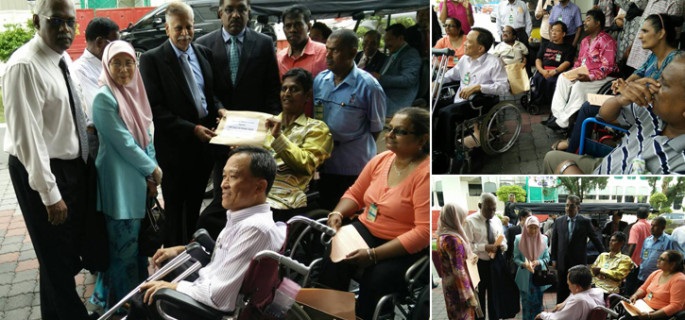
NEW MINISTER FOR WELFARE MINISTER OF MALAYSIA

NEW MINISTER FOR WELFARE MINISTER OF MALAYSIA
Badan Latihan dan Hidup Berdikari Malaysia (ILTC) pada 23hb Mac 2016 menyerahkan memorandum kepada ahli-ahli parlimen mendesak supaya golongan orang kurang upaya (OKU) dikecualikan daripada cukai barangan dan perkhidmatan (GST).

Disabled Members Protest

Disabled Members Protest
Disabled Members Protest at JPJ Wangsa Maju

ILTC Malaysia members staged a protest outside JPJ Wangsamaju KL.

ILTC Malaysia members staged a protest outside JPJ Wangsamaju KL.
Disabled group’s protest disabled drivers required to produce doc's medical report.

Thursday, 17 November 2011

Welfare dues withheld

Welfare dues withheld

G Vinod
| November 16, 2011

Some beneficiaries of the Disabled Worker’s Allowance have not been paid for two months.

KUALA LUMPUR: The Department of Social Welfare has withheld payment of the Disabled Worker’s Allowance (EPC) to some beneficiaries, according to reports received by FMT.

Several members of the Society of the Blind said they had not received their monthly dues since last month and that a similar situation happened last December and January.

The department normally banks in the allowance by the second day of the month.

An official of the Kuala Lumpur Welfare Department said payment would be frozen if a beneficiary failed to update records of his address and marital and employment status on time.

The update has to be done once a year. Most state welfare departments require it in October.

However, the president of the Independent Living and Training Centre, Francis Siva, rejected the explanation, saying the department gave different reasons for the delay to different people.

“Just last week, I went to the welfare office in Kuala Kubu Baru to check on why my allowance was not ready and the officer there told me the Federal Treasury had not disbursed the funds,” he said.

“When I pressed on the matter, they changed their tune, saying the state had not disbursed the funds. So which is which?”

He criticised the requirement for an annual update of particulars, saying it created unnecessary problems for people already facing many challenges.

“You expect a bedridden man to come and update his status annually? The welfare department has logistics to go house to house, but they are just lazy and inefficient.”

Unhelpful staff

Goh Harp Boon, a blind 36-year-old masseur, said he moved often to improve his employment opportunities and it would be difficult for him to inform the department every time. “Must we do it every time we move?”

According to his MyKad, Goh’s address is in Perak. But he now lives in Kuala Lumpur. He said the Kuala Lumpur Welfare Department told him he would not qualify for any more aid until he changed the address on the card.

He claimed the officer who spoke to him also demanded his pay slip as proof that he qualified for the RM300 monthly allowance given to disabled people who are employed. (Unemployed disabled people get RM150 a month.)

“They fail to understand that I work on a freelance basis,” Goh said. “Where am I going to get a pay slip?”

Goh said he knew many other blind people facing similar problems with the welfare department but were afraid to come forward to complain.

He also alleged that many had been turned away when trying to update their particulars.

“Sometimes they will just say the officer in charge is not around and tell us to come again another day. It costs us a lot of money to travel to the office in Jalan Pahang.”

Another blind person, 55-year-old Hor Hee Teck, said he went to the department to inquire about the delay of his allowance but was told that the online system was down.

To prevent overlapping of information

According to the Kuala Lumpur welfare official, the annual update of particulars was necessary for the department to keep track of beneficiaries and to “prevent the overlapping of information”.

She also said funds were usually returned to the Treasury if the beneficiaries did not collect them by the 20th day of the month.

“Nevertheless, we do retrieve the funds back for them when they lodge a complaint with us,” she added.

She rejected allegations that department officials turned disabled people away or that it was difficult for them to get their records updated.

“Any of our officers are allowed to take their particulars for updates. They don’t need to change their MyKad addresses at all.”

Tuesday, 15 November 2011

Deepavali joy at state open house


Deepavali joy at state open house

Published: Fri, 11 Nov 2011

SELAYANG: Over 3,000 residents in Rawang attended the Selangor Deepavali open house on Jalan Maxwell here on Monday night.

“Thank you for letting us celebrate the festival of lights with you here in Rawang,” said Menteri Besar Tan Sri Khalid Ibrahim in his opening speech.

He later handed over two mock cheques for RM15,000 to an orphanage and a disabled home in Rawang.

The event was jointly organised by the state and the Selayang Municipal Council (MPS), and was attended by Speaker Datuk Teng Chang Khim and executive councillors Ronnie Liu and Dr Xavier Jayakumar.

Rawang and Batu Caves assemblypersons Gan Pei Nei and Amirudin Shari were also present at the celebration, which was marked by a fireworks display.

The open house was also attended by MPS President Datuk Zainal Abidin Aala and his senior staff.

Organisers set up food stalls serving Indian and Malaysian favourites such as roti canai, nasi briyani, curry chicken and cendol.

Monday, 14 November 2011

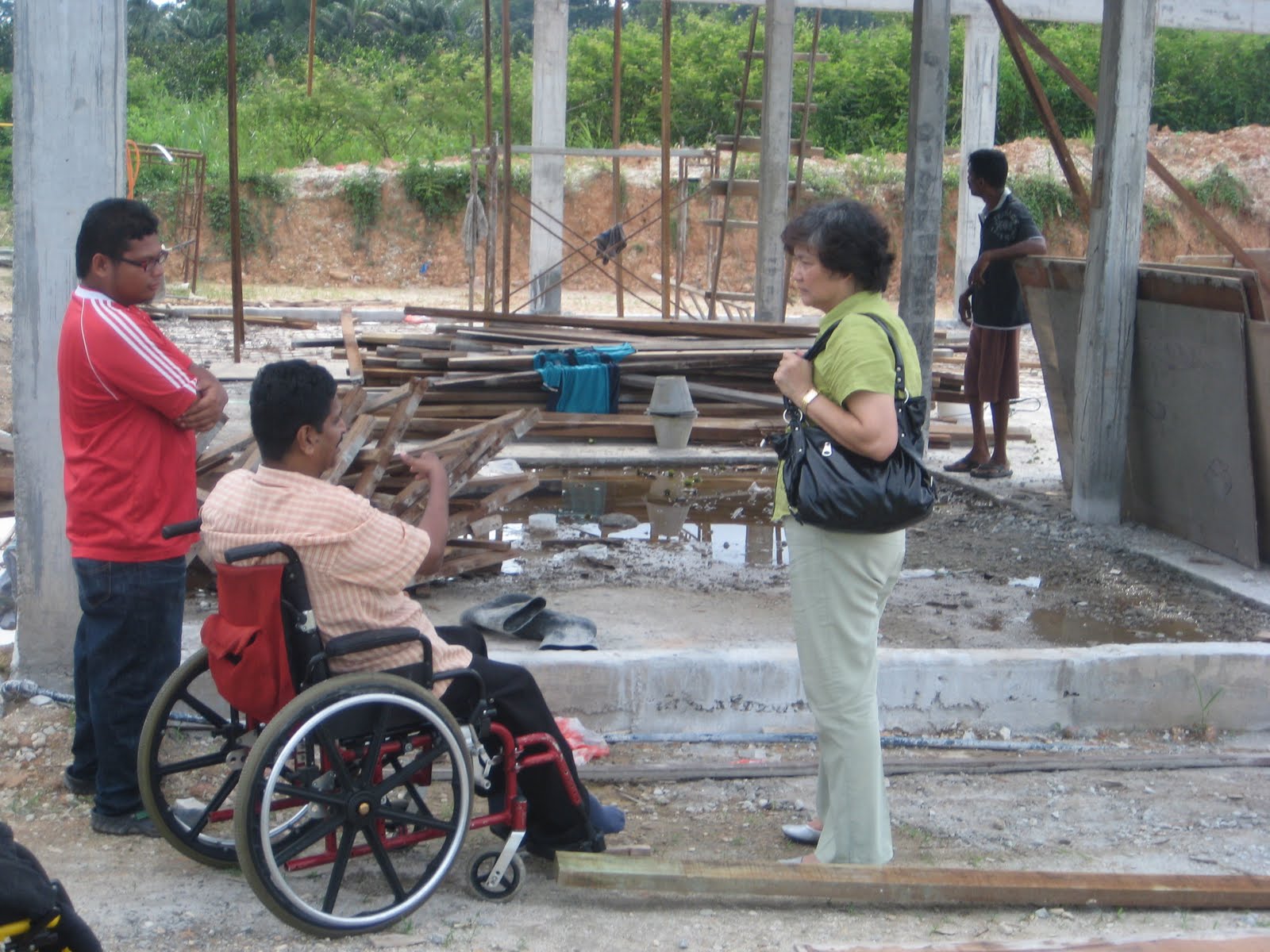
PROGRESS REPORT: Updates - Photos of Construction Progress at ILTC Project on 14/11/2011

The latest news

Today, Madam Diana from HL Management Co. visited the ILTC Project side, the construction of the new building in order to getting information and to view in-progress development of the project.


Friday, 4 November 2011

Disabled group upset over ‘terrible’ action

November 4, 2011

The ban on Seksualiti Merdeka festival will earn the derision of forward-looking countries, says Petpositive.


PETALING JAYA: The banning of the “Seksualiti Merdeka” festival by the police yesterday has earned the scorn of disabled rights activist Anthony Thanasayan.

Anthony, the Petpositive (Malaysian Animal Assisted Therapy for the Disabled and the Elderly Association) president said that an event such as Seksualiti Merdeka greatly affected the disabled people as well.

“It is a handicap to be disabled. It is a double handicap to be also gay,” said Thanasayan, who has counselled many homosexuals, both abled bodied and disabled.

“People forget that the disabled, including the deaf and blind, are human too. Sexuality transcends the able-bodied or disabled. They are always advised not to think about sex. For many of us,
our genitalia still work; besides, sexuality is not limited to your genitalia,” said Thanasayan, who is wheelchair-bound himself.

Thanasayan said it is much worse for a disabled person who has sexual confusion to find help, and this could even lead to those who are not homosexual to turn gay in the process.

“This is because the disabled have limited chances to explore their sexuality, whereas an able-bodied person has more chances. Out of desperation, I have seen cases where a man goes into a relationship with an uncle, or brother because they have no other options,” he said.

Thanasayan, who is also a councillor with the Petaling Jaya City Council (MBPJ), said that an event such as Seksualiti Merdeka allows everyone – abled-bodied as well as the disabled – to know themselves and this is vital for a good relationship or marriage.

“I went to the Seksualiti Merdeka event and I am so happy, because finally I see some people who can approach such issues with maturity, without discrimination,” he said.

“But today I see everything has crumbled. This (banning Seksualiti Merdeka) is a terrible step for Malaysia and would earn the derision of other more forward-looking countries. This kind of action is always based on ignorance; it will promote prejudice. Thus, this will increase the frustration of those in the minority community, and can also lead to suicidal tendencies,” said Thanasayan.

Police have banned the ongoing Seksualiti Merdeka festival, saying strong action would be taken against those who defied the directive.

Deputy Inspector-General of Police Khalid Abu Bakar said the law in the country did not recognise any deviationist activity that could destroy the practice of religious freedom.

Seksualiti Merdeka is an annual sexuality rights festival celebrating human rights of people of diverse sexual orientation and gender identity. A coalition of NGOs, artistes, activists and individuals had been organising the event since 2008.

This year’s event, “Queer Without Fear”, started on Tuesday at The Annexe Gallery, Kuala Lumpur. It will end on Nov 13.

Thursday, 3 November 2011


Thursday November 3, 2011

Awkward moments

Rules are meant to be bent – sometimes.

LAST week, I received an interesting mail from a blind reader who identified herself as Vicky. She shared how awkward it was for her whenever she needed to answer nature’s call.

“I don’t have to use the toilet for the handicapped because I don’t have a problem with my limbs. But on many occasions when I headed to the loo for able-bodied people, I was stopped by an attendant or a staff member, and redirected to the toilet for the handicapped.

“I realise these people mean well. But no matter how much I try to explain to them that I am capable of using the so-called ‘normal’ toilet, they would insist that I use the toilet for the disabled because I am blind.

“This slows me down, especially when the toilet is occupied. I also do not want to take up space, in case a wheelchair-user comes along with an emergency,” explained Vicky.

On a roll: The writer trying out the Helio during a recent trip to Malacca.

She suggested that perhaps it would be more appropriate to have a label on the toilet door which reads: Reserved for wheelchair users.

On the issue of employment, Vicky opined that it would be best if the Government could step in and subsidise assistive devices such as screen readers for the visually impaired or toilets for those in wheelchairs.

“Otherwise employers may consider us ‘too expensive’ for their budget and pass the job to the non-disabled instead.

“When giant companies such as IBM, Google and even Nasa can employ blind programmers in their countries, why are the blind in Malaysia only expected to become masseurs, basket-weavers, telephone operators or trinket-sellers on street corners?” she asked.

On another note, I’ve been busy testing out the Helio, an innovative high performance wheelchair from Canada. Everything about this latest chair on wheels will make any handicapped person sit up and take notice.

The Helio has an ultralight body. This makes it easy for even a woman to carry the wheelchair into the boot of her car. The wheelchair comes with highly detachable parts, so drivers with disabilities can dismantle the key parts and place them in the back seat without help.

A unique feature of the Helio is that each wheelchair part can be ordered to suit the user’s needs. There are as many as 21 different accessories to choose from.

Despite its light weight, the Helio is no delicate beauty. It has a robust body which gives added confidence to the user. The Helio is so smooth that it glides across effortlessly with a single push, unlike conventional wheelchairs.

The only downside is that the Helio is priced between RM8,000 and RM10,000. You may need to shell out more for add-ons.

Produced by a company called Motion Composites, the Helio comes in six colour frames. It will be making its debut in Malaysia and other South-East Asian countries very soon. For details on the product, please e-mail the local distributor KG Teo at bbbteo@yahoo.com.sg

Wednesday, 2 November 2011

Love and Hope Charity Dinner

Love and Hope Charity Dinner which was held recently on 16th Sept 2011 from 7.00pm to 11.00pm at Thean Hou Temple, KL.
Love and Hope Charity Dinner was attended by more than 1000 sponsors, donors, receiver of wheelchairs and other well-wishers and was officially opened by Mr. Pathmanathan Nalasamy, Ketua Penolong Pengarah Jabatan Pembangunan Orang Kurang Upaya of Jabatan Kebajikan Masyarakat, YB Teresa Kok, and YB Ronnie Liu.

ILTC extends our heartiest and sincere thanks and appreciation to Pertubuhan Orang Cacat Cina Malaysia for the kind contribution of 4 units of light weight fully detachable wheelchair (every wheelchair costs RM1500) for the ILTC members with the vision to assist people with disabilities to lead independent lives without fear and comprehension as well as to integrate them into society and to be a part of a productive workforce of the nation towards this charity event.


Tuesday, 1 November 2011

World Hunger Relief Malaysia

The World Hunger Relief Malaysia campaign is an initiative of KFC and Pizza Hut Malaysia stores nationally. All funds raised had donated to the United Nations World Food Program.

More than 8,000 people was taking part in the "Be The Movement" charity walk on last Saturday 29/10/2011 at 4.00pm in Putrajaya, in support of the World Hunger Relief cause under the United Nations World Food Programme (WFP).

The 5km walk, which starts and ends at the Palace of Justice in Precinct 3, is organised by Kentucky Fried Chicken (KFC) and Pizza Hut Malaysia, which are owned by QSR Brands Berhad.

Nestle Malaysia and Fitness First are also taking part for the first time in this annual cause.

Apart from the walk, there was a mini-carnival with fun activities.

The main purpose is to create greater public awareness about many underdeveloped nations facing a constant struggle to provide enough food for their people and also to put an end to famine and starvation.

ILTC giving a big thank you to all those that came to the walk.

KFC Holdings (M) Bhd contributed to ILTC RM5000.00 under the corporate social responsibility.


PROGRESS REPORT: Updates - Photos of Construction Progress at ILTC Project on 01/11/2011


Thursday, 27 October 2011

How disabled-friendly is Malacca city?


Thursday October 27, 2011

How disabled-friendly is Malacca city?

I HAD a terrific time earlier this month when I visited the beautiful and historic city of Malacca. As chairman of MBPJ’s technical committee on disabilities, I was eager to find out what the council had done – and is currently doing – to make their much-talked about national heritage city friendly to residents with disabilities as well as disabled visitors.

I couldn’t think of a more effective way to carry out my task than to make a spontaneous visit to the city. But not without taking an able-bodied assistant with me, just in case.

Our first stop was Christ Church in Malacca town which was built by the Dutch in the 18th century. I was disappointed to discover that the oldest functioning Protestant church to the country had no ramp for wheelchair access.

Thus I was forced to stay outside the church whilst scores of visitors walked in and out of the age-old building to appreciate its beauty from the inside.

The writer and his assistant, Jason Jegathiswaran, taking in the sights and sounds of historic Malacca.

When I asked one of the church officials why a ramp was not built for disabled tourists, I was shocked by his reply that “a ramp would spoil the beauty of this ancient building.”

When I pointed out that there were more than enough entrances to build just one ramp to allow tourists in wheelchairs and those with walking difficulties to access the building, he said that he would bring the matter up with the building committee.

I couldn’t help thinking how short-sighted he was to make such a statement about the usefulness of ramps.

Don’t these people realise that perceptions are changing as society ages and more people are strugging with disabilities brought on by old age, accidents and illnesses?

I have been to countries where wheelchair ramps are always provided as an alternative access for the disabled.

In heritage buildings, the engineers have cleverly constructed ramps in an ancient style to blend in with their natural surroundings. Excuses were never given to avoid providing access for the disabled.

Back to Malacca city, there were no disabled-friendly toilets within a decent distance from where I was. I did see a public toilet for the handicapped when I was travelling in my vehicle. However, that was too far away for my convenience.

The only parking lot for the handicapped that I saw was near the church. However, it was not as long and wide as a proper disabled parking lot should be.

The wheelchair logo on the ground was fading. One had to take a good look to notice it. Needless to say, this wouldn’t go well with drivers with poor eyesight.

Most of the pavements were inaccessible to wheelchairs. Frankly, they were also not good for walking. Luckily my assistant was with me to help me get around.

Because of the lack of wheelchair-friendly pavements, I was forced to use the road where my safety was compromised. At one point, I had to literally get off the road to allow a huge tourist bus to get past me.

In the 10 hours that I spent in the city, I did not come across a single person in a wheelchair. This is a clear sign of how hostile the city is to disabled and elderly denizens when it comes to access to the outdoors.

I must add that there appeared to be some attempts to make pavements wheelchair-friendly but these were scarce and not properly done. There were no guiding blocks for the blind, too.

Despite all these, I managed to take in unforgettable sights like the river boat rides and the colourful rickshaws, and sampled the mouth-watering fare that is unique to the city.

Disabled people, too, want to enjoy the marvellous sights, sounds and smells of Malacca.

Tuesday, 25 October 2011

Deepavali Greetings From President of Independent Living & Training Centre.


Dear Friends, Wishing everyone a very happy and prosperous deepavali.

May this festival of light brings joy & happiness to you & your family.

From,
Mr. G. Francis Siva
President

Ms. Rina - Secretary of ILTC
Independent Living & Training Centre

Tuesday, 18 October 2011

PROGRESS REPORT: Updates - Photos of Construction Progress at ILTC Project on 18/10/2011


Space allocated to build aerobridges at KLIA2


Tuesday October 18, 2011

Space allocated to build aerobridges at KLIA2

AT THE DEWAN RAKYAT
Reports by MARTIN CARVALHO, YUEN MEIKENG, RAHIMY RAHIM and CALVIN YEO

THE Transport Ministry told the Dewan Rakyat that space has been allocated to install aerobridges at the new KLIA2 low-cost terminal if airlines demand for such facilities.

Deputy Minister Jelaing Mersat said Malaysian Airports Holding Bhd (MAHB) was still considering constructing the aerobridges.

“The decision is in the final stages and MAHB had also allocated space to build aerobridges if any airlines need the facilities,” he said when replying to a question from Teresa Kok (DAP – Seputeh).

Kok had asked the ministry to state whether it had approved the construction of aerobridges at KLIA2.

He added that the Government was concerned with the plight of the public especially considering views from the disabled community, the Malaysian Association of Tour and Travel Agents and the board of Airlines Representatives on the need to build aerobridges.

The estimated cost to build 80 aerobridges was RM132mil.

Saturday, 15 October 2011

'Friendly' protest march by blind


'Friendly' protest march by blind

Friday, October 14th, 2011 11:43:00
Brickfields

MAKING A POINT: (From left) Gunabalan, Ajong Sidim and Gobal Rajee standing on a section of the tactile walkway

BRICKFIELDS: A peculiar sight greeted Brickfields residents yesterday when representatives of the blind community, who were protesting against the festive traders who had set up stalls on the tactile walkways they use, ended up side-byside with the ones they were supposed to be protesting against.

Ajong Sidim, 55, a blind legal executive, and G. Gunabalan, 56, a partially-blind businessman, were joined in the "protest march" by Brickfields Indian Petty Traders Association Kuala Lumpur chairman Gobal Rajee and several association members. Also present was Bukit Bintang MP Fong Kui Lun.

Starting from the corner of Jalan Tun Sambanthan 4, Ajong and Gunabalan walked to Little India and back.

Although they sometimes had to walk on the road and were rarely able to use the tactile walkway, they managed to make it with the help of Gobal and the association members.

During the walk, stall owners elsewhere were also seen helping blind pedestrians along.

Although there was moderate police presence in the area, the march ended on a quiet note, with the participants returning to their own business after that.

The Malay Mail had previously highlighted the plight of the blind in Brickfields, which led to the Federal Territory Ministry instructing traders to move off the tactile walkway to clear a path for the blind.

Thursday, 13 October 2011

The disabled could do with


Thursday October 13, 2011

The disabled could do with

LAST Friday’s Budget 2012 may have put a smile on many people’s faces. However, not everyone was ecstatic about it and for good reason, too. Take the case of Chong Tuck Meng who hails from Bentong, Pahang.

“I was never really interested in the national budget until I became a wheelchair user following a motorcycle accident 29 years ago,” said the 50-year-old tetraplegic who is a founder member and adviser of Perwira K9 Malaysia, a national disability organisation that supports people with spinal cord injuries.

“The first lesson that I learnt: it is extremely difficult being a disabled person in Malaysia. There are numerous social obstacles and hefty medical bills to contend with.

“I slowly discovered that national budgets can help to alleviate the struggles and hardships that Malaysians with disabilities go through every day.”

Chong wishes the latest budget had specifically addressed the issues he has to deal with after he became paralysed from the neck down.

“The accident changed my life completely. I was a very independent person. Now I need help in coping with daily activities. I need a full-time caregiver by my side to give me a glass of water whenever I am thirsty, and feed me my meals.

“I also need to be turned on my bed every four hours to prevent bedsores. I have to be carried to my wheelchair for my baths and back again. Wounds caused by sitting too long in my wheelchair also need to be dressed daily.”

The operations, cost of medication and services of a full-time care-giver have taken a heavy toll on Chong’s finances.

Though free medical checkups are available for the disabled in government hospitals, many of the medications are not available, and have to be purchased from the pharmacy.

“Getting to the hospital is another obstacle. I have to pay RM200 for a trip to Kuala Lumpur for follow-ups with my specialist,” says Chong.

“Many government dental clinics are not located on the ground floor. This makes access difficult. So I have no choice but to go to a private dental clinic and pay a bomb for their services.

“The Government should identify those who really need help and ensure they are provided with all the medicine they need,” Chong points out. “Hospitals should arrange for home visits by dedicated nurses.”

Chong says he is grateful to his mum for looking after him when he became disabled.

“My mum is 80 and can no longer take care of me. I had to raise RM6,000 to pay for an Indonesian maid as a caregiver. Unfortunately she ran away after two months and I was told to pay another RM6,000 for a replacement maid.

“It took me months to raise the money and it was gone in just two months. We are at the losing end. How are we to manage in such a situation? Why can’t our Government help us in this area? Even politicians have personal assistants, what more we?” laments Chong.

Chong pointed out that in the United States, the government provides the profoundly disabled with caregivers who are called “personal attendants”. For those who need 24-hour care, they are provided with a helper during the day, and another helper at night.

Chong feels a national budget can help in situations like his if the Government:

> Does not impose a levy on maids employed by Malaysians with disabilities.

> Subsidises the salary of maids for the disabled, or better still, pay for the maid’s full salary.

> Helps the disabled to get a replacement for maids who run away, without additional cost.

> Gives RM500 in monthly aid to all persons with disabilities.

Chong feels that even though the latest budget may have missed these pertinent issues, it is never too late to reach out to the disabled.

“When there is a political will to do something, there will always be a way!” Chong adds.