NEW MINISTER FOR WELFARE MINISTER OF MALAYSIA

NEW MINISTER FOR WELFARE MINISTER OF MALAYSIA
Badan Latihan dan Hidup Berdikari Malaysia (ILTC) pada 23hb Mac 2016 menyerahkan memorandum kepada ahli-ahli parlimen mendesak supaya golongan orang kurang upaya (OKU) dikecualikan daripada cukai barangan dan perkhidmatan (GST).

Disabled Members Protest

Disabled Members Protest
Disabled Members Protest at JPJ Wangsa Maju

ILTC Malaysia members staged a protest outside JPJ Wangsamaju KL.

ILTC Malaysia members staged a protest outside JPJ Wangsamaju KL.
Disabled group’s protest disabled drivers required to produce doc's medical report.

Tuesday, 23 October 2012

High School students from Sapporo, Japan visited ILTC Malaysia

Forty Five Kiyato High School students from Sapporo, Japan visited ILTC Malaysia on 18 October 2012


During a visit, they have donated 4 units of wheelchairs to our disabled members to needy individuals.

Secretary had effectively shared of information in a way and commitment on our experience over the past several years on our work to fight and create a better opportunity for the disabled persons in Malaysia.   


JOM SHOPPING TREAT FOR DISABLED PERSONS


Nearly twenty disabled members form ILTC Malaysia enjoyed shopping at Tesco Rawang on 21st October 2012 under the state’s “Jom Shopping” programme launched for the Selangor with YB. Gan Pei Nei (Adun Rawang)


A field visit to our new ILTC Malaysia Building site

Today, 23-10-2012 we had a field visit to our new ILTC Malaysia Building site with Artichect, Structural Engineer and Roof contractor to check and to ensure the safety with structural systems.


Monday, 22 October 2012

World Hunger Relief Walkathon 2012

World Hunger Relief Walkathon 2012 

World Hunger Relief Walkathon 2012 in Putrajaya was a success on 6th October 2012. 

KFC and Pizza Hut raised RM2.2 million to fight hunger, and have more than 12,000 walkers took part in the "Be the Movement" charity walk!

It was an AWESOME event! 

Thank you so much to KFC and Pizza Hut for inviting ILTC Malaysia.

We're reliving the some event in pictures.


Saturday, 13 October 2012

A disservice to our disabled athletes

A disservice to our disabled athletes

Jeswan Kaur | October 13, 2012
The government is totally wrong in categorising our Paralympics atheletes as second class citizens.
COMMENT
If the disabled community is given a chance to rate ruling government Barisan Nasional, they would without the blink of an eye give it an ‘F’.
The reason for this is the community’s frustration with the federal government in taking disabled people for granted so much so that even the 15-year wait for the Persons with Disabilities Act which finally came into existence in July 2008 now seems worthless.
For one, this Act provides no penalty for discrimination against the OKU group.
And even the creation of the National Council for Persons with Disabilities, headed by the Women, Family and Community Development Minister is a waste of time, for the council is ‘helpless’ when it comes to compelling other ministries to streamline or amend their laws to be consistent with those pertaining to persons with disabilities (PWDs).
The council can only “advise, consult, review and recommend” – all of which are non-legally binding. This being so, where does the OKU community turn to air their grievances each time they are discriminated against?
In 1990, an amendment to the Uniform Building By-laws made it mandatory for all public buildings to provide facilities for PWDs. Premises already built prior to the amendment were required to make the necessary changes within three years from the date of commencement.
Twenty-two years later, the situation remains the same if not worse; very few buildings in Malaysia are OKU-friendly. As for the rest, they simply dismissed the demand made by the Uniform Building By-Laws and faced no penalty. Why?
The never-ending discrimination and prejudice faced by the PWDs is heart-breaking; but to look at this community as a ‘charity’ case as was done by Sports and Youth Minister Ahmad Shabery Cheek is unpardonable.
In his desperate attempt at explaning why the disabled athletes competing in the 2012 London Paralympics Games have been discriminated against in terms of reward, Ahmad Shabery went on the defensive, claiming the ministry was no charity institution to dole out alms.
PWDs second class citizens?
That and the fact that Ahmad Shabery has in effect categorised the Paralympics atheletes as second class citizens has put the Sports and Youth Minister in hot soup. To the Dewan Pemuda PAS, the remark by Ahmad was regrettable and had offended the feelings of OKU-community.
The minster had gone on to say that the federal government would not be giving pensions to the disabled athletes who brought back medals from London. Malaysia bagged one silver and one bronze medal in the London Paralympics Games last month, equalling the achievement of the able-bodied athletes in Olympics.
Of the 23 athletes in Malaysia contingent, Hasihin Sanawi won a silver medal in archery while Mohd Ziyad Zolkefli clinched a bronze in shot putt. The DPPM vice-chief Dr Raja Ahmad Iskandar wants Ahmad Shabery to apologise to the Paralympics athletes.
Just as angry is former Youth and Sports deputy minister and one-time MCA chief Ong Tee Keat who is questioning the discriminative and ‘unfair’ reward system for disabled athletes.
Ong, the MP for Pandan plans to raise the issue in Parliament soon and would devote a portion of his debate speech on Budget 2013 to question the system, which offers a lucrative one-off cash reward to Olympics medalists but not to their Paralympics counterparts.
Under the Athlete Incentive Scheme (Shakam), gold medal winners at the Olympics received a one-off RM1 million payment while silver and bronze medal winners receive RM300,000 and RM100,000 respectively.
This was in stark contrast to Paralympic gold medal winners who received RM300,000 while silver and bronze medal winners get RM200,000 and RM100,000 respectively.
Via a video clip posted on his YouTube channel, Ong said: “Today, despite them winning medals, there is still a world of differences in terms of the treatments they got as compared to Lee Chong Wei or Pandelela (Rinong).
“Disabled athletes fork out double efforts to take part in Paralympics, they should be given equal shares of reward.”

Minister’s confounded ignorance
Ahmad Shabery claims the Paralympics games’ structure, where multiple sub-categories are found under a category such as 100 metre sprint was the reason for the reward gap between the able-bodied and disabled athletes.
But Ong is not buying the Youth and Minister’s lame excuse, saying the ministry should remember the physical challenges the disabled athletes need to endure and the jobs they may forgo to take part in the trainings.
“The adoption scheme (bapa angkat) should be extended to disabled athletes, whereby government-linked companies and big corporate entities adopt them and provide them with a flexible job.
“At least they don’t need to worry that if they go for training for two or three times in a week, they will lose their jobs,” Ong said.
But the question is does Ahmad Shabery share the same concern as Ong and Raja Ahmad? From the look of things, it does not seem so.
Jeswan Kaur is a freelance writer and a FMT columnist.

Wednesday, 3 October 2012

Government's nation’s budget 2012

ILTC Members watched local TV on the Government's nation’s budget 2012

We disabled group were very disappointed and not balance. Millions of dollars of funding has been allocated to help able-bodied.

Saturday, 29 September 2012

Budget 2013 draws mixed reactions

Budget 2013 draws mixed reactions

FMT Staff | September 28, 2012
Several NGO leaders and experts share their views on the Budget 2013.
PETALING JAYA: Following Prime Minister Najib Tun Razak’s tabling of the Budget 2013, which amounts to RM251.6 billion, several NGO leaders and associations shared their views on the matter.
Federation of Malaysian Consumer Associations (Fomca) chief executive Paul Selvaraj:
Overall the budget is good as it addresses several pertinent issues such as transportation and healthcare. But more needs to be done to improve connectivity of transport system between rural and urban areas.
As for healthcare, it’s good the government is increasing the number of 1Malaysia clinics in the country. However, we must also look into having more hospitals and doctors in the so that people can have better healthcare system.
Malaysian Trade Union Congress (MTUC) president Khalid Atan:
It is quite a good budget that does not only concentrate on foreign investment but also on the domestic economy. It also focuses on the development of human capital and the welfare of the rakyat. It covers all levels of the people and it is a fair budget.
I understand that the global economy is not stable, so more is needed domestically. If we can generate better income, we can reduce the mation’s deficit.
National House Buyers Association secretary-general Chang Kim Loong:
Najib is ill-advised in his decision to revise the Real Properties Government Tax (RPGT) and increasing the ceiling price of PR1MA My First Home Scheme to RM400,000.
The 15% RPGT which will be levied on those who dispose their properties within two years will not help to curb property speculation. Even now, house buyers are already waiting for two or three years for their houses to be completed so that they can sell it.
In layman’s terms, the revision will allow speculators to purchase properties from developers upon launch and spike up the property price, while paying only the proposed 10% RPGT on the third year.
(Currently, the RPGT levied on properties disposed between three to five years of ownership is five percent.)
Consumer Association of Penang (CAP) president SM Mohamed Idris:
We welcome the reduction in sugar subsidy and the resulting rise in the price of sugar. For the sake of consumers health it would be better if the the subsidy is withdrawn totally. As for the RGPT, a tax of 15 % for the first two years is not high enough as banking loans are still cheap.
RPGT of 70% for the first two years will be more effective in curbing speculation and bringing down house prices to a more affordable level. Housing for Malaysians should be be given priortiy as such foreigners should not be allowed to buy landed properties (as in the practice in certain countries).
As for non-landed properties, foreigners should not be made eligible for local housing loans unless he is a permanent resident.
Orang Asli Concerns director Colin Nicholas:
Although Budget 2013 provides RM88 million to implement economic development programmes and water supply projects for the Orang Asli community, it’s not addressing the issue as most of the time there is water gravity system in place here.
(Water gravity system refers to a system where the Orang Asli obtains water from nature.)
What is needed is proper delivery system with no leakages. Two years ago, a similar project was mooted but the project failed.
Centre for Independent Living and Training advisor Francis Siva:
We are very disappointed by the budget. Nothing much for us disabled people despite the prime minister also being the women, family and community development minister. We are living in bad shape and suffering from high cost of living.
Nothing is mentioned about healthcare facilities and job opportunities for the disabled to live life in dignity. Najib is not fit to hold the welfare portfolio.
Sarawak Dayak Iban Association president Sidi Munan:
No doubt it’s an election budget. It looks like it will favour urban areas better as compared to rural areas like Sarawak.
The government must understand that when you offer financial remuneration to civil servants, prices of goods will soar and it will also affect those who are not earning a fixed income like those in rural areas.
Rural dwellers, especially from Sarawak, got a raw deal from Budget 2013.
United Borneo Front deputy chairman (Keningau chapter) Nicholas Guntobon:
I’m upset that the budget did not address the need to abolish the cabotage policy that is imposed on Sabah and Sarawak. The polic is really affecting our economy. I don’t see how the budget is going to benefit Sabahans in general. I don’t feel encouraged by it.
Political analyst Khoo Kay Peng:
The government has not diverted its usual strategy. Budget 2013 is a lot similar to Budget 2012. This is not the way forward, knowing Malaysia is facing a middle income trap.
The operating budget is suppressing and development budget has not increased. In addition, it focuses on hand outs and subsidies. We need to move away from that.
The budget only addresses plantation and oil and gas industries and not the manufacturing and services industry.
As for the Tun Razak Exchange project, it will only attract local players to take advantage of the tax benefits. The budget does nothing to impress foreign investors.
Political analyst Lim Teck Ghee:
This is an election budget and is fiscally irresponsible, The government is continuing with a system of unjustified handouts aimed at buying votes of younger voters. This cannot be sustained.
Government expenditure needs to be reduced and all ministries should have a budget cut in operational and development cost. The growing deficit expenditure has not been cut back. It has ballooned over the years and we need to rationalise our tax structure. It needs to be more progressive.
Upper income earners need to pay more. They are getting away with more disposable income.
Malaysian Medical Association (MMA) president Dr R S Manalan:
I am disappointed that there is no allocation for a partnership between the government and the general practitioners. I don’t understand why people in the age group of 25-40 are left out for mammogram tests. Even the amount announced is not sufficient.
I am also disappointed that there was no mention on sin tax. The funds could be channelled to the Health Ministry.
National Union for Teaching Profession (NUTP) secretary general Loke Yim Pheng:
Najib made a right move. Budget 2013 would ensure no children are left behind by allowing better access to pre-schools. The formation of the Education Development Unit (EDU) is also welcomed as it would allow us to monitor what goes wrong and what goes right.
RAM Holdings economist Yeah Kim Leng:
The various goodies promised by Najib in Budget 2013 are within expectation, and meant to widen the beneficiary groups. It is commendable that the government is trying to cut the fiscal deficit from 4.5 % to 4.0%, although we would like to see a drastic reduction.
More importantly, middle and long term measures must be taken to achieve a balanced budget. But I understand that it is unlikely for the government to cut massive spending until the conclusion of the general election.
Institute for Democracy and Economic Affairs chief executive Wan Saiful Wan Jan:
The PM is trying to improve his standing with the middle income group as evident with the RM250 handouts offered to single people and income tax reduction. They know their biggest challenge for the election is the middle income group, so this is exactly where they are trying to target.
However, it is also an unhealthy continuation of the subsidy mentality and does not fit with the New Economic Model espounded by Najib himself. If he is serious about liberalising the economy, subsidy should be reduced.
Friday, 28 September 2012

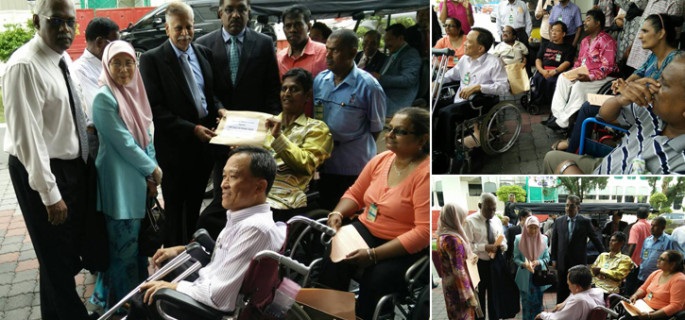
About a dozen disabled persons handed over a memorandum to Suhakam

About a dozen disabled persons handed over a memorandum to Suhakam calling for improved health services for their needs ahead of Budget 2013