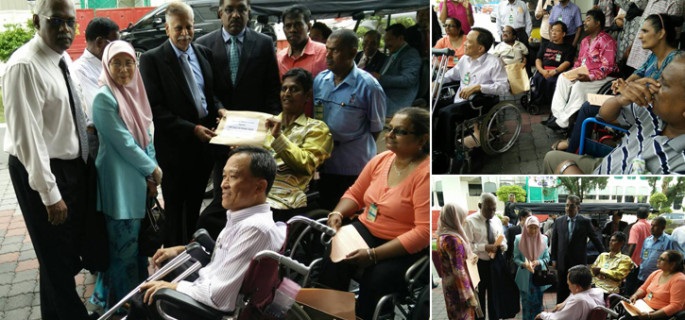
NEW MINISTER FOR WELFARE MINISTER OF MALAYSIA

NEW MINISTER FOR WELFARE MINISTER OF MALAYSIA
Badan Latihan dan Hidup Berdikari Malaysia (ILTC) pada 23hb Mac 2016 menyerahkan memorandum kepada ahli-ahli parlimen mendesak supaya golongan orang kurang upaya (OKU) dikecualikan daripada cukai barangan dan perkhidmatan (GST).

Disabled Members Protest

Disabled Members Protest
Disabled Members Protest at JPJ Wangsa Maju

ILTC Malaysia members staged a protest outside JPJ Wangsamaju KL.

ILTC Malaysia members staged a protest outside JPJ Wangsamaju KL.
Disabled group’s protest disabled drivers required to produce doc's medical report.

Tuesday, 4 June 2013

Blind but he didn’t lose sight of his goal

Tuesday June 4, 2013

Blind but he didn’t lose sight of his goal

By EILEEN NG
eileen@thestar.com.my

KUALA LUMPUR: Azril Che Ibrahim was an active football player until his world came crashing when he was 11. He became blind.
He went into depression for six months, keeping to himself and not mixing with his friends and family.
“I was very sad. I lost my appetite and could not face my friends as they kept teasing me about my condition,” he said at the launch of United Nations Children's Fund (Unicef) “The State of the World's Children 2013: Children with Disabilities” report.
But he has proven that there's life and football even without eyesight. He is now a member of the national futsal team for the blind.
Born with sight, Azril, now 20, was active in football in his early primary school years with his two elder brothers, who were also active in the sport.
He had dreams of becoming a footballer like his idol David Beckham but his eyesight started deteriorating when he was eight. By the time he had his eyes checked, doctors confirmed he only had 40% of his vision left.
“Despite all this, I persevered and completed Standard Six in a regular school. I used to ask my friends to tell me what the teacher wrote on the blackboard,” he said.
Determined lad: Women, Family and Community Development Ministry deputy secretarygeneral Datuk Harjeet Singh (right) and Belmonte chatting with Azril after launching a Unicef event in Kuala Lumpur. — BernamaDetermined lad: Women, Family and Community Development Ministry deputy secretarygeneral Datuk Harjeet Singh (right) and Belmonte chatting with Azril after launching a Unicef event in Kuala Lumpur. — Bernama
He subsequently went to two schools for children with disabilities and started to slowly dabble in football again when a schoolmate wrapped a football with plastic bag so he could hear the sound.
In 2011, he followed a senior schoolmate to a futsal game for the blind in Bangsar and was thrilled to be selected as part of the national team.
His first international tournament was against the South Korean team where he scored his first goal in the semi-finals.
“My dream of playing football is finally fulfilled. My advice to people is not to let any disability be a barrier to success,” said Azril, who is currently studying at Kolej Darul Quran.
The five-a-side blind football, or more commonly known as blind futsal, consists of five players, of which four are blind.
Only the goalkeeper is sighted. There is also a guide, who is positioned behind the opponent's goal post, to assist in directing the players.
The court, which is the same as any futsal court, has side kickboxes to keep the ball, which produces a sound thanks to ball bearings inside it, within the court.
Unicef Malaysia representative Wivina Belmonte commended Malaysia for its efforts in addressing the needs of the disabled.
She said Malaysia was also among the first to sign and ratify the Convention on the Rights of Persons with Disabilities.

50% off for the disabled

Tuesday June 4, 2013

50% off for the disabled

By EDWARD R. HENRY
edward@thestar.com.my

DISABLED people who own and live at the same address in Selangor will be given a 50% discount on their assessment tax to ease their burden as most of them often live on a fixed income.
Petaling Jaya mayor Datin Paduka Alinah Ahmad said people with serious or permanent disabilities could apply for the discount.
Selangor government made the decision in March at the state executive council meeting.
“MBPJ has been informed of this decision to give a 50% discount on assessment tax for the disabled to ease their difficulties as most of them live on a fixed income from the state’s Welfare Department or do simple jobs,” she said after the council’s full board meeting.
“Our officers will get the details of the discount scheme sorted out with the state officials for a smooth implementation.
“MBPJ is eager to implement this scheme as it is an important initiative to make it possible for the disabled to live in their homes without the added burden,” she said.
She stressed that the council would be strict on the applications as it must be the applicant’s principal place of residence and the property must not be rented or leased out.
“Discounts are given to a disabled person who owns and lives in the said property.
“The council’s Evaluation and Property Management Department will conduct a visit to the house or apartment and confirm that it is the applicant’s residence,” she said.
For assessment tax purposes, MBPJ’s definition of residence will depend on two factors — physical presence and intention.
Alinah said the application would have to be made on an annual basis by Feb 28.
Disabled people are given a discount according to the following criteria:
·Has lost the use of both limbs. Losing the use of a limb means that the limb has been amputated or its use has been lost by reason of paralysis or other muscular degeneration,
·Is blind in both eyes and has a visual acuity of 5/200 or less, or visual field to five degrees or less, and
·For disabled persons with a Welfare Card, the council’s assessor must consider the application without subjecting the person to further medical documentation.
Malaysian Animal-Assisted Therapy for the Disabled and Elderly Association president Anthony Thanasayan said the 50% discount was a good gesture but it does not go far enough.
“Disabled people must be given a total waiver as this is more appropriate. Just like in the case of a total exemption of Malaysian passport and road tax fees for the disabled,” he said.
Anthony added that most disabled people were still unemployed and faced a high cost of living for medication, assistive devices and rehabilitation therapies.
“Government entities must strive to improve their services for the disabled and must not make money from their misfortune and be aware of their hardship,” he said.

Monday, 20 May 2013

Article Appeared Star - 20/05/2013

Article Appeared Star - 20/05/2013

Hotel theme park holds three-day charity bazaar for homes and NGOs


Monday May 20, 2013

Hotel theme park holds three-day charity bazaar for homes and NGOs

<b>One for the album:</b> Yeo (standing fifth from left), Chew (sixth from left) and First World Hotel vice-president Victor Foo (fourth from left) with representatives from each home at the ribbon-cutting ceremony.One for the album: Yeo (standing fifth from left), Chew (sixth from left) and First World Hotel vice-president Victor Foo (fourth from left) with representatives from each home at the ribbon-cutting ceremony.
RESORTS World Genting recently organised an annual charity fundraising event titled “Every Sen is Hope” Charity Bazaar at the Universal Walk of First World Plaza over three days at the end of April.
The aim of the charity bazaar was to foster a caring society and to promote awareness to the public of these homes and NGOs’ needs.
In addition, the objective was to also help them promote their small businesses to raise some funds to sustain their daily living.
A total of seven charity homes and associations were invited to participate in the event.
The seven homes and NGOs were Malaysian Association for The Blind (MAB), The Independent Living and Training Centre Malaysia, Beautiful Gate Foundation for the Disabled, eHomemakers Salaam Wanita, Shu-ang Fu (Double Blessing) Disabled Independent Living Association, Com-munity Service Centre for the Deaf (CSCD) and Pusat Kanak-Kanak Istimewa Kajang.
The homes displayed and sold handicrafts and goodies such as wire art, recycled magazine baskets, costume jewellery, picture frames and pineapple tarts.
Other homes offered services such as foot massage, manicure and body art drawing using henna.
Each received overwhelming response from visitors.
The Orang Asli community from Bentong, represented by the Koperasi Kampung Orang Asli Chinta Manis Bentong, displayed their fine handicrafts made of rattan and screwpine leaves.
A launch ceremony was held at the Universal Walk with an opening performance by Cik Rahimah from the Independent Living and Training Centre Malaysia, who gave the audience a dance performance on her wheelchair.
This was followed by a ribbon-cutting by Genting Malaysia Bhd public relations and communications senior vice-president Datuk Anthony Yeo with his vice-president Katherine Chew to-gether with the Genting Theme Park’s Mascots — Tabby and Allie.
Also present was the Theme Park Balloon Sculpture performer — Lady Vee who very quickly and skilfully made roses and animals using balloons for the visitors.
Genting also held several competitions for the public with surprise gifts such as entrance tickets to Universal Studio Singapore, Genting Theme Park tickets, dining vouchers and souvenirs up for grabs.
During the four days of the bazaar, the homes managed to raise RM23,486 of sales and RM6,544.25 worth of donations from the public.

Thursday, 16 May 2013

A welcome change for disabled voters


Thursday May 16, 2013

A welcome change for disabled voters

WHEEL POWER
By ANTHONY THANASAYAN


<b>Equal opportunities:</b> The disabled and the elderly were given all the help they needed at polling stations throughout the country during GE13.Equal opportunities: The disabled and the elderly were given all the help they needed at polling stations throughout the country during GE13.
OUR much anticipated 13th General Election has come and gone. So, how was it for Malaysians with disabilities who joined the crowd that turned up to cast their votes?
This was the first time my helper was allowed to enter the classroom at the polling station to assist me in my wheelchair.
Marcus Foo, 19, from Sri Hartamas in Kuala Lumpur drove over to my house in Petaling Jaya to help me get ready and pushed my wheelchair about a hundred metres to a nearby school where the voting was conducted.
We sailed through the crowd of about 100 people who had made a beeline to the polling station by 9am. We were duly guided by the election staff on what to do and where to go, and we were done within 10 minutes.
I was pleased to see empty wheelchairs provided by the Election Commission for the elderly and those with walking difficulties. They were placed in front where everybody could see them.
As an added bonus, I noticed that the school had done some renovations. They had levelled the ground in several places since I last voted there five years ago.
However, I was disappointed to see that the entrance to the classroom still had a four-inch step. I needed some assistance to get in. The single step is a barrier to students in wheelchairs.
As I cast my votes, I closed my eyes and wished for all such barriers to be removed from schools across the country so that Malaysians with disabilities would have equal opportunities to education in the country.
For TKC, 44, a wheelchair user, last week’s voting turned out to be a pleasant family affair.
TKC was wheeled by his brother to a nearby school in the morning. He was accompanied by his sister-in-law, mother and a curious two-year-old nephew.
TKC and his elderly mother did not have to queue up, but the abled-bodied voters in his family had to wait out the queue. Needless to say, TKC and his mum finished long before the rest.
TKC found the ballot box too high, though. One of the lady officers had to tilt the box so that he could slip in his ballot papers.
Chong Tuck Meng, 52, who is paralysed from the neck down, was pleased that one of his two helpers was allowed into the classroom to assist him as he voted for the candidates of his choice. Everything was over in 10 minutes.
This was a welcome change for Chong who hails from Bentong, Pahang. During the last general election, Chong was not allowed to bring a helper into the classroom to assist him.
The only issue Chong had this time round, was a small uncovered drain outside the classroom. Fortunately for Chong, he had his helpers to carry his wheelchair over the drain.
Antony Leopold, 61, was delighted when the parking cones that blocked cars from entering the polling station were immediately removed when the police found out he was a disabled driver.
Some of the benches were also removed to make way for his car as it was raining at the time.
Three officers with umbrellas helped Antony, who had walking difficulties, into his wheelchair and accompanied him all the way to the classroom to cast his vote.
However, things did not go so smoothly for Yap Khen Siong, 39, from Bandar Tun Razak in Kuala Lumpur. Yap travelled in his electric wheelchair to the polling station 2km away.
When he arrived at the polling station, he found that the voting room was on the first floor. It was clear that it would be impossible to carry his wheelchair up the flight of stairs. So, he had to wait for almost half an hour to cast his votes.
Yap’s ballot papers were brought down from upstairs, and he had to sign some documents before
casting his vote.
His ballot slips were then put in an envelope and taken upstairs – something Yap didn’t quite like. His ballots were no longer confidential as they had to be removed from the envelope and placed in the box.
For Yam Tong Woo, 59, it was his first time as a blind voter. He was accompanied by his sighted wife and son who were also voters.
An Election Commission official spotted Yam’s white cane and approached him immediately.
Yam and his wife were ushered to the queue for the disabled and the elderly. Yam was helped by his wife to cast his votes. She had to fill up a special consent form as a helper.
“I look forward to the day when the blind will be able to cast their votes independently, with assistive technology at the voting booth,” said Yam.

Tuesday, 14 May 2013

Today the Star - 14/05/2013View articles


Thursday, 2 May 2013

We want action, not talk


Thursday May 2, 2013

We want action, not talk

WHEEL POWER
By ANTHONY THANASAYAN


Improved facilities: Screen readers allow visually impaired users to read the text that is displayed on the computer screen with a speech synthesiser. The blind welcome subsidies for gadgets and devices that enhance independence.Improved facilities: Screen readers allow visually impaired users to read the text that is displayed on the computer screen with a speech synthesiser. The blind welcome subsidies for gadgets and devices that enhance independence.
There’s much that can be done to help the disabled.
MALAYSIANS go to the polls on Sunday in one of our country’s most eagerly anticipated general elections in history. So, what would people with disabilities like to see changed in the first 100 days after the 13th general election?
Persons with learning disabilities remain one of the most neglected groups in society. They are largely unable to speak up for themselves and need their caregivers to voice their needs.
Many teachers who have been sent to work with special needs children often lack exposure to kids with autism, Down syndrome, dyslexia and other learning disorders. A serious effort is needed to correct this. Special education teachers need to go to learning centres run by NGOs to gain experience so that they can become more effective teachers. Theory picked up from seminars and workshops alone isn’t enough. Hands-on experience in working with dyslexic children, for example, will disclose the finer points of how they learn.
Dyslexics are visual learners and have to see things for themselves before they can really understand ideas. Thus, the curriculum should not be fixed but remain flexible for people like them.
The Special Education Department should start acting on the many suggestions that were handed to them by disability groups nearly 10 years ago. These include planning a mandatory special learning programme for each child as they all learn things differently instead of focusing on writing and the chalk and board method. How about introducing motor repairs, animation and designing, art and drawing, and even theatre in vocational schools?
Employers are sadly not keen to hire learning disabled people because of their handicap. The good news is the Government started training people to be job coaches early this year to help pair each candidate with a suitable task. What’s the progress so far? And can we have more job coaches in the near future?
A minimum RM500 monthly living allowance for all disabled Malaysians registered with the welfare department will go a long way in helping them cope with the high cost of living, medical expenses and purchase of special needs equipment.
Subsidies are needed for gadgets and devices that enhance independence and empower the blind. Screen readers, Braille notetakers and Braille displays, and electronic book readers are off limits to many as they are very expensive.
Let’s have more beeping traffic lights, tactile pavements, and taxi and bus stands outside government buildings, malls, places of worship and important public places. Can buses and trains please announce their stops so that the blind can know when to disembark?
Though this may be too late to implement now, in the next general election, can we use the voting system used in Singapore and some African countries that enable the blind to vote independently? Ballot papers are inserted into a clear plastic holder. Holes are cut matching the boxes where the crosses are supposed to be marked. This aids blind voters to feel the hole and mark the cross there. This can be used as an alternative for those who want to vote without any assistance.
Can we have our very own disability welfare department instead of sharing it with other groups? This will help focus on the many needs of the disabled community. It will also ensure that funds channelled into the department will go to the needy. Please employ more people with disabilities to head the department as they have a better understanding of the needs of the disabled.
It is high time that a member of the disabled community be appointed as senator. Do not be misled by academic qualifications; chose someone who knows what it feels like to struggle everyday with their disability to fit this very important position.
There should be home visits by nurses from the nearest government hospital to care for the disabled who need their services. Transport to the hospital – via ambulance or van for follow-ups – should be provided free of charge.
Specially-trained and subsidised local and foreign maids should be made available to people with profound disabilities. Alternatively, more nursing homes should be set up for those who need such services.
Last but not least, the disabled look forward to better discounts and support from Internet and communication service providers.

Tuesday, 23 April 2013

Maxis - IT - Maxis Academy


On behalf of our organization, we would like to thanks "Maxis" for teaching IT to our 15 members on more about data transfer, music download and phone backup etc. on 19/04/2013 at Menara Sunway, (Maxis Academy)

Special thanks to Ms. Esther who had arranged a mobile disabled toilet which will be placed nearby training location for easy access for all.


Saturday, 13 April 2013

Calon Parlimen Titiwangsa mahu debat nasib OKU


Calon Parlimen Titiwangsa mahu debat nasib OKU

Jamilah Kamarudin
 | April 12, 2013
Masa depan OKU bersama Pakatan Rakyat lebih terjamin berbanding kehidupan mereka selama ini di bawah BN.
KUALA LUMPUR: Calon PAS Parlimen Titiwangsa Ahmad Zamri Asa’ad Khuzaimi menawarkan diri untuk berdebat dengan wakil Barisan  Nasional (BN) mengenai nasib dan masa depan Orang Kelainan Upaya (OKU).
Ini berikutan keluhan wakil Persatuan Orang Buta Mohammad Faizal Che Yusof dalam laporan akhbar The Sun mengenai nasib dan  layanan yang diterima 2.8 juta OKU untuk bertarung dengan tekanan kos sara hidup yang tinggi.
Selain itu, masalah pengangguran, beban ekonomi, serta kadar kemiskinan bandar yang semakin meningkat turut dirasai golongan  terbabit.
“Saya sedia berdialog dengan Mohammad Faizal yang mewakili badan bukan kerajaan (NGO) Bangkit serta calon Umno khususnya di  Parlimen Titiwangsa.
“Bahkan saya sedia bertemu dan bersemuka dengan mana-mana pemimpin Umno bagi membuktikan masa depan OKU bersama Pakatan  Rakyat lebih terjamin berbanding kehidupan mereka selama ini dibawah BN.
“Tarikh, masa dan tempat perdebatan terpulang kepada Mohammad Faizal,” katanya kepada pemberita di Pusat Khidmat Parlimen  Titiwangsa di sini hari ini.
Katanya, menjadi dasar Pakatan Rakyat memastikan setiap golongan OKU dibantu termasuk kemudahan awam dan pendidikan seperti  yang dijanjikan dalam Manifesto Rakyat.
Beliau berkata, kehidupan OKU masih lagi ditakuk lama, bahkan kebanyakannya dipandang remeh seolah-olah mereka adalah golongan kelas kedua yang terpaksa menagih simpati dan belas kasihan masyarakat untuk hidup.
Namun, kerajaan BN pula tidak memandang golongan ini dengan perhatian utama dan membiarkan mereka sehingga tersisih daripada  arus pembangunan.
“Sebagai kerajaan menanti (government in waiting) Pakatan Rakyat berazam dan berikhtiar membantu OKU sedaya upaya supaya  golongan ini mempunyai kedudukan dan hak setaraf insan sempurna,” katanya.

Thursday, 4 April 2013

NGO Awareness Campaign at the Taylor College

On the behalf of ILTC Malaysia, would like to express our appreciation to Golden Land Expo for invited us to the NGO Awareness Campaign at the Taylor College at Sunway which held on 28/29 March 2013.


Saturday, 30 March 2013

Kuala Lumpur Selangor Chinese Assembly Hall Annual Charity Event

Kuala Lumpur Selangor Chinese Assembly Hall, Jalan Maharajalela, (KLSCAH) had invited ILTC Malaysia to their annual charity event which was held on 10/03/2013. They have donated money to our charity work.