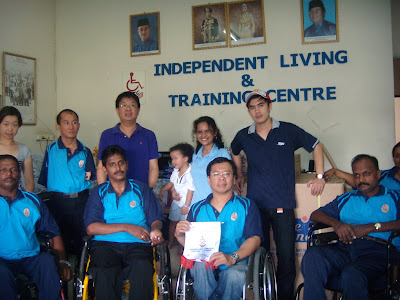
NEW MINISTER FOR WELFARE MINISTER OF MALAYSIA

NEW MINISTER FOR WELFARE MINISTER OF MALAYSIA
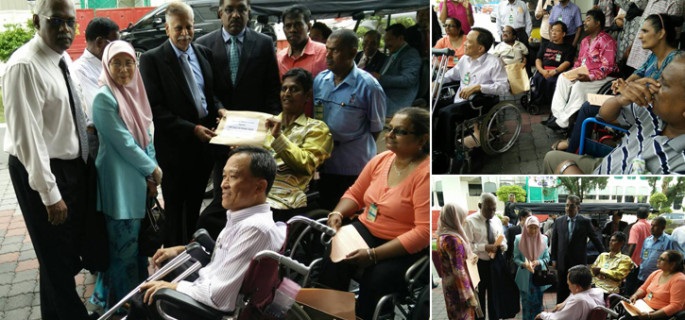
Badan Latihan dan Hidup Berdikari Malaysia (ILTC) pada 23hb Mac 2016 menyerahkan memorandum kepada ahli-ahli parlimen mendesak supaya golongan orang kurang upaya (OKU) dikecualikan daripada cukai barangan dan perkhidmatan (GST).

Disabled Members Protest

Disabled Members Protest
Disabled Members Protest at JPJ Wangsa Maju

ILTC Malaysia members staged a protest outside JPJ Wangsamaju KL.

ILTC Malaysia members staged a protest outside JPJ Wangsamaju KL.
Disabled group’s protest disabled drivers required to produce doc's medical report.

Friday, 24 April 2009

Peraturan sekat elaun OKU dikaji

Jumaat, 24 April 2009


Peraturan sekat elaun OKU dikaji
SHAHRIZAT bertemu OKU yang tidak puas hati mengenai penarikan semula bantuan kewangan bagi golongan OKU di Kuala Lumpur, semalam.

KUALA LUMPUR: Kementerian Pembangunan Wanita, Keluarga dan Masyarakat memberi jaminan akan mengkaji semula peraturan menyekat orang kurang upaya (OKU) menerima elaun kebajikan sekiranya mereka memiliki televisyen atau Astro.

Menterinya, Senator Datuk Seri Shahrizat Abdul Jalil memberi jaminan itu selepas berbincang dengan sekumpulan 12 OKU yang mengunjungi pejabatnya di sini, semalam.

"Anda memberitahu saya untuk melihat semula peraturan ini, saya akan melihatnya... saya berasakan permintaan ini adalah wajar dan saya akan melihatnya kembali. Kita akan kembali dengan jawapan yang realistik," kata Shahrizat. Beliau turut menegaskan peraturan itu tidak bertujuan untuk mendiskriminasi OKU.

Shahrizat berkata demikian mengulas laporan akhbar New Straits Times, semalam, bahawa golongan OKU yang memiliki televisyen atau Astro di rumah masing-masing disekat daripada menerima bantuan kebajikan.

Beliau kemudian menjelaskan, peraturan itu hanya dikuatkuasakan terhadap mereka yang tergolong di bawah skim OKU yang tidak mampu bekerja dan diberi bantuan RM150 sebulan.

"Apabila OKU mempunyai kemudahan Astro di rumah mereka... ini ditakrifkan sebagai petanda OKU sudah mampu berbelanja lebih... dalam konteks ini untuk hiburan. "Tindakan menggunakan Astro dianggap sebagai perbelanjaan bulanan tambahan yang mengurangkan penggunaan wang bantuan untuk keperluan asas," katanya.

Bagaimanapun, Shahrizat menegaskan peraturan itu tidak menjejaskan dua lagi skim kebajikan untuk pekerja kurang upaya dan penjaga OKU lumpuh yang menerima bantuan bulanan RM300.

"Mereka yang masih menguat kuasa peraturan ini terhadap dua kategori OKU terbabit boleh diambil tindakan. Bagaimanapun, saya akan mengkaji semula peraturan berkaitan pemilikan Astro dan televisyen," katanya.
Terdahulu, keadaan agak tegang di ruang menunggu kementerian terbabit dengan beberapa individu membawa sepanduk mengutuk peraturan itu tetapi suasana kembali tenang sebaik Shahrizat tiba.

Beliau kemudian berjabat tangan dengan semua OKU yang berada di ruang menunggu kementeriannya sambil bertanya nama dan latar belakang sebelum menarik sebuah kerusi duduk bersama mereka untuk mendengar masalah dibangkitkan.

Disabled folk protest against Astro ruling


Thursday April 23, 2009

Disabled folk protest against Astro ruling

KUALA LUMPUR: About 20 disabled people turned up at the Women, Family and Community Develop-ment Ministry yesterday to protest against the ruling barring those with Astro from receiving welfare aid.

The wheelchair-bound protesters were led by Independent Living and Training Centre president Francis Silva, who urged the ministry to reconsider its ruling. Silva said the ruling was a clear indication of discrimination against the disabled.

“The RM50 subscription fee is minimal. Astro channels have become a source of information and knowledge for our children. We don’t want the Welfare Department to withdraw the allowance which we are entitled to,” he said.

The group later met Minister Datuk Seri Shahrizat Abdul Jalil for 30 minutes.

In a statement, Shahrizat said the aid was meant to assist the poor and needy with basic needs such as food, clothing and shelter.

“Subscribing to Astro for an entertainment channel is considered a monthly expense that would reduce the amount of welfare aid,” she said, adding that there would also be more dialogues and reviews of legislation, policies and regulations to enhance the quality of the lives of the disabled.

Shahrizat to review Astro ruling, brings hopes to disabled

Thursday, April 23, 2009


Shahrizat to review Astro ruling, brings hopes to disabled
Senator Datuk Seri Shahrizat Abdul Jalil meeting with representatives from three organisations for the disabled yesterday. — NST picture by Yazit Razali

Minister meets disabled reps, promises to come up with realistic solutions to meet their needs.

KUALA LUMPUR: The disabled may yet get to enjoy Astro satellite programmes together with Welfare Department aid.

Women, Family and Community Development Minister Senator Datuk Seri Shahrizat Abdul Jalil said the department would be reviewing the ruling that bars the disabled from getting aid if they had a television set or Astro service at home.

She said this at a meeting with 12 disabled people who came to see her at her ministry yesterday over the issue.

The disabled, who came in wheelchairs, were from the Disabled Persons Integrated Family Services (KIOKU), Independent Living and Training Centre and the Malaysian Animal-Assisted Therapy for the Disabled and Elderly Association.

"You are telling me to look at it, which I will. I think it's a reasonable request and I will look at it," she said, adding the ruling did not constitute discrimination against the disabled."

We will come back with realistic answers."Shahrizat was responding to a report in the New Straits Times yesterday on the disabled being barred from getting welfare aid if they had a TV set or Astro at home.

She said the ruling only applied to those under the Disabled Persons Unable to Work scheme, who were being given RM150 per month in aid.

"The underlying principle for welfare aid to the poor and needy is to ensure that their basic needs, such as food, clothing and shelter, are met."As such, the ruling on Astro is applicable because it gives an indication of the affordability of the applicant to spend on something extra, in this case entertainment."

She said Astro was considered a monthly expense that would reduce welfare aid being used for basic needs.

Shahrizat said the ruling did not affect the other two welfare schemes for disabled workers and people caring for a bedridden disabled person, who get RM300 a month.


She said action would be taken against officers who imposed the ruling on people in these two schemes.

Earlier, the mood in the waiting room at the ministry was dark, with the disabled carrying placards condemning the ruling.

But the atmosphere changed when Shahrizat entered and shook hands with them, asked their names and their backgrounds before pulling up a chair to sit with them.

She said she understood the predicament of the disabled, with most lying on a bed the whole day, with nothing to do but stare at empty walls.

Shahrizat said she would also speak to Astro to provide free services to the disabled as part of the company's corporate social responsibility.
There are 28,608 disabled people registered with the ministry.

Wednesday, 22 April 2009

Got Astro or TV? Sorry, no welfare aid for you


2009/04/22
Got Astro or TV? Sorry, no welfare aid for you
By : Suganthi Suparmaniam

KUALA LUMPUR: The words "disabled, Astro" and "aid" cannot occur in the same sentence, as far as the Welfare Department is concerned.

The department bars the disabled from getting welfare aid if they have Astro or a television set at home.The rule applies even if one lives in someone else's house, temporarily or otherwise.

S. Karupanan, 73, found this out the hard way three months ago when the department cut the RM200 aid to him as he was temporarily staying in a house which "had Astro service".

The department had paid for surgery on one knee and promised to underwrite the cost of the operation on the other knee.

But while awaiting the second surgery, he moved into his daughter's house and his troubles began.

Welfare officers who came to visit him saw red when they chanced upon the Astro connection and immediately withdrew the aid.

For K. Shanmugam, 51, who applied for welfare assistance in 2005 on becoming paralysed, it has been a string of "no's" from the department for aid.

His mistake, he believes, was his honest reply when asked if he had a television set and Astro at home."That's the first question they asked.

When I said I had both, they immediately said that I was not eligible for assistance as there were others poorer than me.

" The former crane driver, who was earning RM2,000 in Singapore when a motorcycle accident four years ago left him paralysed, was baffled by the department's decision.

He said that the bills of the family of six were paid by relatives who realised that he only had Astro to keep him company when the children were out of the house."

I cannot work. The only pleasure in my life now is the Astro service," he said.

Another extreme case is that of a a disabled 40-year-old, paralysed from the neck downwards, who lives with he partly-paralysed mother.

The disabled woman, who declined to be identified, decided against applying for an Astro connection after being warned by a welfare officer that they would cut aid to them if she did so.

What she cannot understand is why they would do so as Astro was the "only" company she and her mother could have at home.

"We cannot leave our house and we live on donations and welfare aid. What's wrong if some people who sympathise want to get us an Astro connection?"

Welfare director-general Datuk Meme Zainal Rashid could not be reached for comment.

Monday, 20 April 2009

A Serious Discussion - Mahumas Sdn Bhd

Not Accessible for the disabled - New Bus Terminal for Rawang

THE new bus and taxi terminal at Pusat Bandar Baru Rawang will begin operations next month not accessible at all for the disabled.


Recently, ILTC visited the newly-completed bus and taxi terminal located along the Federal trunk road was build with poor accessible facility and would be opened in the middle of May.

Last week, we had a serious discussion with the Mahumas Sdn Bhd management. The management willing to up grade all the facilities for the disabled people as soon as possible. In the mean time we will be monitoring the the developer to comply with MS1184 accessible facilities.

NEW MALAYSIAN CABINET APRIL 2009

NEW MALAYSIAN CABINET APRIL 2009

Sunday, 19 April 2009

Computer Class For The Term 2009

Computer Class For The Term 2009 Begins From April

A group of fresh disabled members have started their Computer Training Programme for this year 2009 with the help of new computers donated by RENTWISE SDN BHD.

Tuesday, 14 April 2009

Happy Tamizh New Year. ( இனிய தமிழ் புத்தாண்டு நல்வாழ்த்துக்கள்)

ILTC Wishing You & Your Family A Prosperous Happy Tamizh New Year. ( இனிய தமிழ் புத்தாண்டு நல்வாழ்த்துக்கள்)

From President & All ILTC Members


May your touch - is Midas

May your words - is Mantras

May your heart - is Pure

May you concious - is Clear

Monday, 13 April 2009

Public transport needs to be more disabled-friendly: Ong

Published: Monday April 13, 2009 MYT 2:20:00 PM


Public transport needs to be more disabled-friendly: Ong
By NG SI HOOI

KUALA LUMPUR: Public transport needs to be more disabled-friendly and moves are being made to improve facilities, said Transport Minister Datuk Seri Ong Tee Keat.

“We are aware that a lot of facilities do not take into consideration their needs.

“In the fourth quarter of last year, I instructed several agencies under my ministry to take into account of the needs of the physically challenged individual especially in public transport,” he told reporters after opening the KKAJ Vocational Centre for the Disabled in Bandar Baru Ampang here Monday.

Ong, who is the patron of the centre, said he had instructed the agencies to speed up the process and make this their main challenge.

“I know it is not easy and there are lots of obstacles. We must endeavour to overcome the challenges,” he said.

Ong said he had come across cases where physically-challenged individuals had struggled to get on public transport.

“This renders them less mobile. I do not think it is fair,” he said.

Earlier in his speech, Ong said physically-challenged individuals needed assistance but not in the form of welfare.

“They need help in the form of training opportunities, to excel in life and to compete with others.

“These are the key parameterd that we should set our sight on,” he said.

The KKAJ Vocational Centre for the Disabled is set up by Resorts World Bhd and Kelab Kercergasan Ampang Jaya to give disabled-people a chance to learn skills and generate income for themselves.

The centre will provide training and facilities such as paper lamination, document binding and food packaging.

This Parking Lot Is For The Disabled

April 13, 2009 09:45 AM

"This Parking Lot Is For The Disabled"
By Zulkiple Ibrahim

KUALA LUMPUR, April 13 (Bernama) - Recently a daily reported the claim of a wheelchair-bound man about an unpleasant treatment that he encountered during a trip to a commercial bank in Subang Jaya near here.

In the report, the physically-handicapped man claimed that he had to wait for some 45 minutes outside the bank before getting assistance, as there was no facility for a wheelchair-bound person to get into the premises.

"No need to go to the bank lah. Ask your wife lah," said a friend in colloquial English.

Earlier, this writer who is a person with disability (PWD) and previously wheelchair-bound, had related the above experience to the friend.

"What ever happens to the Persons with Disabilities Act 2008?" queried academician Fatimah Mansur.

She said even though the Persons with Disabilities Act came into force in July last year, this legislation has yet to show how effective it is in protecting the rights of disabled people.

Fatimah said: " Where is the justice for disabled people when even the parking spaces for the PWDs are being abused? Is it the case of public apathy against the disabled?"

A check at several public spots confirmed Fatimah's views.

At the North-South Highway's Sungai Buloh rest area, all the three parking bays reserved for vehicles of the PWDs were observed to be frequently full with motorcycles.

The same goes for parking lots reserved for the handicapped at several shopping complexes in the city where they are utilised by vehicles with non-handicapped drivers and occupants.

FIRST CLASS TREATMENT

Still smarting from a similar distasteful experience in 2006, this writer who is wearing a prosthetic leg hesitantly hobbled into a bank in Petaling Jaya recently as he had to settle an outstanding bill.

The electronic queue number board showed '5041' and this writer's heart sank as a glance at the queue number slip in his hand revealed that his turn at the counter was after another 60 clients.

Then a pleasant surprise happened!"Can I help you sir?" A bank officer who appeared out of now where, asked.

The writer was assisted to a counter and his transaction was done within minutes.

The day turned out to a very thrilling and enjoyable for this writer as he experienced 'first-class' treatment at the Employees Provident Fund (EPF) office at Jalan Gasing in Petaling Jaya and Inland Revenue Board (IRB) office in Shah Alam, Selangor.

At the EPF office, this writer was ushered to a counter and the officer there settled his request for certain documents within mere minutes.

At the Shah Alam IRB office, he enjoyed 'green lane' and VIP treatment where he did not have to pick a queue number and an officer even invited him to a counter to entertain his request for a refund.

Now, that is first-class treatment for a PWD.

PEOPLE WITH DISABILITIES ACT

The Persons With Disabilities Act came into force on July 7, 2008. This is the first rights-based legislation for people with disabilities (PWD).

Former Women, Family and Community Development Minister Datuk Dr Ng Yen Yen was reported to have said that with the enforcement of the Act, people with disabilities would be able to enjoy better public transport facilities, amenities and services.

They will also have equal opportunities to health, education, information, communication and technology, habilitation and re-habilitation, improved employment opportunities as well as sports, leisure and cultural life, she said.

This act provides for the registration, protection, rehabilitation, development, and well being of people with disabilities along with the establishment of National Council for People with Disabilities.

However the then president of the Malaysian Bar Council Datuk Ambiga Sreenevasan noted that:

"There is no provision for any penalty for any party who does not live up to the obligations under the Act".

She was reported as saying that although the Act stated that persons with disabilities have the right to enjoy the benefits of public transport, housing, education, employment and healthcare, it did not offer remedies if they face discrimination in these areas.

BERNAMA

Thursday, 9 April 2009

Not Accessible - New Bus Terminal for Rawang

Not Accessible for the disabled - New Bus Terminal for Rawang

THE new bus and taxi terminal at Pusat Bandar Baru Rawang will begin operations next month not accessible at all for the disabled.

Recently, ILTC visited the newly-completed bus and taxi terminal located along the Federal trunk road was build with poor accessible facility and would be opened in the middle of May.
New landmark: Construction work on the new terminal is almost complete.
We discovered that the developer were not comply with MS1184 accessible facilities.
The ramps to the food court are too steep for the wheelchair users and accessible parking spaces were not reserved for disabled people.

Utilities in the toilets were fitted at the wrong places. Wheelchair users should be able to use accessible facilities independently and able to move conveniently inside without assistance.

After observing tightly the bus and taxi terminal, the Selayang Municipal Councilor Ms. Rina will be taking a serious action very soon to update all the facilities to be disabled friendly.
She also has arrange an urgent meeting with the Mahumas Sdn Bhd management soon.

Thursday, 2 April 2009

Living with floods for six long years

Thursday April 2, 2009


Living with floods for six long years
Story and photo by STUART MICHAEL


FOR six long years, residents of Taman Garing in Rawang have had to bear with flash floods in their area with water reaching almost 0.7m into their houses. They are hopeful the ordeal is over now.

Taman Garing was first hit by floods on Aug 13, 2003. Two years later, on April 30, 2005, it was flooded again. Then, on Oct 26, 2006, the area was again inundated. On April 13, 2007, and July 21, 2007, the deluge came again.

For the last two years, flood water continued to enter the houses whenever there is a heavy downpour, and the residents are fed up with the Selayang Municipal Council (MPS) for not doing anything to relieve their suffering.

Close watch: Gurdip Kaur (in a wheelchair) checking on the cleaning up of the monsoon drain in Taman Garing by workers from the MPS Health and Licensing Department.

The residents blamed the floods on the Kota Emerald housing project at the top of a nearby hill.

However, it is actually the MPS which is to blame for not cleaning up the monsoon drain that is filled with trees, tall grass and weeds and that caused the floods to occur frequently.

The rubbish trapped in the drain is also causing a foul smell and attracting flies.

According to MPS councillor Gurdip Kaur, the drain has not been cleared for the last eight years. However, the MPS Health and Licensing Department cleared the weeds, trees and tall grass in the drain recently.

“With the drain cleared, we hope the flood woes in Taman Garing will end,’’ Gurdip Kaur said.

Wednesday, 1 April 2009

Visit To ILTC By Sinclair Knight Merz Sdn. Bhd.

Visit To ILTC By Sinclair Knight Merz Sdn. Bhd

Date: 28th March 2009
Time: 11.00AM – 1.00PM
Venue: Independent Living & Training Centre

On behalf of ILTC, I the President of ILTC take this opportunity to wish my personal thank to Mr. Micheal & his organizing team which has put a lot of afford to make this event a very successful one.
During their visit they also contributed some Electrical items, Lightweight Wheelchairs, Stationary items & Provision.

ILTC members who participated were very happy with this event and looking forward for many more events like this.

Wednesday, 25 March 2009

Monday March 23, 2009

The Star - Lifestyle

Against all odds
By WONG LI ZA

Jessica Cox inspires audiences around the world with her spunk and indomitable spirit.

JESSICA Cox is a superwoman of sorts. She may not be saving victims from burning buildings, but she is a heroine in the hearts of many.

Born without arms, Cox used to watch with envy as other kids swung about on the monkey bars in elementary school while she was limited to the swings.

Frustrated, she would envision herself flying over the playground like Superwoman while everyone watched in disbelief. “I would imagine taking people up one at a time to experience my super powers. Years later, I realised that my imagination had become a reality,” said Cox at a media interview.

"It’s only human to have low moments in life because if you don’t, then you won’t feel the high, exciting times"- JESSICA COX

Cox, 26, is the first woman pilot in aviation history to fly without arms. She was invited to Kuala Lumpur recently to speak at the Women of Independence Conference organised by Intelligence Business Networks.

The two-day conference, to commemorate International Women’s Day, gathered successful women from all over the world, who are leaders in their respective fields.

Wearing dark-rimmed glasses and a grey vest over white blouse, Cox was a petite picture of confidence as she took to the stage.

The motivational speaker articulately delivered her speech entitled Architecturing Your Destiny – Disarming Fears, sharing about her life growing up and how she overcame various obstacles.

Cox said one of the challenges she faced when she first learnt flying was how to tie the seatbelt in the aircraft.

To demonstrate, she climbed onto a chair that was on stage and slipped down into an attached, pre-buckled seatbelt, immediately drawing warm applause from an awe-inspired audience.
In control: Cox is the first woman pilot in aviation history to fly without arms. She earned her US Federal Aviation Administration sport pilot licence in October last year.

“I may not have arms but that does not determine who I am or who I can become,” she said.

Her favourite quote is one by spiritual teacher Marianne Williamson: “Our deepest fear is not that we are inadequate; it is that we are powerful beyond measure.”

Disabling norms

Cox, the middle of three siblings, was born to an American father and a Filipino mother in Tuscon, Arizona.

Doctors could not explain her rare congenital condition as sonogrames and other prenatal tests did not reveal any defect.

However, the spunky lady’s indomitable spirit overrides what she may lack physically.

Standing at a mere 5’ 1” tall (155cm), Cox holds a sport pilot licence, has a double black belt in taekwando and is an active swimmer. (She is the first person without arms to get a black belt in the American Taekwando Association.)

When she first learnt to drive a car, she was encouraged to use special modifications. However, after she had her car modified, she decided to remove the modifications and now holds an unrestricted driver’s licence.

The University of Arizon psychology graduate still draws stares when she pumps petrol at the gas station. She can type 25 words a minute, blow dry her hair, and put on her makeup and contact lenses with as much ease as anyone else.

On Mother’s Day in May last year, Cox flew solo over San Manuel, Arizona, wearing a T-shirt that aptly read: “Look Ma, No Hands!”

She earned a US Federal Aviation Administration sport pilot licence last October. (This type of licence does not require a medical examination, only a valid US driver’s licence, an oral and written exam, and a certificate to fly solo.)

Due to airplane logistics, it took Cox three years, instead of the average six months, before she got her licence. It also required four Ercoupe planes (a type of light aircraft originally built without rudder pedals), three certified flight instructors and 89 hours of flight training in three different states.

“When I fly, I have the greatest feeling of freedom, independence and power,” said Cox, who controls the throttle with her left foot and the yoke with her right.

So far, she has clocked in about 130 hours of solo flights, impressive since flying in commercial planes was her greatest fear since childhood. Needless to say, piloting an aircraft was never on her to-do list.

However, that changed when a member of Wright Flight, a Tucson-based non-profit group, approached her after a Rotary Club talk she gave in 2005. The group uses aviation as motivation.

A fighter pilot named Robin Stoddard who represented the group asked if she would like to fly an airplane.

Being the achiever and optimist that she is, Cox decided to give it a try and was instantly hooked.

“Sometimes fear is rooted in a lack of knowledge and the unknown. When I first started flying, I realised my fear was because I did not know much about it.

“A universal fear people have is a fear of inadequacy and lack of faith in ourselves,” said Cox, who also appeared on the Ellen Degeneres Show in December last year.

Growing pains

Confident, poised and ambitious, Cox has come a long way to become who she is today.

Besides being a motivational speaker (details at rightfooted.com), she has also been mentoring children with the International Child Amputee Network for the past five years.

However, getting to this stage in her life was not an overnight process, nor a walk in the park.

When she was young, she often got angry, kicking and screaming in her tantrums.

“As a child, there was no way to understand why I did not have arms like everyone else. It was difficult being different,” said Cox, her voice softening.

Nevertheless, she still took part in various activities such as gymnastics and tap dancing, often performing on stage.

She wore prosthetic arms from the ages of three to 14, but hated them and was more comfortable using her feet.

“In fact, I often wished the prosthetic arms would break so I wouldn’t have to use them!” said Cox with a chuckle.

On her first day of eighth grade, she finally decided to take off her prosthetics before boarding the school bus. “As the bus door closed behind me, I felt freer and independent. Since that day, I never wore the prosthetics again.”

For Cox, the greater challenge of being born without arms is the constant stares rather than the physical adversity.

“I used to get very irritated when people stared, especially when I’m walking down the street or eating with my feet. But I’ve learnt to turn that into something positive and use that opportunity to channel positive vibes and be an example of optimism.

“Accepting myself is an ongoing journey. It’s difficult to keep your spirits up all the time but I rely on my faith to carry me through the rough times.

“It’s only human to have low moments in life because if you don’t, then you won’t feel the high, exciting times.”

Cox credits her parents for being her role models and pillar of support. Her mother is a nurse and her father, a retired music teacher.

“My mum left the Philippines and came to the States without knowing anyone here when she was 22. She is my role model and always tells me I can do anything I’ve set my mind to.

“My dad never once shed a tear when I was born because he did not see me as a victim. It is hard being a parent to a disabled child. He was my rock during the difficult times and that has shaped me into the person I am today,” she said.

At the moment, there are two things that Cox is still trying to achieve – how to tie her hair into a ponytail and do rock climbing, although she can water ski and snow ski.

She also hopes to get certified as a pilot instructor and teach people with disabilities.

“Once you have a taste of something so great, you want to share it with everyone.”

At present, Cox is not seeing anyone but she has no intention of jumping into just any relationship.

“One good thing about not having arms is I can filter out a guy who is superficial and someone who is genuine. If a guy can really see me for who I am despite how I might look, then he is really worth pursuing,” she said.

Eventually, Cox hopes to get married and have kids. “I know it will be difficult to have a family but I know I am going to be a good mum. I don’t think I will be limited in being that and things like carrying the baby will come naturally.”

Her mother, who was also at the conference, said the word “disability” is alien to her daughter, just as alien as having upper limbs would be.

“This is just to show that there’s always more than one way to accomplish a task.
Boy gets wheelchair worth RM9,000

Saturday March 21, 2009


Boy gets wheelchair worth RM9,000

IT WAS a day of joy for Adam Firdaus, nine,who received a custom-made wheelchair worth RM9,000 from Resorts World Bhd.

The company’s deputy chairman, Tun Hanif Omar, presented the wheelchair to Adam who has cerebral palsy and is a quadriplegic.
For you: Hanif Omar (right) and Resorts World Bhd corporate services vice-president Kay Prakash (left) with Adam (centre) and his family members.

His mother, Marlina Ab Rashid, said ordinary wheelchairs were not suitable for him due to his curved spine.

“His old wheelchair did not provide enough security for Adam and whenever he experienced convulsions, he tends to fall off the wheelchair,” said Marlina, who is a teacher at the Sekolah Menengah Sains Shah Alam.

Marlina, who has two other children, added that she had been looking for a donor to buy the wheelchair for her son for more than a year.

“My family and I are grateful to the company and will forever cherish this act of kindness.” she said.

At the brief wheelchair-presentation ceremony, Hanif said: ”We are happy to be of assistance to the family.

Adam’s condition is severe as he only had a small part of his right brain and the rest of it is filled with water.

He had difficulty in carrying out daily routines such as cleaning himself, feeding and moving.

Adam attends a special school and undergoes medical treatment once every two weeks.

The new wheelchair was custom-made to suit Adam’s condition with an adjustable firm back, seat board and a trunk support to prevent body collapse.

Thursday, 19 March 2009

Wednesday March 18, 2009

Respect differences
ChildwiseBy
RUTH LIEW

Teach children to see beyond physical disability.

CHILDREN absorb their parents’ attitudes. They learn how to love and how to hate the differences in people from observing their parents. Sometimes children have a limited view of other people and their beliefs. Their parents try to “protect” them, fearing they may “catch” what others have.

Living in a diverse society, we should bring up our children to respect and value people who are different from us. We need to practise the good values we want our children to inherit.

Preschoolers have very little problem playing with physically challenged children. They do not really care what the less able-bodied cannot do. They are more interested in what they would like to do with them. They are eager to play with the physically disabled and enjoy their companionship.

Children are curious. They want to know why the other child is wearing a leg brace or not able to hear what they are saying. They will ask questions. Parents should help them understand that physical and mental abilities are only part of a person. There’s more to the person than what appears to be. It is important to remind children that all people have abilities. Children can focus on what their friends can do rather than what they cannot do.

It is up to parents to do the right thing by their children. Many adults can trace their own prejudices to their childhoods because their parents and care providers impressed upon them negative messages regarding people who looked different from them.

As psychoanalyst Carl Gustav Jung said: “If there is anything we wish to change in the child, we should first examine it and see whether it is not something that could be better changed in ourselves.”

Be honest with yourself and your children by examining your own prejudices and biases. If you are ignorant about people with physical or mental disabilities, find out more about them. Better still, take the opportunity to volunteer in communities where there is an integrated programme for people of all abilities. According to The Anti-Defamation League’s Hate Hurts. How Children Learn and Unlearn Prejudice by Caryl Stern-LaRosa and Ellen Hofheimer Bettmann, parents must treat children’s questions with respect and seriousness.

Use age-appropriate language and offer correct facts about disabilities. Answer matter-of-factly without being too lengthy in your explanations.

For example, if your child asks about someone who is in a wheelchair without legs or arms, you can tell him that some people are born without limbs and others may have lost them in accidents or in sickness.

Reassure your child that people who have physical disabilities are capable of doing many things in life. Whenever it is possible, read books on stories about children who have disabilities and their success stories.

Do not cloud your child’s perception of people with disabilities with emotions such as pity and fear. Your child should be kind to people of all abilities and disabilities. Discuss with your child how he can play with his friend with a disability. Explore different ideas on doing activities that are best suited for everyone.

More importantly, use respectful language when referring to people from all backgrounds and abilities. No matter what race, creed, religion or disability, the person has a name and should be referred with respect. I remember a four-year-old Korean-American girl who had just met me in her day-care programme, calling out, “Hey, Chinese girl.” The assistant nursery teacher immediately reminded her that I have a name and she should use that instead of calling me “Chinese girl”.

If you are uncomfortable when children ask why some people are born with disabilities, or you are unable to reply, find someone who is confident to answer. You may make a mistake and say the wrong thing. Don’t cover it up. You should admit your mistakes and help the child learn that they can do the same when necessary.

Avoid using words like “us” and “them”. Instead of “We can do this but they cannot”, try saying “We can all do this together.” In your family conversations, offer more positive statements on people with diverse backgrounds and interests. This way when children start making statements of their own, they can find the right words to use.

We fear what we do not know. If children have positive experiences with diversity, they will be accepting and respectful towards people who are different from them. Parents must learn an important lesson together with their children that all people are unique and valuable.

Tuesday, 17 March 2009

Selangor to introduce parking privileges for the disabled

Tuesday March 17, 2009


Selangor to introduce parking privileges for the disabled

THE Selangor Government will offer car stickers as a special parking privilege for the disabled.

State welfare and womens affairs chairman Rodziah Ismail said the move was in line with the state’s caring policy towards the underprivileged.

She said those who wished to obtain the stickers would be required to register themselves.

“This will enable the disabled to enjoy free parking at public parking bays in the state.

“The stickers will be launched soon,’’ she told the assembly.

Rodziah said the state had ordered local authorities to impose stricter enforcement against motorists who abused the special parking allocated for the disabled.

She said the state was also looking into easier accessibility for the disabled at public areas including temples, surau and markets.

“We also want public transportation, especially buses, to be disabled-friendly,’’ she said in her reply to a written question from Wong Koon Mun (PR-Kuala Kubu).

Rodziah said the state also offered micro- credit loans of between RM500 and RM5,000 to the disabled.

Monday, 16 March 2009

RM200 Million Will Be Used To Upgrade JKM - Ng Yen Yen

March 12, 2009 21:35 PM

RM200 Million Will Be Used To Upgrade JKM - Ng Yen Yen

By: Ramjit

KUALA LUMPUR, March 12 (Bernama) -- The RM200 million the Women, Family and Community Development Ministry will get from the Second Economic Stimulus Package will be used to upgrade the Welfare Department (JKM) and hire more staff, said its minister Datuk Seri Dr Ng Yen Yen.She said JKM offices nationwide would be upgraded to be more people and disabled-friendly, which would involve a cost of RM45 million.

"The ministry will also give more attention to old folks homes, especially in Sabah and Sarawak," she told a press conference at the pre-launch of the Purple Ribbon Movement, which will officially launched at the Sunway Resort in Petaling Jaya on March 21.

Ng said RM10 million would be set aside to purchase four-wheel-drive vehicles to facilitate JKM's services for old folks in rural areas while another RM10 million would be spent for hiring new staff to beef up JKM's work force.

BERNAMA

Friday, 13 March 2009

Helping hand

Thursday March 12, 2009


Helping hand
WHEEL POWER

By ANTHONY THANASAYAN

Crash course gives disabled group a head start.

IT IS always encouraging to hear how Malaysians with disabilities are being helped. The latest news I received is a wonderful initiative to help about 30 disabled women familiarise themselves with computers. This is to empower them to have a better quality of life through information technology.

Wheel Power spoke to Thomas Low last week.

Thomas became disabled after he was accidentally dropped as a child. The fall caused him to suffer from a condition called juvenile stroke which affected the right side of his body, causing a limp in his right leg.

Thomas is the project manager of an intensive three-month programme called Small Office Home Office (Soho).

The pilot project was organised and sponsored by eHomemakers and the Women, Family and Community Development Ministry. eHomemakers is an NGO which assists single mothers to work from home to enable them to become self-reliant. Thomas’s job is to oversee the training of the 30 participants in the project which ended early this year.

“There were so many challenges to overcome before the training could even start,” he said.

First, he had to find and identify women who were wheelchair users. Soho was also keen on working with people who use crutches for mobility.

“Finding them was not easy,” Thomas recalled. “I did some active canvassing and approached disability organisations, attended functions for the handicapped, and made call after call to recruit participants for the course.”

The initial reaction from the women wasn’t welcoming either. Many were sceptical about the training.

“Some even thought I was a conman,” said Thomas, with a laugh.

The training was free, with meals and refreshments included.

A daily transport allowance was also given to each participant. The course included soft skills training to give the women a better chance of securing jobs.

Areas covered included confidence-building and phone etiquette.

The programme also covered stuff such as Office, Skype, Facebook, blogging and e-mail. The participants were also taught about nasty viruses that could invade computers and how to prevent such virus attacks.

Locating a disabled-friendly venue with 30 units of computers with Internet facilities was another major hurdle.

“I approached cyber cafes and computer training centres but almost all of them gave me the cold shoulder,” said Thomas.

Finally, it was the Young Women Christian Association (YWCA) Kuala Lumpur that rallied to their aid.

“They had the right place, ample parking space, and disabled-friendly facilities in their building,” said Thomas.

“They had a large classroom with as many as 30 computers at our disposal. They even had a spacious bedroom for those who wished to stay in. The YWCA staff were very accommodating, making changes here and there to suit the participants’ special needs,” he added.

Participants came from as far as Kajang, Bangi and Rawang in Selangor.

All 30 disabled women are now looking for job openings.

If you can help these women, please contact eHomemakers ( 03-7726 5271 ).

Thursday, 12 March 2009

MINI BUDGET 2009 SPEECH BY MALAYSIAN DEPUTY PRIME MINISTER YAB DATO' SRI MOHD NAJIB TUN ABD RAZAK IN THE DEWAN RAKYAT ON 10 MARCH 2009

MINI BUDGET 2009 SPEECH BY MALAYSIAN DEPUTY PRIME MINISTER YAB DATO' SRI MOHD NAJIB TUN ABD RAZAK IN THE DEWAN RAKYAT ON 10 MARCH 2009

SPEECH BY

YAB DATO’ SRI MOHD. NAJIB TUN ABDUL RAZAK
DEPUTY PRIME MINISTER AND
MINISTER OF FINANCE

IN INTRODUCING
THE SUPPLEMENTARY SUPPLY (2009) BILL 2009

IN THE DEWAN RAKYAT
10 MARCH 2009

Creating Job Opportunities in the Public Sector

25. The Government will recruit 63,000 staff to fill vacancies and serve as contract officers in various Government agencies. For this, the Government will:

First: Expedite recruitment for 50,000 vacant posts at the support and professional level in the Federal civil service. For vacancies in the support group, the Public Services Commission will delegate authority to recruit to the relevant agencies; and

Second: Create additional 13,000 jobs for officers on a contract basis in Government agencies, as follows:

1. Recruit 4,000 officers on short-term service with minimum Sijil Pelajaran Malaysia qualification and monthly salary of RM1,200;
2. Recruit 1,000 graduates as school teachers on contract basis with monthly salary of RM2,000;
3. Recruit a total of 800 contract workers to strengthen the implementation of Program Cari under the Ministry of Women, Family and Community Development for a period of six months to a year;
4. Recruit 1,000 Public Health Assistants on contract basis in local authorities for control and prevention of infectious diseases, such as dengue;
5. Recruit a total of 4,500 contract officers as enumerators in the Department of Statistics to carry out population census; and
6. Recruit 1,700 nurses and health support staff in the Ministry of Health.

Assisting the Less Fortunate

42. In Budget 2009, an allocation of RM830 million was provided to implement social safety net programmes to ensure the well-being of the less fortunate, including the elderly, disabled and single mothers. The Government will increase financial assistance and support staff to manage the welfare of this group. In the Second Package, an additional allocation of RM20 million will be provided to improve the facilities of daycare centres for the elderly, strengthen the management of women shelter homes and increase facilities for childcare centres.