Dear Friends,


Wishing all of you a festive season filled with Loving wishes and beautiful thoughts.
Please take care and stay safe!
Merry Christmas and a Prosperous New Year 2011
From, Mr. Francis Siva
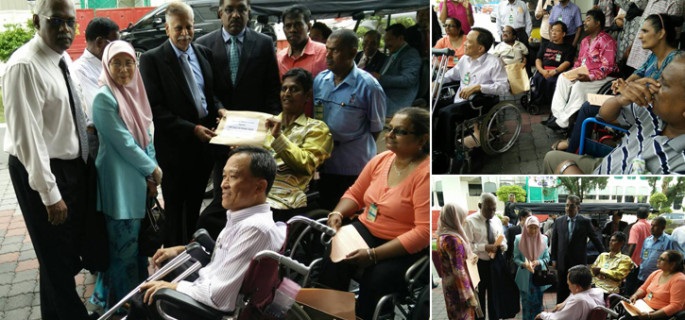


Wishing all of you a festive season filled with Loving wishes and beautiful thoughts.
Please take care and stay safe!
Merry Christmas and a Prosperous New Year 2011
From, Mr. Francis Siva

UNTIL I read the story of the nativity all over again recently, I never realised how much people with disabilities could relate to Christmas.
And it wasn’t until I went through each amazing account in the Bible that the hidden truth suddenly dawned on me – from the angel announcing the conception of the child to being turned away at the cramped inn and finally to the blessed birth in a humble manger.
Even baby Jesus – who is the reason for this glorious season – knew exactly what it felt like to be unwanted and have no place in society.
“No room at the inn” was what his distraught parents were told as they frantically looked for a place to birth him.
“No room”, “no access”, “no ramps” and “no disabled toilets” are common phrases Malaysians with physical handicaps still hear today.
And yet, many of us don’t even flinch a muscle when we stand up and declare that Malaysia is a caring society.
Some of these most uncaring and unfriendly buildings are, ironically, churches and other places of worship that are supposed to stand as pillars in a caring society.
Although they speak about the disabled and the elderly often, and preach to their congregation about the importance of “love” and “the need to think of others”, their actions and architecture often tell a totally different story.
I was talking to a member of the board of a local church only last week about adding a wheelchair ramp and a disabled-friendly toilet when her response took me by surprise.
“Oh ye of little faith,” she said, as if quoting a passage directly from the holy book.
“You don’t need to use a wheelchair. Just come to our church and we’ll pray over you and you will walk again.
“You’ll become one of us, and then there will be no need for ramps or disabled toilets, Hallelujah!”
Years ago, another lady who was an elder in the local church which I used to go to told me the same thing.
She was the epitome of health, and anyone who got sick rushed to see her so that she could pray over them. Even those with permanent disabilities and terminal illnesses sought her prayers as they believed they would be healed.
We eventually lost contact, but out of the blue, I got a call from her.
Speaking to me on the other end of the telephone line was a totally different person. I hardly recognised her.
Her voice was weak and frail. It was clear that she was also extremely depressed.
And then she made the most astonishing revelation.
She told me that she – now in her 60s – was a disabled person, too.
She was told by a doctor that she had Parkinson’s disease.
In fact, the medical specialist had told her that she had had the insidious condition for several years but she was not aware of it.
Her first reaction, she said, was to reject it. She prayed, fasted and even went to other faith healers to shake it off.
But nothing worked. Only medication could slow down the effects of the disease.
When she started using a wheelchair, she lost her independence and she had to be cared for by a maid.
She lost her job and eventually all her friends too.
She found it difficult to manoeuvre around in her church as it has no ramps or wheelchair access.
She had to hold on to her weak bladder until she got home because it has no toilet for the disabled. Several times, she had embarrassing “accidents” in public.
She told me that she now realised what a terrible mistake she had made. “I should have fought for people like you then in the council, but I never dreamt that something like this could happen to me.”
I couldn’t believe that the woman, who was once hostile towards me, had now become my friend – albeit over phone conversations late into the night.
She wanted to learn as much as she could about disability. I, too, learnt so much from her and how she was coping in life until she passed away, six months later.
Physical handicaps are only one aspect for a caring society to consider. The blind, deaf, people with learning disabilities and those with multiple handicaps also deserve attention.
Then, there are other conditions that are brought on by heart attacks, stroke, diabetes and old age.
Will we open our doors to all these people in our lives? And what would happen if we too find ourselves looking for room at the inn one day and being turned away?
Merry Christmas from Wheel Power!

SEREMBAN: Disabled Malaysians seeking employment in the public sector have been told to apply online with the Public Service Commission (PSC) to speed up the government’s plan to reserve at least 1% of jobs for them.
Public Service director-general Datuk Seri Abu Bakar Abdullah said the disabled should state their status on their application.
“These are among several affirmative measures introduced by the government to ensure the disabled are considered for jobs in the civil service.
“The PSC must also ensure that all vacancies for jobs advertised online or through any other channel have a special section for the disabled,” he said in a circular.
The website of the PSC is www.spa.gov.my.
The disabled can apply for jobs in the top management group which is made up of the cream of the civil service, professionals and management as well as the support groups.
The disabled, he said, can seek assistance from the Welfare Department on how to apply for these jobs.
He said that to be considered for government jobs, the disabled must have registered with the department.
Although there are an estimated 2.7mil disabled Malaysians, only some 10% were registered with the department.
It is learnt that only the Welfare Department has achieved the government’s target to have at least 1% of its work force made of the physically or mentally challenged, blind, deaf or mute.
Abu Bakar said the PSC should ensure that the panel set up to interview disabled persons for such jobs had an officer from the Welfare Department or an officer who had experience dealing with the disabled.
He said Ministries should let the PSC know if there were jobs suitable for the disabled to make it easier for the PSC to place them.

Selangor state government hosted an early Christmas party recently at Rawang, Selangor and there nearly 5000 people from Rawang participated.
 They also had invited a few charitable organisations to the wonderful evening with its caring society.
 ILTC were proud and delighted to be given an opportunity to participate this wonderful event.
 ILTC members had a wonderful time at the live show and other performances.
There were plenty of foods. On the day, we had received donation from the Tourism Selangor.
Among the guests were YB Dato' Seri Anwar Ibrahim, Selangor Mentri Besar Tan Sri Khalid Ibrahim, YB Azmin Ali, YB. Dr. Xavier Jayakumar and Y.B. Tuan Ronnie Liu Tian Khiew.

 During the Christmas Celebration President Francis Siva chatting with YB. Dato' Seri Anwar Ibrahim to possible ways to deliver some assistance for the disabled people in Malaysia.
 The Selangor Mentri Besar Tan Sri Khalid Ibrahim urged the public, especially the younger generation, to have the determination to make Malaysia a better place.
He added that there was still plenty of room to deeper understanding among the races.
Today, children and adults have come here to enjoy the celebration together. This reflects the Malaysian spirit among the communities,” he said.
 The ILTC was thankful for the positive role of the Selangor state government in giving to all walks of life an opportunity to experience the spirit of giving and sharing during the festive season.
In conclude this Christmas Greetings, let us share the spirit of joy and sharing, bring about love and peace to this world.
MERRY CHRISTMAS TO ALL!
 DATELINE: KOTA DAMANSARA COMMUNITY FOREST RESERVE, PETALING JAYA


 |
| Dr Nasir (in black) chatting with protesters |


| |
 Advocating change for PWDs
IF THERE is one thing Norani Haji Mohd Hashim could wish for, it would be that people with disabilities (PWD) have better access to infrastructure and services.
As the Deputy Director-General (Operation) for the Department of Social Welfare, Norani is an advocate for the disabled, a role to which she is fully committed, no matter how fraught it is with challenges.
“If I were to put myself in their shoes, I’d want to be able to walk out of my home and get around like any other person. I’d want to be able to walk, drive and move about freely. I’d like to be able to watch a movie or go shopping with ease.
“At the moment, accessibility for PWDs is just not there. The moment they step out of their homes, there are so many hazards. It’s just not fair to them,” said Norani.
Accessibility is one of the two themes of this year’s national level celebrations of the International Day Of Persons With Disabilities. The other theme is employment.
“Accessibility and employment are two key aspects of our initiative to integrate persons with disabilities into mainstream society. Improvements in these areas will enable PWDs to become independent,and by default productive citizens as well.
“Many PWDs, because they are given the means and opportunities, are able to support themselves, their families and contribute to the communities they live in. This is what we are aiming for – inclusion and integration of all people, regardless of their abilities.”
The national-level celebrations will take place today in Malacca and will be officiated by Women, Family and Community Development Minister Datuk Seri Shahrizat Abdul Jalil.
“Although there are laws and regulations to ensure accessibility for PWDs in public buildings, outdoors and in all new housing projects, enforcement is lacking,” said Norani. State local authorities have to play a more active role in enforcing the existing laws.
“The local authorities in every state must take charge because they are the body that issues licences and approvals. If they are strict, then developers will have to comply and provide for PWDs in all development projects.
“By right, all new buildings are supposed to follow the universal design principals. The provisions are there but the implementation isn’t. This is where the local authorities must step in,” said Norani.
She was referring to the amendment to the Uniform Building Bylaws in 1990 which makes it compulsory for buildings to provide access and facilities for the disabled.
Existing buildings were given three years to make modifications to comply with the bylaw.
In July, Malaysia ratified the Convention on the Rights of Persons with Disabilities.
“This means we are obliged by law to ensure that PWDs have equal access in terms of access in/to public facilities, amenities, buildings, public transport and so on.
“We have to work fast because we have to present a report on our progress to the UN in two years,” said the deputy director-general.
Though there is much to be done, Norani acknowledged that things are changing. The number of companies that are willing to employ PWDs is increasing and the perception of PWDs in society has also changed.
“People are not awkward or shy when they talk about PWDs. They are accepted in society now more than ever,” she noted.
Today’s celebrations is to pay tribute to PWDs and recognise their contribution to society. There will be awards for outstanding PWDs who have courageously triumphed over their disabilities and also certificates for care providers who have worked tirelessly for the disabled.
One of the highlights of the event is an exhibition showcasing the handiwork and products of PWDs.
The exhibition will also highlight programmes run by government agencies, non-governmental organisations and service providers for PWDs, and suggest areas in which the corporate sector can play a part.
There will also be a registration drive to encourage PWDs to register with the Department of Social Welfare.
“A lot of PWDs and their parents are not aware of the services that are available to them. These services include employment assistance and also the access to early rehabilitation programmes.
“In Malaysia, it isn’t compulsory for PWDs to register with the department. But we encourage them to because to be eligible for our services, they have to be registered. That is a criteria,” said Norani.
There are presently about 330,000 PWDs registered with the Department. This, says Norani, is only a small percentage of the total number of PWDs in the country.
“The World Health Organisation estimates that PWDs make up five to 10% of the population of every country. This is a general estimation. The categorisation of PWDs differ ... some countries categorise old people as PWDs as well. In Malaysia, PWDs are divided into seven categories,” said Norani.
The seven categories of disabilities are visual impairment, physical disability, deafness, speech impairment, mental disability, learning disability and multiple disabilities.
“Once they register with us, they will be assessed by experts to determine if they qualify and into which category they best fit,” said Norani.
She explained that Malacca was chosen as the venue of this year’s celebrations for several reasons.
“We really wanted to reach the masses and reach out to PWDs everywhere. The celebrations will be held at Fashion City (at the Melaka International Trade Centre grounds) which is accessible to everyone. Also, this is a tribute to Malacca, which was was recently declared a developed state.”
Norani concluded: “We also wanted to see whether, as a developed state, it would be able to provide for PWDs.

KUALA LUMPUR: There is a need for stricter laws to make facilities for disabled persons at public buildings and properties a must, said Malaysian Bar Council president K. Ragunath.
He added that most public transportation and walkways were not disabled-friendly.
“There is not enough pressure on the government to take the matter seriously,” he said.
He added that the Bar Council planned to set up a committee to advocate the rights of the disabled within the next two months.
The committee would work with the government, various NGOs and town councils to increase awareness on the needs of the community.
“More government intervention is needed to protect the rights of the disabled community especially in terms of employment and accessibility to public property,” he said after the grand finals of the Bar Council Human Rights Debate 2010 last night.
The three-day competition saw participation of debaters from 18 local and international institutions in conjunction with the World Human Rights Day on Saturday.
The winning team will get RM5,000 from the total cash prize of RM30,000, while the remaining RM25,000 will be donated to five charity organisations.
The organisations selected to receive the donation include the National Autism Society of Malaysia and the Society of the Orthopaedically Handicapped Malaysia.


