NEW MINISTER FOR WELFARE MINISTER OF MALAYSIA

NEW MINISTER FOR WELFARE MINISTER OF MALAYSIA
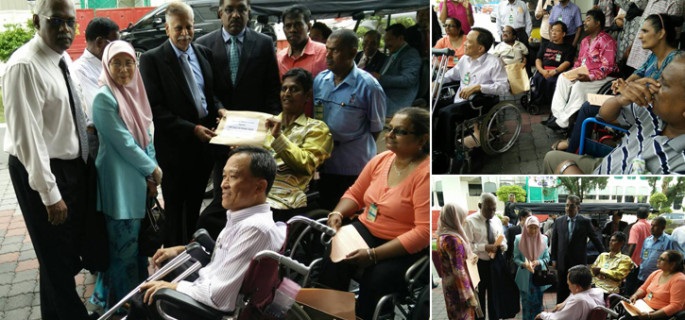
Badan Latihan dan Hidup Berdikari Malaysia (ILTC) pada 23hb Mac 2016 menyerahkan memorandum kepada ahli-ahli parlimen mendesak supaya golongan orang kurang upaya (OKU) dikecualikan daripada cukai barangan dan perkhidmatan (GST).

Disabled Members Protest

Disabled Members Protest
Disabled Members Protest at JPJ Wangsa Maju

ILTC Malaysia members staged a protest outside JPJ Wangsamaju KL.

ILTC Malaysia members staged a protest outside JPJ Wangsamaju KL.
Disabled group’s protest disabled drivers required to produce doc's medical report.

Friday, 17 June 2011

I want my flat or I’ll stay here till I die


"I want my flat or I’ll stay here till I die’

G Vinod
| June 6, 2011

The two longhouse residents who had their homes demolished vow to stay near the rubble until developer delivers on pledge

VIDEO INSIDE

PETALING JAYA: The two residents of PJS 1 longhouses, whose homes were demolished last Friday, vowed to stay put at the site until a promise made to them by the developer is honoured.

V Mahalingam, a 56-year-old disabled man and A Pushparani are living in a makeshift tent where their homes once stood pledged to stay put until Peter Brickworks provides them the low cost flat it promised eight years ago.

“I want my flat. If not I will stay here until I die,” said Mahalingam, a 56-year old disabled. “Life as a disabled is hard enough and Peter Brickworks has made it worse for me. They must answer for the misery I’m going through.”

After nearly a week-long tussle with the residents, Petaling Jaya City Hall (MBPJ) and the state government, Peter Brickworks ignored numerous pleas and demolished their homes on June 3.

Mahalingam and Pushparani received eviction orders from the developer on May 23 and given a seven-day deadline to make way for a condominium project.

The eviction was postponed after MBPJ issued a stop-work order against Peter Brickworks in an attempt to compel the developer to find an amicable solution with the residents.

Mahalingam said today that the MBPJ had offered him a low cost flat at Lembah Subang on June 1 but he rejected the offer because it was a temporary solution to his predicament.

“Lembah Subang is too far away. I receive medications from a nearby medical facility. How am I to travel all the way from there to PJS 1 if I take up the unit there?”asked Mahalingam.

As both he and his wife S Tamilchelvi were not working, Mahalingam said he relied a lot on assistance from friends and well-wishers who live near PJS 1. Tamilchelvi, 53, is partially blind.

“I also receive monthly provisions from a nearby spiritual organisation. Who will help me in Lembah Subang?” asked Mahalingam, who gets a monthly RM110 from the Welfare Department.

Mahalingam said he had no other place to go. “We have a son but we lost contact after he got married four years ago,” said Mahalingam who was reluctant to delve into the matter.

Pushparani, 44, lamented that the developer went ahead with the demolition despite promising not to at a meeting with Selangor state exco Iskandar Abdul Samad on June 2.

“We can only hope that the state government will help us now,” said a teary Pushparani.

‘We fear for our safety’

Pushparani, who ekes out living ferrying children to school by a mini van to make ends meet said she had to send her six children to stay with friends.

“My husband V Balakrishnan and I now camp out in the makeshift tent or in our van,” said Pushparani.

She added that she also feared for her safety as several unidentified men were lurking around the area where their homes once stood.

“I hold Peter Brickworks responsible should anything untoward happen to us,” said Pushparani.

Residents action committee chairman, M Sugumaran, said he received a text message from Iskandar this morning saying the state government would seize the land from Peter Brickworks.

During a walkabout this morning, FMT team saw two individuals taking pictures of the makeshift tent of the two families and the FMT journalists.

Sugumaran said that one of them was the general manager of Peter Brickworks while the other was the project manager of the condominium project.

Sugumaran urged the state government to speedily provide alternative housing for the residents, especially for Mahalingam.

“I also hope the state assemblyman (Haniza Talha) and the MP for Petaling Jaya Selatan Hee Loy Sean will continue with their effort to assist the residents,” said Sugumaran.

In a latest development, Sugumaran said several men started baricading the area with wire fencing around the demolished area at about 2pm.

Meanwhile, Iskandar, who is in charge of the state housing portfolio, said that the state would acquire the three plots of land at the site because of Peter Brickworks’ defiance.

“The mentri besar (Abdul Khalid Ibrahim) had instructed state secretary Khusrin Munawi to acquire the plots under state laws on Friday,” said Iskandar.

However, Iskandar could not confirm whether the notice has been issued to the developer.

Also read:

Friday, 10 June 2011

Count us in


Thursday June 9, 2011

Count us in

The disabled should be involved in decisions which affect their lives.

SOME good things are in store for people with disabilities in the country. For many of us who have to put up with society’s lack of concern for the basic needs of the handicapped, we can now breathe a sigh of relief.

On Tuesday, more than half a dozen persons with disabilities – me included – met at the state secretariat building in Shah Alam, Selangor. We were there to hold our first meeting as a special team on a mission to help set up disability committees in all the local councils in Selangor.

We were following up on the directive by Ronnie Liu, chairman of the state’s local government, study and research committee, to get local councils to be proactive in looking into the needs of the disabled and the elderly.

Be friendly: Pavements should be constructed with the needs of the handicapped in mind.

It was strongly felt that unless persons with disabilities were actively involved, nothing much was going to happen in towns and cities, as far as their needs were concerned.

The all-important meeting included people with a variety of handicaps. There was a representative for the blind and the Deaf. Notice how I spell the word “Deaf” with a capital “D”? This is because Deaf persons, like many other disabled people, wish to have a unique identity of their own, rather than be seen as people with a medical problem.

There were also three representatives for the physically handicapped. One was paralysed from the chest down, another from the waist down, while the third person had walking difficulties.

Input from each of them is vital as not everyone who uses wheelchairs has the same needs.

One of the most forgotten groups are people with learning difficulties. A representative from a national society on dyslexia was also present. We plan to expand the group later on, to include people with other types of disabilities.

Feedback from all these groups will help to give us an accurate picture of their needs.

Called the Disabled Technical Committee of Selangor, our quest has so far taken us to three local councils: Shah Alam, Subang Jaya and Selayang.

Selayang was the first to set up a committee; the other two are still working on it.

All the local councils received us warmly. As experts on disability through our own experiences, we want to offer all the help that we can to make our world a better place for the handicapped.

First, we set up a committee to look into the needs of the disabled. The committee meets monthly to ensure that the handicapped are not forgotten by the local councils.

Next, we provide feedback on the plans that the local councils have for us. After all, it is our lives and needs that they are talking about, and it is only right that we have a say in whatever affects us.

The committee also ensures that users of disabled-friendly facilities get to test them out first before they are launched by the local councils.

Sadly, very often we come across pathways with tactile flooring which may be friendly to the blind but totally disregard wheelchair-users and mothers with prams.

And it is not uncommon to come across toilets with a wheelchair logo on the door only to discover that the facility can only be used if you are able to get out of your wheelchair because the narrow doors are not wheelchair-friendly.

That is why the participation of the disabled is important in every local council, not just in Selangor, but throughout the country. It is not only the most sensible thing to do but it is also our right as disabled Malaysians.

As the slogan goes: “Nothing about us, without us!”

Tamil papers Makkal Osai highlighted ILTC Charity Event.


Thursday, 2 June 2011

Theme park for the disabled


Thursday June 2, 2011

Theme park for the disabled

By PAUL J. WEBER


Morgan’s Wonderland is a fun park designed for children and adults with special needs.

THE carousel has chariots for wheelchairs. Braille games decorate side panels on the jungle gym. And table-high sandboxes allow just about any kid to build a castle.

Morgan’s Wonderland in Texas aims to offer everything a special needs guest might enjoy at a theme park, while appealing to non-disabled visitors, too.

“If it wasn’t for searching Google,” founder Gordon Hartman said, “it would’ve taken me a lot longer to put this together.”

Fun world: The ‘Taking Flight’ bronze sculpture at Morgan’s Wonderland in San Antonio, Texas, a 10ha theme park that caters to people with physical or mental disabilities.

The result is both inventive and heartwarming: a 10ha, US$34mil (RM102mil) park catering every detail to people with physical or mental disabilities, down to jungle gyms wide enough to fit two wheelchairs side-by-side, a “Sensory Village” that’s an indoor mall of touch-and-hear activities, and daily attendance limits so the park never gets too loud or lines too long.

Since opening last year, Morgan’s Wonderland has attracted more than 100,000 guests, despite almost no national marketing by the non-profit park. Admission for people with special needs is free, and adults accompanying them pay US$10 (RM30). Three out of every four visitors do not have disabilities.

The park is the first of its kind in America, according to Hartman, a San Antonio philanthropist who named the place after his 17-year-old daughter, who can’t perform simple maths and struggles to form sentences because of cognitive disabilities. A map in the lobby entrance, where adults with special needs volunteer as greeters, offers a more visual way to gauge the park’s early popularity. The 49 US states and 16 countries which visitors have come from are marked in purple.

Persons with autism, orthopaedic impairments, mental disabilities or seizure disorders are among the most regular visitors. Tifani Jackson’s 11-year-old son, Jaylin, has Williams syndrome, a rare genetic disorder that causes learning disabilities and developmental delays.

Jaylin was showing off his new hat from the gift shop, before coaxing his mum towards the off-road adventure ride, where rugged-looking jeeps that are wheelchair accessible twist and turn through a short track.

“It’s so nice to have a place like this,” said Jackson, who lives in nearby Austin.

Built on the site of an abandoned quarry, Morgan’s Wonderland is one-tenth the size of SeaWorld, the destination mega-attraction on the other side of San Antonio.

Morgan’s Wonderland is deliberately designed so that visitors do not have to go through an exhausting trudge from one overcrowded ride to the next.

Generously spread out, the park has about 20 attractions from active (Butterfly Playground) to easy-going (a train circling a 1.6km-long loop through the park and around a lake). Even more tranquil is the Sitting Garden, a quiet and almost meditative enclave that’s a favourite among parents with autistic children.

Refugio Valls rides a wheelchair swing at Morgan’s Wonderland.

Inside Sensory Village is a mechanic’s shop with tools mounted on a low table. A light touch of the drill triggers the crank-like sound of a bolt driving flush into an engine block. Next door is a pretend supermarket with plastic lobsters, ears of corn and cans of tuna, and cashiers who always hand back the right amount of invisible change.

Most interactive is a low-lit space with a touch-sensitive floor, giving the illusion of walking across a pond as the water ripples and colours burst with every step. White canvases on the walls transform into butterflies chasing a shadow anytime someone steps in front of the projector.

Sprouting from the sandboxes are “diggers” – think shovels and rakes – that can be operated sitting down from a wheelchair. Another nearby sandbox is elevated 1.4m next to a musical garden of giant xylophones and chimes. The chariots on the carousel are reserved for wheelchairs, and many of the horses are fitted with high back cushions for children who need the support.

Reservations are encouraged because of the daily attendance limits, though as general manager Dave Force put it: “We’re not going to turn away a family that’s driven all the way from Arkansas.” Each guest is also given an electronic wristband that allows families and caregivers to keep tabs on their group in the park, and scanning the wristbands on some rides e-mails a free photo back home.

Yet despite being completely designed for individuals with special needs, the park is playful enough to be enjoyed by any kid. The motto of Morgan’s Wonderland is “Where Everyone Can Play”. That inclusion was important to Hartman, who on a family trip a few years ago, saw his daughter Morgan wanting to play with three kids tossing a ball in a pool but couldn’t interact. The kids, just as unsure how to interact with Morgan, stopped playing.

Five years later, Morgan’s Wonderland opened, putting regular playground swings and swings for wheelchairs in the same park. That’s where nine-year-old Kriste was on a recent May afternoon, her wheelchair rolled onto a platform and being swung back and forth by two park volunteers.

“She doesn’t talk,” said her father, Michael Hernandez, “but you can tell she really enjoys it.” – AP

Living with a disability

Thursday June 2, 2011

Living with a disability

CLOSE TO HEART
By AHMAD DANIEL SHARANI


If it is within our means to make life better for others, what is there to hold us back?

DURING the early years, not a single day went by without me wishing that the whole ordeal was just a nightmare. It got to a point where I would hit my cheeks hard, hoping to wake up and put an end to my misery. The pain, however, did not come from the self-inflicted bruises on my face. When reality sank in like fangs, the emotional pain was unbearable.

The timing couldn’t be worse. At a time when my peers where all set to let their hair down after spending 11 years in school, I had to endure yet another test which determined not what my future might hold, but whether I’d pull through in a life-and-death situation.

I survived, of course, but how was I to cope with this cruel twist of fate? I was 18 then, with the world before me, waiting to be explored, when tragedy struck. I was riding pillion on my friend’s bike, when we were knocked down by a car. My best friend was killed in the accident, while I was left with a spinal injury.

The writer, Ahmad Daniel Sharani

Coping with the physical pain was one thing. It was worse when I learnt I could never walk again. That hurt the most. Freedom lies at your feet, I used to think. My legs would literally take me places. Now all that would change.

Being confined at home – that’s the last place a young man wants to be – when the spirit yearns to roam free.

Being physically disabled means you’re dependent on others to get even the simplest things done. A few sessions of physiotherapy may do wonders but not when the mind’s weak and in distress.

In fact, the mere sight of a newly-bought wheelchair repulsed me. Acceptance did not come easy. Cliched as it may sound, time heals everything. It took me quite a while before I finally gathered enough courage to face the world again.

Back then, it was quite a feat even to go a short distance outside my house. As a result, I spent most of the time in the comfort of my home.

I remember one evening though, a few friends and I decided to try out a highly recommended restaurant in town. It was supposed to be a fun outing. A combo of good food and good company – a simple recipe for a pleasant night out. Nothing could possibly go wrong, right?

But who am I kidding? When you’re in a wheelchair, a lot of things can go wrong. As we found out, getting into the restaurant itself was a big challenge for wheelchair-users like me. Patrons had to climb up a flight of stairs, the only access to the restaurant.

The only option that day – and on many other occasions – was to carry my wheelchair up the stairs which my friends gladly obliged. It was no mean feat. We were quite a sight, indeed.

Had I known this particular restaurant lacked basic disabled-friendly facilities, I would have given it a skip. The last thing I wanted during a rare day out was to feel unwelcome. Besides, I don’t want my friends to risk breaking their backs!

The dinner turned out well, if not for the early hiccup which left a bitter aftertaste in my mouth.

After that incident, I was more guarded when it came to dining out.

On another occasion, I turned up at a reunion dinner but the sight of so many concrete obstacles that stood between me and the bistro where the event was held, made me turn back in frustration. I gave the dinner a miss.

No, these incidents did not stop me from eating out.

Much as I look forward to a day out without a hitch, the problem of inaccessibility weighs heavily on my mind.

We often read about the culinary adventures of foodies who write about the quality of the food, the services, the ambience and the overall hygiene of the outlets.

For wheelchair users, however, we have a few extra worries to think about, chief of which is the issue of accessibility. And forget about the toilet’s cleanliness; getting into one itself is a herculean task.

It’s wonderful of food writers to share their experiences, and provide recommendations of where to head to for some gastronomic excitement. But if the writers must know, the disabled community are diners, too. Just like our able-bodied counterparts, we do read these columns and salivate at the sight of the scrumptious spread in print.

For many, the write-up is good enough to help them decide there and then, to check out the outlet reviewed at the next available opportunity. But for wheelchair-users, we would really appreciate an extra line or two, to inform us if the outlet is generally disabled-friendly or wheelchair-accessible. Such information is essential for wheelchair-users who, like everyone else, love to eat out occasionally.

Imagine turning up at the place, only to find that it’s out of bounds. Besides, wheelchair-users include the elderly. Those who want to take their elderly parents out for the night, would appreciate knowing if there are ramps for their parents’ wheelchairs. The ramps will also come in handy for young couples with babies in strollers.

Maybe the disabled community should just resign to the fact that restaurants located in old shophouses are not compelled to provide wheelchair-friendly ramps. But a bigger question that comes to mind is: what about those situated in newly constructed buildings which have blatantly disregarded the Uniform Building By-Laws (UBBL) by operating their premises without providing disabled-friendly infrastructure?

In Malaysia, it is mandatory for public buildings to provide facilities for the disabled. Under the UBBL, namely by-law 34A, which was amended way back in September 1990, it is clearly stated that it is compulsory for buildings to provide access for disabled persons. Buildings which were built before the amendment of the by-law are given three years from the date of commencement, to make modifications to comply with the regulations.

Be as it may, we see many buildings – both old and new – which are not disabled-friendly. When there’s no enforcement, law-breakers have a field day.

But then again, playing the blame game is the last thing we want to be caught up in. Instead of pointing fingers, everyone could play their part in the name of social responsibility by making the environment a better place for all.

Co-operation from all quarters – from the law-enforcers to the building developer right to the restaurant owners, and even useful information from the media – will to some extent, move more disabled persons to get out of their cocoons and rejoin society.

Encouragement – that’s the magic word. Food writers and those in the media may want to take note of this. Information empowers us and encourages us to get out of the house more often.

In turn, restaurateurs will be driven to make their eateries more disabled-friendly, by providing a simple ramp for wheelchair-users. Apart from making life easier for their customers who consist of people from all walks of life, they can cash in on this.

After all, the disabled community are Malaysians, too, And knowing our passion for good food, the first stop out of our homes would be the eateries.

By-laws or not, the ball really is in the restaurant operator’s court. We hope they will not wait for the authorities to come down hard on them before making a change.

Similarly, they can always ignore our plea and carry on with business as usual and just hope the authorities will continue to sleep on the job. Bear in mind, however, that there are many restaurants and bistros around, and surely some would not mind taking the cue.

It is heartening to note that food courts which have sprung up around town, have taken heed of the bylaws by providing ramps, giving their outlets an edge over their insensitive competitors.

In any case, it boils down to choices. We won’t hesitate to support businesses which show they have a heart for the disabled or the disadvantaged in society.

We have the interest of our special needs readers close to heart, and hence the name of this new fortnightly column. We welcome contributions from readers who are living with a disability of one form or another. Share with us experiences that are uniquely yours. Give us a glimpse of your world. E-mail your stories to star2@thestar.com.my. Contributions which are published will be paid, so please include your full name, IC number, address and telephone number.
Public transport upgraded to be more disabled-friendly

Monday May 30, 2011

Public transport upgraded to be more disabled-friendly

KUALA LUMPUR: In its ongoing effort to improve commuting via public transportation in the city, the government has made several upgrades to existing public transport services to facilitate the disabled as part of its efforts to increase public transport ridership under the GTP’s Urban Public Transport (UPT) NKRA.

There are now 100 public buses that have been upgraded to provide better accessibility for the disabled community.

Women, Family and Community Development Minister Datuk Seri Shahrizat Abdul Jalil said 19 KTM Komuter train stops were also equipped with disabled-friendly features last December. All 25 Ampang Line LRT stations are currently in the process of installing disabled-friendly features including lifts and ramps and is expected to be ready by the end of 2011.

In addition, she said the Road Transport Department would also introduce a disabled-friendly bus design guideline for bus operators.

She said the Government must prioritise public transport accessibility in its aspiration to become a barrier-free and developed nation.

Shahrizat said it was the government’s ultimate intention to ensure all public transportation hubs were disabled-friendly.

Saturday, 28 May 2011

MRT Headed To Be A Disaster For Disabled And Elderly

MRT Headed To Be A Disaster For Disabled And Elderly

A wheelchair-bound local councillor says that Prasarana's efforts at public consultation were half-hearted and not professional.
PETALING JAYA: Those backing the Mass Rapid Transit (MRT) project appear to have little regard for the disabled, said a wheelchair-bound local councillor.

Petaling Jaya Municipal Council (MBPJ) councillor Anthony Thanasayan said the MRT’s proponents were more interested in paying lip service than actual public consultation.

“In any engineering endeavour, the services of professional consultants are required to ensure that what is proposed is (both) fit for the purpose and value for money.

“This is no more apparent than when it comes to the disabled, but these are the people who are significantly left out of any infrastructure so far,” he told FMT.

Thanasayan said the MRT project owner, Syarikat Prasarana Negara Bhd (Prasarana), had organised a meeting with several disabled people last Thursday.

However, the councillor claimed that he, along with several other disabled activists, were conveniently left out of the loop.

“We forced ourselves to be invited,” he said, adding that the meeting took place at Prasarana’s Bangsar office and was attended by Land Public Transport Commission (SPAD) officials as well.

Eventually allowed in, Thanasayan claimed that Prasarana came up with a “very general” presentation on the MRT and failed to touch much on disabled-related topics.

“They spent more than an hour talking about irrelevant things. They showed us a video, but gave us very little exact details,” he said.

Another cause for concern, the councillor added, was the lack of understanding when it came to disabled needs.

Outdated standards

Thanasayan said both SPAD and Prasarana were basing their designs on outdated Sirim (Standards and Industrial Research Institute of Malaysia) standards.

He claimed that the standards did not favour the disabled, but rather the able-bodied.

(The standards are the MS1184:2002 Code of Practice on Access for Disabled Persons to Public Buildings by Sirim, the Guidelines on Buildings Requirements For Disabled Persons.)
He was also worried that SPAD was following the Kuala Lumpur City Hall (DBKL) designs, which Thanasayan was directly against.

Thanasayan pointed out that many government agencies did not know how to apply good designs for the disabled, and ended up inconveniencing them.

“Sometimes they put the disabled car parks far from the entrance (of an LRT station). Or they build a normal car park, put a wheelchair sign there and call it a disabled car park,” he said.
Thanasayan also said that Prasarana did not have any disabled people sitting on their technical committees.

“How do they know how (to build facilities) when they don’t use wheelchairs?” he asked.
He said Prasarana and SPAD officials merely nodded when he gave his views, and had neglected to call him and other activists since.

“It felt like they were trying to bulldoze through without going over the finer points, and later run away without being fully responsible,” he added.

‘Big difference with Melewar’
Thanasayan said Prasarana’s efforts at public consultation were half-hearted and not professional.
As a comparison, Thanasayan cited Melewar Integrated Engineering Sdn Bhd, which had prepared the proposal for the failed Penang Monorail project a few years ago.

The councillor said that Melewar had called representatives from “all disabled groups”, and had six meetings with them over the course of eight months.

“We were requested to attend and (help with the) design. Disabled access was covered thoroughly, and we went through equipment and systems specifications,” he said.

At one point, Thanasayan said that Melewar had spent three months discussing specific requirements with the disabled representatives.

“I remember asking one of the Melewar officials: Why are you taking so much time in getting involved with us? He told me that it was the right thing to do, and that it was cost-effective.

“It is one thing to show us a design. There is also the process of visiting the site when they are doing the design. We have to go there a number of times (as well to make sure),” he said.

Originally slated at a price of RM36.6 billion, the MRT had been estimated to cost at least RM53 billion. It is Malaysia’s largest infrastructure project to date.

Four lines are scheduled to be built, with the first Sungai Buloh-Kajang line expected to be completed by 2016.

Tuesday, 24 May 2011

Census on welfare homes in Selangor


Census on welfare homes in Selangor

Stephanie Sta Maria
| May 23, 2011

The recent landslide tragedy prompts the state government to act to ensure all welfare homes are approved by local councils.

KUALA LUMPUR: The Hulu Langat landslides have prompted the Selangor government to act: it will conduct a census on the number of shelter and welfare homes in the state within the next three months.


The move comes after a probe into the two landslides that killed 16 people at the Rumah Anak-anak Yatim dan Anak-anak Hidayah Madrasah Al-Taqwa on Saturday revealed that the orphanage was built without approval from the local authorities.

Dubbed “Ops Selangor Prihatin Masyarakat”, it will fall under the purview of the Selangor Welfare, Women’s Affairs, Science, Technology and Innovation and Culture Committee.

Its chairman, Rodziah Ismail, said that the first step would involve issuing a directive to all local councils and district offices to identify the existence and locations of all such homes in the state.

These include orphanages as well as homes for the elderly, the disabled and single mothers.

“The next step would be to check whether all these homes are abiding by the state government’s regulations, which include owning a licence with a certificate of fitness (CF), a business licence and an operating licence,” she said.

“If we find that there are still homes without any of these required licences, they will be asked to immediately submit their applications.”

Rodziah, the state assemblyman for Batu Tiga, added that the Pakatan Rakyat-led state government would also set up a one-stop centre to coordinate the issuance of licences by the local councils, Registrar of Societies and the Welfare Department before granting approval to the applicants.

“The Selangor government takes people’s safety seriously,” she said. “We urge all parties, be it those who manage these homes or residents of private homes, to ensure the safety of their respective properties to avoid lives from being lost through carelessness.”

Thursday, 19 May 2011

Better access to transport for the disabled


Tuesday May 17, 2011

Better access to transport for the disabled

By LEE YEN MUN
yenmun@thestar.com.my

KUALA LUMPUR: To date, 100 public buses have been upgraded in a move to provide greater access to the disabled community.

Five LRT stations and 12 KTM stops were also upgraded with disabled-friendly facilities last December, said Women, Family and Community Development Minister Datuk Seri Shahrizat Abdul Jalil.

She added that the Road Transport Department would launch a disabled-friendly bus design guideline for operators next month.

“To be a developed nation, we must provide accessibility and become a barrier-free nation.

“Ultimately, we want to see all public transportation hubs to be disabled-friendly,” she said after meeting representatives of the National Council for Persons with Disabilities here yesterday.

Shahrizat said more ministries had seriously considered its proposals to help the disabled.

They include the setting up of a task force with the Education Ministry to study challenges in the special education and early intervention sector.

She said the Human Resources Ministry would also look at the absorption of more members of the disabled community into the workforce.

“The greatest challenge is to push for a mindset change among employers and the disabled community.

“Although the situation is better today, disabled-friendly infrastructure in our country is still not enough,” she said, adding that employers must enforce affirmative policies to achieve the goal.

Wednesday, 11 May 2011

The disabled learn of their rights

The disabled learn of their rights

2011/05/10
Farhana Syed Nokman


One of the participants, K. Pavithra showing off her Rakyat Guides booklets. — Picture by  Hazreen Mohamad
One of the participants, K. Pavithra showing off her Rakyat Guides booklets. — Picture by Hazreen Mohamad
PETALING JAYA: An educational programme to help the disabled learn of their rights was held recently at the Petaling Jaya City Council (MBPJ) headquarters.

It was organised by its zone 19 councillors in collaboration with Malaysian Bar Council.

Kuala Lumpur Bar Committee chairperson Syahredzan Johan said the objective of the programme was to bring the constitution to the people.

"Our initiative is to bring the information to the public so they will be aware about their rights as citizens and be brave enough to speak up," said Syahredzan.

The Rakyat Guides booklets, which consist of nine chapters elaborating on the federal constitution, were also distributed to participants of the programme.

According to Syahredzan, the content of the booklets had been rewritten and simplified to help the layman understand his rights.

The public, he said, can also buy the booklets at the Bar Council for RM6.

All proceeds from the sale of the booklets will be channelled back to the programme.

The one-day programme was officiated by senator S. Ramakrishnan.

MBPJ councillor Jeyaseelan Anthony said this was the first programme organised for the disabled.

"We received good response from the participants and they were happy to learn more about the constitution," said Jeyaseelan.

More of such programmes will be held upon request, he said.

For details, log on to www.perlembagaanku.com.

Read more: The disabled learn of their rights http://www.nst.com.my/nst/articles/3pcj/Article#ixzz1M2kvgQf6

Sunday, 8 May 2011

A four hour journey to collect welfare cheque

A four hour journey to collect welfare cheque

B Nantha Kumar
| May 7, 2011

A disabled fruit seller says the new district office is 20 kilometres away from the old one and there is no public transport

SHAH ALAM: A disabled fruit seller has to travel for about four hours to the new Petaling district office to collect his welfare cheque.

S.Krishnan, from Shah Alam, had no problem going to the district office when it was situated near Subang Parade.

The district office moved to U5 in Mutiara Subang on April 1 because it is understood that the site of the previous building was awarded to a prominent family-run developer.

FMT learned that the developer was planning to demolish the old building to build a new motorcar showroom.

According to a source, this is the second state government-owned land to be given to the same developer.

The Selangor government awarded a contract to an unknown RM2 company linked to the developer to build nine blocks of high-rise buildings in Section 52, Petaling Jaya.

Krishnan says the new district office is 20km from Subang town and the only form of transport is the Rapid bus from Kuala Lumpur.

Krishnan spends about four hours travelling to the new office and back by bus.

“From Shah Alam, I travel to Kuala Lumpur and take another bus from there to the district office,” he said, adding that if he was to take a taxi, it would cost him RM40.

He asked why the state government, which called itself a “concerned government”, would move the office to a place which was so inconvenient, especially for the poor.

He urged the state government to provide transportation service to the office as soon as possible.