NEW MINISTER FOR WELFARE MINISTER OF MALAYSIA

NEW MINISTER FOR WELFARE MINISTER OF MALAYSIA
Badan Latihan dan Hidup Berdikari Malaysia (ILTC) pada 23hb Mac 2016 menyerahkan memorandum kepada ahli-ahli parlimen mendesak supaya golongan orang kurang upaya (OKU) dikecualikan daripada cukai barangan dan perkhidmatan (GST).

Disabled Members Protest

Disabled Members Protest
Disabled Members Protest at JPJ Wangsa Maju

ILTC Malaysia members staged a protest outside JPJ Wangsamaju KL.

ILTC Malaysia members staged a protest outside JPJ Wangsamaju KL.
Disabled group’s protest disabled drivers required to produce doc's medical report.

Monday, 6 August 2012

Annual General Meeting of the Independent Living & Training Centre Malaysia


9th Annual General Meeting of the Independent Living & Training Centre Malaysia which was held on 24th of June 2012, at 10.10am, at ILTC Malaysia, 76, Jalan Taman Garing 4, Taman Garing, 48000 Rawang, Selangor Darul Ehsan.


 Speech by Y.B. Gan Pei Nei – ADUN Rawang

Y.B. thanked President and ILTC Malaysia Committee Members for inviting her to the AGM.

Y.B. congratulated ILTC Malaysia for a significant role and making a meaningful contribution in developing the capabilities and improving the knowledge skills for the disabled.

Y.B. informed that, all 12 local councils (PBT) in Selangor have been ordered to set up OKU Technical Committee by EXCO Kerajaan Negeri Selangor. At presently, the only Councillor Mr. Anthony Thanasayan from MBPJ is doing very well but other 11 local councils are not active. Therefore she expressed that, this matter will bring up again to the Selangor government initiatives to push and help all local authorities in Selangor to setting up of technical committees for the disabled and have linked more closely with the local council and provide input to the developments of the disabled.

Y.B. added that, in Rawang town there are not accessible for the disabled therefore she requested ILTC Malaysia to work closely with local council to provide positive and effective ideas to build a better structure for the disabled.  

In conclusion, Y.B. informed that, there are some facilities provided by Kerajaan Negeri Selangor example educational facilities, Air percuma, Tabung Warisan Anak Selangor, Skim Mesra Usia Emas etc…. She has requested our members to register under the skim to benefit.


The 9th Annual General Meeting ended at 11.30 am. with a vote of thanks to President and lunch was served to all present.

Building Committee Meeting


Building Committee Meeting held on 9th July 2012 at Lot 114, Kg. Sungai Dua Tambahan, Taman Garing , 48000 Rawang, Selangor Darul Ehsan

President of ILTC Malaysia thanked the all the Members for their presence to the 2nd Committee Meeting.


INVITED TO TALK AT HELP UNIVERSITY


Ms. Rina (Secretary of ILTC Malaysia) formally invited her to speak approximately 150 students at HELP University, 2nd Year Psychology students, on the topic “Living with Physical Disability in Malaysia” with sharing of her experiences as person with disability living in Malaysia.

Date: 19th June 2012, Tuesday
Time: 9.30am - 10. 30am
Venue: Department of Psychology, WISMA HELP, Jalan Dungu, Pusat Bandar Damansara.
Topic: Living with Physical Disability in Malaysia:

She was given a little background about her and shared about her life in general some of the challenges she faced daily as a disabled person in Malaysia.

She was shared the support available to help physically disabled people gain independence and functional living skills.

She was shared the attitudes of the Malaysian society towards disabilities and how do these help or hinder her lifestyle.

In conclusion, she advice that how we can do as a society to help improve the quality of life of disabled people in our own community.

There were also have attended lectures on other areas of exceptional development such as intellectual disabilities, autism, dyslexia, ADHD and language disorders.

At the end of the her talk, she answered all the questions from students at the floor.

ILTC Malaysia would like to thanks Ms Tan Cheng Yi (Chartered Educational Psychologist) for given this opportunity. 


Wednesday, 1 August 2012

Disabled by the abled


Wednesday August 1, 2012

Disabled by the abled

So Aunty, So What?
By JUNE H.L. WONG


American comedian Jerry Lewis might have joked about it – ‘Pity? You don’t want to be pitied because you’re a cripple in a wheelchair? Stay in your house!’ – but there’s nothing funny about being denied access to most things the able-bodied take for granted.
IT’S Saturday night and the mall is packed. The crowd is building up in front of the lifts and everyone is watching eagle-eyed to see which lift doors will open to take them up or down.
Getting in requires strategy: you place yourself close to the doors, ease in as soon as you can, sometimes not waiting for people to exit even. Otherwise, you might just miss the ride.
That’s what the able-bodied do. Now imagine if you have someone in a wheelchair. You would think people would be nice enough to give way, right?
Forget it. If anything, when they see someone in a wheelchair, people will deliberately stand in front of the wheelchair and thereby effectively cutting off access to the lift.
No, when you have someone in a wheelchair, you need a different kind of strategy. You push the wheelchair as close to the doors as possible. You also look mean as if you are prepared to run over toes; and that’s a real possibility because you will need space to reverse the wheelchair into the lift.
Lots of other people don’t understand that. But just think: when you enter a lift, do you stand facing the back of the lift or you turn around to face the doors? So why do you think a person in a wheelchair should not do the same?
Indeed, I speak from personal experience. I am not in a wheelchair but I certainly spend enough time pushing someone in a wheelchair and believe you me there are pitifully few places that are disabled friendly.
Forget taking the wheelchair-bound for an evening “stroll” because in most neighbourhoods, except maybe in some new, swanky and gated ones, there aren’t even paved sidewalks to do that.
Shopping malls are your best bet because of their long, flat and generally smooth floors.
Even then beware: There are many hidden obstacles and inconveniences. For one, walkalators can be scary because the front wheels can get caught at the end of the walkway.
Scarier still are the disabled toilets because they are predictably dirty, wet and missing soap and toilet paper.
A sad irony, again from experience, is the shocking state of disabled toilets even in hospitals. The able-bodied can roll up pants, hover over toilet bowls in wet, filthy loos.
But what if you have to sit down to do your business? How would you feel if the toilet seat is missing and there isn’t even toilet paper to line the porcelain rim?
Access ramps at many hospitals are so steeped and sharp-angled, you really have to be strong to prevent the wheelchair from crashing. No way can a disabled person manage to wheel him or herself up or down such ramps.
The bad planning extends to the doors which are usually narrow and difficult to open.
But really, it doesn’t need a lot to make it easier for the disabled. All it takes is a bit of thoughtfulness and common sense. If we need an example, I will point south.
When I needed to take my dad to Singapore’s National University Hospital (NUH), I never worried about getting a wheelchair for him. There were always plenty parked in convenient bays at every entrance. And unlike here, you don’t need to hand over any ID to take one.
At NUH, every clinic and department has automatic sliding doors and the toilets are pristine.
Yes, I am on a bit of a warpath today because so many things make my blood boil where accessibility and facilities for the old and disabled are concerned.
As mentioned earlier, the shopping mall is usually the safest bet if we want a day out with my dad. My family tends to go to Gardens Mid-Valley Megamall simply because it has decent parking and long, smooth stretches of corridors with lots to see and do. Other families have the same idea. So on a weekend, it’s like Wheelchair Central there.
Even then, as I said, it’s a struggle to get into the lifts and the state of the toilets is always suspect.
So I worry for my dad and for myself because we are a nation that is slowly but surely tottering towards old age.
It has been reported Malaysia is expected to reach ageing nation status by 2035 with the number of people above the age of 60 making up 15% of the population. (According to the United Nations definition, a country with 10% of its population above 60 is an ageing nation.)
But do we need to wait for that to happen before we really provide safe and easy access for the disabled and the elderly? What about the ones who need such facilities right now?
True, it’s probably better now than say 15, 20 years ago. Awareness is higher and there are some basic concessions to the disabled like special parking lots. For that, I am to say The Star has played a key role.
We are the only newspaper to have regular columns on disability, first with Anthony Thanasayan’s Star2 column, Wheel Power, and more recently, with Ida Nerina whose column, Crazy, Sexy, Honestly, appears in Star2 on Sunday. Both are wheelchair users.
Anthony started writing almost 20 years ago. Today he is a Petaling Jaya City councillor and influencing PJ city policies and practices regarding the needs of the disabled. Ida, who is an actor, director and producer, is adding her voice from her unique perspective.
So there is progress but mostly on the facilities, the so-called hardware. But ultimately, like our recent stories on Ugly Malaysians and their rude behaviour, it boils down to people’s attitude and sense of civic-mindedness and decency.
Animal rights activists often quote Mahatma Gandhi for their cause: “The greatness of a nation and its moral progress can be judged by the way its animals are treated.”
I would like to say that nation’s greatness and moral progress should also be judged by how we treat the old and the infirm for the simple reason that all of us, if we live long enough, can become either or both.
The writer belongs to the sandwich generation: baby boomers who still have children to raise on one side and ageing parents to look after on the other. Sometimes that can be quite a tight squeeze.
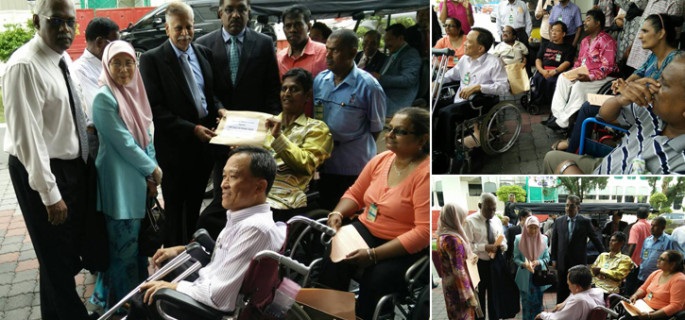
Inner Wheel Club Subang 2nd Installation Dinner

Inner Wheel Club Subang 2nd Installation Dinner & Wheelchair giving ceremony at Holiday Villa Subang Jaya Selangor


Updates on the above said event held on 28/07/2012 from 1930 - 2130 a total of nine person representing ILTC was there to witness the handover of a new sport wheelchair to Mr Murugan a/l  Mariappan of ILTC. Everybody was having a good time buka puasa with good food, entertainments (Indian, Chinese & Malay songs), wheelchair dancing by Mr Murugan and catwalk by the beautiful models.

Attached with some photos
.


Thursday, 26 July 2012

Tough guy


Thursday July 12, 2012

Tough guy

WHEEL POWER
By ANTHONY THANASAYAN


Disability and hardship serve as a motivating force for Chong Tuck Meng.
THIRTY years ago on July 4, my chum Chong Tuck Meng encountered the darkest moment in his life. Chong was riding pillion on a motorbike when it skidded. Chong and his best friend were flung onto the highway. The latter died on the spot. Chong survived the accident, but he was paralysed from the chest down.
Chong now needs assistance to carry out his daily activities. He needs help from the moment he wakes up. Someone has to help him into his wheelchair and to the bathroom. The same applies for dressing up and even eating his meals.
‘Giving up was never an option,’ says Chong Tuck Meng.
“It has been three decades since but a shiver still runs down my spine each time I think about the accident,” says Chong, 51, who hails from Bentong, Pahang.
Chong has undergone more than 30 surgeries to deal with various medical problems, but he has emerged stronger from each episode.
Chong is an inspiration to the disabled community in Malaysia. He has a number of feathers in his cap: he founded Perwira K9 Malaysia, an association that supports people with spinal cord injuries, 10 years ago. Chong is also into wheelchair sports: he is president of the Malaysian Wheelchair Rugby Federation.
Chong is married to Elizabeth Roxas, a Filipina, and the couple have a daughter who is studying in Universiti Malaya.
Rather than give up on life, Chong uses every opportunity to help others who are in the same predicament.
“My disability and the hardship I have endured motivate me to push on. Giving up was never an option,” says Chong. “Many doctors back then gave me a poor prognosis. But it is fantastic that I have survived the past 30 years and look forward to many more.”
Chong shares some pointers on what we can all do to make a difference in the lives of the handicapped. They include:
> All persons with disabilities – especially those with spinal injuries – should find out as much as they can about their condition. Healthcare professionals should ensure that every individual is given the right information regarding his or her disability or at least directed to an NGO or source where they can get the necessary information.
> It is important for all who work with the handicapped to note that it is not the individual alone who may suffer from neglect or lack of support. Their families and caregivers go through the same experience, so they need help and support, too. Many of them need a break. For example, they like to be able to go shopping or take a holiday.
> Exceptions should be made for persons with profound disabilities. They should never be discharged from hospital and sent home when they still need medical care for conditions like pressure sores. Quite a few of them have died as a result of the lack of care or their families did not know how to treat pressure sores. If hospitals are short of beds, then an alternative healthcare home should be made available so that they can have access to expert caregivers trained in medicine. These should be provided free for those who cannot afford to pay.
> A new rehabilitation hospital in Kuala Lumpur will be launched by the end of this year. It is said to be the best of its kind in South-East Asia. It will have modern and proper facilities and services. Whilst this is a very positive move by the Health Ministry, the Government should always think outside the box to ensure that disabled and elderly people who do not have access to such outfits are ensured of specialised homecare and help when their families are no longer around to look after them. One way is to provide caregivers, sponsored by the Government, to help the bedridden at home.
Chong hopes to see special allowances in the coming Budget for such caregivers, waiver of levy on foreign caregivers for the disabled, and a prompt replacement – without charge – if these foreign caregivers abscond. For stay-at-home patients, nursing care to dress wounds and free medicine should be provided by the nearest government hospital.

A chance to voice out


Thursday July 26, 2012

A chance to voice out

Wheel Power
By ANTHONY THANASAYAN


It is about time that our city pay attention to the needs of the disabled and build with them in mind.
MORE than 200 participants attended the PJ Liveable City Conference 2012 – City of Your Choice conference, organised by the Petaling Jaya City Council and the Malaysian Institute of Planners.
This was the second time the organisers were holding such an event after four years.
The purpose of the seminar, from my perspective, was to review, check and fine tune the goals of the 2008 conference. The vision was to make Petaling Jaya more “liveable” for all its residents with diverse needs.
It was good to see participants with disabilities at the seminar. The blind with their noticeable white canes and people in wheelchairs as well as the elderly were present.
The deaf were also invited, along with their sign-language interpreters. Judging from their participation, they certainly did not hesitate to express their views and concerns.
The talks that got my attention most were those by foreign experts who were invited to speak at the seminar. These included a husband and wife team, who were managing directors and consultants from Perth in Australia. The other trainer was from Canada.
The speakers offered valuable insight on how to effectively engage with the local government.
In terms of the local council, they reminded the authorities of the importance of including stakeholders in their planning and development projects.
No matter how critical some groups may be, it is still vital to embrace all residents and their special needs, they stressed. They then went on to point out the weaknesses in their own local governments and societies, as a learning curve for the benefit of the participants.
One of the things that made the disabled community sit up and pay attention was when one the experts suggested putting able-bodied local council heads, town planners and even architects, in wheelchairs for a day.
It was pointed out that this would be the most effective way to get people in positions of power to understand the needs of the handicapped community.
A blind participant said that he was thrilled to be invited to talk about his city’s future, especially as far as his needs as a blind resident was concerned.
He was delighted to be able to mingle with town planners, architects and Residents Association representatives.
“Many of the sighted persons were surprised that I had so much to contribute, even though I can’t see a thing,” he shared with me later.
He brought up the example of hotel facilities which were often not friendly towards the handicapped like him.
He had even met architects who hadn’t a clue about tactile flooring which are meant to assist the blind find their own way independently.
Another common problem was non-talking lifts. Since there are no voice synthesisers, blind people have no idea which floor they are getting off.
Braille buttons only help them decide which floor they want to get to.
A wheelchair-user said he always worries about accessibility whenever he goes out in his wheelchair.
“Hotels that don’t provide disabled-friendly car parks right at the entrance with wheelchair logos are actually saying to handicapped people that they don’t want us there. This is the message we indirectly get from them,” said the 51-year-old participant.
A liveable city for wheelchair users should have smooth pavements for wheelchairs, covered-up manholes, ramps in entrances of buildings and handicapped-friendly toilets on every floor, he pointed out.
An able-bodied participant, who is involved in several major development projects in the Klang Valley, said that it is high time that the handicapped and the elderly’s needs are taken into account in every aspect of city-building.
“Malaysia can no longer afford to be lackadaisical about this,” he added.
“Creating a community which is accessible and inclusive will help the disabled immensely. It is important for the government of the day (at state and federal levels) to prepare for access for the disabled and have an inclusive plan for Malaysians with special needs. Such a plan is much needed, considering the current trend where more and more people are growing older and becoming disabled.
“One can ask what does access and inclusion mean? It means different things to different people. By providing information, services and facilities that are accessible to people with various disabilities, an authority is reducing barriers to participation, and promoting inclusion in the activities and functions of that community,” he concluded.
The Liveable City Conference certainly opened up the eyes and hearts of many a participant that day.