NEW MINISTER FOR WELFARE MINISTER OF MALAYSIA

NEW MINISTER FOR WELFARE MINISTER OF MALAYSIA
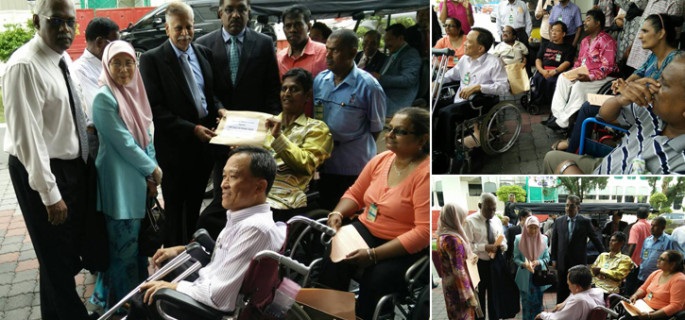
Badan Latihan dan Hidup Berdikari Malaysia (ILTC) pada 23hb Mac 2016 menyerahkan memorandum kepada ahli-ahli parlimen mendesak supaya golongan orang kurang upaya (OKU) dikecualikan daripada cukai barangan dan perkhidmatan (GST).

Disabled Members Protest

Disabled Members Protest
Disabled Members Protest at JPJ Wangsa Maju

ILTC Malaysia members staged a protest outside JPJ Wangsamaju KL.

ILTC Malaysia members staged a protest outside JPJ Wangsamaju KL.
Disabled group’s protest disabled drivers required to produce doc's medical report.

Wednesday, 24 December 2008

Launching a barrier-free city

24 December 2008


Launching a barrier-free city
Good news for the disabled community in Petaling Jaya: they will soon have 150 sheltered parking lots in designated areas around the city
Malaysiakini: First rainproof car park for the disabled

Malaysiakini: First rainproof car park for the disabled

Imagine a disabled person trying to get in and out of the car in pouring rain. It's hard enough for a person carrying an umbrella but even harder if he or she is on wheelchair.

Recognising this problem, the Petaling Jaya City Council (MBPJ) today launched the first sheltered parking space for the disabled at its headquarters.

The parking space is located next to the building's main entrance with the shelter extending to the nearby wheelchair ramp.

Speaking at the launch, wheelchair-bound MBPJ councillor Anthony Thanasayan lauded the creation of the special parking space.

"For anyone else it would take 2-3 minutes to get out of the car. But for a disabled person it takes 10-15 minutes. With this sheltered car park, we (have the luxury) to take our own sweet time," he said.

Thanasayan, who heads the council’s disabled expert committee, also welcomed the shift in mindset regarding the disabled.

"Even when we want to work, the toilet is not assessable to us. We are not affected by our disability but are affected by society lacking to provide for us to live like normal people."

But this car park is a change in mindset and gives the disabled what we want," he added150 special parking spaces.

The MBPJ plans to create 150 specially designated parking spaces which will be located around the Petaling Jaya area.

The council hopes to fit at least 20 of these parking spaces with shelters.

Officiated by Selangor exco Ronnie Liu in the presence of Petaling Jaya mayor, Mohammad Roslan Sakiman, the event is part of the efforts towards creating a 'barrier free city' where people are free to move without physical, social and economic obstacles.

Meanwhile, MBPJ Developmental Planning Department director Sharipah Marhaini Syed Ali said another 149 designated parking spaces will be created in the next six months."They will be located at post-offices, heath centres, stadiums, malls and other places," she said.

For the moment, MBPJ is funding the implementation but the council hopes to get developers involved as well.

"A Merry Christmas & A Happy & Prosperous 2009".

I would like to take this wonderful opportunity to wish all members, their families and all the well-wisher's "A Merry Christmas & A Happy & Prosperous New Year 2009"

From

Mr. Francis Siva
President
Independent Living & Training Centre

Friday, 19 December 2008

Yen Yen: Plan for disabled to get better help

Thursday December 18, 2008
Yen Yen: Plan for disabled to get better help

KUALA LUMPUR: The Women, Family and Community Development Ministry will come up with a wider set of categories for the disabled in an effort to channel help to them more effectively.

The categories, which group disabled people according to their conditions, will enable the ministry to allocate funds and execute specific plans to help in their welfare.

“There are currently limited OKU (Orang Kurang Upaya) categories based on the records from the Statistics Department,” said Minister Datuk Seri Dr Ng Yen Yen.

“We want to widen the scope so that the OKU would be better represented,” she said at a media briefing on the second meeting of the National Council for the OKU yesterday.

She added that the ministry also discussed plans to improve special education during the meeting.

During the council’s first meeting on Aug 14, five committees were set up to look into registration, quality of life and care, accessibility, education and employment for the disabled.

“We are also coordinating with other relevant ministries such as the Housing and Local Government Ministry to further aid the disabled,” Dr Ng said.

She added that the provisions under laws such as the Housing Act and Local Council Act which protect the rights of the disabled must be followed to improve their quality of life.

Wednesday, 17 December 2008

Disbaled Need Jobs, Not Charity

December 17, 2008 16:17 PM

Disbaled Need Jobs, Not Charity
By: Ramjit

KUALA LUMPUR, Dec 17 (Bernama)-- The disabled in the country need decent jobs and business opportunities rather than charity, donations and handouts, according to a disabled leader.

President of the Independent Living and Training Centre (ILTC) G. Francis Siva said most of the disabled people very capable and talented and needed the right guidance and incentive to live independently.

Francis who runs a well equipped training centre for the disabled in Rawang near here, lost the use of his lower extremities due to an accident.

He said it was the norm in Malaysian society to give donations and handouts to the disabled.

While this was praiseworthy, it was nevertheless not effective in overcoming the challeges faced by the handicapped.Francis pointed that the disabled were people with dignity and wanted to contribute to the country's development.

On the ILTC, he said that since its inception eight years ago, the centre had trained some 120 people who were now leading normal live with their families.

The cost of running the centre was around RM96,000 per year and it received about RM30,000 annual grant from the government.

The services provided by the centre included counselling and motivation, providing disability information and advice, computer training, handicraft making and other self-development programmes.

BERNAMA

Employ The Disabled

December 15, 2008

Employ The Disabled
By: Ramjit

KUALA LUMPUR, Dec 15 (Bernama) -- Private organisations have been urged to employ disabled persons to enable them to earn a living.

"I hope private organisations will employ more disabled persons. There is no wrong in taking them, they too have skills and some are very proactive in their jobs," said Senator Datuk Yip Kum Fook while debating the 2009 Supply Bill in the Dewan Negara here today.

The senator said the private sector should cooperate to help the disabled to get work in view of the fact that the Public Service Department only allocates a one per cent intake from among the disabled.

BERNAMA

Friday, 12 December 2008

Penang to make public transport disabled-friendly by 2010

Published: Thursday December 11, 2008 MYT 1:20:00 PMUpdated: Thursday December 11, 2008 MYT 3:52:55 PM

Penang to make public transport disabled-friendly by 2010

GEORGE TOWN: Penang will be the first Malaysian state to conduct a full audit of its public transport facilities while it develops a comprehensive blueprint to improve the access and mobility of people with disabilities by 2010.

The initiative to boost the economic and social independence of those with disabilities, will be done through a two-year pilot project by the state’s Economic Planning Unit (UPEN) and the United Nations Development Programme (UNPD) to study how to create a barrier free public transportation in Penang.

UNPD Assistant Resident Representative James George Chacko said the ‘Transport for Persons with Disabilities - Support of the Development of Accessible Transport in Penang’ and its access audit on public buses, taxis, trains, ferries and airplanes as well as other infrastructures would lead to the development of a holistic transport improvement strategy that would in turn offer a framework for raising awareness levels in the general public.

“The audit will also look into pick-up points, road pavements and pathways emphasising on inter-connectivity. The findings of this audit will form the basis to develop an accessible public transport improvement master plan.

“The other initiatives to be undertaken in the coming months will include a demand responsive door-to-door transport service in Penang island; capacity building for disabled people in accessing public transportation; disability equality training for front line transport operators; training on access building requirements and universal design for contractors, architects and civil servants; designing a barrier-free bus stop model; and an awareness campaign,” he said at the launching ceremony of the UNPD-UPEN project at Dorsett Penang Hotel on Thursday.

Chacko also said the project was supported by the Women, Family and Community Development Ministry, and UNPD was confident with the project’s strong rationality, it would receive the necessary financial backing of the Federal Government.

“The project seeks to develop a ‘best practice’ model that we hope can be replicated nationwide,” he added.

State Local Government, Traffic Management and Environment Committee chairman Chow Kon Yeow, who launched the project, said the state government was also studying the possibility of drawing up a transport master plan and forming a state transport commission to serve as a one-stop agency responsible for planning, implementation and management if all transport issues in Penang.

“The necessary documents are currently being prepared for submission to the state executive council.

“We hope they will be ready by the end of the month or early next month before we start work on formulating the master plan, which we estimate will take one or two years to draw up and implemented,” he said.

Bernama

In need of facilities


Thursday December 11, 2008

In need of facilities
Wheel PowerBy ANTHONY THANASAYAN

Despite so much awareness created, only a few government bodies are making life easier for the disabled.
LAST week began with such a nightmare.

The one thing that most active persons in wheelchairs frequently worry about suddenly happened to me.

And of all things, it happened on Dec 3, the day each year on which the world celebrates International Day of Persons with Disabilities (IDPD).

I was at a Government-sponsored function to observe the occasion when all hell broke loose.

A major war was going on inside my tummy, and I was about to explode. Generally, when a person in a wheelchair has to go, he really has to go!

My only consolation (or so I foolishly assumed at the time) was that I was fortunately in a disabled training centre with several hundred handicapped people.

Together with help from an able-bodied friend, we made a dash to the nearest restroom with a wheelchair logo. To our horror, there was no toilet bowl in it!

We raced to the only other men’s toilet at the other end of the building only to find a cramped space. Not only was it wrongly designed, but it was also poorly maintained.

There was no toilet seat or toilet rolls. There were not enough grab bars to hold on to and the one that was there was fixed at the wrong spot.

In fact, there would have been no way I could transfer myself onto the throne had my friend not been there to help.

The place was so tight that it was amazing how we managed to do it at all. My friend heaved and puffed and had to perform a couple of unbelievable acrobatic feats to finally get me out of my chair.

To prevent soiling my clothes, I was forced to strip down to my birthday suit with my helper in the cramped cubicle all the time because I could not reach the door to shut it.

To think that the IDPD’s focus this year was on “dignity and justice”, and here I was, ironically being robbed of both on an that particular day.

That unpleasant episode lasted for more than an hour. I felt even more guilty as I had prevented many other disabled people from using the facilities all that time.

Apart from the drama in the restroom, I was told that the ­disabled were not served at the meal table until some of them com­­plained about it. It was the VIP able-bodied persons who had the privilege of waiters attending to them.

It was also sad to note that all the official vans by the government used to transport their staff were not designed for wheelchairs.

One would have thought that after all the awareness created about disabled persons and their needs (including by the authorities), at least one or two vehicles would have such features by now.

On the contrary, I was inform­ed that currently none of the vehicles owned by the Govern­ment are wheelchair-friendly.

The next day, however, was much better.

This time, I found myself with a group of disabled persons in Jalan Gasing, Petaling Jaya.

We were there as part of a new initiative by the Majlis Bandaraya Petaling Jaya (MBPJ) to make the entire stretch of pavement on Jalan Gasing friendly to all persons, especially the disabled and the elderly.

The MBPJ project is part of the city council’s mission to create a liveable city for all its residents.

What this means is that the present pathway will have to undergo various changes. Narrow passageways will have to be widened to allow access to wheelchairs.

Proper kerb cuts will need to be provided to allow wheelchairs and prams to access the pavements. Bus stops will also need to be accessible.

Street furniture will have to be rearranged. These include signboards, postboxes, lamp posts and even trees that cause obstruction to pedestrians.

Open drains will have to be covered so that the blind (and children) do not fall into them.

Tactile flooring to help the blind move about independently and traffic lights with audible alerts to tell them when to cross the road, will have to be provided.

Once these changes are implemented, the disabled will no longer feel imprisoned in their homes.

Even though there is presently no disabled-friendly public transport, they will at least be able to go out to the nearest shop, religious building or hospital like the rest of society.

The MBPJ project is expected to be completed by next March.

Disabled folks need our respect


Tuesday December 9, 2008


Disabled folks need our respect

MARIAM Mokhtar made an excellent point in the article “Time to heighten plight of the disabled” (The Star, Dec 4).

I wholly agree that International Day for the Disabled should be something we need to not only celebrate but also to show our respect, kindness and admiration for the disabled.

It is disheartening to know how a country like Malaysia still harbours a backward attitude when it comes to the disabled community.

I am baffled that Malaysia is not disabled-friendly and that society is not empowering the disabled community at all.

It makes me angry to see a few ignorant Malaysians do nothing but stare at a disabled person venturing out in public for everyday chores.

In Britain, where I come from, the only response you get for staring at a disabled person is either a rude gesture or a good scolding.
Disabled individuals have feelings and rights to be treated with dignity and respect like their able-bodied counterparts.

They don’t need to be stared at, teased or be made fun of.
How would you feel if you were a disabled person where you have to endure a barrage of insults and rude stares by others?

Helen Keller, Rick Allen, Kristi Yamaguchi, Ian Dury, Ray Charles, Stevie Wonder, Stephen Hawking, Louis Braille, David Blunkett, Franklin D. Roosevelt and Cameron Leslie. What do these 11 persons have in common?

They are all not just famous for their achievements and talents but have also proven that their disabilities do not impede them from achieving success in life.

It shows that disabled individuals can be as successful as their able-bodied counterparts as long as we give them the support they need.

It is about time that Malaysians stopped thinking that disabled people cannot make a useful contribution to society, the economy and social issues.

CHRISTOPHER K. BIRCH,
Kuala Lumpur.

All senior citizens can take advantage of free transport

Monday December 8, 2008


All senior citizens can take advantage of free transport

I REFER to “Offer free transport to all senior citizens” (The Star, Nov 17) which raised the question as to why transportation for senior citizens is only provided at old folks homes that are registered.

The allocation of 11 vans to the Day Care Centres for the Elderly is a pilot project implemented by the Social Welfare Department Malaysia (JKMM) through a smart partnership programme with an NGO, Majlis Pusat Kebajikan Semenanjung Malaysia (MPKSM).

These vans are placed at the Day Care Centres for safety and maintenance purposes. Any local senior citizen who may have the need to use these vehicles to seek treatment at local clinics or hospitals may make a request to MPKSM by calling these lines – 03-2274 3714 or 03-2274 9918 .

However, this facility is provided only for senior citizens who have physical disabilities or live alone and do not have guardians/family members who can assist them to seek treatments at clinics or hospitals.

This is part of the JKM’s role in ensuring the well-being of all underprivileged senior citizens.

We will continue to do our best to ensure that they are well cared for and can live more comfortable and fulfilling lives.

HELYA MAIZUREEN HASHIM,
Public Relations Officer,
Department of Social Welfare.

Disabled urged to register with Welfare Dept

Monday December 8, 2008

News
Home > News > Nation


Disabled urged to register with Welfare Dept

PETALING JAYA: Less than 1% of the disabled people in Malaysia are registered with the Welfare Department.

Deputy Women, Family and Community Development Minister Noriah Kasnon said according to the World Health Organisation, an average of between five and 10% of a country’s population was made up of the disabled.
Impressive: Noriah (right) launching the Hilton Christmas Train in Petaling Jaya yesterday. Looking on (from left) are Hilton Petaling Jaya general manager Luc Bollen and organising chairman of the hotel’s GongxiDeeparayamas Charity Party V. Jayamurugan.

But our ministry only has 233,000 registered disabled members, which is less than one per cent,” she said after launching the Hilton Christmas Train yesterday.

She also attended the GongxiDeeparayamas Charity Party at the hotel.

Noriah encouraged the disabled to register with the department so that the ministry would have a clearer picture in assessing the disabled community’s situation.

She added that only 581 registered OKU (disabled people) were working in the public sector.

“OKU with a monthly income of less than RM1,200 would be entitled to apply for a RM300 incentive under the department’s scheme,” she said.

A monthly allowance of RM300 would also be given to caregivers of bed-ridden OKU with a total household income of less than RM3,000 per month. Noriah presented 25 charity homes with RM4,500 each at the event.

The donations were generated from the Fifth Hilton Christmas Train project which features a train display by lecturers and students from the University College Sedaya International School of Architecture and Built Environment.

Saturday, 6 December 2008

BANDAR BARU SELAYANG - Meriah

BANDAR BARU SELAYANG - Meriah

Kemeriahan sekitar Sambutan Hari Orang Kurang Upaya (OKU) Sedunia anjuran Majlis Perbandaran Selayang (MPS), Jabatan Keselamatan Jalan Raya dan Badan Latihan & Hidup Berdikari (ILTC) yang berlangsung di hadapan pekarangan Stadium MPS, di sini minggu lalu. Satu Kempen Keselamatan dan Kesedaran Kemalangan Jalan Raya turut diadakan di mana sebanyak 120 jaket keselamatan dan topi keledar diberikan kepada OKU yang hadir dalam majlis tersebut.

Turut hadir Ahli Parlimen Selayang, William Leong Jee Keen, Yang Dipertua MPS, Zainal Adidin Azim dan Pengarah Jabatan Keselamatan Jalan Raya Selangor, Shah Rizan Mohamad Sirat.

Friday, 5 December 2008

Time to heighten plight of the disabled


Thursday December 4, 2008


Time to heighten plight of the disabled

THE International Day for the Disabled fell on Dec 3 and I wonder how many of us were aware of this.

Malaysians treat the disabled with a curious combination of either disrespect or as morbid objects of curiosity. We still have a long way to go to accept the disabled as useful contributors to society.

In the west, the disabled are taught and encouraged to live independently, with self-respect and integrity. Over here, people are more curious than helpful, with scores of nosey bystanders whenever the disabled dare venture out for everyday chores or visits.

We still have much to learn from the West when it comes to empowering our disabled community.

First of all, we have to heighten the plight of the disabled to the general public. As a community, the disabled can and do make a useful contribution to society, the economy and social issues.

However, many individuals, companies and politicians are not willing to extend full rights to the disabled.

Legislation of laws which will ease the daily life of the disabled are slow to pass. In simple terms, the disabled are treated as second-class citizens.

Job opportunities are still not being made available to the disabled in either the public or private sector, buildings do not incorporate features to help the disabled, transport facilities for the disabled are lacking. Even the provision of special handicap parking badges have recently been turned down.

Most taxis refuse to take a wheelchair users. Even hotels, especially those that are state-run, do not have proper functioning facilities for the disabled.

For instance, cobbled paths that lead to the rooms or ramps that have a steep incline make it impossible for wheelchair users. The devil is in the detail and it is the detail that is sorely lacking at most places.

Our society, maybe even our culture, tends to exclude the disabled from normal life. Politicians only pay lip service to helping the disabled. Some MPs have made unflattering remarks about the disabled rather than treat them with the dignity and the respect they deserve.

If we are serious about being a fully fledged developed nation, then it is time we made a serious effort to promote the interests and well-being of the disabled.

Secondly, politicians should legislate aggressively to help empower the disabled to include them in the mainstream of society. Individuals, companies and organisations could also involve themselves in the development of ideas to counteract the negative perception of society towards the disabled.

Schools should be encouraged to have an after-school activity that makes our children aware that the disabled have the right to live, work and be educated alongside us.

International Day for the Disabled should be a time for us to show our respect, pride and admiration for the disabled in our society.

MARIAM MOKHTAR,

Ipoh.

Failure to fill form costs disabled jobs

2008/12/04

Failure to fill form costs disabled jobs


BANGI: Almost all of the 1,000 disabled who sought government jobs between July and this month were unsuccessful because of their failure to fill a compulsory form.

They had failed to submit a form issued by the Public Services Commission, completing only a form issued by the Social Welfare Department.This led to only five successfully obtaining jobs.

Social Welfare Department division for the development of people with disabilities director Jayalatchumy Cumaraswamy said many applicants were not aware they had to fill out the form issued by the commission.She said this after the launch of a job expo for the disabled.

The form issued by the commission will be available online at www.spa.gov.my. from Jan 1.

Include The Disabled In All Development Efforts - UN Sec-Gen

December 03, 2008 18:41 PM

Include The Disabled In All Development Efforts - UN Sec-Gen
By: Ramjit

By Muin Abdul MajidDUBAI, Dec 3 (Bernama) -- United Nations (UN) secretary-general Ban Ki-moon has urged governments and all stakeholders to ensure the disabled and their organisations are an integral part of all development processes.

"In this way, we can promote integration and pave the way for a better future for all people in society," he said in his message to mark International Day Of Persons with Disabilities on Wednesday.

According to Ban, the UN General Assembly had stressed that to achieve the Millennium Development Goals (MDGs), those with disabilities must be included in all processes.

"With 80 per cent of the disabled -- more than 400 million people -- living in poor countries, we need to do much more to break the cycle of poverty and disability," he said.

Ban said this year's celebration came just a week before the 60th anniversary of the Universal Declaration of Human Rights, and the UN was commemorating both under the theme, 'Dignity and Justice for All of Us'.

"We have much to celebrate this year. The entry into force of the Convention on the Rights of Persons with Disabilities in May was a turning point."

When the first Conference of the Parties convened in October, participants immediately began considering how the Convention can serve as a tool to achieve the MDGs."

This progress has been made possible, thanks to the active participation and leadership of persons with disabilities, by ensuring that they have access to -- and are included in -- all aspects of our work," said the head of the world body.

Noting that the UN remained committed to this approach, Ban said the renovation of the UN headquarters complex would bring its facilities up to the latest standards of accessibility.

"These advances are long overdue," he added.

BERNAMA
Thursday December 4, 2008

- Lifestyle > Focus


Better facilities
WHEEL POWER
BY ANTHONY THANASAYAN

INTERNATIONAL Day of Persons with Disabilities (IDPD), which was observed yesterday, turned out to be quite a memorable event for a number of disabled persons in the Klang Valley. The theme for this year’s celebrations was Dignity and Justice – two words which matter a great deal to disabled communities all over the world.

On Monday, I was invited as a Majlis Bandaraya Petaling Jaya speaker to a road safety awareness campaign at the MPS stadium in Selayang, Selangor. The event brought together more than a hundred disabled motorists. The campaign, held in conjunction with the UN international disabled day, was targeted at disabled drivers, and organised by the Selayang Municipal Council, together with the Malaysian Road Safety Department and the Independent Living and Training Centre (ILTC).

Francis Siva, president of ILTC, said: “Because of the lack of disabled-friendly public transportation, the handicapped have to find ways to acquire vehicles on their own to earn a living or for hospital visits. As cars are expensive, many of the disabled resort to buying bikes, which are not exactly safe.”

These bikes are modified into four-wheelers or three-wheelers. The four-wheeler looks like a normal bike except that it has three wheels at the back with the usual one wheel in front. The disabled can tie their foldable wheelchairs at the backend of their seats. The three-wheelers come with an attached sidecar. Although the wheelchair can be placed in the sidecar, it would take a strong disabled motorcyclist to lift the wheelchair into the sidecar. Riders with poor balance also risk falling off their bikes.

“There are no driving schools which provide disabled-friendly cars or motorcycles for the handicapped,” said Francis, who became disabled in a driving accident more than 20 years ago.

That did not stop him from driving again 10 years later. He uses a hand-powered car that allows him to control the pedals with his hands. He said the only centre that has two modified cars for disabled persons to learn to drive is at the government Bangi training centre in Kajang, Selangor.

“I often receive complaints that the centre has no instructors to teach disabled drivers,” he said, adding that all driving schools should provide at least one modified car and motorbike for handicapped students.

Francis has a couple of suggestions:

>Make special concessions: Many disabled persons are illiterate because they have not been to school. Others were forced to drop out because schools refused to provide disabled-friendly facilities or there was no transportation available. Special training to handle such persons is required for all staff.

>Many PJ buildings are not disabled-friendly. Its offices in Padang Jawa, Selangor, and Wangsa Maju, Kuala Lumpur, provide services at the disabled car parks. However, there are complaints from the handicapped that the allocated parking lots are not next to entrances, security personnel are never around, and the handicapped are being charged for parking.

Helping hand for the handicapped

Monday December 1, 2008

Helping hand for the handicapped


LIKE most parents, lottery ticket seller Ramesh Moses has many worries concerning his children.

However, his worries are over simple, yet essential, matters like having enough food on the table each day.

The 44-year-old is wheelchair-bound and was handicapped by polio at the age of two. He earns about RM550 a month through the ticket sales.Feeling the pinch: (From left) K. Kaliamma, her son M. Muhilan with Mary and her husband Ramesh at their home in Sri Johor flats in Cheras during the visit by Azman.

His wife R. Mary, 43, is a housewife and they have four children aged between 11 and 18 years old.

They have been living at a Kuala Lumpur City Hall (DBKL) flat in Cheras for about 20 years now.

The church they attend also helps out with some RM200 each month.

However, the total is hardly sufficient for a family of four with children in school and other expenditures like the flat rental and utility bills.

“My flat rental is overdue by about 12 months. I only sell tickets three times a week and I go to work at nearby areas such as Maluri and Pandan Jaya, within Cheras so that my cab fare does not exceed RM8 to and fro each time,” he said during a visit to his flat by Bandar Tun Razak MP Tan Sri Khalid Ibrahim’s personal assistant Azman Abidin.

Azman also visited a handicapped boy, M. Muhilan, 19, in the area. Muhilan was accompanied by his mother K. Kaliamma Thevi, 44.

Kaliamma said Muhilan and his younger brother M. Anbarasan, 16, were born with Down Syndrome.

“I can’t work because I have to be here and take care of Muhilan while my sister takes care of Anbarasan. Sending them to a day-care centre would be too expensive for me.

“I cannot leave them alone as they need attention all the time, especially since they occasionally have seizures,” she said, adding that her husband, who works for Alam Flora, was a diabetic and was also often ill.

Azman, who provide some monetary help to the two families on behalf of the MP’s office, said there were many low-income, handicapped people living in the DBKL flats.

“The cost of living in KL is quite high and especially during this time of economic crisis, the low-income groups feel the pinch the most.

“I suggest that the government waives the rental for certain low-income, handicapped groups to help them in the long-run and think of ways of helping them sustain themselves,” he said during the visit.

To make contributions to these families call the MP’s office at 03-9172 1200/ 4200.

Ministry To Get Equal Recognition For Disabled Athleles

December 01, 2008 16:10 PM


Ministry To Get Equal Recognition For Disabled Athleles

BERA, Dec 1 (Bernama) -- The Youth and Sports Ministry is trying to get equal recognition for disabled athletes to enjoy the rights and privileges received by their normal counterparts.

Its Minority Sports Development Director, Kamaruzaman Hassan Mansor, said Monday the ministry hoped that the disabled athletes would receive the same incentives because they too had struggled to put Malaysia's name in the world sports arena.

"If a normal athlete gets RM1 million if he or she wins a gold medal in the Olympics, we hope the same reward will be given to the disabled athlete for a gold medal at the Paralympic Games," he said at the closing of the national-level Tasek Bera Kayaking Expedition for the Disabled Challenge 2008, here.

Kamaruzaman Hassan said the ministry would also try to secure pension for disabled athletes who win medals at international sports meets.

He also called for a sports and recreation association for the disabled to be set up soon in each state to take care of the welfare and interests of disabled athletes.

BERNAMA