NEW MINISTER FOR WELFARE MINISTER OF MALAYSIA

NEW MINISTER FOR WELFARE MINISTER OF MALAYSIA
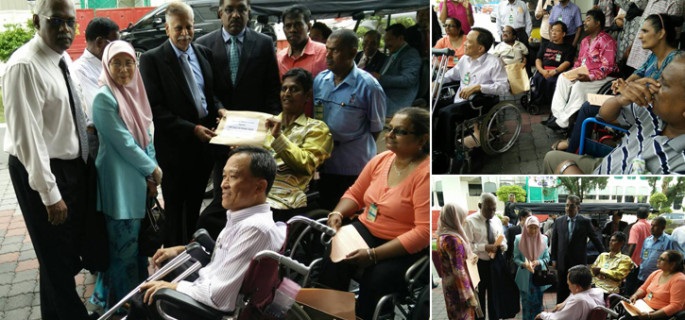
Badan Latihan dan Hidup Berdikari Malaysia (ILTC) pada 23hb Mac 2016 menyerahkan memorandum kepada ahli-ahli parlimen mendesak supaya golongan orang kurang upaya (OKU) dikecualikan daripada cukai barangan dan perkhidmatan (GST).

Disabled Members Protest

Disabled Members Protest
Disabled Members Protest at JPJ Wangsa Maju

ILTC Malaysia members staged a protest outside JPJ Wangsamaju KL.

ILTC Malaysia members staged a protest outside JPJ Wangsamaju KL.
Disabled group’s protest disabled drivers required to produce doc's medical report.

Saturday, 10 July 2010

Istana Negara Acknowledgement on HRP & HINDRAF appointment on this 11/7/10 Sunday at 2.30 pm.

Istana Negara Acknowledgement on HRP & HINDRAF appointment on this 11/7/10 Sunday at 2.30 pm.

Istana Negara acknowledgement on Human Rights Party (HRP) & HINDRAF appointment to hand over Petition to constitute Royal Commission of Enquiry to King DYMM YDA on an estimated 2,237 top Indian students denied JPA scholarships, PTPTN loans, University and Matriculation places.

ILTC Disabled Members enjoy orchestra performance

ILTC Disabled Members enjoy orchestra performance Mercedes-Benz Malaysia and Dewan Filharmonik Petronas (DFP) hosted over 150 children and 20 wheelchair-bound individuals to a fun-filled afternoon of musical delights celebrating famous heroic tales at the ‘Heroes and Heroines’ Open Rehearsal by the Malaysian Philharmonic Orchestra (MPO) conducted by Matthew Coorey and presented by Kevin Hathway.
The ‘Heroes and Heroines’Open Rehearsal was held especially for underprivileged children and wheelchair-bound individuals giving them the chance to enjoy a concert experience in a world-class hall. The experience also provided an exclusive look into the working sessions of an orchestra.

The children from the San Pedro Shelter Home, Rumah KIDS, Angel’s Home, Persatuan Kanak-Kanak Istimewa Ampang, Taman Megah’s Handicapped & Disabled, Pusat Pemulihan Dalam Komuniti and Bangsa Ria, Independent Living & Training Centre as well as the residents under Yayasan Salam were abuzz with excitement as they waited in anticipation for the rehearsal to begin.

Friday, 9 July 2010

Press Release: Time to remove all reservations and sign the Optional Protocols

Press Release: Time to remove all reservations and sign the Optional Protocols

Thursday, 08 July 2010 03:11pm

The Malaysian Bar welcomes the Government’s ratification of the Convention on the Rights of Persons with Disabilities (CRPD). Alongside Malaysia’s well-publicised ratification, the Government has nonetheless taken reservations to Article 3 on general principles, Article 5 on equality and non-discrimination, Article 15 on freedom from torture or cruel, inhuman or degrading treatment or punishment, Article 18 on liberty of movement and nationality, and Article 30 on participation in cultural life, recreation, leisure and sport.

This means that the Malaysian Government does not fully subscribe to the fundamental principles that persons with disabilities should enjoy such equality, non-discrimination, freedom or liberty, or to fully participate in culture, recreation, leisure and sport. This makes for a hollow ratification since such reservations take away from fundamental principles that underpin CRPD.

These kinds of reservations are consistent with the reservations made to the Convention on the Rights of the Child (CRC), which Malaysia acceded to in 1995. Despite withdrawing reservations to Articles 1, 13 and 15 of CRC, Malaysia still has five reservations in place. These are to Article 2 on non-discrimination; Article 7 on name and nationality; Article 14 on freedom of thought, conscience and religion; Article 28(1)(a) on free and compulsory education at primary level; and Article 37 on torture and deprivation of liberty. This indicates that the Malaysian Government still takes the view that children can be discriminated against, have no right to a name or nationality, have no freedom of thought, conscience and religion, and staggeringly, should not be free from torture and deprivation of liberty.

The Malaysian Bar also welcome the Government’s withdrawal of reservations to Articles 5(a), 7(b) and 16(2) of the Convention on the Elimination of All Forms of Discrimination Against Women (CEDAW). While noteworthy strides have been made in terms of efforts to eliminate discrimination against women, Malaysia also still has five reservations in place with respect to CEDAW. These deal with equal rights for women to pass their nationality to their children (Article 9(2)); equal rights to enter into marriage (Article 16(1)(a)); equal rights and responsibilities during marriage and at its dissolution (Article 16(1)(c)); equal rights and responsibilities with regard to guardianship, wardship, trusteeship and adoption of children (Article 16(1)(f)); and the same personal rights in a marriage, including the right to choose a family name, a profession and an occupation (Article 16(1)(g)).

In addition to these reservations, the Malaysian Government has still not signed or ratified any of the Optional Protocols to CRPD, CRC or CEDAW. These Optional Protocols grant specific rights to the citizens/residents of a country to refer their government to the international supervisory committee for non-compliance with each of these conventions. At present, although Malaysia is a State Party to these conventions, Malaysians cannot hold the Government accountable if it does not honour or comply with their provisions.

Similarly, the Persons With Disabilities Act 2008, which supposedly implemented the provisions of CRPD and which came into force in July 2008, does not provide for any form of punishment or remedy for breaches. It remains to be seen how the Malaysian Government will ensure that provisions of that Act are implemented. The Act also does not ensure that the persons with disabilities are not discriminated against, e.g. in education and employment opportunities.

The ratification of CRPD, and the withdrawal of some of the reservations to CRC and CEDAW, are all positive steps. However, more can, and should, be done.

We call on the Malaysian Government to give full effect to its international obligations by removing all remaining reservations, and by signing all three Optional Protocols. It should also expand the scope of the existing Child Act 2001 and Persons With Disabilities Act 2008 to comprehensively cover all areas of CRC and CRPD respectively. Currently, many of the provisions of CRC and CRPD have been left out of the enabling Malaysian legislation.

Finally, to show that it is fully transparent and accountable to the rakyat, we call on the Malaysian Government to insert provisions in all enabling legislation to allow the Malaysian Government to be challenged in Malaysian courts for non-compliance with its full obligations under CRPD, CRC and CEDAW. In particular, as a member of the United Nations Human Rights Council, the Malaysian Government should do no less.

Lim Chee Wee
Vice-President
Malaysian Bar

8 July 2010

Worst Toilet Found In Welfare Department

Story - Courtesy from Petpositive

Worst Toilet Found In Welfare Department

RECENTLY a small group of us came together to attempt the unimaginable – check out the public toilets in town!

We all know the kind of nightmarish encounters such a task would, more often than not, entail. Un-flushed toilet bowls, broken or missing taps and toilet seats, tissues that are nowhere in sight; you get the picture.

However, fortunately there was a special twist in our particular mission.

We were – thank heavens – to only look out for disabled-friendly loos.

Our target: some of the most important government buildings that the members of the public frequent.

And so an unlikely pair of journalists – a writer by the name of Priya Menon and Munirah Muzamer, a photographer – together with another wheelchair user like me, Francis Siva, we took off to our destinations.

Francis and I made a sort of a perfect combination between us because he was paralysed from his neck down and I, from the waist below.

Our feedback towards the exercise would be more comprehensive with our varied and specific needs, we thought. As council members of the city of Petaling Jaya’s (MBPJ) disability technical committee, our first stop was naturally at the PJ Civic Centre.

Needless to say the architects who designed this landmark building in its original form had obviously never dreamt of disabled and elderly people patronising the building.

And although years later a ramp was constructed outside and inside the building, no attention was given to the restroom even though a wider cubicle of sorts that can squeeze in wheelchairs are available both at the men’s and women’s section.

To access the restrooms, however, one had to contend with a step with his or her wheelchair until recently, when a ramp was installed.

But sad to say the ramp is still not suitable because of its steepness.

The good news, however, is that planning has already been underway at MBPJ over the past several months to overcome all the challenges presented by the older designs.

The Civic centre will be undergoing some major renovations very soon where all the facilities will be revised to become more user-friendly.

For the first time in the building’s history, a special place in one of the best spots in the auditorium where performances are held has been specially reserved so that at least two wheelchairs can be “parked” there.
Our second stop at the Kelana Jaya Swimming Pool was most frustrating as wheelchairs had to be carried up and down a flight of steep steps to get to the pool area.

Once inside, there were more steps to the changing rooms and toilets.

What is ironical is that I am told that a few disabled swimming championships have been held at the very pool where makeshift ramps and other alternatives were included to facilitate wheelchair-using athletes.
It is high time that MBPJ took up the challenge to overcome the various obstacles in the building to incorporate permanent structures so that even the ordinary disabled member of the public can use the pool without difficulty.

For those who are unfamiliar, people who are paralysed in their legs can still swim with their hands. It is not only an excellent all-rounder exercise for them but it also provides a great source of therapy by allowing them to move about in the pool without the need for wheelchairs.

At the national registration and immigration offices in Damansara in Kuala Lumpur, we made the shocking discovery that no handicapped toilets could be found.

The only one that they said was accessible was too far away for us to even try because it was several blocks away. But an even bigger horror awaited us at the KL Social Welfare Department which was located at the ninth floor of the Grand Seasons Avenue in Jalan Pahang.

Here is where people in wheelchairs and the elderly frequent to get aid from the government.

We couldn’t believe our eyes when we came across the toilets for disabled men and women in separate sections that used mere shower curtains as a door and to make up one side of the walls. There was no way that a person using it could not expose himself or herself to the able-bodied others in the restrooms.

There was hardly any room to manoeuvre a wheelchair and no grab bars in sight posing an extremely dangerous situation of handicapped users falling down and injuring themselves.

I couldn’t believe that here was an institution that was supposed to be caring and looking into the needs of the disabled – and yet, obviously having no qualms about allowing such a situation to go on for several years. When asked, their reply was “they couldn’t do anything about it as the building didn’t belong to them”.

However, as soon as I reached home I received a piece of good news on the telephone from the top management of the building.

They had learnt of our visit at their premise and informed me that a proper toilet will be built for the disabled at both the men’s and women’s section.

The toilets should ready by this week.

The End

Thursday, 8 July 2010

VOTED BEST PICTURE OF THE YEAR

If you think you don't have many friends...

Wednesday, 7 July 2010

Great news to tell you!!!

Great news to tell you!!!

ILTC members were invited to witness of the signing ceremony for the RATIFICATION of the UN Convention on the Rights of Persons with Disabilities at the Ministry of Women, Family and Community Development towards protecting the rights of persons with disabilities and for the improvement of the living standards of disabled people in Malaysia

Malaysia is still a developing country, but it is far ahead of other developing countries.

Malaysia Signs Convention On Rights Of Persons With Disabilities

July 06, 2010 21:21 PM

Malaysia Signs Convention On Rights Of Persons With Disabilities

KUALA LUMPUR, July 6 (Bernama) -- Malaysia on Tuesday signed the instrument to ratify the Convention on the Rights of Persons with Disabilities and withdrew its reservations on several articles in the Convention on the Rights of the Child and the Convention on the Elimination of All Forms of Discrimination Against Women.

The signing of the instrument by Women, Family and Community Development Minister Datuk Seri Shahrizat Abdul Jalil showed the government's commitment to protecting and improving the welfare of the disabled, women and children.

Shahrizat said the Convention on the disabled outlined eight common principles, including respect and self-reliance, removing discrimination against the disabled, and their full and effective participation in society.

"We hope it will bring change to the lives of the disabled in this country," she said at the signing ceremony, here.

Shahrizat also handed over the instrument ratifying the Convention to Deputy Foreign Minister Datuk Richard Riot Jaem to be sent to the United Nations for further action.

On the withdrawing of Malaysia' reservations on certain articles in the Convention on the Rights of the Child, Shahrizat said the government would give children the freedom to have their say and the right to form associations and to assemble peacefully.

She said the move was in line with the recognition given to children's rights as they would be the nation's future leaders.

Besides that, she added, the government would also fix the minimum age for women to marry and make the marriage registration compulsory, remove prejudices and customs that discriminated against women, and stress on opportunities to be given to women to hold public office.

Shahrizat said when the government agreed to the Convention on the Elimination of All Forms of Discrimination Against Women, it acted by appointing two women as Syariah Court judges recently.

"This is a positive step in raising the status of women in this country by giving them important decision-making positions," she said.

-- BERNAMA

Tuesday, 6 July 2010

ILTC Committee Meeting

4th ILTC Committee Meeting held on Sunday, 4th July 2010 at 76, Taman Garing, 48000 Rawang, Selangor Darul Ehsan.

Monday, 5 July 2010

Ratification Of A Critical Disability Document By Sharizat Tomorrow

Courtesy from PETPOSITIVE

Ratification Of A Critical Disability Document By Sharizat Tomorrow

PETPOSITIVE BARKING NEWS!

The signing of the ratification of the Convention of Rights of Persons with Disabilities - a legal document by the United Nations that will bring about positive changes for the disabled community by participating governments will take place in Kuala Lumpur at 2pm in the Ministry of Women, Family and Community Development.

It will be signed by the Minister herself Datuk Seri Sharizat Abdul Jalil.

The ratification of the treaty is the second of three critical steps towards improving of the quality of lives of all disabled Malaysians.

The only disappointment with tomorrow's signing of the document is that we understand that when Malaysia signed the document, it did so with reservations. This means that not everything in the official paper will be followed.

At this point, we are not sure as to what the reservations are.

Petpositive will be there at tomorrow's ratification ceremony.

Below is a statement by us that appeared on Malaysiakini in 2008. Click on our title if you wish to go to the original page.

PET+BLOGSPOT

Friday, May 16, 2008

PLEASE MAKE IT HAPPEN FOR THE DISABLED MALAYSIA - Malaysiakini

The Malaysian Animal-assisted Therapy for the Disabled and Elderly Association (PetPositive) joins hands with all disabled Malaysians and organisations committed to their cause in and outside the country to welcome the coming into force of the Convention of Rights of Persons with Disabilities (CRPD).

MCPXThis landmark treaty which was adopted two years ago was made available for signatures in March of last year. With Ecuador being the 20th nation to ratify the significant agreement last month, the CRPD took effect on May 3.

We are especially thrilled that our nation, Malaysia, has also signed the document in New York last month. By doing so, our government has taken the first all-important step to keep its promise and determination to improve the quality of lives of all Malaysians with disabilities.

However, there are two more significant steps for Malaysia to take with utmost urgency. We have to ratify and then implement the CRPD treaty, seeing to it carefully that the ‘Optional Protocol’ section is accepted without conditions or changes.

The Optional Protocol provides disabled people with a means of redress for individuals or groups who feel that their government has violated the convention and where national remedies have been exhausted.

It is only after this that our disabled citizens can truly, fully and finally enjoy the rights and dignity that our society has long denied them.

The CRPD will finally provide 650 million handicapped people around the globe and in Malaysia what they have been asking all their lives - a chance to go to school, find jobs, get married, raise a family and retire peacefully like everyone else.

PetPositive urges all political parties in both the Barisan Nasional and the Pakatan Rakyat to do everything in their power to make this a reality for disabled Malaysians who have been left out of our mainstream society for far too long.

Here and now is the chance for us all to prove to the world and our society that we really care for our disabled citizens!

The writer is president, the Malaysian Animal-Assisted Therapy for the Disabled and Elderly Association (PetPositive).

Thursday, 1 July 2010

Looking Forward as To Who The Next New Councillors

All of us at the Independent Living and Training Centre are eagerly looking forward as to who the next new councillors will be, especially those representing people with disabilities.
The names are scheduled to be announced at any time now. All councillors lose their post on Tuesday, next week, and the new ones will be sworn-in on Wednesday.

We strongly support Anthony SB Thanasayan, the president of the Malaysian Animal-Assisted Therapy for the Disabled and the Elderly Association (PETPOSITIVE) to be reinstated for the third time as councillor for the city of Petaling Jaya in Selangor.

We support his candidacy because in two short years he has succeeded to bring about remarkable changes for the disabled in PJ. In fact, he has achieved much, much more than all the disabled groups in PJ have managed to do in years.

Meanwhile, we at ILTC have learnt that there is a very desperate attempt by a disabled woman to try and get his place as councillor. Also a resident of PJ, she apparently has been eyeing Thanasayan's seat since last year.

Sources told us that she tried her best to lobby all of Pakatan's politicians and even the Datuk Bandar and the Chief Minister to try and get Thanasayan out. However, she failed miserably in her attempts.

This year, she is trying to do the same through very low down and unscrupulous means. Professing to be a champion for women with disabilities, she has been promoting the "disabled woman" ticket to try and get Thanasayan out.

In her blog, she has suggested that Thanasayan is moving to Klang instead of staying put in MBPJ. Her latest lie is a clear demonstration of how low this woman will stoop and to what extent just to destroy a good councillor's reputation.

However, the fact is the woman concerned is a failure herself. Despite being in the disability field for nearly two decades, she has done squat to help disabled Malaysians in all that time.

Instead, using the "disabled cause" she shamefully only bettered herself rather than the people she was meant to help. She traveled around the world to disability conferences (so that she can visit countries) and never did anything to help the disabled in Malaysia.

In addition to enjoying free overseas travels, she has also won several awards with cash prize money for herself instead of disqualifying herself from such privileges and allowing the ordinary members to take part in the benefits.

In fact, disabled groups have protested against her for denying memberships in an organisation in which she was in for many years. She has done nothing to change the plight of the disabled in all that time.

She is loathed by many disability groups and many of them want to have nothing to do with her. She is an utter disappointment and disgrace to the disabled struggle and community.

It is for these reasons why we at the ILTC are strongly opposed of her ever becoming a councillor for the Pakatan Government.

The disabled community have waited too long for changes and we will not sit idly by as hypocrites like these are allowed to be appointed and disrupt any chances for the disabled community to come up in life.

We are quite prepared to hold a public demonstration against her and the people who put her there if she is selected as a councillor. There are enough hypocrites already holding high positions without an extra one being added on the list, especially a disabled one.
On another note, we are anxiously looking at Selayang to see if a disabled councillor will be appointed there since a disabled councillor was replaced by an able-bodied representative a year ago.

Many of the projects proposed by the then disabled councillor have not been followed up and thus it is crucial that a handicapped councillor be put into Selayang to carry out the disabled-friendly plans in the municipality.

From,
Mr. Francis Siva
President of ILTC, Malaysia

Tuesday, 29 June 2010

FLASHBACK - A TRIBUTE TO LATE MOORTHY MANIAM

FLASHBACK - A TRIBUTE TO LATE MOORTHY MANIAM

Late Moorthy Maniam is a national hero. He had been a member of the Independent Living & Training Centre (ILTC) and also Malaysian team that had climbed Mount Everest.

Moorthy became quadriplegic (paralysed from the neck down) in1998 as a result of an accident in the Sungai Udang Military Camp.

On 11th November 2005, Moorthy fell from his wheelchair, injured his head and went into a coma. He did not recover
and passed away on 20th December 2005.
In January 2005, Moorthy took part in the Thaipusam festival in Batu Caves by carrying a ‘paalkudam’ (or milk pot) and shaving his hair. He was apparently carried up the 256 steps of the Sri Subramaniar Temple at Batu Caves in his wheelchair by RELA volunteers.

Monday, 28 June 2010

Long way to go for the disabled


Monday June 28, 2010
Long way to go for the disabled
By PRIYA MENON
priya@thestar.com.my

TO an able-bodied person, the so-called toilets for the disabled in Malaysian buildings may seem appropriate for the elderly and the disabled. The truth is most of the facilities are actually far from adequate.

For many years, the disabled community have had to put up with the lack of tolerance the society has shown them. They live in the shadows and come out only when necessary wearing adult diapers to cope throughout the day.

All this because the toilets have not been built to accommodate their needs, forcing them to rush home every time.
Easy does it: Guards helping Francis down the stairs after a futile attempt to check toilets for the disabled at the MBPJ swimming pool.

“Most buildings have toilets for the disabled on only one floor in the entire building compared with the other toilets.

“It is ironic actually, they ensure that disabled visitors look all over the place for the toilet while the able-bodied are able to walk into any toilet at their convenience,” Malaysian Animal Assisted Therapy for the Disabled and Elderly Association president Anthony Thanayasan said.

According to Anthony, many of the disabled have weak bladders and bowels, forcing them to visit the toilets more often than others.

He added that wearing diapers for too long could also lead to urinary tract infections, one of the top killers for the disabled.

Independent Living and Training Centre presidnt Francis Silva said many of the disabled were ashamed to leave their homes due to the lack of toilet facilities.

“We have been put in embarrassing situations many times. I was invited to a function where no toilets for the disabled were provided. After searching for more than an hour, I found one and had to lie down on the floor to proceed with my task,” he said.

For both Anthony, who is paralysed from the waist down, and Francis, who is paralysed from neck down, some of the most horrible toilets for the disabled are in government buildings.


Aghast: Anthony (right) and Francis were livid to find a shower curtain being used as the ‘door’ for a toilet for the disabled at the Social Welfare Department.

“They build toilets with outdated specifications from the Public Works Department. None of them can be used in this day and age,” Anthony said during a spot check to several locations in Petaling Jaya and Kuala Lumpur.

The first stop was the Petaling Jaya City Council’s (MBPJ) Civic Centre where the toilets were not up to par, but proved to be better than the rest of the toilets seen that day.

The next stop was the MBPJ Swimming Pool in Kelana Jaya. His first step into the centre proved to be difficult as there were no ramps to assist the wheelchair-bound Francis. The guards and officers had to carry him into the lobby but Francis had to give up on his check after coming to a second set of stairs leading to the pools and the toilets.

“There are no ramps for us to move freely into this building. Swimming is a great therapy for the disabled and yet they have deprived us of this facility,” Francis said.

The team then headed to the Pusat Bandar Damansara National Registration and Immi-gration departments and were shocked to note that no toilet facilities for the disabled could be found. When asked, a cleaner said the disabled toilet was located several blocks away.

Tight squeeze: Francis faced difficulty getting into the toilets at the Civic Centre in PJ.

From there, they moved on to the KL Social Welfare Department at the Grand Seasons Avenue in Jalan Pahang.

Anthony and Francis were livid to find a shower curtain being used as the door of toilet for the disabled. According to an official from the department who declined to be named, they could not renovate the toilets because they were only tenants and proper toilets were available on the ground floor. While this was true, Francis argued that the older generation and the disabled were forced to come down nine floors to use the toilet.

“Toilets for the disabled in Malaysia should have several things, including a sliding door, space, a toilet bowl with the right height, a siren, an emergency bell pull, the mirror at a lower angle and proper flush handles,” added Anthony, who is also an MBPJ councillor.

He added that the toilets should be built after consulting a disabled person who is knowledgeable and the toilets should be built for those with profound disabilities in mind.

Over the years, they have been fed with many excuses and both believe the excuses can no longer be accepted.

“Anyone can become disabled one day. They think it is only a small community but according to research by the United Nations, by the year 2035, 10% of the world population will be the elderly and, by 2040, there will be more elderly than children,” Anthony said.

Francis added that the government needed to look into these facilities, especially in key government offices and areas like hospitals and police stations.

“The planning should be done now for the future in order to accommodate the growing number of disabled and the elderly,” he said.

Wednesday, 23 June 2010

Golongan sasar diberi perhatian

Rabu 23-6-2010

Golongan sasar diberi perhatian

PETALING JAYA SELATAN - Pejabat Ahli Dewan Undangan Negeri (ADUN) Taman Medan dengan kerjasama Jabatan Perancangan Pembangunan Majlis Bandaraya Petaling Jaya (MBPJ) akan mengadakan program bantuan berterusan kepada golongan miskin, orang kurang upaya (OKU) dan warga emas di Taman Medan.

ADUNnya, Haniza Mohd Talha berkata, bagi tujuan itu pihaknya dan MBPJ sebagai sebuah pihak berkuasa tempatan (PBT) yang proaktif akan mengadakan program pencarian golongan yang kurang berkemampuan di Taman Medan untuk dibantu.

Katanya, sebagai langkah awal program berkenaan akan mencari 100 golongan yang memerlukan bantuan di sekitar kawasan itu.

“Antara perkhidmatan yang diberikan ialah membantu penduduk yang rumahnya mengalami kerosakan seperti kebocoran, tidak kukuh, ataupun diserang serangga perosak seperti anai-anai.

“Selain itu, bantuan perkhidmatan van percuma untuk golongan OKU, terutamanya yang berkerusi roda akan ditawarkan,” katanya ketika ditemui selepas melancarkan Program Bantuan Kemudahan Penduduk Miskin, OKU dan Warga Emas di sini.

Hadir sama, Pengarah Perancang Bandar MBPJ, Sharipah Marhaini Syed Ali.

Haniza yang juga Timbalan Speaker DUN berkata, kemudahan yang disediakan itu bagi memudahkan golongan sasar terbabit ke klinik, hospital ataupun ke destinasi yang memerlukan bantuan untuk dihantar.

Katanya, perkhidmatan bas percuma di dalam DUN Taman Medan juga akan disediakan untuk golongan miskin.

Bas itu katanya, mengikut laluan RapidKL dan dikhususkan penggunaannya untuk golongan yang miskin.

“Justeru, kami sangat mengharapkan dengan adanya program seumpama ini, golongan yang miskin tidak lagi terasa dipinggirkan oleh arus pembangunan bandar,” katanya.

Sementara itu, katanya, bagi memastikan tiada golongan memerlukan terlepas pandang, pihaknya berharap pemimpin masyarakat dan wakil penduduk bersama-sama mengenal pasti individu yang layak menerima bantuan mengikut kategori di kawasan masing-masing.

“Kita mahu membantu seberapa ramai golongan yang memerlukan bantuan, tetapi matlamat ini tidak akan tercapai jika pemimpin masyarakat atau wakil penduduk tidak membantu kita mengenal pasti mereka yang layak diberikan bantuan.

“Apa yang kita harapkan golongan ini benar-benar dapat memanfaatkan sumbangan yang diberikan,” katanya.

Monday, 21 June 2010

Monday June 21, 2010

MBPJ reaches out to poor
By YIP YOKE TENG

THE Petaling Jaya City Council (MBPJ) has embarked on a pro-active campaign to go door to door to provide aid for the poor and the disabled.

With only 150 disabled people and 450 poor families registered, the council feels that its activities and facilities have not reached the target groups as desired.

As such, a programme was launched on Saturday at the Taman Dato Harun market in PJS2, Petaling Jaya, to reach out to the disabled, poor and senior citizens in the city.

Taman Medan assemblyman Haniza Mohd Talha, MBPJ planning department director Sharipah Marhaini Syed Ali, councillors Anthony Thanasayan, Halimey Abu Bakar and Prof Madya Melasutra Md Dali were present at the event.

The launch also highlighted the facilities the council had been providing for the poor, among them are:
Thoughtful service: Haniza (middle), Sharipah (right) and Anthony unveiling the van used to transport disabled persons around the city.

·Two community buses plying PJU and PJS;

·Two vans equipped with hydraulic lift to transport the disabled around the city;

·One mobile clinic that now travels to PPR Kota Damansara and Taman Sri Manja, but will expand its service to Impian Baiduri; and

·Various financial aid for poor families with schooling children and ill members.

Counters were set up at the site to register disabled people and poor families.

“Today we are launching a programme to look for the disabled, poor families and senior citizens, instead of waiting for them to come to us for help.

“MBPJ is the first local council in the country to take the initiative,” Haniza said.

“We target to have another 100 families registered with us by the end of the year and we will send a team to visit them one by one so that we can help them according to their needs.

“We hope they will realise that the council does care for them and respect their right to live a quality life like others in this city. With this campaign we can create an even more harmonious society,” she added.

The team that will visit the poor families comprises Thanasayan and officers from the planning department and Haniza’s service centre. They will also make trips to Lembah Subang, PJS 1 to PJS 6 and Kota Damansara.

Sharipah said even though the council had been providing various facilities for the target groups, the response had not been as good.

“We will look at all their needs including home environment and may even offer to turn their washrooms into disabled-friendly ones,” she said, adding that the council had set aside RM30,000 to provide the service and would also request developers to contri­bute to the cause dollar-to-dollar.

Thanasayan hoped that other local councils and state governments would emulate MBPJ’s proactive efforts in reaching out to the target groups.
Friday, 18 June 2010

Sinar: OKU guna kemudahan bas transit

Today's Sinar


Friday June 18, 2010

Towards disabled-friendly buildings in PJ
By TAN KARR WEI
karrwei@thestar.com.my

THE Petaling Jaya City Council (MBPJ) hopes to set up a team to look into enforcement of guidelines for disabled-friendly buildings.

MBPJ secretary Puasa Md Taib said now there was only one officer in charge of the guidelines for barrier-free buildings while developed countries had a whole department to handle these matters.

“We’re looking into having a team with at least five officers, including those from the other departments like engineering, building control, landscaping and also councillors,” said Puasa after launching the two-day Section 13 Barrier-Free City workshop at the PJ Live Arts Centre in Jaya One.

He said having a team would ease the implementation of a pilot project in Section 13 for a barrier-free city.
At the launch: Puasa (second from left) flanked by MBPJ councillors Richard Yeoh, Puasa and Anthony Thanasayan with Sharipah and Living and Training Centre (ILTC) president Francis Siva.

“Many of the older places like Section 52 have been upgraded with disabled -friendly facilities but they are not inter-connected.

“We choose Section 13 because it has just been gazetted as a commercial area and we can put the responsibility on landowners to come up with buildings that are barrier-free and interlinked with the other structures,” Puasa said.

Puasa said the council would not issue a Certificate of Fitness (CF) to landowners who did not comply with the barrier-free guidelines.

“I hope to see Section 13 as a place with all the disabled-friendly facilities in place,” he said.

He added that the council would also be pushing for developers to follow the Green Building Index when planning their developments.

MBPJ town planning director Sharipah Marhaini Syed Ali said MBPJ also had plans to install mobile ramps on staircases at MBPJ buildings and parks.