NEW MINISTER FOR WELFARE MINISTER OF MALAYSIA
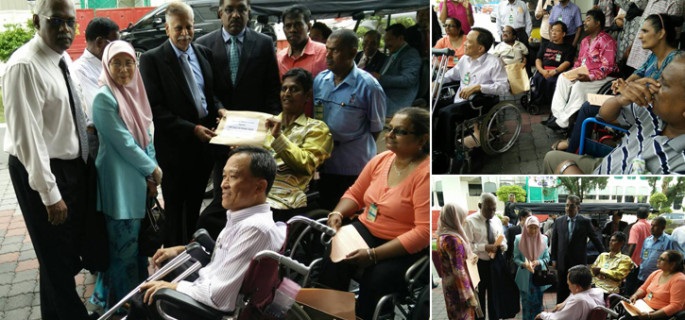
Badan Latihan dan Hidup Berdikari Malaysia (ILTC) pada 23hb Mac 2016 menyerahkan memorandum kepada ahli-ahli parlimen mendesak supaya golongan orang kurang upaya (OKU) dikecualikan daripada cukai barangan dan perkhidmatan (GST).
Disabled Members Protest

Disabled Members Protest at JPJ Wangsa Maju
ILTC Malaysia members staged a protest outside JPJ Wangsamaju KL.

Disabled group’s protest disabled drivers required to produce doc's medical report.
Thursday, 25 August 2011


Our women 'a force for unity'


Keeping this in mind the Women, Family and Community Development Ministry has chosen "Women: A Force for Unity" as the theme for this year's National Women's Day.
"We want to convey that women are powerful agents of peace and unity.
"As women, we pledge individually and institutionally to strengthen and safeguard our rights.
"An empowered woman is an asset to herself, her family and her country," said Minister Datuk Seri Shahrizat Abdul Jalil in a recent interview.
This year's National Women's Day honours the outstanding achievements of two women through The Prime Minister's Award for Woman Entrepreneur and The Prime Minister's Award for Woman Social Activist.
The celebration also highlights the ministry's achievements over the years.
Particularly significant is a policy which requires a minimum of 30 per cent women at decision-making level in the public sector beginning 2004.
Since then, the number of women in decision-making positions has almost tripled.
Of particular significance is the increase of women officials at the JUSA (premier grade) level from 18.8 per cent in 2004 to 32.3 per cent last year.
Women in Malaysia have come a long way. Many of them are holding high positions as rectors and vice- chancellors of public universities, secretaries-general of ministries and Syariah court judges. Even Bank Negara governor and the Securities Commission chairman are women.
The ministry was also instrumental in the 2002 amendment to the Pensions Act 1980 which allows widowers who remarry to continue receiving pension and the Land (Group Settlement Areas) Act 1960 which allows wives or ex-wives or the settler's heirs to be part of land schemes and to become land owners.
In the area of women's health, the ministry has worked tirelessly to promote a healthy lifestyle, including mammogram testing for early detection of breast cancer. To make mammogram available to all women, including the poor, a subsidy of RM50 per person was introduced for those earning below RM5,000 a month over the age of 45.
This subsidy was given added value when the ministry came up with another scheme where external breast prostheses and special brassieres were made available to breast cancer patients. The scheme came with a government allocation of RM4.3 million a year.
The Anti-Trafficking in Persons Act 2007 was the result of continuous advocacy and the ministry continued to raise the issue until the Attorney-General and Home Affairs Ministry were asked to draft an act.
The act was passed in Parliament in 2007 and the ministry was put in charge to protect and rehabilitate trafficked victims who are women and children.
To date, three shelters have been set up for such victims.
Other notable achievements include amendment of immigration law where children born overseas to Malaysian women and their foreign husbands are awarded citizenship; amendment of the Penal Code to increase the penalty for rape to a maximum of 30 years' jail, 15 years for incest and if the victim dies, the death sentence.
The National Women Policy and Women's Development Action Plan was passed on July 22, 2009, and launched by the prime minister on Aug 29, 2009. It aimed to accelerate the achievement of gender equality in line with the country's international commitment to the Convention on the Elimination of all Forms of Discrimination against Women.
Beginning mid-October last year, the government had extended maternity leave of civil servants from 42 days to 90 days.
The appointment of senior officers as Gender Focal Points (GFP) at all ministries is also a hallmark of the ministry's efforts over the years. As GFPs, these officers will assist the ministry in ensuring that gender equality is implemented within all government agencies.
Full of Kar1sma

Full of Kar1sma
By Farrah Naz Karimfarrah@nst.com.my

Prime Minister Datuk Seri Najib Razak (centre), flanked by his deputy Tan Sri Muhyiddin Yassin and Women, Family and Community Development Minister Datuk Seri Shahrizat Abdul Jalil, with representatives of groups who will get aid under the Kar1sma programme in Putrajaya yesterday. — NST picture by Izhari Ariffin

He said the poor, elderly, handicapped, single mothers and underprivileged groups would benefit from monthly payouts of between RM100 and RM450.
The programme also set aside RM4.1 million for about 2,000 widows of military personnel and policemen.
Described as a “newly branded welfare programme for the people”, Kar1sma will provide skills training for the said groups to improve their lives and instil independence in them.
“We have people who need help. If there are no government intervention programmes like this, they will be sidelined. “This is one of the pillars of Gagasan 1Malaysia in upholding social justice.
These people will not only be helped financially, they will also be given new skills and mindsets to help themselves and contribute to the countr y.” Najib said the programmewas initiated under the Government Transformation Programme to ensure these people were not left out of the nation ’s growth.
While some countries reduced allocations for pensioners and welfare programmes, he said, Malaysia not only continued to help the needy, but also increased funds for them.
“We will reach out to about 500,000 people. Don’t make one-off contributions and go around telling the whole world about it.
“The Barisan Nasional government is committed to helping underprivileged Malaysians on a monthly basis.
“This shows our commitment to the people and that we will uphold social justice.” Last year, the government spent RM1.2 billion, through welfare programmes, to help 424,000 people.
The largest group of recipients are senior citizens, who make up 30 per cent.
Present were Women, Family and Community Development Minister Datuk Seri Shahrizat Abdul Jalil and representatives of groups who will receive the aid.
Shahrizat said the programme would help the underprivileged break out of their cycle of hardship.
She added that the programme complemented other government initiatives, including health benefits for the needy.
In identifying the recipients, she said the ministry, through its agencies, stressed on the efficiency of application processes, including removing red tape.
Read more: Full of Kar1sma http://www.nst.com.my/nst/articles/FullofKar1sma/Article/#ixzz1W2CZEXs8Be more helpful

Thursday August 25, 2011
Be more helpful
Do not turn a blind eye to the needs of the visually impaired.
LIVING life as a blind person is something few people understand, except for the blind themselves. Blindness can strike anyone at any time, with little or no warning. When it happens to an adult, the experience is often devastating.
But it isn’t only the blind person who suffers. The trauma is also frequently and deeply felt by family members and loved ones of the affected individual.
For those who lose their sight when they are much older, coping with blindness is not easy at all.
My friend, Yam Tong Woo, 57, from Sungai Buloh, Selangor, knows about the condition all too well when he suddenly became blind three years ago.
We were chatting about it only last week. He remembers the incident as if it took place yesterday.
Yam was working in Kunming, China, as the general manager of a heavy machinery company when he fell ill and lost his eyesight.
“My life was plunged into total darkness and the future looked bleak,” said Yam.
Unfortunately, the doctors he sought were of no great help.
“I approached a well-known association for the blind for help on how to cope with blindness, but the association wasn’t much of a help,” Yam lamented.
He started looking for answers himself. The Internet proved to be a lifeline in times of crisis.
“I learnt how to use the white cane which is a very important aid for those who are newly blind,” Yam pointed out.
“Later I discovered how very different it is for disabled people in overseas countries. In Australia, for instance, the government takes a special interest in looking into the needs of aging blind citizens. No one is denied help, no matter how old they are, especially if they are people with disabilities.
“Regardless of an individual’s age, everyone is given a fair chance to be rehabilitated. In Australia, losing one’s sight at 54 is considered young,” said Yam.
Counselling for the blind is virtually unavailable in Malaysia.
“Even our NGOs don’t provide such a service. As a result, many newly blind people and their caregivers do not get the support and advice they need to cope with their condition.
“Assistive technology for the blind – such as screen reader software that converts text to speech in order for the blind to access the Internet – is much too expensive for the blind.”
Yam said this sad state of affairs is regretful when information technology is meant to empower the blind so that they can live independently. With National Day round the corner, Yam has the following three wishes for the blind community:
> There should be support for the elderly who lose their sight. It is even more traumatic for the blind person and his family members, if they do not get proper support and counselling. The various NGOs – as well as government centres – should buck up and provide a help centre for such persons.
> Doctors should arm themselves with knowledge on the blind. Every blind person who comes to them for help should be directed to the local NGOs. Every eye doctor should be trained on how to deal with blind people, instead of just treating their condition. Showing compassion alone doesn’t really help a blind person.
> The environment – both outside and inside buildings – should be made blind-friendly by the local councils. Members of the public should also play a supportive role and treat the blind like human beings and not aliens from outer space. Be courteous and do not knock into them in crowded places.
Always respect the white cane which is an international symbol of the blind.
When in a lift, allow the blind to get in first and get out as well. And when you see the blind trying to find their way about, always come forward to help instead of just staring at them.
RM1.4b fund to help the needy

Thursday August 25, 2011
RM1.4b fund to help the needy
By ZUHRIN AZAM AHMAD
zuhrinazam@thestar.com.my
PUTRAJAYA: A RM1.4bil fund to help the underprivileged has been launched by Prime Minister Datuk Seri Najib Tun Razak.
The 1Malaysia People's Welfare Programme, or Karisma, is expected to benefit about 500,000 people, comprising senior citizens, the disabled, children and single mothers.
He said the recipients would each receive between RM100 and RM450 per month.
“I am also happy to announce that widows of policemen and soldiers are also eligible for aid.
“This is the Government's appreciation to the Armed Forces and policemen for their contributions and sacrifices,” he said during the launch of the programme at his office here yesterday.
Also present were Deputy Prime Minister Tan Sri Muhyiddin Yassin and Women, Family and Community Development Minister Datuk Seri Shahrizat Abdul Jalil.
Under the Karisma programme, RM332mil is allocated to the disabled, RM290mil to underprivileged children, RM455mil to senior citizens, RM4.1mil to widows of police and army personnel and RM303mil to fund community-based programmes.
Najib said the initiative was part of the Government's continuing efforts to improve the standard of living of the poor and ensure that no Malaysian was excluded from enjoying the country's wealth.
He added that the programme was the Government's initiative to uphold social justice, which was one of the main pillars of the 1Malaysia concept.
“We have changed the direction and focus of the Government through the Government Transformation Programme (GTP) and we have identified a large part of our community that needs help so they can become independent.
“The underprivileged represents a large group of the community and without government intervention, they will remain marginalised and we will have failed to uphold social justice,” he added.
Najib said while the economic growth of certain countries had contracted and others were slashing the pensions of their retirees and welfare aid, Malaysia has been able to provide, and even increase, financial aid to the underprivileged.
“We in Malaysia are not only able to carry on with the (welfare) programmes but also provide higher allocations for the needy.
“I hope that those who receive aid will be inspired with new hope, skills and spirit so that they will be able to contribute to their future and that of the country,” Najib said.
Shahrizat said some 2,000 widows of policemen and servicemen would benefit from the programme.
She added that this group would also be provided with a launching grant to start their own businesses.
Saturday, 20 August 2011
New Cheras bus terminal disabled-friendly
Thursday August 18, 2011
New Cheras bus terminal disabled-friendly

LAST week, we were pleasantly surprised to receive an invitation from Maju Terminal Management and Services (Maju TMAS), the operators of the new bus terminal, Terminal Bersepadu Selatan at Bandar Tasik Selatan (TBS-BTS) in Cheras, Kuala Lumpur. They wanted us to check out the disabled-friendly features at the terminal.
Maju Holdings, the parent company of Maju TMAS, was awarded a design-and-build contract in November 2007. They had the mammoth task of constructing the RM570mil terminal within three years. The terminal would serve as an integrated transportation hub where the public can commute by bus, taxi and rail. Bandar Tasik Selatan was identified because of its ERL and Komuter rail lines.
The terminal which began operating at the start of this year, has replaced the newly renovated Pudu Raya bus station for all south-bound buses.
A key feature of TBS-BTS is the disabled-friendly facilities which also cater to the elderly.
 Special service: Wheelchair-users can purchase tickets with ease at dedicated counters for the disabled and the elderly at Terminal Bersepadu Selatan in Cheras, Kuala Lumpur.
So when I was invited to offer feedback on the company’s efforts in looking into the needs of handicapped users, I was quite excited.
As chairman of the disability technical committee of the Petaling Jaya City Council (MBPJ), which offers advice on handicapped-friendly features to developers, I thought it would be a good idea to bring along some of my team members with disabilities, as well as MBPJ’s planning and engineering staff.
Now, I must admit that we were half-expecting to see things that were not in proper order at the terminal, because of past experiences with other outfits which promised the same thing but turned out to be the opposite.
But boy, were we in for a surprise! The first thing that we were thrilled to notice at the terminal were the guiding blocks for the blind. These bright yellow tiles with grooves in them – also called tactile flooring – help the blind find their way about independently.
If you live in KL or PJ, you are likely to notice more and more of them being built in the outside environment, especially on the pavements.
However, what is notable about TBS-BTS’ tactile flooring is that they are also placed inside the terminal. This is exactly how it should be done – both outside and inside.
Long stretches of tactile lines from outside of the terminal effectively lead blind commuters into the building all the way to the information and ticketing counters.
They are also designed to guide the visually impaired into the restrooms which are wheelchair-friendly.
Our blind technical expert was thrilled. He used his white cane to cover almost the entire building.
Most buildings that claim to be friendly to the blind, sadly stop short of providing tactile flooring inside the building. This leaves blind visitors at a loss over what to do next when they are inside. Although our expert is blind, he was quick to point out areas that could do with some improvement. Some of the tactile lines, for instance, were not continuous at entry points such as the doors. For some reason, the able-bodied designers had overlooked this.
There were also certain areas where the management had placed chairs, stand-up signs for the public to queue up or other obstructions close to the markings. Blind commuters may accidentally knock into them.
As for wheelchair-users, there were three of us, including me. We represented various degrees of handicaps and gave our views based on our personal experiences.
We pointed out that the “lowered public phone booths” were not low enough for our wheelchairs. Some of the fittings such as the sink, water closet and dustbin in the restrooms were more of an obstruction than a help.
However, overall the boys at TBS-BTS had done an amazingly good job. We appreciated their willingness to receive feedback from us in good faith.
They said our feedback was a challenge to them to strive to make their terminal even better for persons with special needs.
The best news was that the terminal staff would be trained to go the extra mile to help all disabled commuters.
We were told that even before commuters with disabilities could approach the respective counters, the staff would get to them first.
With its golden service and improvements in the pipeline, TBS-BTS is certainly headed in the right direction. Syabas!
Thursday, 11 August 2011
A death that could have been prevented
Thursday August 11, 2011
A death that could have been prevented
The Star
WHEEL POWER
By ANTHONY THANASAYAN
THERE was sadness in the disability community last week when news broke out of the death of a disabled girl in Rawang, Selangor. She was only 14. She had pressure sores which may have led to septic shock and eventual death.
Pressure or bed sores can occur when a disabled person is sleeping on the bed or sitting in one position for a prolonged period of time. Constant pressure on one spot reduces blood supply to the area. Over time, it can cause the skin to break down and form an ulcer which can take a long time to heal. If left untreated or not properly cared for, bed sores can develop into a nasty infection which can prove fatal.
There was mixed reaction to the news of the teenager’s death. Some of it was rather disturbing.
Some able-bodied people actually told me that it was better for the girl to have died than to live her life out as a disabled person. This kind of thinking is not only discriminatory but shows a complete ignorance of disability.
I recall an incident not long ago when the Supreme Court in the United States made the decision to finally pull the plug on a woman who was brain-dead. They removed the artificial tubes that were keeping her alive.
It was a very dark day for the international disabled community and activists.
Countless disabled people with profound handicaps, who depended on medical equipment for their survival, came forward to support the handicapped woman.
Their press statement was entitled, “We love our tubes” which said it all about being disabled and leading a high quality of life.
The campaign was led by a group of activists who depended on feeding tubes and breathing apparatus for survival. They aptly called themselves, “Not Dead Yet.”
The teenager who died last week was born disabled. She needed to be carried from her bed to her wheelchair and the bathroom. Although she was able to push herself in her wheelchair, she could only do it very slowly.
Her father was in prison. Her mum was a sweeper. They lived in a very simple house and had no transport.
The girl had no friends. She was also illiterate.
Although she is gone now, she leaves behind many disturbing questions that remain unanswered.
Some of the pertinent ones are:
> Why was she never hospitalised for her condition? Neighbours said her mother went to several clinics for help, but was she ever referred to a specialist in a government hospital? Why does her case not qualify for nurses to visit her in her home to care for her wounds? With no transport of her own and no financial resources, where can Malaysians with disabilities like her turn to for help? It is for this and other reasons that disabled leaders are asking that all disabled Malaysians be given a monthly allowance of RM500 for a start to help raise their quality of life.
> It is not clear if she was registered with the Welfare Department. What kind of follow-up does the department have for needy cases like hers? Were home visits made on a regular basis to monitor her progress or was it a one-off visit only, if at all?
Many of us are familiar with advances made by our society to help raise disabled sportsmen, and make more buildings and roads disabled-friendly.
However, what good are these if the basic needs of Malaysians with disabilities are largely ignored.
The teenager’s death may have been prevented if she was given the help that she so desperately needed.
Wednesday, 10 August 2011
Wonderful Trip To Melaka

We (disabled friends) and trio interns from China, Taiwan and Japan decided to go Melaka for a short trip on last Sunday. We woke up early and had our breakfast at the ILTC and to ready for our trip. Once we picked up other friends at Kuala Lumpur we headed towards Melaka. It’s really long way journey from KL to Melaka, it takes less than two hours.

We are very happy in the ILTC's Van!!!


We were expected to this trip!!!!
 The architectures and landscapes are very attractive . You can see a lot tricycles with beautiful flowers and music. Many tourists can travel around the church by taking the tricycles.


Thursday, 4 August 2011
The right fit


Thursday August 4, 2011
The right fit
Tips on getting a suitable wheelchair.
A READER wrote in to ask for advice on what would be the most suitable wheelchair for an amputee who lost both his legs to diabetes recently.
Well, I’ve been using a wheelchair for almost 40 years, so the reader certainly came to the right person to ask for advice. Here are some tips for anyone who is wheelchair-hunting:
 Get it right: Do your homework first and look into the needs of the user before you rush out to buy a wheelchair.
> Do your homework first before you shop. Find out more about the user and his specific needs.
How old is the user? Is he totally dependent on a wheelchair to move around or does he need to use it occasionally? Is the user able to wheel himself or does he need a caregiver?
Whenever possible, take into consideration the wheelchair user’s living environment. Look at the space required for the wheelchair, and any adjustments that need to be done once the wheelchair arrives.
It is also helpful to get some input from a rehabilitation doctor who specialises in disability. I recall a couple of incidents when well-wishers ended up getting the wrong wheelchairs for disabled people. They relied on the advice of GPs without taking note of an important factor – those doctors are not users of the products themselves.
> Get the right wheelchair. Older persons with walking difficulties may require a wheelchair to help them get from the bed to the bathroom or to the garden, or for an outing with the family.
For this, a wheelchair which you can get for as little as RM300 from a pharmacy, would suffice. However, please note that such wheelchairs are not as durable as the more expensive ones. They may need to be replaced, depending on wear and tear. The more lasting ones can range from RM1,000 to RM5,000 or even more.
The second category is designed for those who are paralysed from the waist down. These wheelchairs are not only tougher but they are often lightweight, which makes transporting them in and out of a vehicle much easier.
They also come with detachable parts unlike the cheaper wheelchairs. Arm rests or foot rests which can be detached are important to users with more impaired body movements.
Removing a foot rest so that the wheelchair can inch nearer to another object like a bed or the toilet seat makes a world of difference to those who cannot use their legs when they are shifting from the wheelchair to say, the toilet seat.
The option to remove the arm rests is very helpful, especially when these pose an obstruction during transfers.
Care should be taken to ensure that wheelchairs and their parts do not have rough or sharp edges that can cause cuts or bruises to the user who has no feeling in the limbs.
> Custom-made wheelchairs: These are specialised wheelchairs for children and people with profound disabilities such as those who are paralysed from the neck down. For such cases, it is best to seek the advice of a professional such as a rehabilitation doctor who specialises in disability issues.
Wheelchairs come in really handy for the disabled. However, for the first-time user and their caregivers, it takes time getting used to one.
For the able-bodied who find themselves in a situation where they have to depend on a wheelchair to get around, they may feel “wheelchair-bound” by the experience. However, for the disabled who have been using it all our lives, wheelchairs are truly liberating. What would we do without them?
Tuesday, 2 August 2011
Disabled teacher tells of her tower of strength

Monday August 1, 2011
Disabled teacher tells of her tower of strength
By R.S.N. MURALI
murali@thestar.com.my
MALACCA: Wheelchair-bound English teacher Zainun Abdul Jalil is thankful that a coursemate she spurned during her college days is now her knight in shining armour.
The 46-year-old had once rejected her husband Nor Haime Abd Rahim's marriage proposal but is grateful the man she once hated has stuck by her side during difficult times.
“We never got along during our days at a teacher training college in Kuala Lumpur although he was always asking me to marry him,” she recalled in an interview.
 Dedicated: Zainun interacting with her students during her teaching session at SRK Seri Duyung in Malacca.
Her husband, however, knew they were meant to be. Nor Haime decided to directly ask Zainun's father for her hand in marriage in 1986 even though she had rejected his proposal countless times.
“My father called me the next day and said that he liked Nor Haime's modesty.
“He said my family wanted me to marry him.
“I dared not disobey my father and agreed to marry Nor Haime,” she said.
Zainun added that she fell in love with Nor Haime after marriage, drawn to his caring nature.
“I guess my matrimony was arranged by God as the Al-Mighty knew I would one day be immobilised and sent an angel to care for me,” she said.
Zainun has been restricted to a wheelchair after undergoing corrective surgery for a gynaecological ailment in 2006.
“Despite my condition and the fact that I was unable to conceive a child, Nor Haime did not remarry,” said Zainun..
She transferred to her current school, SRK Seri Duyung so that her husband could help her carry out her responsibilities as an English teacher.
“He is my pillar of strengh, literally. He is very tall and strong and can carry me easily,” she said.
Zainun has been given a special classroom on the ground floor of the school where she conducts her lessons.
“I am blessed to have understanding colleagues and pupils who have always been willing to to assist me and my husband whenever we need help,” she added.
Four LRT stations are now disabled-friendly

Monday August 1, 2011
Four LRT stations are now disabled-friendly
KUALA LUMPUR: Four out of the 24 light rail transit (LRT) stations on the Ampang line have recently been implemented with disabled-friendly facilities.
Syarikat Prasarana Negara Bhd infrastructure development director Nor Hasan Ismail said the four stations were Pandan Jaya, Pandan Indah, Cahaya and Cempaka all of which were expected to benefit an estimate of 15,000 disabled commuters.
He said the upgrades to the stations began in February last year and were completed in March.
 Test run: Euro Asia Access Solutions Sdn Bhd director Richard Arnold trying the facilities for the disabled at the Cempaka LRT station in Cheras, Kuala Lumpur recently. Looking on is Nor Hasan (left). — Bernama
Nor Hasan said the disabled-friendly facilities include ramps, elevators, tactile tiles and wheelchair platforms.
He added that the four stations were the first batch to receive disabled-friendly upgrades whereas the remaining 20 stations would be equipped with disabled-friendly facilities by the end of the year.
Nor Hasan said the upgrades were part of an initiative under the GTP's NKRA to improve the quality of public transport, which would benefit around 48,000 Klang Valley commuters daily.