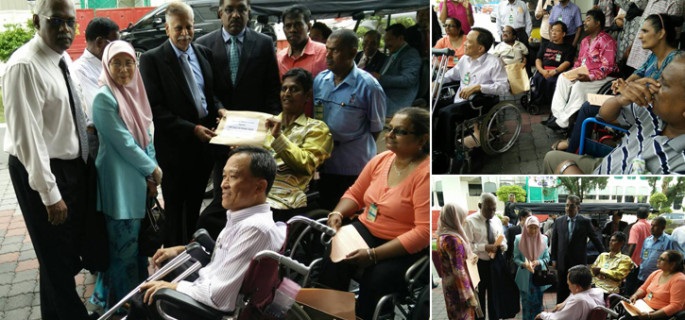
NEW MINISTER FOR WELFARE MINISTER OF MALAYSIA

NEW MINISTER FOR WELFARE MINISTER OF MALAYSIA
Badan Latihan dan Hidup Berdikari Malaysia (ILTC) pada 23hb Mac 2016 menyerahkan memorandum kepada ahli-ahli parlimen mendesak supaya golongan orang kurang upaya (OKU) dikecualikan daripada cukai barangan dan perkhidmatan (GST).

Disabled Members Protest

Disabled Members Protest
Disabled Members Protest at JPJ Wangsa Maju

ILTC Malaysia members staged a protest outside JPJ Wangsamaju KL.

ILTC Malaysia members staged a protest outside JPJ Wangsamaju KL.
Disabled group’s protest disabled drivers required to produce doc's medical report.

Thursday, 8 December 2011

Our day to be loud and proud


Thursday December 8, 2011


Our day to be loud and proud

INTERNATIONAL Day of Persons with Disabilities (IDPD) took off with a blast in Petaling Jaya, Selangor, last Saturday. More than 150 people took a couple of hours off from their daily routine to join the revelry at a street party in a local neighbourhood.

They came in their wheelchairs, walking sticks and white canes. Virtually nothing could stop them. And I was there, too.

We wanted to be loud and proud on our special day, which is commemorated on Dec 3 by the United Nations each year.

The host was the Petaling Jaya City Council (MBPJ). The mayor, Datuk Roslan Sakiman, was present. And so were the directors of MBPJ’s planning and health departments, along with a couple of the city’s councillors.

And in something that isn’t often seen, all the top brass of the PJ council stayed back right to the very end of the event. And it wasn’t difficult to see why.

Whether they were handicapped by a physical condition, blind or deaf, each of the participants under the canopy wore a bright smile. Their smiles were so infectious that it spread to the able-bodied, too, who were made up of caregivers, volunteers and MBPJ staff.

The morning began with a couple of speeches. Datuk Roslan said that Petaling Jaya was privileged and proud to commemorate International Disabled Day. His remark drew smiles, nods and claps from the disabled participants.

He reminded everyone, especially the able-bodied, that disability was everybody’s concern.

“We are all growing older every day and will one day have disabilities of our own, so we had better get used to it,” he quipped. “Thus building a Petaling Jaya city that is friendly to everyone is certainly a forward thinking move.”

The mayor then led a band of disabled activists and residents up a newly-built wheelchair ramp to the nearby shoplots. It was one of MBPJ’s best disabled-friendly designs. The gradient was as gentle as possible so that even the weakest wheelchair-user could access it.

A wheelchair-friendly covered car park was also provided next to the ramp. This was to ensure that drivers with disabilities would be protected from the elements.

The ramp led to scores of shops on the higher floors. There were numerous office lots. A restaurant was located at the far end.

The ramp even led users to a veterinary clinic and a pet food store where the elderly could patronise.

All the wheelchair-users who used the ramp and checked out the car park for the disabled, gave it a resounding thumbs-up. After the launch, the mayor and his team joined the disabled for a good half-hour of music therapy session with pounding drums and shaking tambourines.

A special guest, Ashley Bryant, from Mobility International USA, commented after the event: “I was thrilled to be among so many Malaysians with disabilities and their allies on such an auspicious day as IDPD to create a cacophony of sounds to let the world know what is happening.

“And as the ruckus turned slowly into beautiful rhythms, it was great to find a common pulse with everyone,” said Bryant, who hails from Eugene, Oregon, one of the friendliest cities in the world for persons with disabilities. Bryant was here on a group study exchange programme.

“As a rep from an organisation that has been promoting active participation of disabled people the world over in development and foreign exchange, we were delighted to see such positive changes taking place in the lives of people with disabilities in Petaling Jaya.

“It was great to see Malaysians with disabilities actively working together with the PJ local council to turn the city into a model disabled-friendly environment for all. To accomplish this, people with and without disabilities, as citizens or as policy-makers, need to tune in to one another’s needs. Only then can they really turn up the volume!” added Bryant.

As for the participants, they said they couldn’t recall an event that was so fun and exciting.

Tuesday, 6 December 2011

Cheque Presentation Ceremony

Magnum donates RM2,100.00 to Mr. Munusamy family.

Magnum had donated RM2,100.00 Mr. Munusamy family through “Magnum Cares” community support fund raising programme.

ILTC have made the arrangement.

Our congratulations and thanks to Magnum who have contributed.


PJ New Town to be turned into the city’s first disabled-friendly area


Monday December 5, 2011

PJ New Town to be turned into the city’s first disabled-friendly area

By JADE CHAN
jade@thestar.com.my
Photo by NORMAN HIU


Petaling Jaya mayor Datuk Mohamad Roslan Sakiman said the Petaling Jaya City Council (MBPJ) has taken the initial steps to implement various disabled-friendly facilities in Section 52, and intends to invite the area’s business community to participate and contribute to the initiative as part of their social responsibility.

“The MBPJ has plans to install more infrastructure like covered parking, ramps, disabled-friendly toilets and tactile paving at 150 locations all over Petaling Jaya to make more areas accessible to the disabled.

“The installation will be staggered over a span of five years,” he said.

Roslan was speaking at the launch of the Petaling Jaya Disability Day celebration, which was held to commemorate International Day of Persons with Disabilities that falls on Dec 3.

A convenience: Roslan helping Independent Living and Training Centre president Francis Siva down the newly-installed ramp at the Gasing Veterinary Hospital.

He also officiated at the unveiling of a ramp and covered parking for the disabled at the Gasing Veterinary Hospital in Gasing Indah, Petaling Jaya.

MBPJ Town Planning director Sharipah Marhaini Syed Ali said the MBPJ also plans to connect all the parks in Petaling Jaya by linking these using a universal design and ensuring they are disabled-friendly.

“The parks will be linked using existing pedestrian walkways. We will also go down to the ground to look into how to fill in the missing links to connect all the parks.

“This exercise will allow us to gain more green space,” she said.

In his speech, MBPJ councillor and Petpositive president Anthony Thanasayan said MBPJ was the first local council in Selangor to establish a committee to look into the needs of the disabled and elderly.

“There are many changes taking place in Petaling Jaya because of this move, including Petaling Jaya’s first disabled-friendly park in Section 6,” he said.

“Even other organisations like Prasarana and Malaysia Airports Holdings Bhd are learning from MBPJ on how to improve their facilities for the disabled.”

The highlight of the event was a drum circle performance where invited guests from various disability-related organisations pounded, tapped and jingled their drums and percussions to their hearts’ content.

Thursday, 1 December 2011

Room for all


Thursday December 1, 2011

Room for all


No more excuses for local councils to exclude the disabled and elderly in their development plans.

THE International Day of Persons with Disabilities (IDPD) will once again be commemorated on Dec 3. A yearly affair since it was established in 1992 by the UN General Assembly, the occasion is the most significant for people with disabilities (PWDs) the world over.

This weekend will be marked by scores of activities to highlight the event. They will include forums and public talks by PWDs, campaigns on information about disabilities, and celebrations to mark the true capabilities of handicapped individuals around the globe. All of this is to get disabled people into mainstream society so that they are able to take part in social life and in the nation’s development, just like non-disabled people.

One of IDPD’s focus is to help remove obstacles that stand in the way of the government’s implementation of disability-sensitive policies.

This year’s IDPD theme is: “Together for a better world for all: Including persons with disabilities in development.”

One of the most effective ways in bringing about positive changes for PWDs in Malaysia is to rope in the support of all local councils.

I was privileged to be in the company of scores of disabled people last week at two special events leading up to IDPD to bring about this exact effect.

The first was at the Selangor state secretariat building in Shah Alam. A special meeting was convened by Selangor Chairman of the Local Government, Study and Research Committee, Ronnie Liu, and important representatives from the 12 local councils in the state.

The purpose was to get each of them to set up a committee comprising PWDs and key members of the local councils in order to assimilate handicapped people into mainstream society.

By engaging with PWDs, each local council will be better informed on how to make the necessary changes, such as building ramps, disabled-friendly toilets and guiding blocks for the blind, the handicapped and the elderly residents in their constituencies.

The participation of the disabled will help local councils come up with appropriate and timely policies to integrate PWDs in towns and cities. From the feedback at the meeting, a few of the local councils said they did not know how to set up such a committee. Others did not seem to want to be bogged down with extra work.

Liu pointed out that there was no more excuses for any local council to not include the disabled and elderly in their development plans. He gave them two months to get their act together in coming up with a disability technical committee within their respective communities.

Meanwhile, more than 60 local councils from all over the country attended a recent two-day seminar on disability access at a leading hotel in Kuala Lumpur. It was the brainchild of Women, Family and Community Development Minister Datuk Seri Shahrizat Abdul Jalil, after playing an instrumental role a couple of months earlier in persuading the Cabinet to push for the setting up of disability committees in local councils throughout the country.

This was the first time that I had seen the Women, Family and Community Development Ministry and the Welfare Department tackle the issue of accessibility with local councils so seriously.

It clearly shows that society, including the non-disabled people who work together with us for change, is truly beginning to see that our real problem is the hostile environment outside.

I spoke later to some of the disabled participants who attended the seminar. They had some pertinent pointers to make for the organisers for future seminars:

> Please include some ordinary disabled people instead of some outstanding disabled personalities as speakers. The local councils might get the wrong picture and think all disabled people are successful. If that is the case, then why should local councils help? Also give handicapped speakers more time to speak instead of only five minutes.

> The ramp to the stage was unacceptable. It was steep and dangerous. This was a bad example for local councils who might “follow by example” in their designs.

> The hotel, supposedly a five-star one, had no disabled-friendly rooms among its more than 600 rooms. One disabled woman paid RM270 for a night’s stay, only to have to put up with much discomfort; she almost fell and injured herself. Another, a quadriplegic, returned to Pahang because the room he had booked turned out to be inaccessible. Sad to say, he did not turn up for the seminar the next day. Seminar organisers should be aware of what PWDs need when selecting venues.

Needless woes for the wheelchair-bound


Thursday November 24, 2011

Needless woes for the wheelchair-bound

WHO says life in a wheelchair is all doom and gloom? After sitting in one for more than 40 years, I’ve come to accept the fact that getting around in a wheelchair is – contrary to what many may think – just as fun as walking. Except for those dreaded moments when physical challenges that are absolutely unnecessary are put before a wheelchair user.

Take last week’s event, for instance. I was in the company of some top notch men and women at the main campus of the National Institute of Public Administration (Intan) in Jalan Bukit Kiara, Kuala Lumpur. We were attending a training programme conducted by a former mayor from England.

As councillor for Petaling Jaya, the topic was right up my alley. However, no sooner had I arrived at the venue when I suspected that this was going to be a bad day for wheelchairs. I barely managed to get into the building. They were some dangerous gradients and drain covers for my wheelchair to negotiate.

Once inside, I discovered that the men’s washroom was one floor above me. The only way to get to it was to climb a flight of stairs as there were no lifts.

The training session was scheduled for the whole day. Even single steps in the building did not come with a simple ramp. I had to ask for assistance each time I went in and out of the roundtable discussion room.

Then the most unthinkable thing happened: I was expected to use the women’s toilet. Suddenly, I was no longer feeling “distinguished” among my fellow participants. I felt embarrassed, humiliated and even outraged by the entire experience.

Despite the total lack of facilities for people with my needs, I was shocked when the organisers insisted that I pay the registration fee, which included refreshments and lunch.

I refused. I pointed out that it was morally not right for them to charge me, considering that they had not ensured my right to basic facilities at the event.

I was also disappointed with some of the excuses the organisers gave in response to my complaints:

> We didn’t know that you would be coming in a wheelchair:

Is this a relevant excuse nowadays when more and more buildings are becoming disabled-friendly in view of the increasing number of elderly and disabled citizens? If they had known, are they suggesting that they would have renovated a ramp or toilet in time for the event? Shouldn’t they have done this already? Do people in wheelchairs have to shout out their disability status each time they participate in society? Isn’t this a form of discrimination?

> It is our policy to charge all participants.

Even after you realise that you have been most unfair to a participant by denying him his basic needs? Fortunately, the organisers came to their senses and refunded my money in full.

I hope the experience proved to be a learning point for them as it was for me.

Intan Bukit Kiara was opened in the early 1980s. Why has it taken so long for the institute to include basic facilities for the handicapped? Did they not know that Malaysians with disabilities exist?

I had no choice but to quit the session halfway through its run.

The biggest question now remains: Is Intan going to do anything about making its facilities accessible to Malaysians with disabilities after today? Let’s certainly hope so!

Tuesday, 29 November 2011

Disabled friendly facilities still lacking


Disabled friendly facilities still lacking

RECENTLY, while having dinner in a restaurant near home, I saw two women struggling to get their wheelchair-bound elder relative onto the pavement.

disabled

estung

There was no ramp, so they had to drive as close as possible to the pavement that was at least a foot higher than the road table.

One woman placed a wheelchair on the pavement and went back to assist their elder out of the car.

When she realised that the car door could not be fully opened because the car was too close, she brought the wheelchair back onto the road and helped the elder out of the car. Once their elder was comfortably seated in the wheelchair, both women proceeded to push it towards the entrance to the restaurant where the steps were.

Then they each grabbed the wheelchair by its armrests, lifted it and struggled up the steps.

I watched anxiously, fearful that they might slip. Fortunately, they managed to get their elder safely into the restaurant.

Last week, when I saw wheelchair ramps being built onto the pavement at Lake Titiwangsa near the interior car park, I was relieved.

There are not many public places that are built with the wheelchair user in mind.

At the Lake Titiwangsa, where the ramps were built, large yellow location signboards have also been set up to indicate their presence.

The angles of the ramps were also not made so steep as to prevent wheelchair users from wheeling up unassisted.

Some time ago, when I saw tact tile paths being built onto the same pavement around Lake Titiwangsa, I had wondered why ramps were not built at the same time. Now, with both tact tile pathways and wheelchair ramps in place, Lake Titiwangsa can boast of being a disabled-friendly park, although I rarely come across disabled persons visiting the park when I were there.

Perhaps not many disabled persons and their caretakers are aware that disabled friendly facilities are now in place here. If City Hall can extend the two facilities to all accessible areas of the park, it will be a bonus to the visually-impaired and wheelchair users who wish to join their able-bodied friends for a stroll.

The only thing City Hall should be concerned about, I think, is the parking of motorcycles on the pavements. This is a regular feature at Lake Titiwangsa, especially around the smaller lake by which a road runs. Visit the lake on weekend evenings and you will see what I mean.

Park visitors and joggers have been forced to move onto the road at areas where gangs of bikers and their bikes have completely occupied the pavement.

You can imagine what obstacles wheelchair users and the visually impaired are up against when they visit the park, even if there are facilities friendly to their needs.

Now, with the ramps built onto the pavements, it will be even easier for bikers to park their bikes there unless City Hall does something to prevent them from staking their weekend claim on the pavements.

KL to be disabled friendly soon


KL to be disabled friendly soon

Dear Mayor,

Can you explain City Hall's involvement in providing facilities for the disabled?

AK
Kuala Lumpur

Tan Sri Ahmad Fuad Ismail: We at City Hall want to ensure that our city's development takes into account the needs and facilities for the disabled. The idea is to integrate disabled people into society so that they can play active roles and lead normal lives. The aim is to provide a barrier-free environment for the independence, convenience and safety of people with disabilities.

A concrete step we have taken is to set up the Committee for the Development of the Disabled in 2006 to ensure compliance to existing regulations for standards related to facilities for the disabled -- Malaysian Standards 1883 and 1184 and MS1331 under Development Order since 2007.

The latest initiative is the setting up of the building standards and innovation unit which is responsible for tackling issues related to the disabled such as an access audit.

KL residents will be encouraged to know that this unit was set up in May last year, a year before the directive from the Ministry of Housing and Local Government was issued in June this year to set up an access audit unit in each local public housing project.

Since the unit was set up, it has organised four series of disabled access audit workshops, where more than 136 City Hall staff have been trained and about 21 access audits in myriad development typologies have been implemented.

We are in the process of moving towards a barrier-free city by next year, which will be 75 per cent disabled friendly.

Serious efforts and initiatives have to be implemented and upgraded by all parties to achieve this target. These efforts are to make the city more safe, usable and accessible for disabled people.

City Hall will also arrange preparatory programmes for public facilities for the disabled in areas outside buildings to fulfill the barrier-free and universal design concept. This will include tactile for the blind or guiding blocks for the sight-impaired, ramps for wheelchairs, step ramps, integral lampposts and single pole street signs.

Barrier-free design strives to make the built environment accessible to and usable by all persons. It promotes integration and independence through designs that are safe, functional and dignified for everybody.

A number of streets have been equipped with guiding blocs for the blind, for example, in Jalan Ipoh, Jalan P. Ramlee, Jalan Parlimen, Jalan Pinang, Jalan Raja Chulan, Jalan Semarak, Jalan Stoner, in front of KL Football Stadium Jalan Tenteram, Jalan Tun Sambanthan, Tun Sambanthan Roundabout, Jalan Sultan Abdul Samad, Jalan Telawi, Jalan Berhala, Jalan Bangsar, Jalan Bukit Bintang and a portion of Jalan Sultan Ismail.

Integral lamp posts which are designed specially to reduce the number of lamp posts along walkways to reduce barriers can be used as streetlights, decorative lights, street signs or even traffic lights at junctions. At this time, integral lamp posts have been installed along Jalan Sultan Ismail, a portion of Jalan P. Ramlee, Jalan Bukit Bintang and Jalan Raja Chulan.

Single pole signboards of this kind have been erected to reduce barriers and its height has been designed so that people can walk under it safely. The installation of these single pole signboards have begun in the city centre and will be widened to include other areas.

It is our hope that these initiatives will be implemented successfully so that disabled people are able to commute between home, work and other destinations hassle-free.

When people of all range of abilities move freely at will, the city will have achieved the stature it aspires in terms of accessibility for all. On that note, please rest assured that City Hall is steadily gaining ground.

Monday, 21 November 2011

PROGRESS REPORT: Updates - Photos of Construction Progress at ILTC Project on 21/11/2011

PROGRESS REPORT:

Updates - Photos of Construction Progress at ILTC Malaysia Project on 21/11/2011


Sunday, 20 November 2011

Call For More 'Bite' In Disabled Persons Act

November 18, 2011 17:31 PM

Call For More 'Bite' In Disabled Persons Act

Zulkiple Ibrahim

This is the first of two articles on issues faced by the disabled.

KUALA LUMPUR, Nov 18 (Bernama) -- Ahmad Jasmon, who is a disabled and uses a Wheelchair, wanted to withdraw some money from the automated teller machine (ATM) at a shopping complex here.

"As there was a queue, I didn't mind waiting in line. But, to my shock, when my turn arrived to use the ATM, the person behind me tried to jump queue as if I was non-existent in front of the machine.

"I was disgusted. How could the man have no respect for a person queuing up in front of him. Furthermore the person in front of him is a handicapped guy in a wheelchair, so it is ridiculous if he did not notice me," Ahmad said.

"If the able-bodied refuse to assist the handicapped, it is alright with me, but discrimination is something else," he added.

This writer had the same experience when he tried to withdraw some money from the ATM at a hospital here. According to this experience, some people pay no regard to those in wheelchairs. These situations happen in everyday life.

The is an example of some of the issues faced by the disabled, or "OKU" (as they are known) in this country.

FACILITIES ABUSED

There have been many complaints about facilities for the handicapped being abused by able-bodied persons.

Wahab Jamil, who lost a leg in a road crash several years ago, had this to say:

"I have a wife who is also disabled and needs to use a wheelchair. Shopping for groceries at many shops is almost impossible for us, as there are steps to climb. The only placed for us to shop are hypermarkets, where it is easy for the disabled to go in.

"Hypermarkets provide ample parking spaces for the handicapped but these spaces are often abused by other motorists, despite signs placed by supermarket management.

"Most of the time, I have to park far away from the hypermarket entrance before wheeling my wife into the premises. After we finish shopping, I have to make a few trips to wheel my wife and the goods that we bought back to our car.

"It would be much easier if we were able to use the parking spaces provided, as they are located near the entrance to the hypermarket. Sadly, these parking spaces are being abused by those who are ignorant about facilities provided for the handicapped," he lamented.

Not only parking spaces are abused. Toilets that have the "man on a wheelchair" sign also are abused by able-bodied persons.

THE ACT FOR DISABLED PERSONS

Parliament passed the Persons with Disabilities Act on Dec 24, 2007 (Act 685). The Act was gazetted on Jan 24, 2008 and came into force on July 7 the same year.

This act provides for the registration, protection, rehabilitation, development and well-being of the handicapped. It converts the concept of protecting the disabled from welfare-based to rights-based.

The Act accords equal opportunities and participation for the disabled, on par with that of other members of the society.

But does the Act provide enough protection regarding facilities specially provided for the handicapped? Is there any penalty for those found abusing these facilities?

COMPLAINTS

Many complaints over the abuse of facilities for the disabled have been heard.

What do those who have knowledge about this Act (Peoples With Disabilities Act or PWD Act) say?

According to lawyers, the PWD Act 2008 is purely an administrative act and is toothless, as there is no punishment for non-compliance or acts of discrimination.

Law practitioner N. Surenthiran said there are no penalties for those found abusing the facilities.

"For the time being, those who use parking bays, toilets and other facilities for the disabled can get away without any penalty.

"The authorities want to educate the public but some appear to have ignored what the authorities want for the needs of the handicapped," he said.

Surenthiran said the "no smoking in public" regulation has been effective against those who smoke in public places.

"Why not impose a penalty on those found abusing the facilities for the Handicapped, such as toilets and parking places? This way, people cannot blatantly disregard the law," he said.

Social activist Gurmukh Singh said the purpose of the PWD Act is not to punish but to provide education for the offenders.

"However penalties for parties not in compliance are stated in other acts, regulations and by-laws," he added.

-- BERNAMA

Public Should Know The Rights Of The Disabled

November 18, 2011 20:47 PM

Public Should Know The Rights Of The Disabled

By Zulkiple Ibrahim

This is the last of two articles on issues faced by the disabled.

KUALA LUMPUR, Nov 18 (Bernama) -- "We have put up notices advising the public that the designated parking bays are only for the disabled. But only few pay heed to our advice," said a management officer of a hypermarket in Rawang.

"Our security guards cannot man these parking bays all the time. We only hope the public know the rights of the disabled. Our last resort could be clamping the wheels of the vehicles that disregard the notice we up."

The officer was queried on why the able-bodied were abusing the parking bays reserved for the disabled there.

This writer later went to observe whether the abuse occurs at other shopping complexes in the city.

A shopping complex at The Curve in Mutiara Damansara warns the abusers of such parking bays that their vehicles will be clamped. Cars without disabled-driver stickers will be clamped if the vehicles are found in spaces reserved for handicapped drivers.

In Bandar Utama, the management of a shopping complex posts security guards at the parking bays. The situation is similar at a hypermarket in Kota Damansara.

A public medical centre in the city also does the same. Parking attendants are deployed to advise vehicle owners. Those who flout the rules and still leave their vehicles in the parking bays reserved for the disabled have to pay fines for the wheel clamps to be removed from their vehicles.

PUBLIC ATTITUDE

Mary Anthony (not her real name), who herself has a bone disorder and walks with a limp, has a special-needs child and is among those who feel that some people are still ignorant of the rights of the disabled.

"I have a five-year-old boy who has Down syndrome," Mary said. "Over the last couple of years, I have found myself getting more disheartened every time I see able-bodied people abusing facilities reserved for disabled people.

"One day I politely asked a driver who parked in a disabled bay if he was disabled but his reaction was disappointing. He shrugged his shoulders and said that he would only be in the space for a few minutes.

"At least he said something. Others would give me a stern look and simply walk away. Obviously they had no regard for the handicapped.

"After our shopping trip, the driver's car was still parked there," she said disgustedly.

Do the handicapped feel that they are being treated as second-class citizens? People such as Mary think so.

She said at times she feels very hurt when she goes to public places.

"Some stare at me as if I am a monster or an alien from another planet. It hurts when others treat you like a second-class citizen in your own country," she said.

TOILETS

This writer went to different shopping complexes several weeks ago and on two separate occasions politely asked the person queuing up in front of the toilet reserved for the disabled whether they were disabled.

The response this writer received both times was disgraceful.

"Are you handicapped, too?" One lady retorted and walked away. This writer then wondered whether she had failed to notice that this writer was in a wheelchair.

On another occasion, this writer wanted to use a toilet for the disabled. Somebody else was using the cubicle at that time.

When a man came out, this writer asked whether he was disabled.

"So what?" said the man in an angry tone. "There is nobody else using so I decided to use it. You can ask the management to take action."

POSERS

Social activist Gurmukh Singh has several questions for the physically-able: "If there are queues for the toilets and a disabled toilet is vacant, should you use it?

"If the toilets are upstairs and the disabled toilet is downstairs and vacant, should you use it?

"Is the Persons with Disabilities Act toothless?"

He said it has been more than three years since the Persons With Disabilities Act came into force.

"The act is good in terms of educating the public. However, it needs more bite to ensure that facilities for the handicapped are not abused," he said.

-- BERNAMA