NEW MINISTER FOR WELFARE MINISTER OF MALAYSIA

NEW MINISTER FOR WELFARE MINISTER OF MALAYSIA
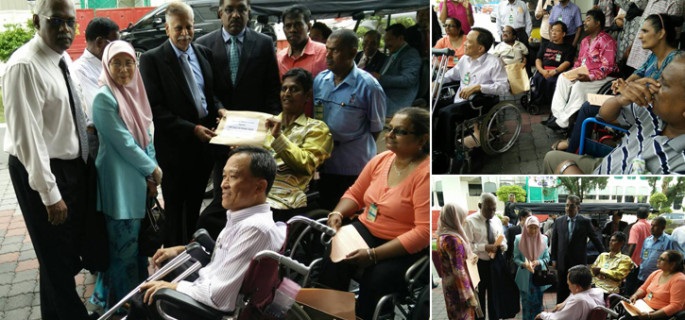
Badan Latihan dan Hidup Berdikari Malaysia (ILTC) pada 23hb Mac 2016 menyerahkan memorandum kepada ahli-ahli parlimen mendesak supaya golongan orang kurang upaya (OKU) dikecualikan daripada cukai barangan dan perkhidmatan (GST).

Disabled Members Protest

Disabled Members Protest
Disabled Members Protest at JPJ Wangsa Maju

ILTC Malaysia members staged a protest outside JPJ Wangsamaju KL.

ILTC Malaysia members staged a protest outside JPJ Wangsamaju KL.
Disabled group’s protest disabled drivers required to produce doc's medical report.

Thursday, 3 May 2012

Terrific tales

Thursday May 3, 2012

Terrific tales

WHEEL POWER by ANTHONY THANASAYAN


Dogs provide the best sort of therapy for those in need.
THERE is plenty of laughter and happiness nowadays in one of the most popular disabled training outfits in Rawang, Selangor, called the Independent Living and Training Centre (ILTC). And it is no secret as to who is creating the smiles. It’s the latest “member” to join in the self-help disabled organisation situated in the quiet neighbourhood of Taman Garing. It’s not a disabled person – but a dog.
Meet Toto, a bright and spunky three-month-old mongrel, which was rescued recently from the streets in Petaling Jaya.
Toto-lly lovable: Gurdip Kaur with her new canine companion, Toto.
“When Toto came into our lives a couple of months ago, it was like a dream come true not only for my husband and I, but for all of the half dozen physically-disabled residents in our home,” says Gurdip Kaur, better known as Rina, who serves as secretary to the ILTC.
“Toto has brought back all the fond memories of our previous service dog, Dusty, the Golden Retriever who died two years ago,” explained Rina, who has been using a wheelchair for nearly two decades.
Rina spotted a picture of Toto on a dog adoption list on the Internet and immediately fell in love with the pup.
She wasted no time in getting her tetraplegic husband, Francis Siva, who has been paralysed for 25 years, to drive from Rawang to Subang Jaya, to bring Toto safely back to his new home.
Today, there is no part of ILTC that Toto doesn’t light up each time the furry little creature enters a room.
Toto loves all the residents. Their wheelchairs and walking sticks are no obstacles to him getting close enough to give them a “happy new day” lick on their hands or faces.
“It was so exciting to go shopping for Toto to get his food and proper utensils that go along with it,” Rina recalls.
“It sure beats just sitting around and thinking about our disabilities and our problems,” she adds.
However, the part that Rina enjoys the most is how the marvellous mongrel has bonded with her so quickly. Toto loves to cuddle up with the couple in bed before he retires to his own crate for the night in their bedroom.
Toto also relishes his baths because he knows he has to “look good” to welcome visitors to the centre.
Toto never leaves Rina alone for one minute. He follows her wheelchair everywhere and even loves sleeping under it at every opportunity.
Both Siva and Rina reveal they have been ever so happy since Toto came into their lives.
“Our little boy just gives us the ‘oomph’ to carry on with each day.”
The young puppy will soon be enrolling with the Malaysian Animal-Assisted Therapy for the Disabled and Elderly Association to become a therapy/service dog graduate for its loving guardians. And that will be another tale to tell for another day.
Meanwhile, Zhar, my latest service canine candidate, turned 15 months old a few weeks ago. This is the ideal age to start intensive training and the Doberman has been passing with flying colours.
His ability to pick up a variety of objects and bring them to me has even surpassed that of my previous Golden Retriever which died last year of old age.
The young Dobie refuses to sit still. Whether it is in the bedroom or the bathroom, Zhar is ever-ready to serve. And the tailless wonder is a great help during car rides, too.
Zhar is the perfect four-legged assistant to leap out from the backseat to the front and get to objects from hard-to-reach places in the car.
Last week, the incredibly large Doberman managed to contort his body in order to retrieve a mineral water bottle that had strayed into the corner end of the floor of the passenger seat.
He can also pick up anything, from two-litre water bottles to delicate items such as combs, coins and business cards from the floor and bring them over to me.
However, the part that is most helpful about my Doberman-assistant is his patience when it comes to my wheelchair – which even puts some human helpers to shame.
Zhar will sit like a rock by my side when I do transfers, for example, getting from my bed to my wheelchair and in and out of my car.
It’s as if he perfectly understands these critical moments of my life; and should I ever fall, I would be able to break my fall thanks to him, and escape injury.
No one could ask for a better friend in life, not with a completely caring canine companion, like Zhar, to help me along.

Thursday, 26 April 2012

Disabled drivers who endanger themselves


23 April 2012 | last updated at 10:25pm
Disabled drivers who endanger themselves
By EStung


IS there a speed limit for disabled persons riding modified motorcycles? I am asking this because of what I saw on the Middle Ring Road recently while I was on the way to Sri Damansara from Batu Caves.

I was driving at 70kph on the elevated highway when a disabled motorcyclist overtook me on the two-lane road.

I doubt the chap, who was riding a modified cub with a rear three-wheel set-up, was aware of the speed at which he was going. He must have been travelling at no less than 90kph before he disappeared into the distance.

The incident was not the first time I had seen a disabled motorcyclist throwing caution to the wind.

Some months back, I saw one  who was following a train of bikers riding up the road shoulders to avoid the traffic jam on the road.

The fact the disabled biker almost lost control of his machine when one of his rear wheels slipped did not appear to frighten him, as he tried to maintain balance on what I thought was a narrow ledge for the modified bike.   

Another encounter I had was near Sentul Pasar one morning. A makcik with a disability was riding a special motorcycle with a signboard mounted in the rear. The signboard that  read orang kurang upaya (or OKU referring to person with disability) was written in a font large enough to be legible from at least 10m.

I thought that was how all bikes for the disabled should be set up. Seeing the makcik riding slowly on the left lane, I also thought that she was a fine example for other disabled bikers to emulate until I noticed that she was not even wearing a helmet. The only covering on her head was a red headscarf.

The traffic policeman, who was busy manning traffic at a zebra crossing there, must have missed it or he would have given her a summons for riding without a helmet.

Once, while travelling from Malacca to Kuala Lumpur along the North-South Expressway, I found myself behind a very slow moving MPV. I thought the driver must have been catching forty winks when I noticed the OKU  sticker on the rear windscreen.

But as I was overtaking the MPV, I saw a middle-aged man driving with one hand on the steering wheel and the other, a mobile phone. He was either surfing the Net or he was trying to text someone. When he saw me staring at him, he didn't look surprised, and he continued with what he was doing.

I get angry whenever I see able-bodied motorists depriving the disabled of the OKU parking lots or when they do not give way to the latter when on the road. But when  disabled bikers or motorists  do not show concern for their safety or that of others  by riding or driving recklessly, it drives me up the wall.

Tuesday, 10 April 2012

More disabled-friendly facilities needed

Tuesday April 10, 2012


More disabled-friendly facilities needed


KOTA KINABALU: A recent nationwide audit conducted by the International Islamic University Malaysia on public amenities found that only a quarter of the facilities met the standards required for handicapped people.
Deputy Dean (Postgraduate, Research and Development) Prof Dr Asiah Abdul Rahim said the university conducted 16 case studies throughout the country and found only four with the required standards.
The facilities for the handicapped in the other cases were found to be below par, she told reporters after opening a workshop on Universal Design in Building Environment at the Kota Kinabalu City Hall.
“We hope all local councils and authorities will give priority to disabled-friendly facilities in their development plans,” she said.
The audit, conducted together with the Department of Standards Malaysia, covered such places as the Malacca Museum and the waterfronts in Kota Kinabalu, Kuching, Danga Bay Johor and Kuantan.
The audit team also studied the facilities at Berjaya Times Square, the Bukit Bintang pedestrian walk, the Penang and Bandar Tasik Selatan train terminals, a housing estate in Seremban and Persiaran Perdana Putrajaya.
She said the study not only looked at the basic infrastructure available but also the access to government services for handicapped people.

Toilets for disabled outdated and abused


Toilets for disabled outdated and abused

KUALA LUMPUR: The public toilets for the disabled are built according to the standards set by the Standards and Industrial Research Institute of Malaysia (Sirim) -- which are outdated.

"Sirim did not involve a wide group of the disabled therefore they couldn't fully understand our different needs," said Malaysian Animal-Assisted Therapy for the Disabled and Elderly Association (Petpositive) president Anthony Thanasayan.

He explained that a person on crutches does not need as much space as a person on a wheelchair or a blind person does.

Although they are able to use the normal toilets, they still need Braille signs to know where the toilet papers and water taps are.

The Petaling Jaya Municipal Council has drafted a guideline to give better public toilet service to the disabled community.

Anthony was also disappointed at how the able-bodied  abused the toilets for the disabled by turning them into smoking and storage rooms.

"There are even shoe prints on the toilet seats. How can that possibly be made by a disabled person?" he said.

Thursday, 29 March 2012

Devigi dreams of a decent home for her disabled children

Thursday March 29, 2012


Devigi dreams of a decent home for her disabled children

By A. LETCHUMANAN 
letchu@thestar.com.my

Lending a helping hand: Mohan speaking to Abby (second from left), Meghala and Devigi at their home in Banting.

BANTING: All supermum S. Devigi wants is a decent home for her three children who have muscular dystrophy.
Devigi fears that her family will have to vacate their dilapidated house at the JKR quarters in Sungai Manggis soon.
“Living in this house is a nightmare; water leaks at several places whenever there is a downpour and we also fear snakes entering our home,” she said.
“We would be grateful if good Samaritans can help us achieve our dream.”
Devigi's children Nyanamambiga @ Abby, 27, Meghala, 26, and Gopi, 24, and her husband V. Ugjayan have muscular dystrophy, a condition that causes the muscles to become progressively weak.
Depending on Ugjayan's salary as a driver in a utility company and assistance from the welfare department, the couple have a tough time ensuring there was enough food for the family daily.
“We don't have savings. Sometimes, we have to beg our relatives and friends to get through the day,” she said, adding that her former employer Paul Rajendran had also assisted them.
MIC Youth chief T. Mohan, who visited the family here on Tuesday, had pledged to help the family move into a new home.
“They have a small plot of land inherited from their grandfather and we will collect money for a home which is disabled-friendly,” he said.
“We will talk to a few developers to help build the house,” Mohan said, adding that the estimate was about RM150,000.
He said Paul and his wife Stella, together with Devigi, would manage the account.
Those who want to contribute can send cheques in S. Devigi's name to 12, Jalan PBP 5, Taman Perindustrian Pusat Bandar Puchong, 47100, Puchong, Selangor, or bank in to Banting Maybank current account 562058051642.
For information, contact Paul at 012-229 4518 or K. Kesavan at 012-355 4104.

Supermum needs a home

Monday March 26, 2012

Supermum needs a home

By A. LETCHUMANAN 
letchu@thestar.com.my

BANTING: S. Devigi is a supermum.

Not only is she bringing up three children diagnosed with muscular dystrophy, she is also taking care of her brother-in-law, who suffers from the same disease.
Muscular dystrophy is a condition where muscles become progressively weak.
Undaunted, Devigi is going all out to ensure her children get an education.
Beating the odds: Devigi lifting Meghala from a wheelchair at their home at Sungai Maggis in Banting, Klang. Looking on are Abby and Gopi (in white).
A few years ago, it was a familiar sight when the 53-year-old housewife put the three children on separate wheelchairs and pushed them to their primary and secondary schools in Banting.
Devigi married V. Ugjayan, 52, a close relative in the early 1980s and gave birth to a daughter Nyanamambiga @Abby in 1985 followed by Meghala in 1987 and Gopi in 1988.
“The children were healthy when they were born but after a few years, they came down with the disease,” she said.
Devigi added that she had spent lots of money on mediums as well as consultants in hospitals.
Life is a struggle for the couple.
With only her husband's salary as a driver in a utility company and assistance from the welfare department, they are having a tough time ensuring that there is enough food on the table.
Her husband underwent a heart operation and has been assigned to light duties while Devigi suffers from swollen legs making it difficult for her to carry the children to the bathroom.
Abby, who has completed her SPM, is pursuing her further studies as well as helping out in a language institute while her brother gets an allowance working in a Banting temple.
Meghala does graphic design work at home.
Their financial difficulties aside, the family one of the very few still living in a dilapidated PWD quarters in Sungai Manggis have received notices to vacate but have nowhere to go.
“We hope a good Samaritan will help us find suitable shelter,” Devigi said.
Devigi's former employers Paul and Stella Rajendran came to the family's aid recently when Gopi's motorised wheelchair broke down.
“I looked after their children when they were young but now, they have been helping mine. I am indebted to them,” Devigi said.
Paul and Stella sought help from the Taman Tun Dr Ismail Kristis Aman Church which undertook a donation drive and collected RM5,500 to buy a motorised wheelchair, which was presented to Gopi last week.
The couple also bought a toilet wheelchair which was a requirement for the three children.

Monday, 19 March 2012

OKU MBPJ Councillor - Yam Comments Part 7

OKU MBPJ Councillor - Gurdip Comments Part 6

OKU MBPJ Councillor - Pam Comments Part 5

OKU MBPJ Councillor - Raj Comments Part 4

OKU MBPJ Councillor - Jeffrey Comments Part 3

OKU MBPJ Councillor - Shirley Comments Part 2

OKU Councillor - Press Conference at SUK Part-1

Disabled want representative in councils

Disabled want representative in councils

Published: Fri, 16 Mar 2012

SHAH ALAM: Members from four associations for the disabled are calling on Selangor to ensure the handicapped are represented in all 12 local governments to ensure their needs are looked after.

The groups want at least one disabled councillor to be appointed to sit on Infrastructure Technical committees and One Stop Centres at each local authority.

“On the issue of building disabled-friendly amenities, it’s not enough to engage handicapped groups for advice. We want our own to sit on the committees,” said Independent Living and Training Centre (ILTC) president Francis Siva.
(From left): Chong, Phang, Francis and Rina say that Selangor should appoint more disabled individuals as local government councillors.

He said disabled persons could better represent the handicapped community as councillors by planning and approving projects that give better access for people with mobility issues.
Chong Tuck Meng, 50, said only disabled councillors understood the need to design and construct public buildings from scratch to cater to the deaf, blind or people on wheelchairs.

Chong, who leads a spinal cord injury rehabilitation group in Kuala Lumpur, said the Federal and state governments could not ignore the rights of the disabled.

“We want the handicapped to be able to access public areas such as shopping malls, tourist attractions and even parks and forest reserves,” he said, during a press conference calling for the reinstatement of Petaling Jaya (MBPJ) councillor Anthony Thanasayan.

His status is in limbo after his extension was put on hold.

Last week, MBPJ called off the swearing-in ceremony at the eleventh hour citing technical grounds for the postponement.

Meanwhile, former Selayang municipal councillor (MPS) Rina Kaur, 50, said all local governments in the state should adopt a move to have at least one disabled person serving as a councillor.

The wheelchair-bound non-governmental organisation leader served Selayang from 2009 to 2011 but did not get her term extended after that.

“I could have done more to get parts of Selayang disabled-friendly with the right kind of access ramps installed at public areas,” she said.

Friends of Kota Damansara (FOKD) co-chairman Jeffrey Phang concurs that disabled councillors should have their terms extended, especially if their performance has been “good”.

“Don’t undermine the momentum by replacing disabled councillors if they are performing.”

He said a local recreational attraction here at Kota Damansara Community Forest was more disabled-friendly and accessible due to the efforts of the handicapped community working with MBPJ on the matter.

Phang cited Anthony for making the recreational park more accessible to disabled travellers and lauded the councillor’s efforts.

He agreed with the others that the state should keep Anthony’s appointment as MBPJ councillor.

They later handed over a memorandum to Menteri Besar Tan Sri Khalid Ibrahim’s office as well as state executive councillor for local government, Ronnie Liu.

Wednesday, 14 March 2012

Show of support for disabled councillor


IN DEFENCE: NGOs say Anthony Sivabalan Thanasayan has contributed to the welfare of the disabled
Francis Siva
Francis Siva (seated, fourth from left) and other NGO representatives at the Selangor state government office in Shah Alam. Pic by Azhar Ramli

SHAH ALAM: A GROUP of non-governmental organisations and residents' associations are urging the state government to reappoint Anthony Sivabalan Thanasayan as a Petaling Jaya   councillor.  

Independent Living and Training Centre president Francis Siva, who represented the group, submitted a memorandum  in support of the disabled councillor  to the state authorities on Monday.

 He handed the letter to  state government media officer Tuan Nazuri Tuan Ismail  as Menteri Besar Tan Sri Abdul Khalid Ibrahim was in Parliament.

Nazuri said he would forward the letter to the MB's office.

 "We appeal to the state government to reinstate Anthony and not to give in to  parties who want him out, based on the councillor's experience and contribution to the disabled community,  in PJ and Selangor.

 "Let him serve for another term and finish what he  started, before deciding on his future," he added.

 He said the fact that the PJ City Council had won special awards for disabled-friendly facilities from the Housing and Local Government Ministry and the state government  was an indication of the weight of Anthony's contribution.

  The letter was endorsed the Independent Living and Training Centre, Malaysian Animal-Assisted Therapy for the Disabled and Elderly Association, Persatuan Warga Istimewa & Rehabilitasi Anggota K9, Hospital Kuala Lumpur, Perwira K9 Malaysia, Community Services for the Deaf, Dyslexia Association of Malaysia and other NGOs.

 Also present were centre secretary Gurdip Kaur, Malaysian Association for the Blind's Cyber Club chairman Yam Tong Woo, Section 6 Rukun Tetangga chairman Rajesh Mansukhlal, animal activist Pamela Lim and Friends of Kota Damansara chairman Jeffrey Phang.

 This  follows a protest last week by a group who said the wheelchair-bound Anthony was not fit to be a councillor.

 It was reported that the swearing-in of PJ councillors was postponed as there was disagreement over the list of candidates.

 Sources said the postponement was due to the retraction of three names -- Anthony, Harmony Ghani Ismail and Tang Fuie Koh.

 "The Petaling Jaya City Council has yet to receive a directive on the matter.

"It will hold its swearing-in ceremony once everything is sorted out," said the source.

 Two NGOs, Warga OKU PJ and Malaysian Dogs Deserve Better, had protested against Anthony's reappointment.

They claimed that he had "discredited their efforts for animal welfare and that he had interfered in canine welfare advocacy work, propagation of euthanasia and attempts of commercialising dog catching in Selangor".


Read more: Show of support for disabled councillor - Central - New Straits Times http://www.nst.com.my/streets/central/show-of-support-for-disabled-councillor-1.60396#ixzz1p5l97tca

Tuesday, 13 March 2012

Pahang To Increase Monthly Allowance For OKUs


March 13, 2012 16:16 PM

Pahang To Increase Monthly Allowance For OKUs

TEMERLOH, March 13 (Bernama) -- The Pahang government has agreed to increase the monthly allowance RM70 per month given to 4,000 Persons With Disabilities (OKUs) to RM300.

Pahang Menteri Besar Datuk Seri Adnan Yaakob said with the assistance could help them cope with the higher cost of living.

He told this to reporters after opening Pahang's OKU Day celebration, which was attended by more than 2,000 OKUs at Tun Abdul Razak Hall, here today.

Adnan said the new payment was expected to be made in April or May together with the arrears, which would be calculated from January.

He said, however, the payments would only be given to OKUd who were really not able to do any job.

-- BERNAMA

Keep disabled man as PJ councillor, S'gor urged


Keep Thanasayan As MBPJ Councillor Says Strongman Chong
 
Koh Jun Lin
11:21AM Mar 13, 2012

Keep disabled man as PJ councillor, S'gor urged

Five NGOs involved in the welfare of disabled people have handed over a memorandum to the Selangor government in support of embattled Petaling Jaya city councillor Anthony Siva Balan Thanasayan.

The delegation of about 20 arrived at the state government headquarters in Shah Alam about 11am yesterday to submit the memorandum to Menteri Besar Khalid Ibrahim and the exco member in charge of local government Ronnie Liu.

Persatuan Warga Istimewa dan Rehabilitasi Anggota K9 (Perwira K9) founding chairperson Chong Tuck Meng told Malaysiakini the memo, among others, calls for Anthony to be allowed to continue his work for disabled people.

“He is doing a very good and professional job in areas such as accessibility issues at car parks and toilets for wheelchair-bound persons. He dares to challenge other councillors to make things right,” Chong said.

Other groups present were the Dyslexia Association of Malaysia, Malaysian Animal-assisted Therapy for the Disabled and Elderly Association (Petpositive), Community Services for the Deaf and Independent Living and Training Centre.

Petition against Anthony

The memo also calls on the state to form a ‘technical committee for the disabled’ and to ensure that disabled persons are represented in local councils, including those other than the Petaling Jaya City Council (MBPJ).

“They are the ones who know what to expect, what to change and what to modify to suit our needs,” said Chong.

English daily New Straits Times reported last Thursday that two NGOs, one for disabled persons and the other for animal welfare, were opposing Anthony’s reappointment as MBPJ councillor.

It quoted Warga OKU PJ vice-president Azlan Elias as saying that Anthony had failed in his duty because few places in Petaling Jaya have facilities for the disabled, while a Malaysian Dogs Deserve Better spokesperson complained that he interfered with their animal welfare efforts.

The second group is also collecting signatures against Anthony, garnering 1,254 signatures as of 7.15pm yesterday.

End or article

Meanwhile, here is the memo that was sent to the Menteri Besar:

MEMORANDUM

Y.A.B. TAN SRI DATO` ABD KHALID BIN IBRAHIM
DATO` MENTERI BESAR SELANGOR
PEJABAT DATO` MENTERI BESAR SELANGOR
TINGKAT 21, BANGUNAN SSAAS
40503 SHAH ALAM
SELANGOR DARUL EHSAN

Y.B. TUAN RONNIE LIU TIAN KHIEW
 PENGERUSI JAWATANKUASA TETAP KERAJAAN TEMPATAN, KAJIAN DAN PENYELIDIKAN
PEJABAT AHLI MAJLIS MESYUARAT KERAJAAN NEGERI SELANGOR
TINGKAT 15, BANGUNAN SSAAS
40503 SHAH ALAM
SELANGOR DARUL EHSAN

We, representatives of nationally registered societies for the disabled in the country are alarmed and dismayed by the recent attempts by some quarter’s criticism to try and stop Anthony Siva Balan Thanasayan from becoming councillor of the city of Petaling Jaya.

Thanasayan had already been selected to serve the 2012/2013 term and we deeply regret that the personal attacks by a disgruntled few have resulted in his delay in being appointed as councillor.

As such, we would like to strongly urge the Menteri Besar not to be influenced by the baseless allegations made by the some individuals.

Rather we would like Tan Sri Khalid to immediately reappoint Thanasayan as councillor as planned and judge him by his impeccable performance. 

Thanasayan was responsible to bring not one, but two outstanding OKU awards for MBPJ during his tenure.

The first one is called Anugerah Khas Kemudahan OKU 2009/2010 untuk Anugerah Alam Sekitar Bandar Lestari Anjuran KPKT. The second one is Anugerah Khas Kemudahan OKU 2010/2011 Anjuran SUK.

In addition to that, we want Thanasayan back for the following key reasons:

  • To complete all the projects and programmes that Thanasayan pioneered for the benefit for people with disabilities and the elderly in Petaling Jaya. These include never before covered car parks for the handicapped, outreach programmes to renovate toilets and living conditions for the disabled and elderly in poorer parts of PJ such as Taman Medan and PPR flats in Kota Damansara.
  • Thanasayan also pioneered the State to set up disability committees in all 12 of its councils. Thanasayan was assigned with his special committee by YB Ronnie Liu to follow up with each councils with visits and support to ensure that the special committees are up and running. The setting up of such committees in each PBT is vital to ensure that the needs of the disabled especially in accessibility is met.
  • Thanasayan has also been working with a broad group of people with disabilities – not only with people in wheelchairs but the blind, Deaf, little people, people with stroke, Parkinson’s disease, epilepsy and even people with mental illness.
  • We urge the Selangor State Government to appoint more disabled councillors in the PBT’s. The disabled communities hereby would like to highlight there are no new disabled councillors appointed for the new term’s.      

The abovementioned statement is endorsed by:

  1. Independent Living and Training Centre Malaysia
  2. Malaysian Animal-Assisted Therapy for the Disabled and Elderly Association (Petpositive) 
  3. Persatuan Warga Istimewa & Rehabilitasi Anggota K9, Hospital Kuala Lumpur, Perwira K9 Malaysia
  4. Community Services for the Deaf
  5. Dyslexia Association of Malaysia
  6. Friends of Kota Damansara.

Thursday, 8 March 2012

A chance to be heard


Thursday March 8, 2012

A chance to be heard

 The disabled want greater accessibility and job opportunities, not pity.
MORE than 10,000 people, including the disabled, had a great time when they gathered at the Putra Stadium in Bukit Jalil, Kuala Lumpur, last Sunday.
They were there at a function to meet Prime Minister Datuk Seri Najib Tun Razak and Women, Family and Community Development Minister Datuk Seri Shahrizat Abdul Jalil.
Representatives from as many as 1,000 NGOs turned up at the gathering under the 1Malaysia people’s welfare programme (KAR1SMA).
Shahrizat gave each one of them a rousing tribute, saying that “without (your untiring work), we would be nowhere”.
On his part, the Prime Minister pointed out the need to reach out to every disabled person.
“Persons with disabilities do not want our pity; they deserve equal opportunities instead and we must give them that,” Najib said.
Several NGOs were given an opportunity to make their requests directly to the Prime Minister. Organisations that work with people with disabilities asked for greater accessibility, jobs to help them eke out a living, and representation of their issues in Parliament.
There were, however, some glitches at the event which I hope the organisers will look into for future programmes.
Only one lift was in working order in the stadium. This resulted in “traffic jams” for wheelchairs, especially during breaks. Not every wheelchair-user had assistance during mealtimes. We were put in the awkward position of asking the waiters for help.
On another note, the Faculty of Creative Multimedia at the Multimedia University (MMU) in Cyberjaya put together an interesting talk last Friday.
Prof Julio Abascal, an accessibility expert from Spain, spoke on “Universal accessibility to ubiquitous services: Supporting the everyday life of people with restrictions.”
Blind activist Yam Tong Woo, 58, e-mailed me his views on the event.
“All my blind friends and those in wheelchairs who attended the talk agreed it was one of the best sessions we have been to in recent times. We all listened in rapt attention as Prof Abascal disclosed how advances in Internet technology and computer software are revolutionising the lives of the disabled and elderly citizens in Europe.
“He pointed out how ubiquitous computing can help vulnerable people stay safe by providing useful information for their specific needs, whether it is at home, in the office or in the streets.”
According to Prof Abascal, elderly people who live alone can now be better monitored at home through computer technology and interfaces.
“Such information is vital in community nursing homes and independent living centres for the severely handicapped.
“Special devises and sensors to detect movements and other activities, can help monitor the safety and health of the individual. Say, if an elderly person slips in the bathroom or elsewhere and sustains a fall, an alert would be triggered within seconds to a medical control centre that will send help immediately.”
Prof Abascal gave an interesting insight into ways in which ubiquitous computering can enhance accessibility for the disabled and the elderly.
“A mobile device could be linked via interface to an Automated Teller Machine (ATM) kiosk ito revolutionise how disabled people manage their banking transactions. Those who would benefit from this technology are the blind, little people and wheelchair users.”
Out of bounds
Yam notes that it is a shame that in Malaysia, ATM kiosks remain out of bounds to the blind community.
“ATMs are not user-friendly for the visually impaired. Worse still, local banks do not allow us to own ATM cards; overseas countries have no problems with such issues.
“Prof Abascal showed us how a universal remote device that could enable disabled persons to be more independent – whether indoors or outdoors – is currently undergoing prototype testing.
“A wheelchair-user or the visually impaired could, for example, use the mobile device to operate the lift’s control panel, switch on the lights, or turn on electrical and electronic appliances and gadgets.
Prof Abascal reminded everyone that accessibility was an issue which would become of increasing concern in an ageing population, added Yam.
On a final note, it is regretful that MMU’s toilet for the disabled was out of order.
The management should make it a point to keep the toilet in working condition throughout the year.