NEW MINISTER FOR WELFARE MINISTER OF MALAYSIA

NEW MINISTER FOR WELFARE MINISTER OF MALAYSIA
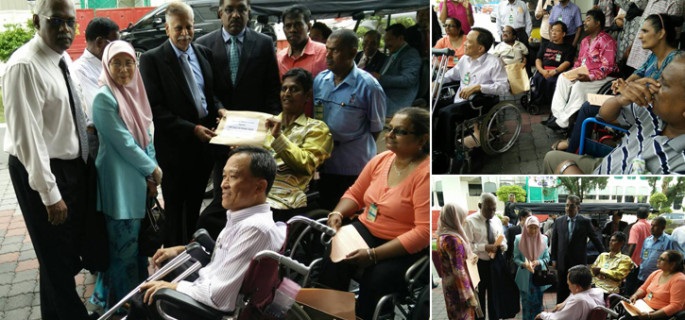
Badan Latihan dan Hidup Berdikari Malaysia (ILTC) pada 23hb Mac 2016 menyerahkan memorandum kepada ahli-ahli parlimen mendesak supaya golongan orang kurang upaya (OKU) dikecualikan daripada cukai barangan dan perkhidmatan (GST).

Disabled Members Protest

Disabled Members Protest
Disabled Members Protest at JPJ Wangsa Maju

ILTC Malaysia members staged a protest outside JPJ Wangsamaju KL.

ILTC Malaysia members staged a protest outside JPJ Wangsamaju KL.
Disabled group’s protest disabled drivers required to produce doc's medical report.

Saturday, 10 January 2015

Lembah Pantai Hindu youth give needy kids and the disabled a treat

Community

Published: Saturday January 10, 2015 MYT 12:00:00 AM
Updated: Saturday January 10, 2015 MYT 8:32:55 AM

Lembah Pantai Hindu youth give needy kids and the disabled a treat

Vibrant dance: College students giving a lively performance depicting unity
 
PEALS of laughter and screams of joy reverberated inside the Girl Guides hall in Brickfields recently. The annual event, called Towards a Caring 1Malaysia Welfare Programme, was organised by the Lembah Pantai Hindu Youth Organisation with the help of volunteers.
It was heartening to see 600 people, mostly children and the disabled, laughing, clapping and singing along to the songs that were being performed by orphans and undergraduates from Universiti Teknologi Petronas and several other colleges.
The event, in its 13th year, was a resounding success, even though it was the first year without the presence of the founder.
“The founder of the welfare programme, the late A. Subramaniam, passed away last year from a heart attack,” said his son, Vinayagamurthi Subramaniam.
“My father died the day after chairing a meeting to organise today’s event. Had he been alive, it would have been his 13th year at the helm of the charitable event,” Vinayagamurthi said.
“But the show must go on as they say, and my father would be proud that his good work will continue in years to come,” he added proudly.
Indeed, the late Subramaniam would be proud to know that his son and a group of volunteers are determined to carry on with the noble tradition.
According to Vinayagamurthi, his father came from a humble background and struggled to work and care for his family at a young age.
“He was only a technician with TNB, but that did not stop him from helping the poor and needy. He was always thankful for his little blessings and always vowed that despite his humble background, he would continue to help those in need,” he said.
“It was his idea to organise a welfare programme comprising children from poor families, orphans from homes, old folks and the disabled; to bring them together, treat them to good food, gifts and ang pow and we will continue to do so,” Vinayagamurti said.
“Apart from providing the homes with essential necessities and giving everyone a good time today, our volunteers are also here to assist the older folk and the disabled with services like taking them to the bathroom and serving them food. It is what my father always preached; ‘Service to man is service to God’,” he added.
Among the homes that were invited were Anbu Illam, Karunai Illam, Independent Living and Training Centre, and the Malaysian Association for the Blind.
The guest of honour at the event was Senator K. Bathmavathi.

Thursday, 8 January 2015

Not Alone in MD Struggle -Anthony Thanasayan

Not Alone in MD Struggle -Anthony Thanasayan

Anthony-ThanasayanMuscular Dystrophy or MD is a serious disease.
A person who has the condition experiences his or her muscles becoming weaker over time, until their ability to walk is no longer possible.
Aquila Dass, 18, has MD.
He was born in Kajang, in the state of Selangor.

He has an older brother and sister in their 30s. They don't have the disease.
Aquila's father, however, had muscular dystrophy. He died approximately six months after Aquila was born.
He was also a wheelchair user.
Aquila grew up pretty much as a normal child, until it became obvious that he was different.
Whilst most babies begin to take their first steps within the first year.
Aquila, however, stuck to crawling around for the first few years.
It wasn't until he was four years old, when he took his first step.
Unlike other toddlers, Aquila had to hold on to objects for dear life.
These included stools and chairs to keep from falling down and maintaining his balance - something he kept on doing as a child growing up.
Aquila had to learn to be very careful in his walking. One slight bump into someone (or from someone), would end up with a fall - something he was used to happening over the years.
By 11-years of age, Aquila discovered that his muscles got weaker and weaker. It was difficult to carry his schoolbag, either with his hands or as a backpack on his shoulders.
He had to also start holding on to his classmates and friends in order to remain on his feet.
Three months before his 12th birthday, Aquila's legs finally gave up on him - leaving him unable to walk; and terribly afraid.
"It was like my best friends (my legs) had deserted me," Aquila told me in a telephone interview, last week.
"Being different at home wasn't so bad," he added. "But not being the same like the other kids in school was pretty embarrassing and weird."
Aquila went on to tell me how he was stared at by his schoolmates and treated differently which he didn't like.
He was also depressed, in particular, that he could not take part in athletic sport.
"Just sitting down and watching all the other kids running around and having a good time with each other was no fun at all. I asked God every night to make me like them, that is, to be able to walk again."
Aquila related to me an incident when he got hurt in school one day that put him in a plaster cast for a month.
A fight broke out with a couple of the boys outside the classroom. Aquila who was walking past them was accidentally pushed into a drain.
He sustained a fracture.
Aquila was helped out of the drain by his teacher and schoolmates and made to rest in the canteen, until his brother arrived to take him home.
When his mother returned home after work, she broke down in tears.
It was then, Aquila told me, that he realised how serious his disability was, and that he was not like the rest of the other children.
And he also knew that it wasn't about to go away very soon.
Things then changed very much for the boy from there.
After recuperating at home with his cast, things only became harder and harder for Aquila.
Instead of taking pains to make the school disabled friendly for their handicapped student, the authorities shooed the boy to another school further from his home, saying they couldn't deal with a disabled child.
But transport became more difficult and complicated for Aquila.
Then, the inevitable occurred.
Aquila began losing interest in his studies and motivation in life.
He became glued to the television all day until he was introduced to a local church near his home.
Aquila said he loves going there because he is treated normally by the members. Instead of being stuck at home, he enjoys taking part in the singing and youth activities of the church.
However, things only really started to change for the positive when Aquila enrolled himself in a centre for disabled persons in Rawang, Selangor.
Called the Independent Living and Training Centre Malaysia (ILTC), it is run by trainers with disabilities who help other handicapped persons with living skills and confidence building.
Aquila who has been living at the ILTC since March of last year, said he has learnt much by living with more senior persons with disabilities.
"I have now learnt some computer skills, typing and email. I have also made some new friends on Facebook; which I didn't have the opportunity to do so before," he said, beaming from ear to ear.
"Part of my responsibility is to help around in the office answering calls, making appointments and being in charge when our centre's president and secretary - both in wheelchairs - have to attend to outside matters.
"Being here, I've found people who share the same difficulties and pain which I go through but the difference is, I am happy to know that I am not alone in my struggles."

The aNt

Thursday, 11 December 2014

A long, long road to go for the disabled -Anthony Thanasayan

A long, long road to go for the disabled -Anthony Thanasayan


Anthony-ThanasayanLast week, more than one billion of the world's population of disabled people - now billed as the largest minority group in every society of the globe - celebrated 'International Day of Persons with Disabilities' (IDPD).
This was on December 3.

Two major local events were held during the same time, in conjunction with the international occasion.
They left us as disability advocates with plenty to think about, when they were over.
Especially so, in the area of improvements and priorities, when someone decides to organise an event involving disabled persons.
Here are the "high and low" points of both occasions - followed by what can - and should - be done in future, for improvement purposes:    
1) IDPD Celebration organised (amongst others) by the National Welfare Department (JKM) and the Seremban Municipal Council of Negeri Sembilan (MPSNS).

  • Spreading the IDPD cause outside KL:
This was a most positive effort by JKM. The IDPD message of disabled welfare and rights, badly needs to be heard in every state of the nation - instead of frequently in KL and Selangor alone.
Kudos to JKM for holding the event in the MPSNS. This will certainly inspire the municipality there to do more in terms of accessibility for its disabled residents.
It will also likely have a snowballing effect in spreading to other states, so that more disabled people and local councils in the country can be empowered through IDPD's events.
By the way, this is not to say that JKM has never held an IDPD occasion outside Kuala Lumpur. They have.
But the point is they should now start holding many more in every other state, before returning to the capital city.

  • Wheelchair users' needs sidelined:
With more than 2000 people attending the whole day event (the exhibition from 8.30am and the official ceremony in the afternoon,) regretfully, not enough consideration was given to the physically disabled.
At least 10 members of the Independent Living and Training Centre, Malaysia (ILTC) from Rawang, Selangor, who came in wheelchairs and with walking difficulties, complained about it.
They said that unlike for VIPs, not a single car park was reserved for disabled drivers next to the venue.
In fact, they couldn't find any wheelchair-logo car parks anywhere! So much so that handicapped guests had to park outside the council's hall and compound.
Some had to park their vehicles as far away as a kilometre. From there, they were forced to wheel themselves, up and down steep slopes on the road, to the venue.
When some of them tried to park inside the compound of the council, they were promptly shoed away by the police. This caused unpleasant arguments to erupt - the last thing that anyone would want to experience in a day of celebration.
Inside, they experienced further barriers.
Physically handicapped guests were unable access to all the activities that were going on - simply because their wheelchairs was unable to get near them.
They had no choice but to sit at a restricted corner and watch the events going on in the council's open field. There was no fun in being spectators instead of active participants.
The disabled toilets were at least 500-metres away. There were no designated volunteers to ask for help in pushing their wheelchairs through all the distance.
At least a couple of disabled women even fell off their wheelchairs. This was because of the poorly constructed ramps in the hostile environment.
"It was clear the organisers didn't go all the way to think about our needs. They were obviously more interested in the able-bodied VIPs' convenience, rather then ours," lamented Francis Siva, president of the ILTC.
"How could it be a called a 'celebration' for us when we suffered so much - especially driving all the way that day about 180 kilometres from Rawang to Seremban, and then, having to head back home again?" he added.
"To make matters worse, the disabled senator who uses a wheelchair, was notably not present to witness what was happening on such an important occasion as the IDPD." Siva concluded.
  
2) The Fifth Asia-Pacific Network for Accessible Tourism jointly organised by the Petaling Jaya City Council (MBPJ) and Beautiful Gate Foundation in Selangor.

  • Great part: Definitely, a most worthy event - featuring top global authority speakers on universal designs that include disabled persons in everything. With more than 20 countries participating (UK to Jordan, India, Philippines and more), this was an excellent opportunity for Malaysia to meet, and see, how nations and societies the world over, are rushing and working against time to prepare themselves for the increasing population of elderly persons - who will have one type of disability or another.
It was also a terrific chance for MBPJ - with several international and local awards on disability access and projects behind them (the latest one from Seremban's IDPD 2014 event), to showcase their achievements which they did at ICAT during site visits.
I heard the overseas delegates were pretty impressed with what they saw. Some of them commented that PJ had "outdone" some of the local councils in their own countries, in terms of wheelchair and blind accessibility in parks.

  • Bad part:
Poor crowd, and mostly the wrong audience.
The key persons, such as representatives from the Tourism Board, government officials, local councils, hotels, architects, developers - simply weren't there to take in all the valuable information. They also missed, in particular, finding out about the latest state-of-the-art adaptable designs and facilities used by in other countries.
Their presence was absolutely critical if things are to significantly change in the quality of lives for all disabled persons in the country.
Petaling Jaya was also, perhaps, not the best choice for a pivotal event like this. KL would have been a better venue for far-reaching results.
The audience in the end - other than the international participants - was made up more of local and ordinary disabled persons and able-bodied volunteers, who are not in positions of authority to bring about changes.
One participant observed that it gave a more "day care centre" like event, than anything business-like or professional.
Finally; and curiously, the international delegates of ICAT were brought to a session of a local animal rescue adoption programme that featured a couple of paralysed canines on wheels, purportedly "to celebrate IDPD."
If true, I'm seriously puzzled by this.
What have handicapped dogs got to do with disabled people - other than the obvious fact of trying to get sympathy from the public, in order to fill up the animal NGOs coffers?
Or, is there a new disability-advocacy movement somewhere, which I don't know about, to also champion for "wheelchair access" for dogs with disabilities in airports, train stations, hotels and tourists' spots?
Whatever the case, the painful truth is, human beings who are disabled, have still light years more to go, for ICAT's noble vision to become a reality.
anthony-thanasayan-wheelchair

Anthony-Thanasayan-bottom

Tuesday, 9 December 2014

My Schoolbag programme in Malaysia,

On behalf of all members, I express our sincere thanks and appreciation for your kind contributions of  My Schoolbag programme towards Independent Living & Training Centre Malaysia.

600 underprivileged children in Malaysia to benefit from donation of RM150,000 under My Schoolbag programme Donation funded by CapitaLand Hope Foundation

‘My Schoolbag’ programme were held on 27/11/2014 at Sungei Wang Plaza in Kuala Lumpur.

Under this year’s My Schoolbag programme in Malaysia, CMA and CMMT are working with 31 charity homes – seven in Kuala Lumpur, five in Selangor, nine in Kuantan, nine in Penang and one in Kedah – to help a total of 600 underprivileged children under the homes’ care. These charity homes are mainly shelter homes for orphans as well as abandoned or abused children, and undertake the children’s daily cost of living and provide a better living environment for them.

Accompanied by over 130 staff volunteers, the participating children will visit one of five CapitaMalls nearest to their charity home – namely Sungei Wang Plaza in Kuala Lumpur;

The Mines in Selangor; Gurney Plaza and Queensbay Mall in Penang; and East Coast Mall in Kuantan – where they will be given a new schoolbag containing school and daily necessities such as stationery, school uniforms and school shoes worth a total of RM 250 (about S$97) each.

The children will also be treated to lunch and various performances specially arranged by the malls.


Ranggi Bikers Club Visited ILTC Malaysia on 6/12/2014