NEW MINISTER FOR WELFARE MINISTER OF MALAYSIA

NEW MINISTER FOR WELFARE MINISTER OF MALAYSIA
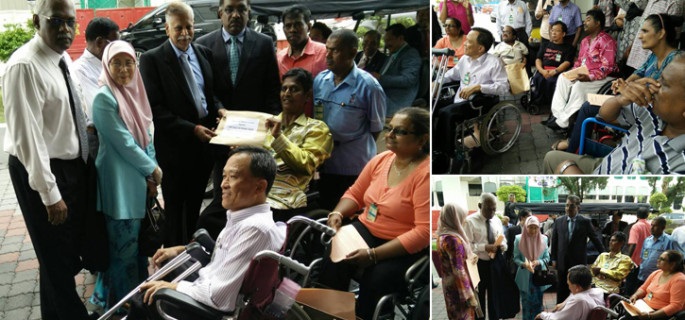
Badan Latihan dan Hidup Berdikari Malaysia (ILTC) pada 23hb Mac 2016 menyerahkan memorandum kepada ahli-ahli parlimen mendesak supaya golongan orang kurang upaya (OKU) dikecualikan daripada cukai barangan dan perkhidmatan (GST).

Disabled Members Protest

Disabled Members Protest
Disabled Members Protest at JPJ Wangsa Maju

ILTC Malaysia members staged a protest outside JPJ Wangsamaju KL.

ILTC Malaysia members staged a protest outside JPJ Wangsamaju KL.
Disabled group’s protest disabled drivers required to produce doc's medical report.

Wednesday, 10 July 2013

6th ILTC Malaysia Committee meeting held 29th June 2013

6th ILTC Malaysia Committee meeting held 29th June 2013 at 76, Jalan Taman Garing 4, Taman Garing,  48000 Rawang, Selangor Darul Ehsan.


Mika Singh Live in Malaysia | 5th July 2013

Awesome Concert - It was a fun filled night.

On behalf of our organization, we would like to Thank you CEO of Hitman Solutions, Rohit Rampal for sponsored 25 Tickets towards watch Mika Singh Live in Malaysia.

We really enjoyed the Mika Singh show.


The ceremonial funeral for Late Mr. Munusamy at the Cheras Lutheran Congregation

The ceremonial funeral for Late Mr. Munusamy at the Cheras Lutheran Congregation at Taman Alam Jaya Cheras which was held on 9/7/2013 (Tuesday) attended by the members of ILTC Malaysia 


Monday, 8 July 2013

CONDOLENCES FROM ILTC MALAYSIA

08/07/2013

CONDOLENCES FROM ILTC MALAYSIA

MR. MUNUSAMY BROUGHT SO MANY HAPPY MOMENTS IN OUR LIFE AND LEFT US WITH A TREASURE TROVE MEMORIES. WE WILL NEVER BE ABLE TO FORGET HIM. WE ARE PRAYING FOR YOU IN DEED DIFFICULT TIME.

WE SEND OUR LOVE AND HEARTFELT SYMPATHY TO MADAM VASANTHY AND HER FAMILY. WE MEMBERS OF ILTC MALAYSIA WOULD LIKE TO EXPRESS OUR DEEPEST CONDOLENCES ON THE DEATH OF MR. MUNUSAMY (COMMITTEE MEMBER OF ILTC MALAYSIA). 

MAY HIS SOUL REST IN PEACE.AMEN

FUNERAL SERVICE FOR THE LATE MR. MUNUSAMY WILL BE HELD AT CHERAS LUTHERAN CONGREGATION ON TUESDAY (09-07-2013) AT 2.00PM.CHURCH ADDRESS:26, JLN. ALAM JAYA 19, TMN. ALAM JAYA. 43200 CHERAS, SELANGOR.

THEN TO CREMATOTION AT CHERAS CREMATORIUM AT 4.PM

G. FRANCIS SIVA
PRESIDENT OF ILTC MALAYSIA

Saturday, 6 July 2013

For and by the disabled

Columnists

Wheel Power

Published: Thursday July 4, 2013 MYT 12:00:00 AM
Updated: Friday July 5, 2013 MYT 12:30:33 PM

For and by the disabled

The Independent Living and Training Centre helps the handicapped feel good about themselves.
THE Independent Living and Training Centre (ILTC) in Taman Garing, Rawang, Selangor, is unique in that it is run by the disabled, for the disabled.
It was set up 13 years ago by a team consisting of tetraplegics (persons paralysed from the neck down) and paraplegics (paralysed from the waist down).
ILTC was formed primarily out of the frustration of the disabled who find that many centres for the disabled are run by able-bodied people who know very little about the needs of the handicapped. Unless one is disabled, it is virtually impossible for someone to understand what a handicapped person’s life is like.
Since its inception, the centre has reached out to more than 200 people. Most of them have walking difficulties or are wheelchair-users.
Many of them came from very poor backgrounds. Most of them were uneducated, neglected by their families and abused.
At the centre, new arrivals are taught to feel good about themselves and their condition.
By meeting and observing other persons with disabilities, they are inspired to take control of their lives, and learn more about their disability and how to deal with it effectively.
ILTC has run a number of self-help programmes which range from acquiring independent living skills to cooking, washing and sewing.
Therapy sessions include peer counselling and animal-assisted therapy.
Recently, some members from ILTC had the opportunity to attend a full-day training session at the Maxis Academy in Subang Jaya, Selangor. The programme was part of a series of sponsored events organised by Maxis when it decided to adopt ILTC under its Maxis Home Adoption Programme a year ago.
More than a dozen wheelchair-users had a delightful time learning how to transfer data, download music and back up their phones.
The participants came from all over the Klang Valley. Maxis provided meals for the eager learners. There was even a portable disabled-friendly toilet.
Maxis also donated two laptops to ILTC.
ILTC is also actively involved in championing the rights of the disabled. In March, disabled persons who had been getting a monthly allowance of RM300 from the Welfare Department, received a rude shock when they went to the bank and discovered that their allowance had been stopped.
Apparently the Welfare Department had stopped all payments as it was in the midst of upgrading the records of all disabled workers.
“I found this out when I met with the director involved last month,” said Francis Siva, president of ILTC.
“The Welfare Department’s latest exercise raised some important issues. It was most unprofessional of the department to keep recipients of aid in the dark. Many of them thought that the payments were delayed. They only heard the news when they called the department and learnt that their allowances had been stopped.
“They were told that they had to fill up a form – JKM Borang 20 – to qualify for financial aid.”
Francis said RM300 may not seem much to people without disabilities but for the handicapped, it makes a world of difference.
“The money goes towards paying for food, medication and wheelchair repairs, among others.”
Francis expressed regret that the Welfare Department had not consulted disabled groups before going ahead with its decision to get the disabled to fill up Borang 20. He said the need to fill up the said form annually from now on, would make the lives of the disabled more difficult.
“At the department’s Kuala Kubu and Gombak offices, for instance, we had to struggle with dangerously steep ramps and there were no disabled-friendly toilets even though we had complained about this three years ago. The department personnel should visit the homes of every welfare recipient to help them fill up the forms. If a record upgrade is necessary, it should be done every five years or so, and not every year,” said Francis, who is a tetraplegic.

Friday, 5 July 2013

The Star Article on 04/07/2013

The Star Article on 04/07/2013

Page 1


Page 2


Tuesday, 2 July 2013

Baik Berita untuk Selangor

Pengurangan Cukai Taksiran 50 Peratus Kepada OKU

20/3/2013 : Kerajaan Negeri bersetuju untuk mengurangkan bayaran cukai taksiran sebanyak 50 peratus kepada Orang Kelainan Upaya (OKU) yang memiliki rumah di seluruh Selangor dan diskaun in berkuatkuasa serta merta.
Pengurangan cukai taksiran itu bertujuan membantu meringankan beban OKU yang perlu berdepan dengan kos sara hidup yang semakin tinggi di Selangor terutamanya di kawasan bandar. Tetapi rumah itu disewakan kepada pihak lain, mereka tidak layak menikmati pengurangan tersebut.

Wednesday, 26 June 2013

Thanks to Maxis

ILTC Malaysia would like to thanks very much to Maxis for installed free wireless Maxis Broadband modem on 25/06/2013 to our charity organization

it is great and making more meaningful help towards our work.


Saturday, 22 June 2013

Service at their doorstep, please

Thursday June 20, 2013


Service at their doorstep, please


‘Special counters should be available to disabled persons, and frontline staff should be trained on how to help persons with special needs,’ suggests Francis Siva.‘Special counters should be available to disabled persons, and frontline staff should be trained on how to help persons with special needs,’ suggests Francis Siva.
The disabled are given the runaround for public services when what they really need is a doorstep service.
DISABLED Malaysians in Selangor were delighted to hear, a fortnight ago, that they now qualify for a 50% discount for assessment taxes in the state. Every disabled person is given the discount for only one property.
Francis Siva, president of self-help group, the Independent Living and Training Centre (ILTC) in Rawang, Selangor, welcomed the move by the authorities.
However, he pointed out that the state could have done better by going all the way and giving a 100% waiver to make it truly worthwhile for the handicapped.
“To do so would not be big money for the government,” says Francis, 54, who was paralysed from his neck down in a road accident almost 30 years ago.
“For the disabled, though, the cut would make a world of difference as not many are able to own houses in the first place,” adds Francis.
“For those that do, it is usually after their parents die and leave their property to them,” Francis explains.
“Most disabled people can’t even afford to rent a house because they are poor. For those who are able to, they come across landlords who flatly refuse them, claiming they will bring them bad luck!”
Some disabled persons are able to place a downpayment for a home from the insurance money they get after they become handicapped though accident or illness.
But they still have to struggle, Francis says, with other expenses related to their disabilities, like purchasing catheters, diapers for urinary problems, wheelchairs, medical beds, medicines and so on.
Francis, who has been working with the disabled poor for more than a decade, also cautions that some things may look good on paper, but when it comes to the real thing of getting it, it’s often another story.
“When working with the disabled, things must be done at their doorstep,” Francis stresses, “and don’t give the handicapped a runaround for services.”
The idea of discounts for the disabled in assessment taxes, he believes, was mooted first in Selayang almost two years ago.
When several disabled persons approached the local government in Gombak, those at the frontline had no clue as to what it was or what they had to do to qualify for it.
“As a result, our disabled members who took the trouble to get there, in spite of all their difficulties, became not only confused but dejected by the whole exercise,” Francis points out.
“This is why we need a doorstep service. It is heartless and downright cruel of the able-bodied to expect people who can’t walk to run around from one department to another just to get information that is supposed to help them and make their lives easier.
“Special counters should be available to disabled persons, and frontline staff should be trained on how to help persons with special needs. Information should also be available on the website, with a hotline to call,” concludes Francis.
DW (who wishes to remain anonymous) became blind in both eyes six years ago. He can’t believe the “torture” he has had to go through to apply for the discount. His application status is still pending since last year.
He first heard about the discount at his local council office when he bumped into a stranger who used a wheelchair. DW and his sighted wife wasted no time in getting the necessary information from the land and property valuation department.
But their frustration began when an officer attended them after a long wait. The couple were quizzed on a myriad of matters and finally given a set of forms to fill in.
DW took pains to complete everything that was required, including a copy of the Sale and Purchase Agreement and forms that needed to be endorsed by a commissioner of oaths or an equivalent.
After having the forms duly stamped and endorsed at a fee, DW and his wife drove straight to the local council to personally hand in all the necessary documents.
They were told that an officer would also make an inspection visit to their house as part of the processing procedure. But no one came for months.
When DW called the office, he was told that an officer had visited his house (unannounced, and without making an appointment) and since there was no one in, they couldn’t complete the process.
When they asked to make an appointment for another visit, they were told that the officer would turn up as and when he or she liked without prior notice.
Another visit was made – and again, it happened at a time when the couple wasn’t in. (They discovered this after calling them up again a month later.)
After further months of total silence, DW and his wife received a letter enquiring about the personal particulars of their children who were both residing overseas and their income details.
“Is this what the Government means when they say they want to help the disabled?” he wonders.

Thursday, 13 June 2013

MPS hits brakes on cable-car project

MPS hits brakes on cable-car project


BATU CAVES: THE Selayang Municipal Council (MPS) has issued a stop-work order on the cable car project initiated by the Batu Caves Temple management.
This followed the recent Selangor Economic Action Council meeting to resolve issues of illegal buildings within the temple's compounds.
The temple committee is alleged to have failed to submit the building plans for structures built in the temple complex.
According to MPS president Mohd Azizi Mohd Zain the State government had given him six months to solve the issue of building structures which had not been approved by the council. This included the 42.7m high Lord Murugan statue.
The statue, which cost RM2.5 million, was unveiled in 2006 during the Thaipusam celebration. Construction of the statue took three years to complete.
Azizi said 20 buildings and some idols in the temple area were deemed to be illegal structures as no building plans were submitted to the council although the structures had already been built many years earlier.
Azizi said the temple management had to submit building plans to comply with the regulations before the council could lift the stop-work order on the cable-car project.
"The cable-car project was given the green light early this year but was stalled due to building discrepancies involving safety which had to be resolved first," he said.
He said the council is still waiting for the temple management to submit the building plans which it requested early this year.
"In order for the cable car project to resume, they need to submit the building plans for reasons of public safety," he said.
Azizi said the order to submit building plans was not only served to the Batu Caves temple management but also to the Seni Silat Lincah organisation, YTL batching plant and Dolomite Properties Sdn Bhd.
"All of these organisations did not submit their building plans and we want them to do so or MPS will be issuing them compounds for building illegal structures," he said.
The Sri Maha Mariamman Devasthanam temple management, which is the caretaker of the Batu Caves' temples and complex facilities, had in an earlier report said that it planned to complete the cable car project by the next Thaipusam.
Temple committee chairman Datuk R. Nadarajah said the cable-car project would benefit the elderly and disabled who are unable to climb the 272 steps leading to the cave temple.
At press time, the temple management could not be contacted for comments.
Mohd Azizi Mohd Zain says the temple management has to comply with the council’s regulations

Bundle of joy for dad

Thursday June 13, 2013

Bundle of joy for dad

Wheel Power
By ANTHONY THANASAYAN


THERE is no greater joy for a man than this: to become a first-time father of a child. And the feeling of jubilation is heightened if you happen to be a disabled dad.
As Father’s Day approaches this Sunday, Jeyaraj Santraju is feeling on top of the world.
“After years of waiting for a child, God gave my wife and I, a beautiful baby boy last month – just in time for Father’s Day!” says Jeyaraj, 35, who resides in Rawang, Selangor.
Jeyaraj, a paraplegic, is married to 38-year-old Bavani who is non-disabled. The couple fell in love and married six years ago.
“Having little Phavickneyaraj in our lives elicited mixed feelings for me,” says Jeyaraj. “I feel extremely proud and happy to become a father. Yet, I’m a little nervous as to whether I can live up to my boy’s expectations and be a great father to him, with my wheelchair and all. Being a father comes with a huge responsibility.”
Jeyaraj was working as a technician in Singapore when he was involved in an industrial accident in 2006. The doctors told him that he would be bedridden for life, but he surprised them when he started sitting up in his bed and wheelchair within a week.
After three months, Jeyaraj was out of the rehabilitation centre and returned to Malaysia to start a new life.
Jeyaraj had been dating Bavani for two years prior to the accident, and he was faced with the nightmare of losing the love of his life. But the disability only made the couple’s love grow stronger for each other. They married a year later.
“I don’t know what a father’s love is because I grew up surrounded by my siblings and my mother,” admits Jeyaraj. “But I would like to bring my son up to accept people, despite their differences. I will be there for him in every situation, even though I am disabled. I can’t wait to see him crawl, utter his first words, and of course, I can’t wait to hear him call me ‘papa’.
“My wheelchair will not stop me from doing everything I can to be my boy’s hero in every sphere, where it involves play, studies or sports.”
Jeyaraj recalls the first time he gingerly picked up his little boy.
“He was so fragile. I was worried that I might drop him. I promised my wife that I would take turns to care for him at night,” shares Jeyaraj.
“I enjoy feeding him, changing his diapers and reading bedtime stories to him. All these chores require me to be extra careful in ensuring that my wheelchair locks are firmly in place.
“I know the day will come when Phavickneyaraj will pop the inevitable question that all wheelchair dads get asked: why are you in a wheelchair? When that happens, I believe I will have the right answer for my little boy.”
In the meantime, Jeyaraj’s wish for Father’s Day is that all local councils will change their mindsets about disabled people.
“Local councils should take steps to make the environment disabled-friendly. As a father who is a wheelchair-user, I would like to take my little boy to the playground, but I worry that it may not be accessible to wheelchairs. In fact, I have dreams of taking my son jungle-trekking, and participating in adventure sports when he is older.
“Becoming a parent is not the dream of the able-bodied only. They are very much the hopes of disabled persons, too, no matter what their handicapping conditions.”

Tuesday, 4 June 2013

Pengecualian Duti Eksais Ke atas Kenderaan OKU!


Blind but he didn’t lose sight of his goal

Tuesday June 4, 2013

Blind but he didn’t lose sight of his goal

By EILEEN NG
eileen@thestar.com.my

KUALA LUMPUR: Azril Che Ibrahim was an active football player until his world came crashing when he was 11. He became blind.
He went into depression for six months, keeping to himself and not mixing with his friends and family.
“I was very sad. I lost my appetite and could not face my friends as they kept teasing me about my condition,” he said at the launch of United Nations Children's Fund (Unicef) “The State of the World's Children 2013: Children with Disabilities” report.
But he has proven that there's life and football even without eyesight. He is now a member of the national futsal team for the blind.
Born with sight, Azril, now 20, was active in football in his early primary school years with his two elder brothers, who were also active in the sport.
He had dreams of becoming a footballer like his idol David Beckham but his eyesight started deteriorating when he was eight. By the time he had his eyes checked, doctors confirmed he only had 40% of his vision left.
“Despite all this, I persevered and completed Standard Six in a regular school. I used to ask my friends to tell me what the teacher wrote on the blackboard,” he said.
Determined lad: Women, Family and Community Development Ministry deputy secretarygeneral Datuk Harjeet Singh (right) and Belmonte chatting with Azril after launching a Unicef event in Kuala Lumpur. — BernamaDetermined lad: Women, Family and Community Development Ministry deputy secretarygeneral Datuk Harjeet Singh (right) and Belmonte chatting with Azril after launching a Unicef event in Kuala Lumpur. — Bernama
He subsequently went to two schools for children with disabilities and started to slowly dabble in football again when a schoolmate wrapped a football with plastic bag so he could hear the sound.
In 2011, he followed a senior schoolmate to a futsal game for the blind in Bangsar and was thrilled to be selected as part of the national team.
His first international tournament was against the South Korean team where he scored his first goal in the semi-finals.
“My dream of playing football is finally fulfilled. My advice to people is not to let any disability be a barrier to success,” said Azril, who is currently studying at Kolej Darul Quran.
The five-a-side blind football, or more commonly known as blind futsal, consists of five players, of which four are blind.
Only the goalkeeper is sighted. There is also a guide, who is positioned behind the opponent's goal post, to assist in directing the players.
The court, which is the same as any futsal court, has side kickboxes to keep the ball, which produces a sound thanks to ball bearings inside it, within the court.
Unicef Malaysia representative Wivina Belmonte commended Malaysia for its efforts in addressing the needs of the disabled.
She said Malaysia was also among the first to sign and ratify the Convention on the Rights of Persons with Disabilities.

50% off for the disabled

Tuesday June 4, 2013

50% off for the disabled

By EDWARD R. HENRY
edward@thestar.com.my

DISABLED people who own and live at the same address in Selangor will be given a 50% discount on their assessment tax to ease their burden as most of them often live on a fixed income.
Petaling Jaya mayor Datin Paduka Alinah Ahmad said people with serious or permanent disabilities could apply for the discount.
Selangor government made the decision in March at the state executive council meeting.
“MBPJ has been informed of this decision to give a 50% discount on assessment tax for the disabled to ease their difficulties as most of them live on a fixed income from the state’s Welfare Department or do simple jobs,” she said after the council’s full board meeting.
“Our officers will get the details of the discount scheme sorted out with the state officials for a smooth implementation.
“MBPJ is eager to implement this scheme as it is an important initiative to make it possible for the disabled to live in their homes without the added burden,” she said.
She stressed that the council would be strict on the applications as it must be the applicant’s principal place of residence and the property must not be rented or leased out.
“Discounts are given to a disabled person who owns and lives in the said property.
“The council’s Evaluation and Property Management Department will conduct a visit to the house or apartment and confirm that it is the applicant’s residence,” she said.
For assessment tax purposes, MBPJ’s definition of residence will depend on two factors — physical presence and intention.
Alinah said the application would have to be made on an annual basis by Feb 28.
Disabled people are given a discount according to the following criteria:
·Has lost the use of both limbs. Losing the use of a limb means that the limb has been amputated or its use has been lost by reason of paralysis or other muscular degeneration,
·Is blind in both eyes and has a visual acuity of 5/200 or less, or visual field to five degrees or less, and
·For disabled persons with a Welfare Card, the council’s assessor must consider the application without subjecting the person to further medical documentation.
Malaysian Animal-Assisted Therapy for the Disabled and Elderly Association president Anthony Thanasayan said the 50% discount was a good gesture but it does not go far enough.
“Disabled people must be given a total waiver as this is more appropriate. Just like in the case of a total exemption of Malaysian passport and road tax fees for the disabled,” he said.
Anthony added that most disabled people were still unemployed and faced a high cost of living for medication, assistive devices and rehabilitation therapies.
“Government entities must strive to improve their services for the disabled and must not make money from their misfortune and be aware of their hardship,” he said.

Monday, 20 May 2013

Article Appeared Star - 20/05/2013

Article Appeared Star - 20/05/2013

Hotel theme park holds three-day charity bazaar for homes and NGOs


Monday May 20, 2013

Hotel theme park holds three-day charity bazaar for homes and NGOs

<b>One for the album:</b> Yeo (standing fifth from left), Chew (sixth from left) and First World Hotel vice-president Victor Foo (fourth from left) with representatives from each home at the ribbon-cutting ceremony.One for the album: Yeo (standing fifth from left), Chew (sixth from left) and First World Hotel vice-president Victor Foo (fourth from left) with representatives from each home at the ribbon-cutting ceremony.
RESORTS World Genting recently organised an annual charity fundraising event titled “Every Sen is Hope” Charity Bazaar at the Universal Walk of First World Plaza over three days at the end of April.
The aim of the charity bazaar was to foster a caring society and to promote awareness to the public of these homes and NGOs’ needs.
In addition, the objective was to also help them promote their small businesses to raise some funds to sustain their daily living.
A total of seven charity homes and associations were invited to participate in the event.
The seven homes and NGOs were Malaysian Association for The Blind (MAB), The Independent Living and Training Centre Malaysia, Beautiful Gate Foundation for the Disabled, eHomemakers Salaam Wanita, Shu-ang Fu (Double Blessing) Disabled Independent Living Association, Com-munity Service Centre for the Deaf (CSCD) and Pusat Kanak-Kanak Istimewa Kajang.
The homes displayed and sold handicrafts and goodies such as wire art, recycled magazine baskets, costume jewellery, picture frames and pineapple tarts.
Other homes offered services such as foot massage, manicure and body art drawing using henna.
Each received overwhelming response from visitors.
The Orang Asli community from Bentong, represented by the Koperasi Kampung Orang Asli Chinta Manis Bentong, displayed their fine handicrafts made of rattan and screwpine leaves.
A launch ceremony was held at the Universal Walk with an opening performance by Cik Rahimah from the Independent Living and Training Centre Malaysia, who gave the audience a dance performance on her wheelchair.
This was followed by a ribbon-cutting by Genting Malaysia Bhd public relations and communications senior vice-president Datuk Anthony Yeo with his vice-president Katherine Chew to-gether with the Genting Theme Park’s Mascots — Tabby and Allie.
Also present was the Theme Park Balloon Sculpture performer — Lady Vee who very quickly and skilfully made roses and animals using balloons for the visitors.
Genting also held several competitions for the public with surprise gifts such as entrance tickets to Universal Studio Singapore, Genting Theme Park tickets, dining vouchers and souvenirs up for grabs.
During the four days of the bazaar, the homes managed to raise RM23,486 of sales and RM6,544.25 worth of donations from the public.

Thursday, 16 May 2013

A welcome change for disabled voters


Thursday May 16, 2013

A welcome change for disabled voters

WHEEL POWER
By ANTHONY THANASAYAN


<b>Equal opportunities:</b> The disabled and the elderly were given all the help they needed at polling stations throughout the country during GE13.Equal opportunities: The disabled and the elderly were given all the help they needed at polling stations throughout the country during GE13.
OUR much anticipated 13th General Election has come and gone. So, how was it for Malaysians with disabilities who joined the crowd that turned up to cast their votes?
This was the first time my helper was allowed to enter the classroom at the polling station to assist me in my wheelchair.
Marcus Foo, 19, from Sri Hartamas in Kuala Lumpur drove over to my house in Petaling Jaya to help me get ready and pushed my wheelchair about a hundred metres to a nearby school where the voting was conducted.
We sailed through the crowd of about 100 people who had made a beeline to the polling station by 9am. We were duly guided by the election staff on what to do and where to go, and we were done within 10 minutes.
I was pleased to see empty wheelchairs provided by the Election Commission for the elderly and those with walking difficulties. They were placed in front where everybody could see them.
As an added bonus, I noticed that the school had done some renovations. They had levelled the ground in several places since I last voted there five years ago.
However, I was disappointed to see that the entrance to the classroom still had a four-inch step. I needed some assistance to get in. The single step is a barrier to students in wheelchairs.
As I cast my votes, I closed my eyes and wished for all such barriers to be removed from schools across the country so that Malaysians with disabilities would have equal opportunities to education in the country.
For TKC, 44, a wheelchair user, last week’s voting turned out to be a pleasant family affair.
TKC was wheeled by his brother to a nearby school in the morning. He was accompanied by his sister-in-law, mother and a curious two-year-old nephew.
TKC and his elderly mother did not have to queue up, but the abled-bodied voters in his family had to wait out the queue. Needless to say, TKC and his mum finished long before the rest.
TKC found the ballot box too high, though. One of the lady officers had to tilt the box so that he could slip in his ballot papers.
Chong Tuck Meng, 52, who is paralysed from the neck down, was pleased that one of his two helpers was allowed into the classroom to assist him as he voted for the candidates of his choice. Everything was over in 10 minutes.
This was a welcome change for Chong who hails from Bentong, Pahang. During the last general election, Chong was not allowed to bring a helper into the classroom to assist him.
The only issue Chong had this time round, was a small uncovered drain outside the classroom. Fortunately for Chong, he had his helpers to carry his wheelchair over the drain.
Antony Leopold, 61, was delighted when the parking cones that blocked cars from entering the polling station were immediately removed when the police found out he was a disabled driver.
Some of the benches were also removed to make way for his car as it was raining at the time.
Three officers with umbrellas helped Antony, who had walking difficulties, into his wheelchair and accompanied him all the way to the classroom to cast his vote.
However, things did not go so smoothly for Yap Khen Siong, 39, from Bandar Tun Razak in Kuala Lumpur. Yap travelled in his electric wheelchair to the polling station 2km away.
When he arrived at the polling station, he found that the voting room was on the first floor. It was clear that it would be impossible to carry his wheelchair up the flight of stairs. So, he had to wait for almost half an hour to cast his votes.
Yap’s ballot papers were brought down from upstairs, and he had to sign some documents before
casting his vote.
His ballot slips were then put in an envelope and taken upstairs – something Yap didn’t quite like. His ballots were no longer confidential as they had to be removed from the envelope and placed in the box.
For Yam Tong Woo, 59, it was his first time as a blind voter. He was accompanied by his sighted wife and son who were also voters.
An Election Commission official spotted Yam’s white cane and approached him immediately.
Yam and his wife were ushered to the queue for the disabled and the elderly. Yam was helped by his wife to cast his votes. She had to fill up a special consent form as a helper.
“I look forward to the day when the blind will be able to cast their votes independently, with assistive technology at the voting booth,” said Yam.