NEW MINISTER FOR WELFARE MINISTER OF MALAYSIA

NEW MINISTER FOR WELFARE MINISTER OF MALAYSIA
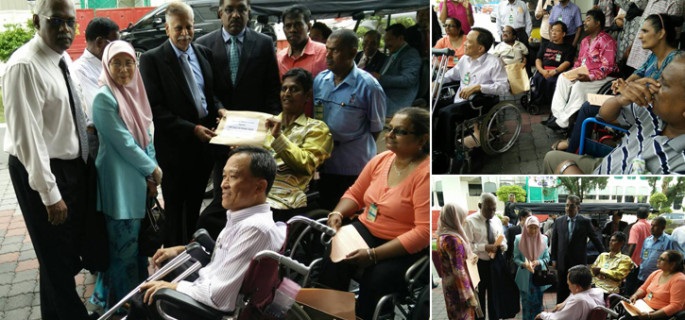
Badan Latihan dan Hidup Berdikari Malaysia (ILTC) pada 23hb Mac 2016 menyerahkan memorandum kepada ahli-ahli parlimen mendesak supaya golongan orang kurang upaya (OKU) dikecualikan daripada cukai barangan dan perkhidmatan (GST).

Disabled Members Protest

Disabled Members Protest
Disabled Members Protest at JPJ Wangsa Maju

ILTC Malaysia members staged a protest outside JPJ Wangsamaju KL.

ILTC Malaysia members staged a protest outside JPJ Wangsamaju KL.
Disabled group’s protest disabled drivers required to produce doc's medical report.

Monday, 20 December 2010

Early Xmas party at Tesco Rawang

Early Xmas party at Tesco Rawang.

Selangor state government hosted an early Christmas party recently at Rawang, Selangor and there nearly 5000 people from Rawang participated.

They also had invited a few charitable organisations to the wonderful evening with its caring society.

ILTC were proud and delighted to be given an opportunity to participate this wonderful event.

ILTC members had a wonderful time at the live show and other performances.

There were plenty of foods. On the day, we had received donation from the Tourism Selangor.

The guests were also entertained by musical performances from several artistes as well as adult and children from the church.

Among the guests were YB Dato' Seri Anwar Ibrahim, Selangor Mentri Besar Tan Sri Khalid Ibrahim, YB Azmin Ali, YB. Dr. Xavier Jayakumar and Y.B. Tuan Ronnie Liu Tian Khiew.

During the Christmas Celebration President Francis Siva chatting with YB. Dato' Seri Anwar Ibrahim to possible ways to deliver some assistance for the disabled people in Malaysia.

The Selangor Mentri Besar Tan Sri Khalid Ibrahim urged the public, especially the younger generation, to have the determination to make Malaysia a better place.

He added that there was still plenty of room to deeper understanding among the races.

Today, children and adults have come here to enjoy the celebration together. This reflects the Malaysian spirit among the communities,” he said.

The ILTC was thankful for the positive role of the Selangor state government in giving to all walks of life an opportunity to experience the spirit of giving and sharing during the festive season.

In conclude this Christmas Greetings, let us share the spirit of joy and sharing, bring about love and peace to this world.

MERRY CHRISTMAS TO ALL!

Disabled Cheated By Nature Group - Want Their Money Back

Story - Courtesy from Petpositive


Disabled Cheated By Nature Group - Want Their Money Back

PETPOSITIVE NEWSFLASH!

DATELINE: KOTA DAMANSARA COMMUNITY FOREST RESERVE, PETALING JAYA

NON GOVERNMENTAL ORGANISATIONS (NGOs) THAT REPRESENT THE DISABLED AND THE ELDERLY ARE FUMING.
THEY ARE CRYING FOUL OVER A SPECIAL FUND THAT WAS MEANT ORIGINALLY FOR HANDICAPPED ACCESS AT THE COMMUNITY FOREST HERE.
HOWEVER, THAT FUND AMOUNTING TO RM30,000 IS NOW BEING USED FOR A NON DISABLED CAUSE.

THE GROUPS ARE NOW DEMANDING THAT EVERY SEN OF THAT MONEY BE RETURNED SO THAT PLANS TO MAKE THE KOTA DAMANSARA COMMUNITY FOREST RESERVE (KDCFR) DISABLED-FRIENDLY CAN GO AHEAD.

"The disabled and elderly community who had been looking forward to explore the forest have not only been dealt with a great blow but also feel cheated by those responsible for the reallocation decision and it's only fair that they give the money back," said Anthony SB Thanasayan from MADDor Malaysians Against the Discrimination of the Disabled - a coalition of half a dozen NGOs for people with disabilities.

He said this during a press conference that was held at KDCFR this afternoon.

It was attended by Kota Damansara state assemblyman YB Dr Nasir Hashim and conservationist and leader of the KDCFR Jeffrey Phang.

The disability groups that were present included theMalaysian Animal-Assisted Therapy for the Disabled and Elderly Association or PETPOSITIVE and the Independent Living and Training Centre (ILTC), a self-help NGO run by people with disabilities.

"The decision to divert the funds was most arbitrary to stay the least and far from the spirit of dialogue and consultation with the disabled community," pointed out Thanasayan who is also councillor for Petaling Jaya's Zone 13 area.

"The funding agency GEF-SGP's (Global Environment Facility - Small Grants Programme) project leader Justine Vaz confirmed the scrapping of the disabled trail, claiming that a 'better area' was in the pipeline but it is extremely arrogant and presumptuous to do things for the disabled without consulting with them first," he said to PET+BLOGSPOT after the press conference.

"Their action is not only discriminatory against people with special needs but also shows how totally ignorant they are about people with disabilities.

"Their workshop is a joke and a farce," he said referring to Monday's final stakeholders meeting the agency is coordinating with the Selangor Forestry Department.
Dr Nasir (in black) chatting with protesters
"What they are doing is going against everything that the PJ City Council (MBPJ) is doing to try and create a barrier-free environment with universal designs."

Thanasayan said that he had met Phang on a couple of occasions early this year to check out the park as well as to plan out the disabled-friendly pavements which MBPJ had expressed its interest to support.

Thanasayan who was invited to the workshop said he is boycotting Monday's workshop, fearing it to be a trap to get his indirect support for the exclusion of the disabled-friendly facilities.

"Even though a detailed list of disabled-friendly points was made available by me, no one had called or wanted to discuss the matter with me at any time," said Thanasayan.

"The KDCFR is excellent for the blind who though they can't see, are fully able to appreciate the rich sounds of the forest and the smells," pointed out Petpositive blind member Yam Tong Woo who took a stroll in the area with his wife.

"People should stop seeing the issue as a charity one but rather from a justice point of view - access to KDCFR is our human right," said tetraplegic Francis Siva, president of ILTC.

He was accompanied by his wife - also in wheelchair - Gurdip Kaur, a former local councillor for the Selayang municipality (MPS).

On his part Dr Nasir said he was upset over the non inclusion of the disabled facilities.

"We should stop segregating people and do everything we can to integrate with everyone," he said, adding that the disabled and the elderly should be given the same rights and privileges as anyone else.

Those who gathered at the press conference said that they are prepared to take up the matter to higher officials including the state's Chief Minister if the matter was not resolved.

Friday, 17 December 2010

Christmas cheer

Good Tidings For The Disabled Community

CHRISTMAS may be ten days away.

But for people with disabilities (PWDs) in the country, Santa seems to have already crawled down their chimneys early for them – at least as far as good tidings are concerned!

Four representatives of disability groups – including me – made a special visit to the Ministry of Women, Family and the Community Development in Jalan Dato Onn, Kuala Lumpur last week.

We went there to meet personally with the Minister Datuk Seri Sharizat Abdul Jalil.

We had some pressing issues confronting PWDs in our society today to urgently discuss with her.

The national NGOs from KL were: The Malaysian Animal-Assisted Therapy for the Disabled and Elderly Association (Petpositive), Malaysian Parkinson’s Disease Association (MPDA) and Dyslexia Association of Malaysia (PDM).

The fourth group was the Selangor and KL-based Independent Living and Training Centre (ILTC) from Rawang.

Although Sharizat was late for our appointment because she was held up in Parliament, she wasted no time to get down to listening to requests.

She personally led us through the passageway to her meeting room. We were touched that she herself literally opened the doors for our wheelchairs – a sign of the positive things (“opening of doors”) to come at the meeting.

Although they were others waiting to see her, she never hurried us. Instead she quickly fished out her pen and notebook and noted down all that we had to say together with her department officials.

Here’s what we told the Honourable Minister:

  • Please get all the local councils (PBTs) everywhere to set up disability committees: This is the only way for significant and positive changes to happen for all disabled persons (OKU) in the country.
Currently there are building bylaws in every state of the nation that requires accessibility for PWDs. However, many PBTs choose to ignore them.

The OKU committee will serve as a driving force for each council to build a disabled friendly environment both inside and outside buildings.
They must represent the full category of PWDs from the blind, people with learning disabilities or their representatives to the blind, Deaf and of course, physically disabled.

They must meet at least once a month if it is to be effective. It is only after pavements are made accessible to wheelchairs and buildings that disabled Malaysians can successfully hold jobs.
They wouldn’t have to travel far to get to them. Children in wheelchairs can also go to schools and be educated instead of becoming a burden to society later on in life.

The Minister had no problem in supporting our point. In fact she reiterated our view by saying that it is only right that PWDs be involved in decision-making processes that involve us.
She even went on to say that “able-bodied people know nuts about the handicapped – and that’s why the disabled’s participation is vital.”
She promised us that the Ministry will start a campaign as soon as possible to get PBTs to set up the special committees. It will start with a major seminar for all PBTs next year.
Meanwhile, head of local councils in Selangor Ronnie Liu Tian Khiew when met earlier by a representative of the same group said he would be sending a directive to all 12 PBTs in the state to set up disability technical groups.
A “starter kit guide” on how to do this is currently being prepared by a town planning expert. It is expected to be handed over to Liu within the next couple of weeks.
MBPJ is currently the only local council in Selangor, and possibly the whole country, to have an active disability committee that meets once a month.
  • Please register People with Parkinson’s disease (PwP) as PWDs: Currently PwP can’t qualify for welfare cards and can’t get free treatment.
Sharizat said her ministry will urgently discuss the matter for approval with the Ministry of Health. Once that is given, the event will be launched early next year.
  • Other issues: The Minister will look into improving the quality of lives of people with learning disabilities especially in care homes and centres through the coordination of the Ministry of Special Education and Welfare.
She will also look into offering help for the profoundly disabled to get assistance from foreign workers. In some countries, the government pays for the services of caregivers of tetraplegics.

Finally, a special committee will be set up to study ways on how to protect the elderly from abuse and neglect in the family based on the laws in Singapore that allows for court action.


The End

Tuesday, 14 December 2010

Advocating change for PWDs

Saturday December 11, 2010

Advocating change for PWDs

By S. INDRAMALAR
indra@thestar.com.my

IF THERE is one thing Norani Haji Mohd Hashim could wish for, it would be that people with disabilities (PWD) have better access to infrastructure and services.

As the Deputy Director-General (Operation) for the Department of Social Welfare, Norani is an advocate for the disabled, a role to which she is fully committed, no matter how fraught it is with challenges.

“If I were to put myself in their shoes, I’d want to be able to walk out of my home and get around like any other person. I’d want to be able to walk, drive and move about freely. I’d like to be able to watch a movie or go shopping with ease.

“At the moment, accessibility for PWDs is just not there. The moment they step out of their homes, there are so many hazards. It’s just not fair to them,” said Norani.

Accessibility is one of the two themes of this year’s national level celebrations of the International Day Of Persons With Disabilities. The other theme is employment.

“Accessibility and employment are two key aspects of our initiative to integrate persons with disabilities into mainstream society. Improvements in these areas will enable PWDs to become independent,and by default productive citizens as well.

“Many PWDs, because they are given the means and opportunities, are able to support themselves, their families and contribute to the communities they live in. This is what we are aiming for – inclusion and integration of all people, regardless of their abilities.”

The national-level celebrations will take place today in Malacca and will be officiated by Women, Family and Community Development Minister Datuk Seri Shahrizat Abdul Jalil.

“Although there are laws and regulations to ensure accessibility for PWDs in public buildings, outdoors and in all new housing projects, enforcement is lacking,” said Norani. State local authorities have to play a more active role in enforcing the existing laws.

“The local authorities in every state must take charge because they are the body that issues licences and approvals. If they are strict, then developers will have to comply and provide for PWDs in all development projects.

“By right, all new buildings are supposed to follow the universal design principals. The provisions are there but the implementation isn’t. This is where the local authorities must step in,” said Norani.

She was referring to the amendment to the Uniform Building Bylaws in 1990 which makes it compulsory for buildings to provide access and facilities for the disabled.

Existing buildings were given three years to make modifications to comply with the bylaw.

In July, Malaysia ratified the Convention on the Rights of Persons with Disabilities.

“This means we are obliged by law to ensure that PWDs have equal access in terms of access in/to public facilities, amenities, buildings, public transport and so on.

“We have to work fast because we have to present a report on our progress to the UN in two years,” said the deputy director-general.

Though there is much to be done, Norani acknowledged that things are changing. The number of companies that are willing to employ PWDs is increasing and the perception of PWDs in society has also changed.

“People are not awkward or shy when they talk about PWDs. They are accepted in society now more than ever,” she noted.

Today’s celebrations is to pay tribute to PWDs and recognise their contribution to society. There will be awards for outstanding PWDs who have courageously triumphed over their disabilities and also certificates for care providers who have worked tirelessly for the disabled.

One of the highlights of the event is an exhibition showcasing the handiwork and products of PWDs.

The exhibition will also highlight programmes run by government agencies, non-governmental organisations and service providers for PWDs, and suggest areas in which the corporate sector can play a part.

There will also be a registration drive to encourage PWDs to register with the Department of Social Welfare.

“A lot of PWDs and their parents are not aware of the services that are available to them. These services include employment assistance and also the access to early rehabilitation programmes.

“In Malaysia, it isn’t compulsory for PWDs to register with the department. But we encourage them to because to be eligible for our services, they have to be registered. That is a criteria,” said Norani.

There are presently about 330,000 PWDs registered with the Department. This, says Norani, is only a small percentage of the total number of PWDs in the country.

“The World Health Organisation estimates that PWDs make up five to 10% of the population of every country. This is a general estimation. The categorisation of PWDs differ ... some countries categorise old people as PWDs as well. In Malaysia, PWDs are divided into seven categories,” said Norani.

The seven categories of disabilities are visual impairment, physical disability, deafness, speech impairment, mental disability, learning disability and multiple disabilities.

“Once they register with us, they will be assessed by experts to determine if they qualify and into which category they best fit,” said Norani.

She explained that Malacca was chosen as the venue of this year’s celebrations for several reasons.

“We really wanted to reach the masses and reach out to PWDs everywhere. The celebrations will be held at Fashion City (at the Melaka International Trade Centre grounds) which is accessible to everyone. Also, this is a tribute to Malacca, which was was recently declared a developed state.”

Norani concluded: “We also wanted to see whether, as a developed state, it would be able to provide for PWDs.
Bar: Stricter laws needed to help the disabled

Monday December 13, 2010

Bar: Stricter laws needed to help the disabled

KUALA LUMPUR: There is a need for stricter laws to make facilities for disabled persons at public buildings and properties a must, said Malaysian Bar Council president K. Ragunath.

He added that most public transportation and walkways were not disabled-friendly.

“There is not enough pressure on the government to take the matter seriously,” he said.

He added that the Bar Council planned to set up a committee to advocate the rights of the disabled within the next two months.

The committee would work with the government, various NGOs and town councils to increase awareness on the needs of the community.

“More government intervention is needed to protect the rights of the disabled community especially in terms of employment and accessibility to public property,” he said after the grand finals of the Bar Council Human Rights Debate 2010 last night.

The three-day competition saw participation of debaters from 18 local and international institutions in conjunction with the World Human Rights Day on Saturday.

The winning team will get RM5,000 from the total cash prize of RM30,000, while the remaining RM25,000 will be donated to five charity organisations.

The organisations selected to receive the donation include the National Autism Society of Malaysia and the Society of the Orthopaedically Handicapped Malaysia.

Friday, 10 December 2010

Please Stop Pitying The Disabled

Please Stop Pitying The Disabled

WITH the year 2010 coming to a quick close in just a matter of weeks – and the observance of International Day for Persons with Disabilities (IDPD) having taken place on December 3 last week – the handicapped community the world over are eagerly looking forward to a better future as far as their plight is concerned.

One of the best-known worldwide disability rights group Disabled Peoples International which is headquartered in Newfoundland in Canada in its statement to mark IDPD used the occasion to point out the key goals of the annual special day which was first established by the United Nations in 1981.

IDPD aims are to bring about a better understanding of what disability is all about and how it affects the people who have them, says DPI which currently has as many as six regional departments from North America to the Asia-Pacific.

“Disability must be seen as a human rights issue and people with disabilities (PWDs) must be integrated into every aspect of society - at the political, social, economic and cultural levels,” the statement went on.

The disability international NGO is pleased to note that their ambitions to get the commitment of the various governments of the world to provide an international policy framework for better access and a high quality living for its disabled citizens was strengthened two years ago by a 2006 key document called the “Convention on the Rights of Persons with Disabilities” of which Malaysia is also a signatory.

The Convention is meant to give an impetus to governments around the world to make good their promise in keeping to the disability rights agenda for the world’s handicapped communities.

Whilst all these are a positive step forward, DPI sadly notes that the gap between policy and practice of governments is still going on.

For this to stop, governments must start including PWDs into each process otherwise the marginalisation of the handicapped will increase even further.

Back in Malaysia, wheelchair-activist Chong Tuck Meng (right) from Bentong in Pahang firmly believes that changes can start happening by some simple steps.

The 49-year old who was paralysed from the neck down after a motorcycle accident 30 years ago suggests a significant mind-shift first about who disabled people really are.

“Just as how ‘re-branding’ is vital to a dying product, it’s time to change our present condescending and negative attitudes towards PWDs or we really won’t get anywhere,” says Chong in an interview with Wheel Power this week.

“Let’s get rid of the present ‘Orang Kurang Upaya’ term in Bahasa meaning ‘persons who are less capable’ to something which is more positive like ‘Warga Istimewa’ or ‘special citizens’, he adds.

“It’s just like how we now refer to older persons as ‘warga emas’ instead of ‘orang tua’”.

Chong says he thinks there will be much more dignity and respect if society would look at disabled people as a special group instead of being seen as the “less fortunate” or “less able”.

“Let’s also please stop pitying PWDs and looking at them as objects of charity all the time,” Chong points out.

“Doing this during the festive celebrations may make the giver feel good but it’s often a different story for the recipients who are then forgotten for the rest of the year until the festivities return.

“Earning an income for the handicapped should go beyond common stereotypes such as selling lottery tickets, tissues and what not.

“The government can play a significant step in changing such perceptions by organising special projects that highlight the positive talents of PWDs in order to instil public confidence in the abilities of the disabled.

“They can do much more to get employers in the private and government sectors to give them jobs; as well as help in their special needs, such as making their offices accessible to wheelchairs, give a special allowance for transport, etc.”

Private telecommunication companies can also exercise their ‘corporate social responsibility’ part by giving meaningful discounts (and not just tokens) and even waivers to disabled subscribers so that they can catch up and communicate with the rest of the world outside of their homes.

Chong says with the petrol and other prices going up, a-RM500.00 monthly allowance for all disabled people in the country would be the right and timely gift to the handicapped community.

Chong concludes by saying that it is time for everyone to get tough with the use of laws to protect the disabled and their rights.

“Let’s promptly tow all cars belonging to the non disabled at handicapped parking spots and get down hard on local councils that conveniently ignore the building bylaws that require disabled access in towns and cities everywhere.”

Chong is a founder member and adviser of the national disabled society in Kuala Lumpur called “Perwira K9 Malaysia”.

He also plays the same roles for Budi Penyayang and Wheelchair Basketball in the state of Pahang.

The End

Saturday, 4 December 2010

PM: Development agenda to benefit all, including the disabled

Published: Saturday December 4, 2010 MYT 4:39:00 PM

PM: Development agenda to benefit all, including the disabled

KUALA LUMPUR: The government will ensure that its development agenda will benefit all sections of the society including people with disabilities, Prime Minister Datuk Seri Najib Tun Razak said.

He said the government's approach would be based on the principles of social justice and inclusiveness to ensure that everyone gets to enjoy the country's prosperity and not just a certain section of the society.

"All sections of the society, irrespective of whether they are able-bodied or with disabilities, will be cared for in line with the social justice principles," he said when opening the national-level Centre for Rehabilitation in Community (PDK) sale carnival at Stadium Titiwangsa, Taman Tasik Titiwangsa, here Saturday.

Present were his wife Datin Seri Rosmah Mansor and Women, Family and Community Development Minister Datuk Seri Shahrizat Abdul Jalil.

Najib said to achieve this, the government would develop a system to fully realise the potentials of each and every person in the country, especially those with disabilities.

He said the government had already set that one percent of civil servants should be appointed from among the disabled.

Although the target had yet to be fully achieved, the government was committed to fulfilling the percentage, he said, adding that the private sector also played an important role in offering employment opportunities to this group.

"They are not seeking for sympathy; what they want is the opportunity to stand on their feet and contribute to the society," he said.

He added that the effort to assist people with disabilities was part of the "1Malaysia, People First, Performance Now" concept and entrenched in the Economic Transformation Plan and New Economic Model which aimed to turn Malaysia into a developed nation by 2020.

He also called on parents to equip themselves with parenting skills, saying some of the disabilities among children, such as those caused by illness like high fever, could have been prevented had they known what should be done. - Bernama

No limits

Saturday December 4, 2010

No limits

By JOLEEN LUNJEW

Having a disability needn’t be the end of the world. The following people have made the most of their shortcomings and created a meaningful life for themselves and the people around them.

Their accomplishments are an inspiration to everyone.

Scientist Stephen Hawking

Stephen Hawking

Stephen Hawking, born in Oxford, UK, in 1942, was diagnosed with Amyotrophic Lateral Sclerosis (ALS) when he was 21, a motor neuron disease that gradually left him almost completely paralysed. A tracheotomy operation in 1985 removed his ability to speak altogether.

Despite his severe disability, Hawking’s scientific work and research have contributed greatly to the fields of cosmology, theoretical physics and quantum gravity, especially in the context of black holes.

Hawking has 12 honorary degrees and has authored many acclaimed publications. He is the recipient of many awards, medals and prizes, among them the CBE award in 1982, the Companion of Honour in 1989 and presented with the National Medal of Freedom in 2009, the highest civilian honour awarded in America. He is also a Fellow of The Royal Society, UK, and a Member of the US National Academy of Sciences.

Tuah Atan

Lawyer Tuah Atan was born without legs and has a deformed left hand.

Despite being born without legs and a deformed left hand, civil and syariah lawyer Tuah Atan, 50, who hails from Tanjung Kling, Malacca has been an active advocate for disabled people in Malaysia. A law graduate from Universiti Malaya, Tuah was instrumental in drafting the Disabled Persons Act 2007.

For his services, Tuah was accorded the Guinness Award 1998, Junior Chambers Youth Award 1995, Malacca Human Resource Award (disabled person category), Malacca Disabled Person Award and Malacca Tokoh Maal Hijrah (professional category) 1996 and Tokoh Maal Hijrah (disabled person category) 2008.

Henry Wayoinke

Kenyan-born Henry Wayoinke lost his eyesight in 1995, at age 21, after suffering a stroke. Despite being blind, Wayoinke held fast to his dream of becoming a successful runner. With the help of his childhood friend Joseph Kibunja as his guide, he went on to win many gold medals in the Paralympic Games, setting and holding world records.

Blind runner Henry Wayoinke (right) from Kenya.

Besides excelling in athletics, Wanyoinke is a respected philanthropist. He is involved in various charitable activities in Kenya, particularly to assist the poor, persons with disabilities, orphans and other less privileged people. His Henry Wanyoike Foundation was set up to assist disabled people, orphans, vulnerable children and youths and families in need.

He is also a Goodwill Ambassador for Standard Chartered Bank’s “Seeing is Believing” campaign that seeks to restore the sight of the visually impaired around the world.

Nick Vujicic

Nick Vujicic, born without arms and legs, is a motivational speaker and author.

Nick Vujicic was born in Brisbane, Australia in 1982 without any arms or legs. He has two small feet, one of which has two toes. Throughout his childhood, he struggled with loneliness and depression but as time went by, he turned towards God to give him hope.

Vujicic started a non-profit organisation Life Without Limbs when he was 19, giving motivational talks and sharing on how God changed his life and gave him a future of hope.

At 28, Vujicic has accomplished more than most people do in a lifetime, travelling around the world inspiring millions, from teenagers to international corporations. He published his first book this year Life Without Limits: Inspiration for a Ridiculously Good Life.

Liu Wei

Liu Wei lost both his arms at age 10 when he was electrocuted during a game of hide-and-seek. His dreams of becoming a musician led to him learning to play the piano with his feet at 19. His hard work paid off when only four years later at 23, he impressed the audiences and judges of China’s Got Talent Show with his moving performance and won the title in Oct 2010.

Pianist Liu Wei who is armless, plays piano with his toes.

Among his many uplifting quotes that touched the hearts of audiences worldwide were, “At least I have a pair of perfect legs” and “There are only two paths in life — either to give up and die, or to live a brilliant life as much as is possible.”

Friday, 3 December 2010

The role of local councils to create a disabled-friendly society

Friday December 3, 2010

The role of local councils to create a disabled-friendly society

By ANTHONY THANASAYAN

As the country celebrates International Day of Persons with Disabilities today, we look at the role of local councils in the making of a disabled-friendly society.

THIS year’s celebration of International Day of Persons with Disabilities is cause for double joy for me as a person who has lived with a disability all my life. This is because I turned 50 last month on Nov 21.

Turning 50 is a big achievement for anybody, especially when they have been told they would never make it that far. The doctors told my parents that because of my congenital condition known as spina bifida, I would not make it past adolescence. Well, here I am, proving those clueless doctors wrong.

More bad luck struck when I was 10 years old. I was forced to go for a leg operation to straighten my knee so that I could use callipers to walk. However, it made my legs worse as I lost whatever sensations I had earlier.

Again, some bad doctors were clearly using me as a guinea pig in the hope of becoming famous, if the operation was a success.

I had to stop schooling at Standard Four because the school authorities said they my wheelchair could not fit in the classrooms and toilets. And I couldn’t get out of my house because the whole environment was hostile to my wheelchair.

There were no pavements in Klang, Selangor, where I lived; and if there were, I couldn’t get my wheelchair on it. Once a car grazed the side of my wheelchair and damaged the wheel. I was about 10 years old then, and my grandmother was pushing my wheelchair. It was a terrifying experience for both of us.

Thoughtful move: There are ample parking lots for the disabled at Sunway Carnival Mall Seberang Jaya.

During my teenage years I moved to Petaling Jaya. However, the situation was worse in the neighbourhood’s public park.

I couldn’t access it for years because the local council kept the gates closed except to their official vehicles. There were no kerb cuts in the pavements. Even if someone carried my wheelchair on it, it was of no use. The pathway would suddenly narrow down to a point where only one person could get through, or a lamp post or some other hindrance would appear right in front of you.

Despite the fact that many of the shops were near my house, I could not access any of them because of the many steps and uneven floor levels in the buildings. All these made me very depressed. However, I soon discovered that all these negative thoughts that society was feeding into my mind was really a big lie.

My break came when I took part in an exchange programme and went to live in the city of Eugene in Oregon, the United States, for a month. It was a wheelchair heaven for people with disabilities. I took my first bus ride there. The buses were equipped with wheelchair lifts. These amazing gizmos would magically unfold from the vehicles at the push of a button.

The pavements were fully accessible to wheelchairs. I could go into supermarkets and virtually every public building; doors would open automatically when I approached or at the push of a button. Some were even voice-activated. Wheelchair-accessible toilets and proper ramps were available everywhere.

Although most Americans were always ready to lend a hand to anyone in a wheelchair, there was no need for it because of the accessibility all around.

The biggest thing that I learnt from my stay in Eugene was that I was not the problem – society was! This was because society failed to provide the necessary facilities for all its citizens. So you can imagine how thrilled I was when I was appointed as a councillor in the Petaling Jaya City Council (MBPJ).

My first task was to get an active disability team into the council in order to provide vital information regarding their many needs.

The MBPJ’s special committee today has representatives with a wide range of disabilities. We have the blind, Deaf, people with learning disabilities, stroke patients and even those with mental illness. These people would be in the best position to articulate their needs. We have also included caregivers of disabled persons.

One of the unique things we have considered is building shelters for car parks for the disabled so that users can be protected from the elements, considering the extra time they need to get in and out of their vehicles.

All new buildings will have to come to our committee first for approval of their disabled-friendly facilities before they get the green light to proceed with their projects from a higher committee.

The MBPJ is also making a special effort to ensure that homes for the disabled and elderly are fully equipped with proper features for the benefit of every user.

One of our proudest achievements is a 500m stretch of pavement along Jalan Gasing, Petaling Jaya, that is universally-designed. It is 90% complete. Once it is ready, everybody – from the elderly with walking difficulties to mothers with prams, children and the blind – will stand to benefit from it.

However, there were some opposition to the project, with some saying that it was a waste of money. Some of these complainants are more than 60 years old. Don’t they realise that they are growing older by the day and could very well become disabled, too, following a heart attack, stroke or some other condition?

It is high time that all of us realise that disabilities are increasing rather than decreasing, and that it is a natural aspect of the human condition. Rather than pretending that it doesn’t exist through fear or ignorance, all councils should start planning for the aging citizens in society. To do that, it is vital for all the departments in the councils to coordinate their efforts to see each and every project through.

As a disabled activist, I used to think that the answer towards creating a disabled-friendly world lay with the welfare ministry or even the Prime Minister. Now I realise the answer lies with each and every local government. It is these institutions which hold the keys to a better future for all disabled Malaysians.

And the first step towards bringing about effective change is to involve the disabled community in consultation with the local councils.

My wish today is that every local council in the country will set up a disabled committee of their own with active participation from the handicapped community to bring about a better future for the latter

Wednesday, 1 December 2010

Sambutan Hari Orang Kurang Upaya 2010

Sambutan Hari Orang Kurang Upaya 2010 PDF Print Emel

SAMBUTAN HARI ORANG KURANG UPAYA PERINGKAT KEBANGSAAN KE-17 TAHUN 2010

Jabatan akan menganjurkan Hari Kurang Upaya Peringkat Kebangsaan ke-17 Tahun 2010

Tarikh : 11 Disember 2010 (Sabtu)
Masa : 8.00 pagi - 5.00 petang
Tempat : Kota Fesyen, Air Keroh, Melaka
Perasmi : YB Senator Dato' Sri Shahrizat Abdul Jalil
Tema : "1 Malaysia : Aksesibiliti dan Pekerjaan Untuk OKU"

Sebarang maklumat lanjut sila hubungi :-

Urusetia Hari Orang Kurang Upaya :-

1) En Sulaiman bin Ismail - 03-26165662
2) En Zulkifli bin Ismail - 03-26165661

Sunday, 28 November 2010

Chance for disabled to showcase their talents

Saturday November 27, 2010

Chance for disabled to showcase their talents

PUTRAJAYA: More than 500 disabled people will gather at Taman Tasik Titiwangsa in Kuala Lumpur on Dec 4 for an event that will showcase their products and talents.

Organised by the Association of Wives of Ministers and Deputy Ministers (Bakti), the carnival aims to encourage community rehabilitation centres to produce quality products to generate income for the disabled.

Bakti president Datin Seri Rosmah Mansor said it would also be a platform for managers of such centres to exchange ideas, views and experiences.

“While it is a challenge to organise such an event as these groups need extra and special attention, Bakti is happy to help bring together more than 500 disabled people to get them closer to the mainstream community,” she told a press conference here yesterday.

Showing compassion: Rosmah speaking about the carnival at the press conference accompanied by Bakti treasurer Datin Seri Lee Sun Loo and Semai Bakti programme organising secretary Datin Seri Dr Mizan Adiliah in Putrajaya Friday.

Rosmah, the wife of Prime Minister Datuk Seri Najib Tun Razak, said the carnival came under the banner of the association’s Semai Bakti programme, which runs educational and recreational activities for disabled people.

“We want to show there are people who care and support the disabled and that they (the disabled) too have the opportunity to excel,” she said, adding the event would be launched by the Prime Minister.

Rosmah said the carnival would be held from 8am to 6pm, followed by a talent competition for the disabled. The winner will take home the Prime Minister’s Challenge Trophy.

Both events will be telecast live over RTM.

Underpass not friendly to disabled

Saturday November 27, 2010

Underpass not friendly to disabled

By ELAN PERUMAL
elan@thestar.com.my

THE contractor of the newly-completed flyover at Persiaran Sultan Ibrahim in Klang has come under fire for failing to provide facilities for the disabled at its pedestrian underpass in the area.

The Disabled Association of Klang has taken SPAZ Sdn Bhd to task for failing to keep to its promise.

Its chairman, Allan Tan, who is also a Klang municipal councillor, said SPAZ had agreed that the pedestrian underpass would be built with consideration given to the wheelchair-bound and people on crutches.

No help: The path that leads to the underpass does not have railings to support the disabled.

Tan said the underpass had failed to link the Mydin complex with a platform that would enable those on wheelchair to cross over.

He said a ramp should have been built so that the disabled would be provided with access to the underpass.

Tan said it had not been provided with hand railing and the path to the underpass was steep.

“It is dangerous for the wheelchair-bound to go up and down the steep path.

“Even people pushing the wheelchairs will find it difficult to go up the slope,’’ he said.

Huff and puff: Tan demonstrating how difficult it is to go up the steep path.

He said the council had made it clear that the underpass must be disabled-friendly.

“It is the responsibility of the government to cater to the needs of everyone, especially for public facilities,’’ he added.

Tan said the council had brought the matter to the attention of the contractor.

The underpass was built as part of the RM32.3mil flyover which connected Persiaran Sultan Ibrahim to the Kota Bridge.

The work on the flyover, which included the construction of a new roundabout near the Metro Plaza, was completed after a year’s delay.