NEW MINISTER FOR WELFARE MINISTER OF MALAYSIA

NEW MINISTER FOR WELFARE MINISTER OF MALAYSIA
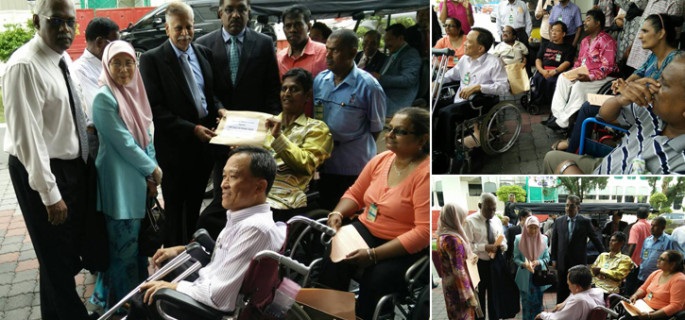
Badan Latihan dan Hidup Berdikari Malaysia (ILTC) pada 23hb Mac 2016 menyerahkan memorandum kepada ahli-ahli parlimen mendesak supaya golongan orang kurang upaya (OKU) dikecualikan daripada cukai barangan dan perkhidmatan (GST).

Disabled Members Protest

Disabled Members Protest
Disabled Members Protest at JPJ Wangsa Maju

ILTC Malaysia members staged a protest outside JPJ Wangsamaju KL.

ILTC Malaysia members staged a protest outside JPJ Wangsamaju KL.
Disabled group’s protest disabled drivers required to produce doc's medical report.

Thursday, 27 September 2012

Pressing issues for the disabled

Thursday September 27, 2012


Pressing issues for the disabled


DESPITE being involved in the business of creating awareness of disability for several decades now, there are days when I feel down and wonder how effective it has all been.
How much, for instance, do people who do not have any disabilities understand what it feels like for those of us who do? From the man in the street to folks who actually work with the Government in trying to solve our problems, it is not unusual to come across people who haven’t a clue what life is like for those who use a wheelchair or a white cane, or live in a world of silence.
Last Friday, several of us in wheelchairs got together to get our voices heard.
We held a press conference in Petaling Jaya. Our audience? The Human Rights Commission of Malaysia, better known as Suhakam.
Suhakam was kind enough to come over to our venue instead of having us go to theirs. However, getting a bunch of people in wheelchairs together is not the simplest thing on earth.
We had to spend time looking for a few vehicles that could accommodate wheelchairs. Then we needed to place at least one able-bodied helper to one wheelchair user.
There was also the issue of disabled-friendly toilets. Being able to sit up for long hours was another issue, especially for those with pressure sores in their buttocks.
Since the issue at stake was important in helping the disabled to achieve a better quality of life, we turned up despite the odds.
The press conference called for several basic things:
A significant improvement in current healthcare services
We heard that although healthcare for handicapped Malaysians is said to be free in government hospitals, this was not entirely true in a number of cases. Disabled patients who seek treatment for pressure and bedsores have been told to buy medication, plasters and even cotton gauze swabs at outside pharmacies.
The disabled strongly feel that nurses from nearby government hospitals should make home visits for wound dressings and other medical assistance as is done overseas.
This is very helpful for those who do not have transport or anyone to send them to hospital.
At the press conference, we also learnt of instances where patients were sent home while recovering from their sores, and they were forced to do the dressings at home. These “early discharge” cases came about because there were not enough beds for new patients.
Trained caregivers for profoundly disabled Malaysians
The Government needs to come out with a clear policy on how to care for the aging disabled population, especially since Malaysia is expected to reach ageing nation status by 2035. Caregivers should undergo special training. Levy and other fees should be waived for caregivers for the disabled.
The situation can become critical when loved ones who play the role of caregiver, pass away. Poorer communities should also have access to such services. Steps should be taken to focus on disabled persons in the community rather than any move to institutionalise people.
Special financial aid for all disabled Malaysians
A flat rate of RM500 should be given to all disabled Malaysians, regardless of their handicap or employment status. This should be given in addition to whatever financial benefits some might be receiving.
The money will go a long way in helping the handicapped deal with the rise in living costs, repair of assistive devices, transportation costs and caregiver expenses.
Pensions of government servants should include all categories of disabilities
The blind and deaf should qualify to receive their parent’s pension benefits after they have passed on. Currently, only certain categories of disabilities qualify to receive such pensions.
The hour-long press conference ended with the group handing over the memorandum to Suhakam Commissioner James Nayagam who promised to pursue the points raised, with the Government.
The group also hoped that tomorrow’s 2013 budget speech will cover some of these issues.

Saturday, 22 September 2012

Disabled Handed Over Healthcare Demands To Suhakam

Disabled Handed Over Healthcare Demands To Suhakam on 21/09/2012

Yesterday, as many as a dozan disabled people - representing the handicapped community in Malaysia - are demanded for much better treatment for healthcare and services by the government.

Leaders of two national disability groups PETPOSITIVE and the Independent Living and Training Centre Malaysia are handed over a memorandum to Suhakam Commissioners James Nayagam listed down our demands for a higher quality of living for the disabled community.

The memo reads:

MEMORANDUM TO SUHAKAM ON 21 SEPTEMBER 2012 BY DISABLED GROUPS ON HIGHER QUALITY OF LIVING FOR OLDER DISABLED AND AGEING PERSONS IN SHELTER HOME, NO: 4, JALAN TINGGI 6/12, OFF JALAN GASING, 46000 PETALING JAYA, SELANGOR.
------------------------------------------------------------------------------------------------------------

WE, DISABLED MALAYSIANS WHO ARE AGEING WITH HANDICAPS ARE SERIOUSLY CONCERNED THAT THERE ARE NO POLICIES THAT ARE SET UP TO TAKE CARE OF PERSONS GROWING OLDER WITH DISABILITIES AS WELL AS THE INCREASING ELDERLY POPULATION IN THE EVENT OF DISABILITY.

AS PERSONS WHO HAVE LIVED WITH DISABILITIES ALL OUR LIVES SPANNING SEVERAL DECADES, WE THEREFORE DEMAND THAT OUR NEEDS AND RIGHTS BE LOOKED INTO IMMEDIATELY AND BE REFLECTED ON THE UPCOMING BUDGET SPEECH ON 28 SEPTEMBER 2012.

WE INSIST ON THE FOLLOWING:

1) IMPROVEMENT OF HEALTHCARE FOR DISABLED AND ELDERLY PERSONS:

• All medication to be provided absolutely free of charge in all government hospitals to persons with disabilities who are registered with the Social Welfare Department. Although it is said to have been done, many disabled patients have been told to buy medication elsewhere when they need it. Medication should include cotton balls, gauzes and other items needed especially for treating bed and pressure sores often affecting wheelchair users.

• Nurses should be made available to make home visits from the nearest government hospitals to disabled and elderly people who require health services, especially those discharged from hospitals and needing professional health care at home.

2) CAREGIVERS FOR PROFOUNDLY DISABLED PERSONS AND THOSE AGEING WITH DISABILITIES.

• Caregivers to deal with disabled and elderly persons should undergo special training. They should include local and foreign workers. Levy and other fees should be waived for caregivers for the disabled. This is important as parents and family members pass away leaving the disabled person with no one to look after them. In overseas countries, they are provided by the government. Care should be taken that poorer communities also have access to such services.

3) SPECIAL FINANCIAL AID FOR ALL DISABLED PERSONS IN MALAYSIA.

• A flat rate of RM500 should be given to all disabled persons in Malaysia, regardless it their handicaps or their employment status. This should be given in addition to whatever some might be receiving. The money will go for a variety of reasons, rising costs, to repairs of assistive devices, transport and caregiver costs.

4) PENSIONS OF GOVERNMENT SERVANTS FOR DISABLED CHILDREN.

• This should be given to all categories of disabled persons and not just those who are “severely mentally retarded” and the bedridden. This is pure discrimination.

The abovementioned statement is endorsed by:

A) Independent Living & Training Centre Malaysia (ILTC Malaysia)

B) Malaysian Animal-Assisted Therapy for the Disabled and Elderly Association (PETPOSITIVE)

C) Persatuan Orang Kurang Upaya Anggota & Penglihatan Malaysia (Persatuan Cahaya Ehsan)

D) Persatuan Budi Penyayang Pahang

E) Persatuan Orang Kurang Upaya Anggota Melayu Malaysia (Permata)

Wednesday, 19 September 2012

PKNS bina rumah mampu milik mesra OKU


PKNS bina rumah mampu milik mesra OKU
 

BANGI : Prihatin dengan kemudahan Orang Kelainan Upaya (OKU),  Perbadanan Kemajuan Negeri Selangor (PKNS) tampil membina rumah kos rendah yang mesra golongan berkenaan.

Sebagai permulaan terletak di Seksyen 3, Bandar Baru Bangi sebanyak empat unit rumah dibina khas untuk OKU dan konsep ini mendapat pujian dari Exco Perumahan, Pengurusan Bangunan dan Setinggan, Iskandar Abdul Samad.

Beliau yang ditemui selepas mengadakan lawatan tapak bagi melihat perkembangan projek ini berkata idea ini akan digunakan untuk beberapa projek perumahan mampu milik yang akan dibina kelak.
“Tahniah saya ucapkan kepada PKNS dan pihak arkitek kerana memikirkan konsep ini dengan menampilkan beberapa kemudahan kepada OKU.


 “Reka bentuk disini lebih luas berbanding rumah kos rendah. Tedapat balkoni bagi setiap rumah serta disediakan tempat santai dan berkumpul untuk orang ramai di tingkat atas,” katanya.

Katanya, setakat ini Kerajaan Negeri masih berbincang untuk memperuntukkan beberapa unit rumah kepada OKU dalam projek perumahan akan datang.
Konsep ini sebenarnya difikirkan hasil perbincangan secara menyeluruh melibatkan pihak Kerajaan Negeri, pemaju dan swasta.

Projek pangsapuri enam tingkat di Seksyen 6,  Bandar Baru Bangi mempunyai 124 unit rumah dimulakan pada tahun 2011 dan dijangka siap pada Februari 2013.

Setakat ini, kerja-kerja pembinaan siap 55 peratus.

Kos pembangunan projek ini ditanggung sepenuhnya oleh PKNS dengan keluasan 700 hingga 800 kaki persegi (kps) dan ia terletak di atas tanah pegangan bebas.

Harga jualan bagi seunit pangsapuri ini dalam lingkungan RM60,000 hingga RM99,000 dan dijangka tidak melebihi RM150,000.

Telco holds open house

Wednesday September 19, 2012
 

Telco holds open house

By MUHD BASYAR MUSTAPHA 
basyar@thestar.com.my

<b>Specially for you:</b> Sandip Das (third from right) presenting a free mobile phone, Hotlink starter pack and top-up ticket to Francis Siva. Looking on (from right) are Maxis corporate affairs division head Mariam Bevi Batcha, Sandip’s wife Purnima Das and Maxis Berhad head of compliance, regulatory & government liaison Azmi Ujang.
Specially for you: Sandip Das (third from right) presenting a free mobile phone, Hotlink starter pack and top-up ticket to Francis Siva. Looking on (from right) are Maxis corporate affairs division head Mariam Bevi Batcha, Sandip’s wife Purnima Das and Maxis Berhad head of compliance, regulatory & government liaison Azmi Ujang.

Residents of various charitable homes were invited to Maxis Berhad’s Hari Raya charity open house recently.
The 123 guests were from Pusat Dalam Komuniti (PDK) Kampung Kenanga, Pusat Jagaan Nur Hikmah, Rumah Jagaan dan Rawatan Orang Tua Al-Ikhlas, 
 Pusat Jagaan Kanak-Kanak Kurang Upaya Kirtarsh and Rumah Victory
They were treated to a spread of traditional Malay delicacies and Hari Raya songs.
To add to the festive cheer, residents of the homes were given RM50duit raya each. The homes also received RM10,000 each from Maxis.
The event also saw Maxis recognising selected caregivers by rewarding them with mobile devices, starter packs and top ups.
Maxis chief executive officer Sandip Das said the organisation always looked forward to sharing the joy of the festive season especially with the residents of the charitable homes.
“Holding this event gives us the opportunity to strengthen our relationship with the community and contribute to the well-being of the underprivileged and disabled children also adults.
“We also wanted to show our appreciation to the caregivers for dedicating their lives for the betterment of society.
“Their tireless efforts demonstrate how the spirit of giving can transform lives,” said Das.
Among the caregivers celebrated was Roslina Ahmad of the National Association for the Deaf Malaysia, who said she was grateful for the recognition given by Maxis.
Another caregiver Francis Siva of Independent Living and Training Centre said he appreciated the acknowledgement from Maxis.
“We at the centre also admire the good works that Maxis has been doing for the unfortunate people out there,” said Siva.

Friday, 14 September 2012

Racist and destroying Indian Disabled Community


Ms. Jayamalar D/O Jaganathan 
Pegawai Pembangunan Masyarakat
(Bahagian Pembangunan Komuniti) JKM Selangor

Racist and destroying Indian Disabled Community 
She live’s in Rawang. She working at Jabatan Kebajikan Masyarakat Selangor.

Let's be honest, this kind of arrogant women does not want to helping the poor Indian disabled community in Selangor.

Therefore, ILTC Malaysia very soon would like to stage a strong protest against her at HQ JKM Selangor. 

We also inviting other Indian NGO’s to come and support to us to teach this arrogant woman.

Jabatan Kebajikan Masyarakat Malaysia become the Racist


‎'Double standards' condemned by ILTC Malaysia

It is now the Social Welfare Department's in Malaysia (JKMM) obviously itself turn to become the Racist at this time towards in allocating funds for the NGO’s and practising double-standards!

Needless to say ILTC Malaysia was extremely disappointed in their performance so far……

I am hatred towards RACIST’S by Jabatan Kebajikan Masyarakat Malaysia.(JKMM), not for certain community. ... 

So, please my dear indian brother and sister, please wake up, and come united to up lift our 
community.

Impressive new personal disabled identification card


Thursday September 13, 2012

A winner


I BECAME the proud owner of a new personal disabled identification card last week. And I must say that I am very impressed with it! I had not expected it to look as good as it did when I first applied for it over a month ago. It certainly beats my two previous disabled IDs.
The latest ID comes in a lovely pink colour. It is the size of our Malaysian identity card. There is a very noticeable outline image of a white wheelchair with a person in it, against a blue background. This is the international logo for the disabled. Below it are the words: “Persons with Disabilities” (PWDs). This is how an increasing number of disabled people wish to be referred to now.
PWDs who prefer this term argue that the general public are more likely to focus on the person first and their respective disabilities, second.
It is encouraging to see that such positive changes taking place globally, are also happening here in our country. The bold words and colours on the latest ID also add a certain dignity to the cardbearers.
PWDs do need a helping hand from society. If we care to be honest about it, it is because we have not taken their needs and rights into consideration from the onset. Had we done that, many disabled Malaysians today would be well-educated and gainfully employed like their overseas counterparts.
Bearers of such cards should be given special consideration in almost every sphere of their lives. It is the least we can do to make up for our “negligence.”
It is great that certain public transport companies are offering half fares, and phone and Internet companies are subsidising prices for handicapped Malaysians. We must strive to improve and outdo ourselves when it comes to exercising our corporate social responsibility towards the disabled.
Another plus point about the new ID is that it bears some of the nation’s most importantlogos, namely, the National Emblem, and the logos of the Women, Family and Community Development Ministry and the National Welfare Department.
This is a great move that will encourage more government bodies as well as private agencies to conduct campaigns to register PWDs and take steps to improve the quality of life of the disabled.
However, there are a couple of glitches with the card that I hope will be resolved.
On the card, it states that it must be returned should the owner be no longer disabled.
When I enquired, I was told it refers to very rare cases where the blind regained their sight after surgery. I think this clause should be removed as it can be misleading to suggest that disabilities can be cured. Not only does this give false hope to PWDs, it also makes them vulnerable to exploitation by unscrupulous salespeople promising “miracle cures”.
Getting the card was a breeze for me. I passed my application to a friend in the welfare headquarters in Putrajaya, who did the necessary.
However, collecting it was another story. I was told I had to either show up at the local welfare office personally or get a friend to collect it on my behalf. Fortunately, the problem was solved with just another phone call to Putrajaya. I was told that any disabled person who is not able to go to the local welfare centre, may request that an officer go personally to see them instead. Sadly, the frontline staff at the local welfare department were not aware of this.
Anyway, my glossy card finally arrived at my home and the exchange was completed in just 60 seconds!

Thursday, 6 September 2012

Time to shine


Thursday September 6, 2012

Time to shine


The Paralympics has more than its share of inspiring moments.
SO, how has the non-stop action from the greatest show on Earth been treating you? I’m referring, of course, to the 13th Paralympic Games that kicked off in London last Wednesday. More than 4,000 of the best disabled athletes from 164 countries are taking part in one of the toughest competitions which will draw to a close on Sept 9. I’ve been trying to follow the action as much as I can on BBC Online, TV and radio.
As it turns out, it isn’t just the high octane events in the stadium that caught my attention. Here are some of the unusual, inspiring moments which provide food for thought:
Former Paralympic gold medallist Tanni Grey-Thompson (centre in wheelchair) carrying the Paralympic Flame on the torch relay in Piccadilly, London, prior to the opening of the Games on Aug 29.Former Paralympic gold medallist Tanni Grey-Thompson (centre in wheelchair) carrying the Paralympic Flame on the torch relay in Piccadilly, London, prior to the opening of the Games on Aug 29.
> Paralympics vs the Olympics: There has always been debate about running the Paralympics simultaneously with the Olympics. Now for the first time I can see why having the handicapped games separately has its advantages. A re-ignition of the Games three weeks after the Olympics ended effectively brought back all the sparks, enthusiasm and euphoria of the Olympics with a special focus on disabled sportsmen and women. To me, the Games could not have achieved quite the same effect had the handicapped athletes shared the limelight with the Olympians.
The opportunity allowed for a total immersion of disability sports and what it is all about. The BBC noted that the local and worldwide coverage and appetite for disabled sports – which had been dismally unequal for years – now bodes well for future Paralympics.
It was reported that 2.4 million of the 2.5 million tickets had been sold. There is a lesson here for our media in covering local disability sports. Disabled sports NGOs have always complained that various sports events for the handicapped were not covered by our media. Perhaps the NGOs must take some blame for not putting enough effort to highlight such information to the press.
> Disabled non-athletes not left out: As the BBC put it, the opening message was clear: “From the call for intellectual curiosity from Professor Steven Hawking, to the high wire arrival in the stadium of a double-amputee serviceman, topped off by the lighting of the cauldron by the winner of Britain’s first Paralympic gold medal over 50 years ago, disabled people excel in many areas, and not just sport.” This is a brilliant point. Life can be tough for people with disabilities who have to face daily struggles in a society that has not taken their needs into account. The organisers put much thought into every possible subtlety in the ceremony.
> Disabled people as pundits and commentators on radio and TV:This is a marvellous move. Instead of always getting the perspective of people who have no experience with disability, the “straight from the horse’s mouth” approach was commendable. And what a refreshing change which brought about a multitude of views. Whilst disability activists in Britain were looking forward to Paralympic 2012 to change negative perceptions about them, they were equally concerned about the “darker side to disability in Britain.”
Charities like Scope pointed out that attitudes to people with disabilities have noticeably worsened in the past year over government plans to cut welfare benefits. Scope hopes the Paralympics could help reverse this trend. Disabled actor and stand-up comedian Liz Carr, however, is worried that the Paralympics could divide disabled people by turning them into super men and women instead of who they really are – and not within the paralympian ideal.
Baroness Tanni Grey-Thompson, winner of 11 Paralympic gold medals and one of the world’s most successful wheelchair racers, likened the Games to fairy dust. “We sprinkle (it on) life as a disabled person; it shows a snapshot in time of some extraordinary people who train very hard, who are good at sport,” she said. “It is great while it lasts, but it’s probably not going to change the world, and certainly not on its own.”
Grey-Thompson would be the first to admit that while she can leave people far behind as she powers down the track, she still cannot get down an escalator to board an inaccessible tube train and needs the public’s help to do what they regard as ordinary things.
For continued coverage on the 2012 Paralympics go tobbc.co.uk/sport/0/disability-sport/.

Monday, 27 August 2012

ILTC Malaysia President & Secretary met KSU

Recently, we (President and Secretary) met Dato Dr. Noorul Ainur Mohd Nur (KSU) in the Program of Merisik News Ministry at Batu Caves, Selangor.

Many guests who come to meet and asking the Secretary-General of the Ministry.


Maxis Home Adoption Programme Launch 18.07.2012


Friday, 24 August 2012

Living with lupus


Thursday August 23, 2012

Living with lupus

WHEEL POWER
By ANTHONY THANASAYAN


SYSTEMIC Lupus Erythematosus (SLE) is a chronic auto-immune disease in which the immune system attacks the body’s cells and tissues, resulting in inflammation and tissue damage.
Dayang Norhidayah Ngah who hails from Kuala Terengganu knows all too well about SLE. Her nightmare began back in November 1999.
Dayang Norhidayah Ngah takes her battle with lupus in her stride.Dayang Norhidayah Ngah takes her battle with lupus in her stride.
Dayang was 10 when she came down with a fever that refused to go away.
“My parents thought it was nothing unusual and took me to the clinic,” said Dayang.
When Dayang’s feet started to swell, she was sent to the Kuala Terengganu General Hospital. Despite a month of intensive medical tests, Dayang’s condition deteriorated and she was referred to several child specialists in Kuala Lumpur.
“I remember Dec 9, 1999, clearly. It was the day the hospital became my second home,” said Dayang. “It took a full two weeks before my ailment was finally diagnosed. Back then, no one in my hometown had heard of SLE.”
Lupus attacked Dayang’s kidneys, causing inflammation. She had to go through many rounds of treatment to stay alive.
Dayang was put on dialysis. She was given steroids which resulted in her having a “moon face,” a common side-effect.
Lupus also attacked her brain, and Dayang had a violent seizure and ended up in ICU. It was another four months before her condition was brought under control.
Despite missing many lessons in school, Dayang managed to get straight As in the UPSR exams.
“My mum taught me Maths, Science and English when I was admitted to hospital and at home when I was not able to attend classes. My sisters helped, too.”
Today at 23, Dayang takes her battle with SLE in her stride. She shuttles between Kuala Terengganu and Kuala Lumpur for her treatments.
Dayang is on peritoneal dialysis, which is done at home, as her kidneys have been damaged.
Dayang maintains a positive outlook despite not being able to live a normal life and enjoy outdoor activities like her peers.
“I am easily susceptible to illness and infections. If I were exposed to sunlight for 15 minutes, I would develop high fever and break out into rashes. There would be reddish butterfly marks on my skin, especially on the areas where my skin was exposed to the sun.
“Sometimes this makes me feel depressed. But I always remember how fortunate I am to have a very supportive family. My Abah is my rock. He is a positive and strong man. He never gives up hope. Ma is a godsend. Her patience inspires me. My sisters Kak Long, Ngah, Obie and Ana, always cheer me up when I am down.
“Although I live with lupus, I don’t allow it to stop me from pursuing my dream to get a diploma in accounts in Universiti Teknologi Mara, Shah Alam.
“I’ve come to accept reality and I try not to lose hope. I’ve learnt that the best way to deal with SLE is to take my medication conscientiously, and understand the disease and its impact on me, both physically and emotionally. It is also vital to follow the advice of the doctors and learn to stay on top of lupus.
“Despite what I have to go through, I am able to have a good quality of life,” added Dayang.

Friday, 17 August 2012

Phone booths for the disabled by next year


Monday July 30, 2012

Phone booths for the disabled by next year

PENANG is ready to introduce disabled-friendly public telephone booths by the end of the year.
Penang Municipal Council councillor Muhammad Sabri Md Osman said two telecommunication companies were already planning with the council to install this type of public telephone booths.
“Among the guidelines set by the council for the companies are at least one disabled-friendly public telephone booth in shopping complexes, government offices and public places such as the ferry terminal, bus station and airport,” he said.
He said the disabled-friendly telephone booth should also be placed near information centres.
They should be easily visible with a big signboard.
“The telephone must be easily reachable for those on wheelchairs and have a foldable seat for those with mobility problems.
“The coin slot should be between 0.90m and 1.20m from the ground,” he said after the council meeting held at the City Hall recently.
He said the phone should have push buttons with Braille font for the visually impaired.
“The space of the booth should be around 1.2m by 0.85m.
“There must be no obstructions in the area to allow the disabled to access the booth either from the front or the sides,” he said.
He said the telephone wire should also be at least 0.75m in length.

Selamat Hari Raya Aidilfitri


Hi All,

I take this opportunity to wish everyone
Selamat Hari Raya Aidilfitri & a safe journey for those who Balik Kampong.

For all others have a Happy Holiday & Open House visits.

Cheers,
G. Francis Siva
President of ILTC Malaysia