NEW MINISTER FOR WELFARE MINISTER OF MALAYSIA

NEW MINISTER FOR WELFARE MINISTER OF MALAYSIA
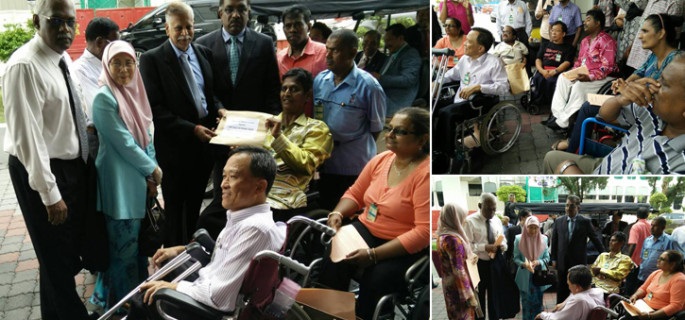
Badan Latihan dan Hidup Berdikari Malaysia (ILTC) pada 23hb Mac 2016 menyerahkan memorandum kepada ahli-ahli parlimen mendesak supaya golongan orang kurang upaya (OKU) dikecualikan daripada cukai barangan dan perkhidmatan (GST).

Disabled Members Protest

Disabled Members Protest
Disabled Members Protest at JPJ Wangsa Maju

ILTC Malaysia members staged a protest outside JPJ Wangsamaju KL.

ILTC Malaysia members staged a protest outside JPJ Wangsamaju KL.
Disabled group’s protest disabled drivers required to produce doc's medical report.

Thursday, 11 September 2008

Big challenge

Thursday September 11, 2008

The Star - Lifestyle

Big challenge
Wheel Power: By Anthony Thanasayan

For the disabled participants at Beijing’s Paralympics Games, the event is often regarded as the highlight of their lives.

AS you read this, as many as 4,000 disabled athletes (including a dozen Malaysians) are taking part in Beijing’s Paralympics Games.

The event, held once every four years, traditionally takes place about three weeks after the Olympics. It is also held in the same country that the Olympic Games took place.

To the disabled sportsmen and sportswomen involved, the Paralympics is often regarded as the most important event in their lives.(From left) Oscar Pistorious of South Africa, Heros Marai of Italy and Christoph Bausch of Switzerland in the heats of the men’s 100m T44 classification race at the 2008 Beijing Paralympic Games.

To me, the event is not only about who wins what and how well they performed. That is important, of course. But what is more important is how a particular sporting event has contributed to the people, and how it will continue to change their lives.

How will life change for the disabled community after major sporting events are over? BBC Online’s web page gave a peek into the lives of the handicapped in China.

The online page’s reporter followed an Olympic volunteer who used a wheelchair and travelled across Beijing by bus and subway, before the Games. The exposure made him realise how serious disability issues are in the country.

Although ramps and lifts were newly added for the Paralympics, this wasn’t so in other towns and villages in China.

The 82.7 million people with disabilities in China still face discrimination and prejudice, which make their daily lives difficult.

Universities in China are still reluctant to take in students with handicaps.

Human Rights Watch based in New York says that “8.58 million employable people with a disability in China did not have jobs last year.”

This even though the Convention on the Rights of Persons with Disabilities laws had been enacted and ratified not long ago.

“So far these protections have meant little to (disabled) persons (and) their advocates in China to be able to fairly compete for employment,” the organisation pointed out.

Despite this dismal outlook, the BBC says the good news is that the Chinese government has made a big effort to educate its citizens on how to talk to the disabled athletes during the Paralympics.

One pamphlet advises locals to be helpful, but not too pushy. It also suggests they should be more sensitive to those with disabilities.

Over here in Malaysia, it was announced that we had won the bid to host the International Paralympic Committee (IPC) world general assembly in Kuala Lumpur. The event will be held in November next year.

Even though this is joyous news for the disabled community, many of us are concerned about the issue of accessibility for the international disabled guests when they arrive in KL.

We know what a nightmare it is for a wheelchair user to move around in the capital.

Will the respective local councils be able to tackle these problems by the time our overseas guests arrive next year?

Or will our disabled visitors be restricted in their movements and told where they can go in the city?

Will they stay in posh hotels (with accessible shiny toilets) during their stay or will they be allowed to mingle with the rest of us and have a chance to see what Malaysia is really like?

If nothing is done from now until November next year, will our disabled guests want to come to Malaysia again?

And how would our disabled citizens benefit from such a visit? That is what I really like to know.

MPS issues warning to billboard owners

Thursday, September 11, 2008

The Star - Metro

MPS issues warning to billboard owners
By OH ING YEEN


OWNERS of expired billboards and banners are urged to pay up quick or the billboards will be taken down, said Selayang Muni-cipal Council (MPS) councillor Gurdip Kaur.

“They should have the approval of the council before putting up the banners and billboards. This is a form of illegal advertisement,” said Gurdip.

“I have noticed the problem of illegal banners and billboards since I lived in Rawang nine years ago but there was nothing I could do then. Now, as a councillor, I’m able to do my duty and take down the illegal advertisements,” said the Zone 16 councillor.

Tear them down: Enforcement officers dismantling illegal billboards and banners along Jalan Kuala Garing while Gurdip (second from left) looks on.

She said safety was another reason for taking down the banners and billboards.

“Five days ago, a driver almost got into an accident when a poster that was blown off by strong winds landed on his car ,” she said.

More than 10 MPS enforcement officers took down illegal banners and billboards starting from the ones in Jalan Kuala Garing, Rawang. They will be continuing the operation to rid Selayang of illegal banners and billboards.

MPS assistant enforcement officer C. Paramasivam said that this was the first large-scale operation carried out to tear down illegal banners and billboards.

“Normally the owners of illegal banners will be issued a RM500 summons but many have been there for too long.

“Some of the billboards we took down have been there for six months since the licences expired while some owners only paid during the first time they applied for the licence and did not renew it. They have breached Section 5 of the MPS advertising by-law for advertising without licence,” said Paramasivam, who is also the MPS Rawang 1 zone chief.

MPS assistant enforcement officer Megat Ainul Fadzlil said that they normally conducted these operations five to six times a year.

“The billboard or banner owners will be given a three-day deadline after they were issued a notice to renew their licences.

“However, things are slow during the fasting month as we are more focused on checking the Ramadan bazaar licences,” he said, adding that approved banners and billboards would have the MPS sticker.

Gurdip, who is in the tourism, finance and traffic subcommittees in the council, also plans to tackle issues such as potholes, lack of street lights as well as ramps for the disabled.

“After the petrol hike, the trains are packed and it is difficult for the disabled to get into them. I’m also looking into quotations for bubble lifts,” said the secretary of the Independent Living and Training Centre (ILTC).

Tuesday, 9 September 2008

Free parking for the disabled

Tuesday September 9, 2008

The Star - Metro

Free parking for the disabled

THE disabled people living in the Subang Jaya municipality have been urged to apply for free parking stickers at the council.

They are also requested to carry their cards at all time to be eligible for their privileges.

Apply now: Yeoh showing the stickers for the disabled while Adnan looks on.

According to the Petaling welfare office some 298 disabled people in Subang Jaya are registered with it, but only 23 of them had applied for the council’s free parking stickers this year.

Subang Jaya assemblyman Hannah Yeoh said not many disabled people were aware of the stickers.

“This is not a new thing as the council introduced it in 2006,” said Yeoh during a press briefing together with the MPSJ president Datuk Adnan Md Ikshan.

“The stickers will enable the disabled to park their cars for free at public parking spaces that are managed by the MPSJ, so that they need not go through the inconvenience of paying at the parking meters.”

The stickers are not applicable at private complexes or shopping malls.

It is learnt that only seven disabled people had applied for the stickers in 2006, while in 2007, only 17 applications were received.

Yeoh said this was one of the first steps undertaken towards making things more convenient for the disabled.

Adnan added that since 1995, there was a compulsory by-law for any submissions of development order and building plan to include facilities for the disabled.

“However, it was only enforced two years ago,” he said.

Yeoh said she would be having a meeting on Nov 1 with the disabled community in Subang Jaya to be held at the MPSJ building.

“I’ll arrange for some councillors to be around during the meeting so that they can listen to the hardships faced by the disabled and work towards a solution.”

For more information on the stickers call Yeoh’s assistant Cherrinee Lee at 012-291 3358 or e-mail: cherrinee@gmail.com.

Jeanne visits paralympic team

Monday, September 8, 2008

The Star - News

Jeanne visits paralympic team
By CELESTE FONG

BEIJING: Developers have been urged to design more disabled-friendly housing projects.

Datin Seri Jeanne Abdullah, the wife of Prime Minister Datuk Seri Abdullah Ahmad Badawi, who was touched by the disabled-friendly facilities she saw at the Paralympic Games Village here, said: “We should do more for the disabled.

“I hope schools will encourage and teach children to help (the disabled) if they see a disabled (person). We should change our mindset to be more caring,” she added.

Pointing at the disabled-friendly ATM machine booth, Jeanne said the facilities in the village showed the level of consideration for the disabled.

She was also awed by the spirit of the paralympians and the courage displayed by them, saying that Malaysians could emulate them.

“This is what we should be doing in our country,” she said, hoping that Malaysians could raise the level of consideration for the disabled.

Jeanne, the patron of the Malaysian Paralympic Council, was accompanied by Youth and Sports Minister Datuk Ismail Sabri Yaakob, Malaysian Ambassador to China Datuk Syed Norulzaman Kamarulzaman, Kuala Lumpur Mayor Datuk Ab Hakim Borhan and National Sports Council director-general Datuk Zolkples Embong to the games village here.

On the Malaysian paralympians, Jeanne, who met them in the village, said Abdullah had conveyed his best wishes to them.

The Malaysian paralympians will begin their respective events today.

Saturday, 6 September 2008

Wheelchair Presentation Ceremony

Saturday, September 06, 2008

PRESENTATION OF WHEEL CHAIRS

Today, Wheelchair Presentation Ceremony organized by Malaysian Institute of Estate Agents (MIEA) had donated six (6) wheelchairs to ILTC at Dewan Berjaya, Bukit Kiara Equestrian & Country Club, Jalan Bukit Kiara, Kuala Lumpur.


On behalf of ILTC, I would like to take this opportunity to thank Malaysian Institute of Estate Agents towards a caring society.

Malaysia wins bid to host Paralympic assembly

Friday, September 5, 2008

The Star - News

Malaysia wins bid to host Paralympic assembly
By CELESTE FONG


BEIJING: Malaysia obtained eight votes against one to win the bid for hosting the International Paralympic Committee (IPC) world general assembly in Kuala Lumpur in November 2009.

Malaysian Paralympic Council president Datuk Zainal Abu Zarin said nine elected IPC governing board members took part in the voting by secret ballot.

“Out of total 13 elected members, 12 attended but two – Malaysia and Denmark – had to go out while the president (Sir Philip Craven) chaired the meeting and could not vote,” he said yesterday.

“We got eight votes against one,” said Zainal, adding that the results were overwhelming and showed the governing board members recognised Malaysia’s contribution and capability.

Five countries in all had bid to be hosts.

Youth and Sports Minister Datuk Ismail Sabri Yaakob, who arrived in Beijing for the Paralympic Games yesterday, described winning the bid as an honour.

Datin Seri Jeanne Abdullah, the wife of Prime Minister Datuk Seri Abdullah Ahmad Badawi, was expected to arrive in the Chinese capital today to attend the opening of the games at the National Stadium.

Thursday, 4 September 2008

Our space

Thursday September 4, 2008


Our space
WHEEL POWERBy ANTHONY THANASAYAN

The provision of special carpark lots for the disabled will benefit everyone.

OF ALL the Merdeka Day celebrations, this year’s was the most significant for me. Last Sunday, as I was listening to the radio at midnight, welcoming our 51st anniversary together with other listeners, I was suddenly overcome by emotion.

I found for the first time that as a disabled citizen, I am now able to rejoice with others in celebrating the true meaning of independence.

I’m referring to the 150 carpark lots for the disabled that Majlis Bandaran Petaling Jaya (MBPJ) will be providing all over the city. Work on the project starts this month and is expected to be completed before Christmas.

Many drivers with disabilities have contacted me to say that they can’t wait to test out MBPJ’s carpark for the disabled.

The city council will ensure that wheelchair users have ample space to get their wheelchairs in and out of their cars. A unique feature is that each parking lot comes with a shelter to protect drivers from the elements.

A hot sunny day can turn the car seat into a hot seat. This can cause blisters and sores for those with paralysed limbs. Because of the numbness, most of them will not realise that the seat is hot until the damage has been done. And when that happens, the situation is often irreversible.

Umbrellas are also useless for wheelchair users when it rains. Whilst an able-bodied person can zip into his car within seconds, the disabled will need at least 10 to 15 minutes to perform the same task. Time is needed to position wheelchairs before the driver swings himself into his car.

One wrong move can send the him or her crashing to the ground.

The overhead shelter will come in handy for caregivers too when they travel with their disabled children or parents. To use the special carparks, you need to get hold of MBPJ’s specially designed wheelchair logos. These will be available free of charge soon.

The disabled will have to produce their ID registration cards for the handicapped. For those who haven’t registered, now is a good time to do so.

Those who have yet to be recognised officially as disabled persons – for example, those with Parkinson’s disease or stroke – need only produce a letter from a government doctor or the society they are a member of, verifying their disability.

Providing these disabled-friendly structures is a positive start towards changing the lot of the disabled. Such facilities will encourage the disabled and their families to come out and participate in public life.

Disabled-friendly carparks will raise awareness that there are many disabled Malaysians among us, and we will move one step forward in creating, to use MBPJ’s theme: “A liveable society and dynamic city for all persons.”

Wednesday, 3 September 2008

Upset over allowance for the disabled

Wednesday, September 03, 2008

The Malay Mail

Upset over allowance for the disabled
September 02, 2008 Categories: News

Don't insult the less-fortunate with paltry allowances, the federal government was told yesterday.

Anthony Thanasayan, Petaling Jaya City Council’s first disabled councillor, found the 2009 budget unfriendly to persons of his ilk.

He said the RM150 per month allowance for the disabled showed the government’s apathy towards to the plight of the community.

“If a person is bedridden, he or she is likely to have bedsores.

The medication costs about RM500- RM1,000 a month. How are they going to survive on RM150?” he asked.

He said the community was also disappointed with Women, Family and Community Development Minister Datuk Dr Ng Yen Yen because she obviously did not push for better allowances for them.

A group of disabled persons met the minister three months ago and asked for a minimum allowance of RM500.

“The allocation only shows that the government does not take us seriously,” he added.

When asked his view on the Persons of Disability Act that came into force last month, Thanasayan said that it wouldn’t be of much help to the disabled if the spirit of the Act was not enforced.

The Persons of Disability Act states the National Council for Persons with Disabilities may require relevant ministries, government agencies, bodies or organisations to submit reports to the council on steps, measures and actions required to be undertaken in complying with provisions of the Act.

The Act is non-punitive and, therefore, powerless to help the disabled.

“In reality, the Act is still holding on to the charity concept which relies on the kindness of society.

Why do the laws penalise those who discriminate against women and not us?” he asked.

He believed Malaysians still discriminated against the disabled. As councillor in charge of the disabled, he came across a developer of a condominium who wanted to build a ramp for an elderly disabled man living there.

However, the residents’ association of the condominium did not want the ramp built as they believed that it would spoil the ambiance of the place.

“If there was strict enforcement of the Persons of Disability Act, we could have taken legal action against the association. But now there is nothing we can do,” he said.

New comment on BREAKING NEWS - LATEST UP DATE

Wednesday, September 03, 2008

Anonymous has left a new comment on your post "BREAKING NEWS - LATEST UP DATE":

I am very happy to learn that the CCM has intervened on your behalf.

The Council of Churches of Malaysia should be praised for taking a positive step in resolving a very serious problem affecting your society.

I pray that justice will be served to your organisation and whoever is responsible for any bad action will be heavily disciplined.

Keep up your good work at the ILTC and in your blog.

Sunday, 31 August 2008

BREAKING NEWS - LATEST UP DATE

Sunday, August 31, 2008

Dear Folks,


BREAKING NEWS - LATEST UP DATE

Regarding Sia Siew Chin & Defamation Against ILTC..........

Dr. Herman Shastri from Council Church of Malaysia has finally invited ILTC President & Secretary for an urgent face to face meeting with Pastor Sia Siew Chin (Beautiful Gate) at CCM Office on 16th September 2008 at 11.00am.

ILTC HOPE FOR JUSTICE.

THANK YOU ALL FOR YOUR SUPPORT.

MORE UP DATES SOON......

MR. G. FRANCIS SIVA
PRESIDENT OF ILTC

Saturday, 30 August 2008

Sunday, August 31, 2008

BADAN LATIHAN DAN HIDUP BERDIKARI, SELANGOR DAN WILAYAH PERSEKUTUAN KUALA LUMPUR.
(INDEPENDENT LIVING AND TRAINING CENTRE,
SELANGOR AND WILAYAH PERSEKUTUAN KUALA LUMPUR)

The 6th Annual General Meeting of the Independent Living & Training Centre, Rawang which was held on 24th of August 2008, at 10.30am, at Restoran Fook Sing (Halal Food) (Rawang) Sdn Bhd, 8-16 Jalan Setia Rawang 1, Taman Setia Batu 18, 48000 Rawang, Selangor Darul Ehsan.


There were 86 members presented at the meeting.

During the meeting ILTC invited Special Guest:

1. Special Guest DSP Shanmugam Reddy
2. Guest Y.B. Tuan Anthony Thanasayan
3. Guest of Honour -

Y.B.. TAN HUI CHUAN
ON BEHALF OF Y.B. Gan Pei Nei - State Assemblyman for Rawang

Participated together...............


HAPPY MERDEKA – WITH OUT I AM NO BODY

Saturday, August 30, 2008


HAPPY MERDEKA – WITH OUT I AM NO BODY

Pensioners, the disabled want more benefits

Saturday August 30, 2008

The Star - News - Budget 2009

Pensioners, the disabled want more benefits

THE National Council of Senior Citizens Organisation Malaysia (Nacscom) president Datuk Lum Kin Tuck said that while the proposal to have a minimum RM720 monthly pension was good, it was still not enough to cope with the rising cost of living.

“While it will help pensioners who have been getting low pensions all along, I feel it should be slightly higher,” he said.

“I think people would be able to cope with the cost of living better if they had a minimum pension of RM900.”

Malaysian Confederation of the Disabled president Mah Hassan said he was happy with the Budget on three points: the RM150 allowance for disabled students, RM200 monthly incentive payment for teaching assistants in special education schools and a higher allowance for caregivers in Rumah Tunas Harapan.

“I must praise the Government for taking all these into consideration,” he said.

“However, on behalf of the disabled community, I must say I am disappointed with the RM150 allowance for the non-working disabled.”

Independent Living and Training Centre president Francis Siva also shared his sentiments.

“At a pre-Budget consultation, we had asked for a RM500 allowance across the board for the disabled.

“What can you do with RM150? I'm very, very sad.

There are many severely-disabled people who have no opportunity to find work. How are they going to live on a mere RM150?” he said.

Budget 2009: RM150 allowance for the disabled 'not enough'

Saturday, August 30, 2008

The News Strait Times - NST Online

Budget 2009: RM150 allowance for the disabled 'not enough' The disabled are restricted by the lack of disabled-friendly infrastructure in the country.

KUALA LUMPUR: The disabled have described Budget 2009 as "insulting" and "terrible".

They said the RM150 monthly allowance for those unable to work is a pittance. Malaysian Animal-Assisted The-rapy for the Disabled and Elderly president Anthony Thanasayan said they had expected at least RM500 for all disabled people, irrespective of whether they were working.

"The amount is so little, you might as well not give it. Those bedridden and in wheelchairs require a lot of money for medical fees.

"A set of five bandages for pressure sores costs RM80 and it only lasts three days. How far will RM150 go?" Anthony asked.

Independent Living and Training Centre president Francis Siva said it was disheartening that the budget failed to address mobility issues.

He stressed that disabled people were not lazy and wanted to be independent but they were restricted by the lack of disabled-friendly infrastructure in the country.

"How will we earn a decent living and be independent if a chunk of our salary goes towards transport?"

Anthony and Francis, however, agreed that the government's multi-pronged approach to combat poverty was a good start.

Associate Professor Dr Sulochana Nair, who is also director for the Centre of Poverty and Development Studies, Universiti Malaya, said there must be a "means-tested methodology" of reaching out to the target groups.

"We must be able to trace the aid to ensure that it reaches the right people."

For Centre for Orang Asli Concerns coordinator Colin Nicholas, the issue is "leakage" during the disbursement process.

He said the allocated sum had in the past gone into improving infrastructure and administration and not enhancing the quality of life.

The government has allocated RM160 million in assistance to Orang Asli under Budget 2009.

For pensioner Wong King Voon, 61, the RM70 increase in his pension to RM720 is too small.

"What can you do with an extra RM70? And despite the exemption for electricity bills payments of RM20 or less, I would still have to pay my electricity bill of about RM100 a month."

Wednesday, 27 August 2008

BN!BN!BN! Ayoooh!

Wednesday, August 27, 2008

BN!BN!BN! Ayoooh!

What Happen? Dont pray pray!

Tuesday, 26 August 2008

ILTC COMMENTS

Tuesday, August 26, 2008

ILTC COMMENTS

Disabled in a dilemma over inconvenient travel environment

Today there was some issue highligted in the The Star - Metro

This is slightly a positive wake up sign by other disabled NGO's who have been sleeping for too long.

But in reality will it make a difference?

Will our Prime Minister include the demands in his Budget Speech on Friday?

It would have been better if the disabled group that organized the protest against the government had done so at least a month or two before Budget 2009.

This would have given enough time for our PM to make the necessary inclusion.

That is if Pak Lah had not already thought about it in the first place.

ILTC is tired of broken promises by our authorities and our needs as disabled Malaysians are still being ignored.

So far nothing has really changed. ILTC also had staged a public show of this approval eight months ago against the public transport system in the country.

Nothing has been done.

The "so-called" 'disabled friendly" buses by RapidKL are totally useless.

I honestly feel that, most disabled person cannot work because of poor access to public transport and buildings.

We need to go out and work and contribute to society, and not be dependent on charity.

ILTC is looking forward a reliable public transport service to the disabled community in Malaysia.

MR. Francis Siva
President of ILTC

_________________________________________________________________
Tuesday August 26, 2008

The Star Metro

Disabled in a dilemma over inconvenient travel environment
By BAVANI M

THERE is no mercy out there, declared by P. Parimala when asked to describe the efficiency of the transportation system in the Klang Valley.

Strong words indeed but then the 47-year-old tutor is speaking from her perspective as a disabled person.

Parimala has polio and walks with a limp. But six months ago, she fractured her back and had been wheelchair-bound since.

Not an easy life: Daily travelling using public transport seems to be a tedious affair for most disabled folks.

“I feel helpless and frustrated every time I take the local public transport to get around. I feel that the government doesn’t care for people like us,’’ she said.

According to Parimala, who lives in a DBKL flats in Pantai Dalam, everywhere and everything -- the lifts at her flats, the roads, the bus stops, the buses and the LRT -- were not disabled friendly.

“How am I going to retain my dignity and the right to live independently when everything around me is inaccessible to people with disabilities?’’ she asked.

K. Loganathan, a clerk with the Damai Disabled Persons Association of Selangor and Kuala Lumpur, said that trying to cross a busy street was like a suicide mission for him.

“I’m afflicted with polio so I walk with a limp. Do you know how a simple exercise of trying to cross a road or even boarding the LRT at the peak hour can become the most scariest moment of my life?’’ he asked.

Mohd Fairuz, from the Malaysian Association of the Blind, said he wished that there was a system that allowed the blind to know when a bus would be arriving.

The 55-year-old said buses should incorporate an alarm system that could notify blind passengers like him when the door was closing and opening.

They want the government to do something about the poor state of the local public transport system which they say is unfriendly and completely inaccessible to the disabled community.

Some 50 BEAT members turned out at the Bangsar LRT station last Sunday to prove their point and to submit their wish list for the Federal Budget 2009.

Damai Disabled Persons Association vice-president V. Murugeswaran said when Prime Minister Datuk Seri Abdullah Ahmad Badawi discovered how bad the public transport system was for the public, he should know that for the disabled people, it was much worse.

Murugeswaran said the public transport system should adopt the social inclusion principle where all planning, design, management and operations of public transport should be accessible, safe and usable.

“It should take into consideration and provide for equitable means for the disabled people to access employment, education, health, leisure and other social activities,” he said.
Murugeswaran said it was reported recently that only 50 disabled people applied for 10,000 jobs available in the public sector.

Women, Family and Community Development Minsiter Datuk Dr Ng Yen Yen had called on the disabled community to be responsive to the job applications and said the government set a policy to reserve 1% or 10,000 jobs for the disabled in the public sector.

“I guarantee you if the government improved the public transport system and make it disabled- friendly than the response from the disabled would be overwhelming,’’ Murugeswaran said.
He said the disabled just wanted to live independently and with dignity.

Wish list for public transport system

IN line with the tabling of the Federal Budget 2009, the Association for the Improvement of Mass Transit Klang Valley (Transit) and the Barrier-Free Environment and Accessible Transport (BEAT) group have come up with a wish list to reinstate their concerns on the public transport system.

According to the two organisations, the system is still almost completely inaccessible and unfriendly to those who are blind, deaf, having learning difficulties, elderly and pregnant, young children and people with bicycle and infants in prams.

The two NGOs have proposed the following:

A National Public Transport Policy which is comprehensive, inclusive and people focused;
A public transport masterplan that incorporates the concepts and principles of universal design to accommodate the needs of all users, including the disabled;

A National Transport Commis-sion — a single regulatory body for land public transportation. At present, there are 13 agencies for the country which make it ineffective and uncoordinated;
Low Floor and Non Step Buses — a budget must be allocated that all new buses bought have low floor, non-step vehicles equipped with ramps, and audible announcements for the blind and clear sin- ages for the deaf.

Bus Stops and Bus Hubs — All new bus stops, and bus hubs must have connecting walkways, pavements, crossings, shelters, all ramps and change levels must be upgraded to the correct design and safety standards and must be barrier free;

Rail Transit — For the Kelana Jaya and Ampang Lines, the proposed extension must ensure that all universal design features such as lifts, tactile guides, audible stop announcements and clear signages. Money should also be allocated for an upgrade of the Ampang line which is inaccessible to wheelchair users.

Monorail — Budget allocations for the upgrade of all monorail stations, At present monorail is totally inaccessible to wheelchair users.

KTM Commuter — All new rail projects be made accessible, that includes access to the train stations, platforms and incorporate universal design features;

Taxis — There must be a minimum quota of accessible taxis — 20% target each year starting from 2009.

Door to Door Demand Responsive Accessible Transport Services — A fully integrated and accessible transport service for the disabled.

Mobility Allowance — Budget should make an allocation to provide mobility allowance of RM350 to each disabled person who is registered with the welfare department until such as time when the country’s transport system is 100% accessible.
Monday, 25 August 2008

Feeling the discrimination

Monday, August 25, 2008

The Malay Mail - News

Feeling the discrimination
By Anu Venugopal An Act of hope?

The Persons with Disabilities Act 2008 has been gazetted and came into force on July 7. This is the first rights-based legislation for people with disabilities (PWD).

With the enforcement of the Act, PWDs will be able to enjoy better public transport facilities, amenities and services.

So many promises made but so little achieved, say disabled groups.

The able-bodied take it for granted, but to the disabled, getting around Kuala Lumpur is a never-ending nightmare.

Through their eyes, the streets of KL are full of obstacles and risks — steep and high pavements, slippery tiles, overhead bridges with narrow steps, poor traffic and transport conditions... and the list goes on.

Promises by the government and public transport companies that amenities will be disabled-friendly are not being adhered to, say the physically challenged.

"The government promised wheelchair-friendly public transport, but it has not been provided. The situation has not improved one bit," said Christine Lee, coordinator for the Barrier-Free Environment and Accessible Transport Group.

The group is an informal coalition of NGOs representing the interests of people with varying disabilities.

It has been fighting for the rights of the disabled since 1994 but Lee says there has been little improvement to the infrastructure and public transport system in the Klang Valley.

"Out of 1,000 buses that were supposed to be disabled- friendly, only 100 buses can be accessed by the disabled. Even then, it is not easy for us to use these buses as it is just too difficult," said Lee.

"The ramps are too steep for people with wheelchairs to manoeuvre by themselves. Some bus drivers are kind enough to help out but if we are on our own, it is difficult.

"The disabled people in Malaysia are still facing barriers to being independent."

"We find it very difficult to move around on our own. There are barriers everywhere.

Pavements are too high for us to manoeuvre the wheelchair. Not many buses are disabled friendly. The ones that are 'disabled friendly' are not good enough."

Many of the disabled are disheartened with Women, Family and Community Development Minister Datuk Dr Ng Yen Yen's remarks that the disabled cannot expect the ministry to knock on doors and offer them jobs,

"We want to work and be independent, but how can we when the infrastructure such as roads and transport system make it difficult for us to move around?" asked Lee.

She believes that one of the ways the government could improve infrastructure and amenities for the group would be to consult the disabled.

Public transport blues

Monday, August 25, 2008

The Malay Mail

Public transport blues Physically challenged P.Santakumari, 49 years old and wheelchair- bound, loves Malaysia but strongly feels that something has to be done about the disabled-unfriendly environment.

"It is very difficult for me to travel on my own. I need someone to help me move around every time I go out," she said.

"The bus ramps are too steep for me to go up on my own. It is very frustrating to take public transport in Kuala Lumpur."

She also feels that there is need for the public to be educated about disabled people. "They are impatient and inconsiderate of our situation and the daily struggles we have to face."

Santakumari hopes that the government will make buses accessible and make all public transport free for the physically challenged.

A disabled person from Rawang, who only wants to be known as Premila, also took KTM Komuter to task.

"The train service has only got worse since I first started using it six years ago,"she said.

"There are more people using the train now, especially after the increase in petrol price, but the number of coaches has not increased."

Friday, 22 August 2008

Joining the workforce

Thursday, August 21, 2008

The Star - Lifestyle

Joining the workforce
WHEEL POWER WITH ANTHONY THANASAYAN

There’s more to the issue than simply providing employment for the disabled.

I READ in The Star last week that the problem of getting disabled persons to take up employment sadly continues to plague our society. It was revealed that despite there being 10,000 jobs openings for the handicapped, only 50 persons with disabilities had applied for them through the government.

The findings, I worry, might give the wrong impression about people with disabilities. Some might think that the disabled are unappreciative of the help that is being offered to them. Others may assume that they prefer to be unemployed – or, worse, are lazy.

All these assumptions cannot be further from the truth.

First, why would the disabled want to be unemployed when they have no source of income? Without financial independence, how would they be able to participate in all the wonderful things that most of us enjoy?

Being disabled is also an extremely costly affair. For example, long-lasting wheelchairs cost about RM5,000 while electric wheelchairs cost more than double that. (Batteries alone cost about RM1,000 and they need to be replaced every two years.)

Medical cushions, which most wheelchair users need in order to prevent potentially deadly pressure sores, cost about RM2,000. These need to be promptly replaced when they expire.

The disabled who were previously employed may be somewhat lucky. They can obtain such equipment from the Social Security Organisation.

But what about the majority of disabled persons who are unemployed?

Some might be able to get charitable organisations to sponsor these aids for them. But again, for the majority of disabled Malaysians, life is a perennial struggle.

It really does not have to be this way, but it is.

Finding jobs may be easier now thanks to the government’s latest efforts. But it is still virtually impossible to get to work.

A big chunk of one’s salary would often be swallowed up by transport costs. And after deducting the cost of travelling to and from work, what is left for the disabled worker to take home?

What if they are married or wish to get married? Or what if they now have to care for their elderly parents?

Would employers consider covering transport costs of disabled workers? Such a move would be a great help – at least until the day the handicapped in Malaysia can have full access to public transport.

It is for these and many other reasons that many disabled organisations are unanimously calling for a monthly allowance of RM500, at least, for all disabled Malaysians – whether they have jobs or not. The financial aid will be a godsend and offer immediate relief.

And what better time for such a gift for the handicapped than next month at our upcoming budget speech.

As for the job application forms offered by the government, it is certainly an encouraging move – one that the disabled community has been waiting for.

I am glad to see that special assistive devices like ramps to wheelchair-friendly car parks and even tactile guiding blocks (for the blind) are mentioned in the form.

However, I also think that there are other things that ought to be considered before we can expect success in this worthy effort.

One of them is to keep on disseminating the forms everywhere.

I have already received feedback from several disabled persons and their caregivers that they are unaware of these forms. Even in their recent visits to their nearest local welfare departments they drew only blank stares from the staff when they enquired about job opportunities.

And finally, let’s not forget that because our disabled have been shut out of society for so long, many lack not only training but also self-confidence.

It would be most unrealistic to expect such persons to rush out immediately for application forms. They will need a counsellor whom they can approach to give them the proper advice and encouragement.

And the best person to understand their needs would naturally be a disabled person himself, who should also coordinate this effort by the government. This way another job will be created.

The disabled person should rightfully be the person to head a special long-term task force to get our Malaysian disabled citizens employed.

After all, it is the human touch – delivered from someone who is able to empathise – which in the end will be far more effective than any piece of paper.

MBPJ sedia kemudahan untuk OKU

Friday, August 22, 2008

Sinar - Harian


MBPJ sedia kemudahan untuk OKU

PETALING JAYA - Majlis Bandaraya Petaling Jaya (MBPJ) akan menyediakan tempat khas untuk golongan orang kurang upaya (OKU) bagi memudahkan mereka meletakkan kenderaan mulai November ini.

Pengarah Jabatan Perancangan Pembangunan MBPJ, Sharipah Marhaini Syed Ali berkata, sebanyak 150 tempat dikenal pasti dan akan dilengkapkan dengan bumbung sebagai keselesaan.

Setiap 150 tempat itu, MBPJ akan menyediakan dua petak khas untuk OKU,” katanya pada sidang media di sini.

Beliau berkata, selain membina tempat letak kereta berbumbung, MBPJ juga akan menaik taraf tandas dan jalan mesra OKU.

Katanya, sebagai permulaan, usaha itu akan dilakukan di Seksyen 52, manakala kawasan lain akan mendapat kemudahan berkenaan secara berperingkat.

Menurut Sharipah Marhaini, bagi memudahkan pemantauan, golongan dan penjaga OKU perlu memohon pelekat khas daripada MBPJ.

Langkah itu, katanya, bagi memudahkan MBPJ mengenal pasti golongan OKU dan mengelak kemudahan itu daripada disalahgunakan orang lain.

“Mereka yang didapati menyalah guna kemudahan itu akan dikenakan saman sebanyak RM300,” katanya.

Beliau berkata, MBPJ akan melaksanakan empat strategi dalam menyediakan kemudahan untuk OKU di Petaling Jaya. “

Antaranya mengubah suai bangunan sedia ada di Petaling Jaya bagi kemudahan mereka, selain mengubah suai bangunan Perpustakaan Komuniti dan ibu pejabat MBPJ.

“Strategi lain termasuk menyediakan kemudahan laluan khas di beberapa tempat, lampu isyarat berbunyi, laluan pejalan kaki dan penghadang,” katanya.

Di samping itu, menurut beliau, MBPJ juga akan mengadakan program kesedaran awam bersama penduduk mengenai kemudahan OKU.

Sementara itu, Ahli Majlis MBPJ yang juga OKU, Anthony Siva Balan Thanasayan berkata, usaha itu hadiah kepada golongan berkenaan. “Ini adalah hadiah paling bermakna kepada OKU.

Ini menunjukkan MBPJ tidak meminggirkan golongan seperti kami,” katanya